You’ve finally invested in that sleek, modern induction cooktop, ready to experience its rapid heating and precise temperature control. You pull out your favorite sauté pan, a trusty companion for years, and place it on the burner. Nothing. You try another, a lightweight aluminum skillet. Still nothing. Frustration begins to bubble, much like the food you’re trying to cook. Why are some of your beloved pans refusing to cooperate with your shiny new appliance? The answer lies not in malice, but in the fascinating science of electromagnetism.
This isn’t a case of your cooktop being faulty or your pans being defective. It’s a matter of fundamental compatibility, a dance between the magnetic fields generated by your induction hob and the materials that make up your cookware. Understanding this science will not only demystify the situation but also equip you with the knowledge to make informed purchasing decisions for your kitchen.
At its core, an induction cooktop is a marvel of electromagnetic induction. Unlike traditional stovetops that generate heat through direct contact (resistance heating in electric coils or open flames), induction works by creating a rapidly oscillating magnetic field. This magnetic field is generated by a coil of copper wire located beneath the ceramic glass surface of the cooktop. When you place a compatible pot or pan on the burner, this magnetic field penetrates the base of the cookware.
The Alternating Current and the Magnetic Field
The magic begins with the electricity supplied to the cooktop. This electricity is an alternating current (AC), meaning the direction of the electron flow reverses many times per second. This alternating current is channeled through the copper coil beneath the cooktop. As the current flows back and forth, it generates a corresponding alternating magnetic field. Think of it like a pulsating invisible force emanating from the burner.
Faraday’s Law of Induction: The Core Principle
The key scientific principle at play here is Faraday’s Law of Electromagnetic Induction. This law states that a changing magnetic field will induce an electromotive force (EMF), which in turn can drive an electric current, in a conductor placed within that field. In simpler terms, the fluctuating magnetic field from the cooktop “pushes” and “pulls” electrons within the base of your cookware.
Eddy Currents: The Engine of Heat
When a compatible pan is placed on the induction hob, the induced EMF causes small, circulating currents of electricity to flow within the base of the pan itself. These are known as “eddy currents.” These eddy currents are essentially miniature electrical circuits within the metal of your pan. The resistance of the metal to these eddy currents is what generates heat. The more resistance, the more heat. This heat is generated directly within the cookware, leading to incredibly efficient and rapid cooking.
Joule Heating: The Scientific Basis of Thermal Generation
The heat generated by these eddy currents is a direct application of Joule’s Law of Heating, also known as the resistive heating principle. This law states that the heat produced by an electric current flowing through a conductor is proportional to the electrical resistance of that conductor and the square of the current. Mathematically, it’s represented as $H = I^2Rt$, where $H$ is heat, $I$ is current, $R$ is resistance, and $t$ is time. The eddy currents flowing through the resistive base of your pan are the $I$, and the material’s inherent resistance is the $R$. This efficiently transforms electrical energy into thermal energy, directly in your pan.
When exploring the reasons why some pans don’t work on induction cooktops, it’s essential to understand the role of magnetic materials in cookware. Induction cooking relies on magnetic fields to generate heat directly in the pan, which means that only ferrous materials will work effectively. For a deeper dive into this topic, you can read more in this related article: Why Some Pans Don’t Work on Induction. This article provides insights into the types of materials that are compatible with induction cooking and offers tips on selecting the right cookware for your kitchen.
The Magnetic Imperative: Why Ferrous Metals Reign Supreme
The fundamental requirement for a pan to work on an induction cooktop is that its base must be made of a ferromagnetic material. Ferromagnetic materials are those that are strongly attracted to magnets, and more importantly, can be easily magnetized themselves. This magnetic property is crucial for the induction process to occur efficiently.
Understanding Ferromagnetism
Ferromagnetism is a property of certain materials, like iron, nickel, and cobalt, and their alloys, where they can become strongly magnetized in the presence of an external magnetic field. This is due to the alignment of their atomic magnetic moments. In ferromagnetic materials, these moments tend to align with each other, creating a macroscopic magnetic effect. When placed in the fluctuating magnetic field of an induction hob, these materials readily respond, allowing eddy currents to be induced.
The Role of Iron and Steel
Iron is the most common ferromagnetic element, and it forms the basis of many cookware materials suitable for induction. Cast iron, for example, is a natural fit due to its high iron content. Stainless steel is also frequently used, but here’s a crucial distinction: not all stainless steel is created equal for induction. Many common stainless steel alloys are austenitic and not strongly ferromagnetic. For induction compatibility, stainless steel cookware typically needs to contain a significant amount of ferrite, which is a magnetic form of iron. This is why some stainless steel pans work on induction while others don’t.
The Non-Ferromagnetic Detractors: Aluminum, Copper, and Glass
Materials like aluminum, copper, and glass are excellent conductors of heat and are often preferred for their non-stick properties or even heat distribution. However, they are generally non-ferromagnetic. This means that when placed on an induction cooktop, the magnetic field passes through them with little interaction. No strong magnetic response means no significant induction of eddy currents, and therefore, no heating. While some cookware manufacturers might incorporate a magnetic layer into the base of aluminum or copper pans to make them induction-compatible, the core material itself is not inherently suited for the process.
The Magnet Test: Your Simple Verification Method
The easiest way to determine if your cookware is induction-compatible is the “magnet test.” Simply hold a common refrigerator magnet to the base of your pan. If the magnet strongly adheres, the pan is likely made of a ferromagnetic material and will work on your induction cooktop. If the magnet weakly clings or doesn’t stick at all, it’s a strong indicator that the pan is not compatible.
The Science of Resistance: Why Material Matters
Beyond just being magnetic, the material of your pan’s base plays a critical role in how effectively it heats up. The electrical resistance of the material directly influences the amount of heat generated by the eddy currents.
Electrical Resistance and Heat Generation
As discussed earlier with Joule’s Law, heat is generated when electrical current flows through a resistive material. For induction cookware, the base material needs to have a certain level of electrical resistance. This resistance impedes the flow of the induced eddy currents, causing them to dissipate their energy as heat. A material with very low resistance might allow eddy currents to flow easily with minimal heat generation.
Conductivity vs. Resistivity: A Delicate Balance
There’s a delicate balance between electrical conductivity and electrical resistivity that’s important for induction cookware. While you want eddy currents to be induced, you also want those currents to encounter resistance to generate heat. Highly conductive materials, like pure copper, are excellent at conducting electricity, but they also have low resistance. This means that while they can be heated by induction, they often require specific designs or layered bases to optimize heat generation and distribution. Conversely, materials with very high resistance might generate heat, but they might not be as efficient at efficiently transferring that heat to your food.
The Multi-Ply Construction: Engineering for Induction
Many high-quality induction-compatible pans utilize a “multi-ply” or “clad” construction. This involves layering different metals together to achieve optimal performance. Typically, a core of aluminum or copper is sandwiched between layers of stainless steel or other ferromagnetic materials. The outer layers provide the magnetic responsiveness needed for induction, while the inner core promotes even heat distribution across the cooking surface. This layered approach allows manufacturers to harness the benefits of different materials for superior cooking results.
Beyond the Base: Thickness and Design Considerations
While the material composition of the pan’s base is paramount, other design elements can influence its performance on an induction cooktop. The thickness of the base and the overall design of the cookware can impact how efficiently heat is transferred and distributed.
The Impact of Base Thickness
A thicker base generally leads to more consistent and even heating. Thicker bases have a larger volume of material for eddy currents to flow through, which can help to distribute the heat more broadly and prevent hot spots. While a thin base might heat up quickly, it can also lead to uneven cooking and a higher risk of scorching. Induction cooktops are known for their precise temperature control, and a well-designed, thicker base complements this by ensuring that the heat applied is distributed evenly across the entire cooking surface.
Flatness is Key: Ensuring Good Contact
For optimal induction performance, the base of your cookware needs to be as flat as possible. Any warping or significant unevenness can create gaps between the pan and the induction hob. These gaps disrupt the magnetic field and hinder the efficient transfer of energy. A warped pan might only make contact in a few spots, leading to localized heating and inefficient cooking. Regular use and improper cleaning can contribute to warping, so it’s important to care for your cookware to maintain its flatness.
The “Induction Ready” Symbol: Your Shopping Guide
To simplify the selection process, many cookware manufacturers now clearly label their products as “induction ready” or feature an induction symbol. This symbol often looks like a coil or a series of concentric circles. This is a reliable indicator that the cookware has been designed and manufactured with induction compatibility in mind. Always look for these markings when purchasing new cookware for your induction cooktop.
Induction cooking has gained popularity for its efficiency and speed, but many people find themselves puzzled when certain pans fail to work on induction cooktops. This is often due to the materials used in the cookware, as induction relies on magnetic properties to generate heat. For a deeper understanding of this phenomenon, you can explore a related article that discusses the science behind induction cooking and the types of materials that are compatible. To learn more about why some pans don’t work on induction, check out this insightful piece on Freaky Science.
Troubleshooting Common Induction Cookware Issues
| Factor | Description | Impact on Induction Compatibility | Typical Materials Affected |
|---|---|---|---|
| Magnetic Properties | Induction cooktops require pans with magnetic bases to generate heat. | Non-magnetic pans do not heat up on induction cooktops. | Aluminum, Copper, Glass, Ceramic (without magnetic base) |
| Base Material Thickness | Thin or uneven bases may not induce sufficient current for heating. | Leads to poor heat transfer or no heating at all. | Thin stainless steel, lightweight pans |
| Pan Size | Induction zones require a minimum pan diameter to activate. | Small pans may not trigger the induction sensor. | Small saucepans, mini frying pans |
| Surface Flatness | Uneven or warped bases reduce contact with cooktop surface. | Decreases efficiency or prevents heating. | Old or damaged pans |
| Coating and Layers | Non-metallic coatings or layers can block magnetic field. | Prevents induction heating if base is not magnetic. | Some non-stick pans without magnetic base |
Even with compatible cookware, you might encounter occasional issues. Understanding these common problems and their scientific explanations can help you troubleshoot effectively.
Hot Spots and Uneven Cooking
If you’re experiencing hot spots despite using what you believe to be induction-compatible cookware, several factors could be at play. As mentioned, a warped pan will lead to uneven contact and thus uneven heating. The material composition might also be a factor; while the pan is magnetic, the specific alloy might not distribute heat as efficiently as others. Furthermore, the magnetic field strength can vary slightly across the surface of the induction hob itself, though this is usually a minor factor. Ensure your pan is clean and free of debris that could interfere with contact.
Pans That Heat Slowly or Inconsistently
Some pans might heat, but very slowly or inconsistently. This can happen if the ferromagnetic material content is low, meaning the magnetic response is weak. In such cases, fewer eddy currents are induced, and thus less heat is generated. Again, the thickness and material composition of the base are crucial. A pan designed primarily for gas or electric radiant heat might not have the optimal base construction for the rapid and efficient heating characteristic of induction.
The “Humming” or “Buzzing” Phenomenon
It’s not uncommon for induction cooktops to produce a slight humming or buzzing sound, especially at lower power settings. This is a normal byproduct of the alternating current and the magnetic field interacting with the cookware. The sound can vary depending on the cookware material, its thickness, and the power setting. Some materials, like cast iron, might produce more audible sounds than others. If the noise is excessive or accompanied by other issues, it’s worth consulting your cooktop’s manual or contacting customer support.
When All Else Fails: The Compatibility Conundrum
If you’ve tried the magnet test, confirmed your pan is supposed to be induction-compatible, and it’s still not working, it’s possible you have a rare compatibility issue. Some extremely thin or specially designed pans might not generate enough magnetic response. In such cases, consider using a magnetic adapter plate. These are flat, ferromagnetic discs that you place on the induction hob, and then place your non-compatible pan on top of the adapter. The adapter heats up via induction and then transfers that heat to your pan through conduction. While not as efficient as direct induction, it’s a viable workaround for cherished cookware.
Understanding the science behind induction cooking and cookware compatibility transforms a potentially frustrating experience into an educational one. By grasping the principles of electromagnetism, ferromagnetism, and material resistance, you can confidently navigate the world of induction-ready cookware, ensuring that your culinary adventures are powered by the most efficient and advanced cooking technology available. Your kitchen, and your meals, will thank you for it.
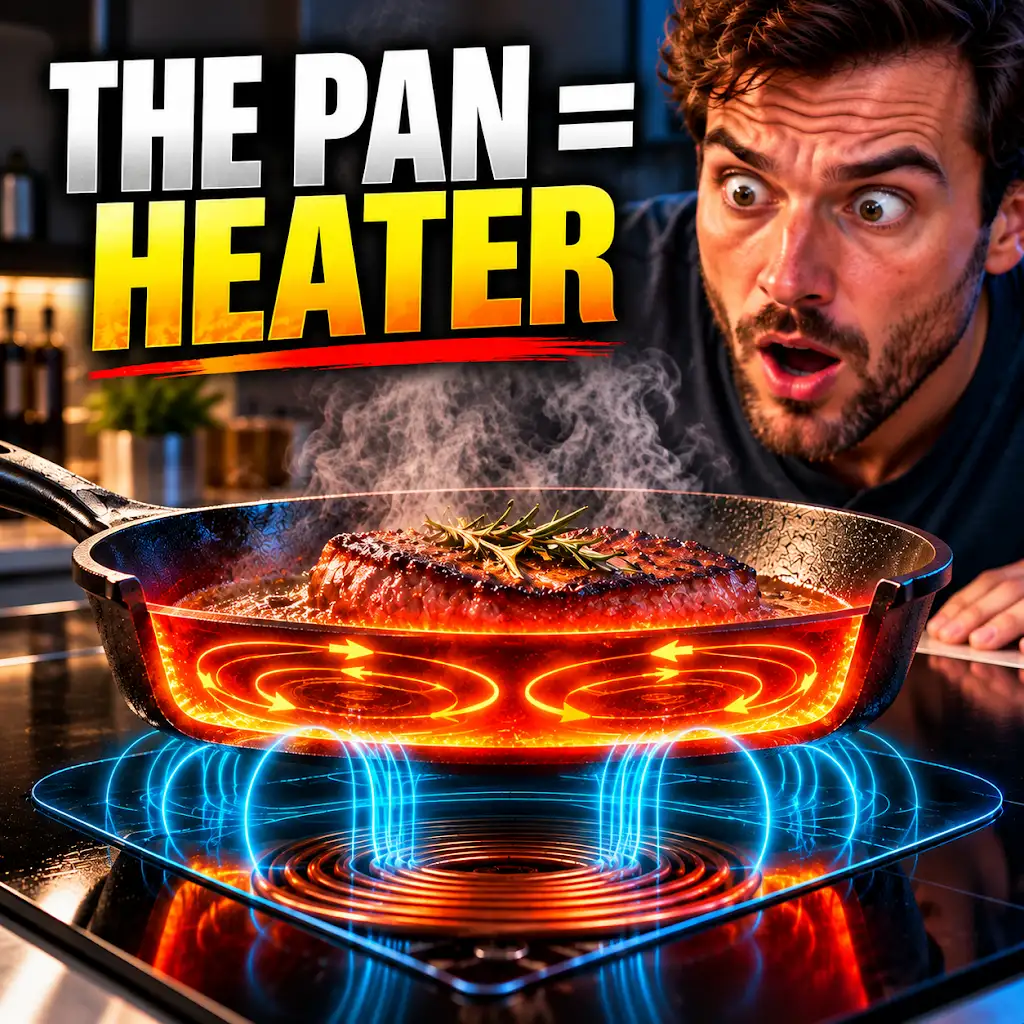
The Pan Is the Heater: How Induction Cooking Really Works
FAQs
What is induction cooking?
Induction cooking uses electromagnetic energy to heat pots and pans directly, rather than relying on a burner to transfer heat.
Why do some pans not work on induction cooktops?
Pans need to be made of a magnetic material, such as cast iron or stainless steel, in order to work on induction cooktops. Non-magnetic materials like aluminum or copper will not heat up on an induction cooktop.
How can I tell if a pan will work on an induction cooktop?
To check if a pan is compatible with an induction cooktop, you can use a magnet. If the magnet sticks to the bottom of the pan, it is made of a magnetic material and will work on an induction cooktop.
Can I use a converter disk to make non-induction pans work on an induction cooktop?
Yes, converter disks made of magnetic material can be placed between the non-induction pan and the induction cooktop to allow the pan to heat up. However, this method may not be as efficient as using induction-compatible pans.
Are there any safety concerns with using the wrong type of pan on an induction cooktop?
Using the wrong type of pan on an induction cooktop can lead to uneven heating, damage to the cooktop, or even pose a safety hazard. It is important to use only induction-compatible pans on an induction cooktop for optimal performance and safety.