
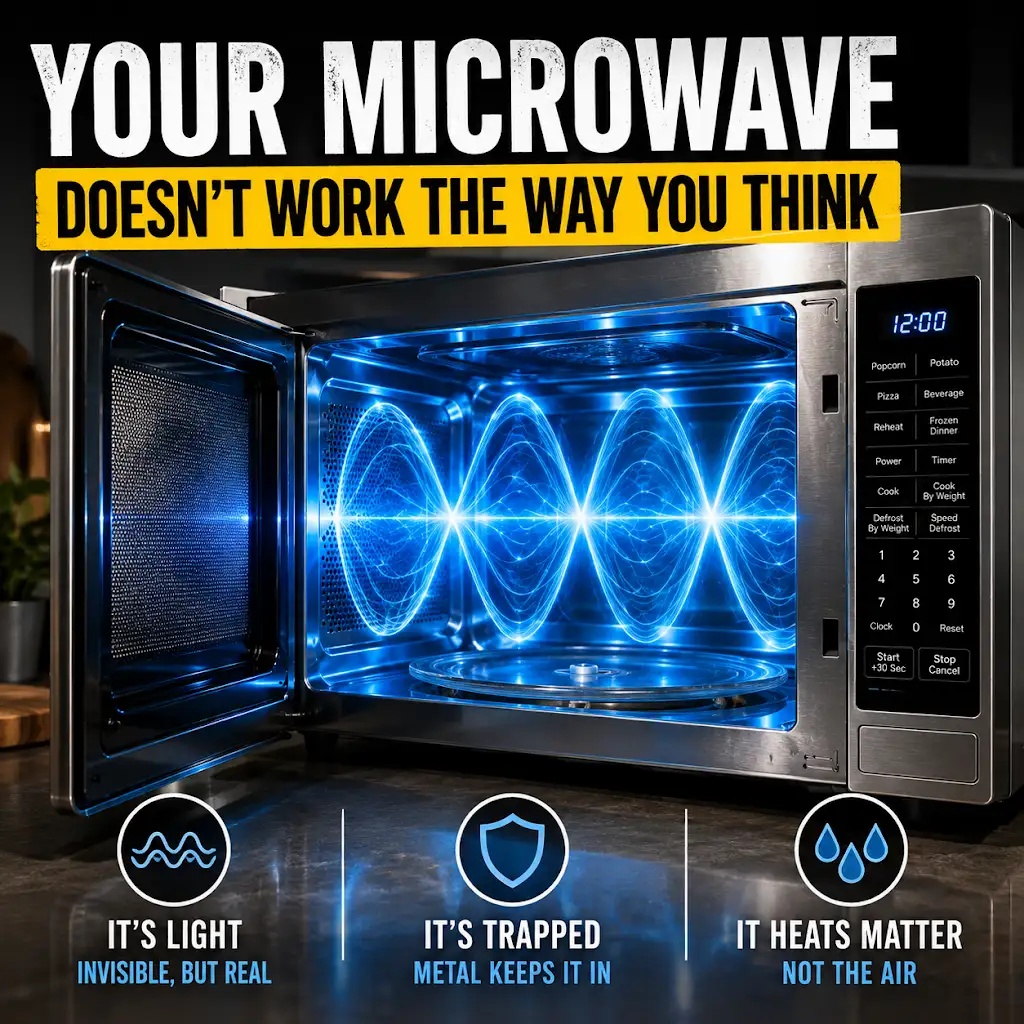
You might have noticed it the last time you nuked your leftovers: that peculiar metal mesh embedded in the glass of your microwave door. It’s not just a stylistic choice or a way to make your appliance look a bit more industrial. No, that intricate grid of tiny holes is a crucial safety feature, designed to keep you and your home protected from something you might not even realize is a potential hazard: microwave radiation.
The Invisible Force Field: Understanding Microwave Radiation
When you heat food in a microwave, you’re using a specific type of electromagnetic radiation. These waves are generated by a device called a magnetron, and their job is to excite the water molecules within your food, causing them to vibrate rapidly. This molecular friction is what generates heat, cooking your meal quickly and efficiently.
How Microwaves Work: The Basics
Think of electromagnetic radiation as a spectrum of energy, with radio waves, visible light, and X-rays all falling within it. Microwaves occupy a specific band within this spectrum, typically between 300 megahertz (MHz) and 300 gigahertz (GHz). Your household microwave oven operates at a frequency of around 2.45 GHz. This frequency is chosen because it’s particularly effective at interacting with water, fat, and sugar molecules in food, making them absorb energy and heat up.
The Magnetron: The Heart of the Microwave
The magnetron is the engine of your microwave. It’s a vacuum tube that uses a combination of strong magnetic fields and electric fields to generate high-frequency microwave radiation. This radiation is then channeled through a waveguide into the cooking cavity. The rotating turntable, if your microwave has one, helps to ensure that the food is exposed to the microwaves more evenly, preventing “hot spots” and “cold spots.”
Energy Absorption: Why Your Food Heats Up
The energy from the microwaves is absorbed by the food, causing the polar molecules within it (like water) to oscillate back and forth. This rapid movement creates friction between the molecules, which translates into heat. This is why microwaved food gets hot, and it’s a very different mechanism from the radiant heat of an oven or the conduction of heat from a stovetop.
Microwave doors are designed with metal mesh for a crucial reason: to keep the microwaves contained within the cooking chamber while allowing you to see your food as it cooks. This safety feature prevents harmful radiation from escaping, ensuring that the appliance operates safely. For a deeper understanding of the science behind microwave technology and its safety features, you can read more in this related article: Freaky Science.
The Potential Danger: Microwave Leakage
While your microwave oven is designed to be safe, like any electronic device that generates radiation, there’s always a theoretical risk of leakage. Microwave radiation, if it escapes the oven in significant quantities, can pose health risks. The primary concern is heating of body tissues. At high enough levels, microwave radiation can cause burns, particularly to the eyes and testes, which are more sensitive to heat.
The Invisible Threat: Why We Don’t See Microwaves
The reason we don’t typically worry about microwaves escaping is that they are a form of non-ionizing radiation. This means they don’t have enough energy to directly damage DNA, unlike ionizing radiation like X-rays or gamma rays. However, their ability to heat tissue is a very real concern. This is why regulations are in place to limit the amount of microwave leakage allowed from ovens.
Biological Effects of Microwave Exposure
Short-term exposure to very high levels of microwave radiation can lead to thermal effects, such as burns. Long-term or chronic exposure to lower levels is less well understood, but concerns have been raised about potential non-thermal effects. However, it’s important to emphasize that household microwaves, when functioning correctly and without damage, emit radiation well within safety limits.
The Importance of Containment
The entire premise of a microwave oven is to contain this generated radiation within the cooking cavity. The metal walls of the oven itself form the first layer of containment. However, the door is a critical junction, and it needs to allow you to see your food cooking while still preventing the microwaves from escaping. This is where the metal mesh comes into play.
The Faraday Cage Effect: The Magic of the Mesh
The metal mesh in your microwave door acts as a miniature Faraday cage. A Faraday cage is an enclosure made of conductive material, typically metal, that blocks external electromagnetic fields. Conversely, it also contains electromagnetic fields generated within it.
What is a Faraday Cage?
Named after the English scientist Michael Faraday, who discovered its principle in 1836, a Faraday cage works by redistributing electric charges on its surface in response to an external electric field. This redistribution effectively cancels out the external field within the cage. In the case of your microwave door, the metal mesh acts in a similar way, but specifically for microwave frequencies.
How the Mesh Interacts with Microwaves
Microwaves are electromagnetic waves, meaning they have both electric and magnetic components. The conductive metal mesh disrupts the propagation of these waves. When microwaves encounter the mesh, the free electrons in the metal are forced to move. This movement of electrons generates opposing electromagnetic fields that cancel out the incoming microwave radiation.
Wavelength Matters: The Key to the Holes
The size of the holes in the mesh is critically important. Microwaves have a specific wavelength, which is the distance between successive crests of the wave. For the 2.45 GHz frequency used in most microwaves, the wavelength is approximately 12.2 centimeters (about 4.8 inches). The holes in the metal mesh are significantly smaller than this wavelength, typically only a few millimeters across.
The Critical Role of Hole Size
The relationship between the wavelength of the radiation and the size of the perforations in the mesh is the key to its effectiveness. If the holes were larger than the wavelength of the microwaves, the radiation would be able to pass through relatively unimpeded, much like light passes through a window. However, because the holes are so much smaller than the wavelength, the mesh acts as a barrier.
Why Small Holes Block Microwaves
Imagine the microwaves trying to squeeze through the tiny gaps. As the electric field of the microwave tries to push charged particles in the mesh, the charges rearrange themselves to create an opposing field that effectively cancels out the microwave’s influence. This continuous process of charge redistribution and cancellation prevents the microwaves from escaping the cavity.
The Physics Behind the Perforations
The metal mesh is essentially a grid of conductive wires or a perforated sheet of metal. When a microwave hits this grid, its electric field component causes currents to flow in the wires. These currents, in turn, create their own magnetic fields that oppose the magnetic field of the microwave. Similarly, the magnetic field component of the microwave induces currents that create opposing electric fields. The combined effect is a significant attenuation of the microwave radiation.
The Trade-off: Visibility vs. Safety
This is a fascinating example of engineering balancing competing needs. You need to be able to see your food cooking, so the door can’t be completely opaque metal. However, you also need to contain the radiation. The mesh provides the necessary compromise, allowing visible light (which has a much shorter wavelength) to pass through while effectively blocking the longer wavelength microwaves.
Microwave doors are designed with metal mesh to ensure safety while allowing users to see inside while cooking. This mesh acts as a barrier that reflects microwaves back into the cooking chamber, preventing them from escaping and potentially causing harm. For a deeper understanding of the science behind microwave technology and the importance of these safety features, you can read a related article on Freaky Science. This resource provides insights into how microwaves work and the engineering principles that keep them safe for everyday use.
Ensuring Your Microwave’s Integrity: What to Look For
While the metal mesh is a robust safety feature, it’s not indestructible. Damage to the microwave door can compromise its ability to contain radiation and should be addressed immediately.
Inspecting the Door Seal
The door seal, often a rubber or plastic gasket around the edge of the door, is just as important as the mesh. This seal ensures that the door closes tightly and prevents any gaps where radiation could escape. Over time, this seal can degrade, crack, or become damaged. Regularly inspect the seal for any signs of wear and tear. If it’s damaged, it needs to be replaced.
Checking for Dents and Warping
Any physical damage to the door, such as dents or warping, can affect its alignment and its ability to create a tight seal. If the door is bent or doesn’t close flush with the oven cavity, it’s a strong indicator of a potential problem. Warping can occur due to overheating or impact.
The Glass and Mesh Integrity
While the mesh itself is quite durable, the glass it’s embedded in can break. If the glass in your microwave door is cracked or shattered, the integrity of the Faraday cage is compromised. Even small cracks can allow radiation to escape. Similarly, if the mesh itself appears torn or has large sections missing, it is no longer providing adequate protection.
When to Replace Your Microwave
If your microwave door is damaged in any significant way – a broken seal, a warped door, cracked glass, or damaged mesh – it’s time to consider replacing the appliance. Trying to repair a microwave door, especially the mesh and sealing mechanism, can be complex and may not restore it to its original safety standards. It’s always better to err on the side of caution when it comes to radiation safety.
The Final Word: A Testament to Smart Engineering
The humble metal mesh in your microwave door is a testament to ingenious engineering, a subtle but critical component that ensures your convenience doesn’t come at the expense of your safety. It’s a perfect example of how understanding the fundamental properties of physics, in this case, the behavior of electromagnetic waves and the principles of a Faraday cage, can lead to practical and life-saving solutions in everyday technology.
Everyday Safety Features We Often Overlook
We interact with countless pieces of technology every day, and many of them incorporate sophisticated safety features that we rarely think about. From the circuit breakers that protect your home from electrical overloads to the airbags in your car, these innovations are designed to keep us safe, often working silently in the background. The microwave door mesh is another such unsung hero of domestic safety.
The Science Behind the Convenience
Your microwave oven is a marvel of applied science. The magnetron’s ability to generate microwaves, the waveguide’s efficiency in directing them, the turntable’s role in even cooking, and the Faraday cage door’s containment of radiation all work in concert to provide you with quick and easy meal preparation. It’s a complex system, but its core safety mechanism is elegantly simple and incredibly effective.
Trusting Your Appliance
When your microwave is functioning correctly and the door is intact, you can trust that it is operating safely within regulatory limits. The metal mesh is a constant guardian, an invisible shield that allows you to peek in on your popcorn popping or your soup heating, all while keeping the powerful waves confined to their intended purpose. So, the next time you look at that intricate pattern on your microwave door, remember the science and safety it represents. It’s more than just a window; it’s a vital part of a carefully designed safety system.
Your Microwave Doesn’t Work the Way You Think
FAQs
1. Why do microwave doors have metal mesh?
Microwave doors have metal mesh to prevent the microwaves from escaping the appliance. The metal mesh acts as a barrier to contain the microwaves inside the oven while allowing visibility through the door.
2. How does the metal mesh in microwave doors work?
The metal mesh in microwave doors reflects the microwaves back into the oven, preventing them from escaping. This design ensures that the microwaves are contained within the appliance, allowing for safe and efficient cooking.
3. Is the metal mesh in microwave doors safe?
Yes, the metal mesh in microwave doors is safe. It is designed to contain the microwaves within the oven and prevent them from leaking out. When used according to the manufacturer’s instructions, microwave ovens with metal mesh doors are safe for everyday use.
4. Can the metal mesh in microwave doors be damaged?
The metal mesh in microwave doors is designed to be durable and withstand the normal wear and tear of everyday use. However, it is important to avoid damaging the mesh by using abrasive materials or harsh cleaning agents on the door.
5. Are there any precautions to take with microwave doors with metal mesh?
It is important to keep the metal mesh in microwave doors clean and free from any obstructions to ensure that it functions properly. Additionally, it is recommended to follow the manufacturer’s guidelines for safe usage and maintenance of the microwave oven.