You’ve probably seen it. Maybe you were carelessly reheating leftovers, or perhaps you were experimenting (something we strongly advise against!). A flash of light, a crackling sound, and suddenly, your microwave is throwing a miniature fireworks show. Metal. In a microwave. It’s a recipe for a dazzling, and often alarming, spectacle. But why does metal transform into a tiny lightning rod when you turn on your microwave? It all boils down to the fundamental principles of how microwaves work and the unique properties of metals.
To understand why metal sparks, you first need to grasp what’s happening inside your microwave oven. It’s not just about heat; it’s about electromagnetic radiation.
How Your Microwave Oven Works
When you set your microwave to a certain power level and time, you’re instructing it to generate microwaves. These are a form of electromagnetic radiation, similar to radio waves and visible light, but with a specific frequency – typically around 2.45 gigahertz. This frequency is chosen because it’s particularly good at interacting with water molecules, which are abundant in most foods.
The heart of the microwave oven is the magnetron. This vacuum tube takes electrical energy and converts it into high-frequency electromagnetic waves. These microwaves are then channeled into the cooking cavity, bouncing off the metal walls. Think of the inside of your microwave as a reflective box. The metal walls don’t absorb the microwaves; they reflect them, ensuring they circulate and interact with your food from multiple angles. This bouncing and re-bouncing is what helps to heat your food evenly.
The Role of Water Molecules
Water molecules are polar. This means they have a slightly positive charge on one end and a slightly negative charge on the other, like tiny magnets. When microwaves hit these water molecules, they cause them to rapidly rotate back and forth, trying to align themselves with the oscillating electromagnetic field. This rapid jostling and friction between the water molecules generates heat, which in turn cooks your food. It’s this vibrational energy transfer that makes microwave cooking so efficient.
The Frequency Matters
The specific frequency of 2.45 GHz is not arbitrary. It’s chosen because it efficiently excites water molecules. Other molecules in food, like fats and sugars, also absorb some microwave energy, but water is the primary driver of the heating process. This is why foods with higher water content tend to cook faster in a microwave.
When it comes to understanding why some metals spark in a microwave, it’s essential to explore the underlying science behind this phenomenon. An insightful article that delves into the details of microwave interactions with various materials can be found at Freaky Science. This resource explains how certain metals can create electric fields that lead to arcing, which is the cause of those alarming sparks. By examining the properties of metals and their behavior in microwave ovens, readers can gain a clearer understanding of what happens when metal is introduced into these appliances.
Metals: A Different Ballgame
Now, let’s introduce the metallic interloper. Metals behave very differently when exposed to microwaves compared to the water molecules in your food. Their atomic structure and electron behavior are the key.
The Nature of Metals
Metals are characterized by their free electrons. In a metallic atom, the outermost electrons are not tightly bound to a single atom but are instead delocalized, forming a “sea of electrons” that can move freely throughout the metal’s structure. This is why metals are excellent conductors of electricity. When an electric current flows through a wire, it’s these free electrons that are moving.
Interaction with Electromagnetic Fields
Microwaves are electromagnetic waves, and as such, they have an oscillating electric field. When this electric field encounters a metal object, it exerts a force on the free electrons within the metal. This force causes the electrons to move. The oscillating electric field of the microwave forces these electrons to move back and forth very rapidly.
Reflection, Not Absorption
Unlike water molecules, which absorb and are agitated by microwave energy, metals are excellent reflectors of microwaves. The free electrons in the metal effectively push back against the incoming electromagnetic field, causing the microwaves to bounce off the surface of the metal. This reflection is why the inside of your microwave is made of metal.
The Sparking Phenomenon: Electron Overload
The rapid movement of electrons in response to the microwave’s electric field is the direct cause of the sparks you see. It’s a complex interplay of electric fields, electron acceleration, and the creation of localized high-energy phenomena.
Induced Currents and Charge Buildup
As the microwaves’ electric field oscillates, it induces currents within the metal object. These currents are essentially the rapid back-and-forth movement of free electrons. If the metal object has sharp edges, points, or is thin, this movement of electrons can become concentrated in specific areas. This concentration of charge can lead to a buildup of electrical potential.
The Critical Threshold: Dielectric Breakdown
Every material has a limit to how much electrical stress it can withstand before it starts to break down. This limit is called the dielectric strength. For air, which is an insulator, the dielectric strength is relatively low. When the electrical charge buildup on a piece of metal in a microwave becomes sufficiently high, it can exceed the dielectric strength of the surrounding air.
Arc Formation: The Miniature Lightning Bolt
Once the dielectric strength of the air is surpassed, the air becomes ionized. This means electrons are stripped from the air molecules, creating a plasma. This ionized air is now a conductor, allowing a massive flow of electrical current to jump from the metal object to another conductive surface (like the microwave walls or another piece of metal) or even just through the air itself. This sudden, intense discharge of electricity is what you perceive as a spark. It’s a miniature lightning bolt happening inside your oven.
The Role of Shape and Size
The shape and size of the metal object play a significant role in how intensely it sparks.
Sharp Edges and Points
Sharp edges and points on metal objects act like lightning rods. They concentrate the electric field. Imagine a pointed needle versus a smooth sphere. The electric field is much stronger at the tip of the needle. In a microwave, these concentrated electric fields can accelerate electrons to extremely high energies, making them more likely to ionize the surrounding air and create a spark. Think of the tip of a fork or the crinkled edge of aluminum foil.
Thinness and Edges of Foil
Thin pieces of metal, like a crumpled piece of aluminum foil, are particularly prone to sparking. The electrons can easily flow across the thin material, and if the foil is crinkled, it creates numerous sharp edges. These edges can lead to localized points of very high electric field strength, facilitating arc formation. If you’ve ever used foil to shield a part of your food from overcooking, you’ve likely experienced this.
Metal Trim on Dishes
Many ceramic or glass dishes have decorative metallic trim. This trim, though often thin, acts as a conductor. The edges of this trim can concentrate electric fields, leading to sparks. The unevenness of the trim or any imperfections can also contribute to this.
Why Not All Metal is Equal in a Microwave
It’s important to note that not all metal objects will necessarily cause a dramatic sparking show. The interaction depends on the metal’s properties, its shape, and how it’s positioned within the microwave cavity.
Surface Area and Conductivity
The conductivity of the metal plays a role. While all metals are conductors, some are better than others. However, the primary factor is the surface area and the presence of sharp features. A smooth, rounded metal object with no sharp edges is less likely to spark than a thin, crumpled piece of foil.
The Faraday Cage Effect
The metal walls of your microwave oven create a phenomenon known as a Faraday cage. This means that the microwaves are largely contained within the oven. However, if a metal object is placed inside, it can disrupt this containment by reflecting the microwaves. This reflection can cause the microwaves to bounce back towards the magnetron, potentially damaging it over time. It also leads to uneven heating, as the microwaves are being diverted.
The Case of Small, Rounded Metal Objects
You might notice that small, rounded metal objects, like certain spoons or some lids, might not spark as dramatically, or at all. This is because their smooth surfaces and lack of sharp edges don’t create the intense, localized electric fields needed to overcome the dielectric strength of air. However, even these can still reflect microwaves and cause uneven heating.
When it comes to the curious phenomenon of why some metal sparks in a microwave, there are several factors at play, including the shape and size of the metal object. For a deeper understanding of this intriguing topic, you can explore a related article that delves into the science behind microwaves and metal interactions. This article provides insights into the electromagnetic waves and how they can cause certain metals to create sparks. To learn more, check out this informative piece on Freaky Science.
The Dangers of Microwaving Metal
| Metal Type | Reason for Sparking |
|---|---|
| Aluminum foil | Thin edges can cause sparking due to the build-up of electric charge |
| Stainless steel | Irregular shapes or sharp edges can cause sparking |
| Other metals | Presence of any metal can cause arcing and sparking due to the reflection of microwaves |
Beyond the dramatic visual display, microwaving metal is not just a culinary faux pas; it can be dangerous and damaging.
Fire Hazard
The sparks you see are essentially small arcs of electricity. These arcs can be hot enough to ignite flammable materials, such as paper towels, food packaging, or even the food itself. This can lead to a fire inside your microwave.
Damage to the Microwave Oven
The reflected microwaves can bounce back to the magnetron, the component that generates the microwaves. Over time, this can cause the magnetron to overheat and fail, leading to an expensive repair or the need to replace the entire microwave. The intense electrical discharges can also damage the internal components of the oven.
Uneven and Ineffective Cooking
Metal objects block and reflect microwaves. This means that the areas around the metal will not be heated effectively, leading to unevenly cooked food. In some cases, the food might not cook at all in those areas.
The “Myth” of Some Metal Being Safe
You might have heard that some types of metal, like the small metal racks or trays that sometimes come with microwaves, are safe. This is often because they are designed with rounded edges and are placed strategically to avoid concentrating electric fields. However, it’s always best to consult your microwave’s manual. If it doesn’t explicitly state that a metal item is microwave-safe, it’s best to err on the side of caution and avoid it. The same applies to metal components in some appliances that are designed for microwave use, like certain toaster ovens with microwave functions.
How to Avoid the Sparking Spectacle
The simplest way to avoid metal sparking in your microwave is to follow one basic rule: do not put metal in the microwave.
Read Your Microwave’s Manual
Your microwave oven’s user manual is your best friend. It will clearly outline what is safe and what is not. Most manuals have a dedicated section on “materials to avoid.”
Use Microwave-Safe Containers
Opt for containers made of glass, ceramic, or microwave-safe plastics. These materials are designed to allow microwaves to pass through them and heat your food without creating hazardous reactions.
Be Wary of Decorations
Check your dishes and bowls for metallic trim or embellishments. Even small amounts of metal can cause issues. If you’re unsure, it’s better to use a plain dish.
Rethinking Foil Use
While aluminum foil can be used in some specific microwave applications to shield food from direct heat (often with careful instructions from the food manufacturer), it’s generally best to avoid it altogether if you’re unsure. If you must use it, ensure it’s smooth and not crumpled, and that it doesn’t touch the microwave walls. However, for most everyday reheating and cooking, it’s unnecessary and risky.
Inspect for Damage
Before putting any item into your microwave, give it a quick inspection. Look for any loose metallic components or damaged parts that might have exposed metal.
In essence, the sparks you see when metal enters your microwave are a visible manifestation of an electrical phenomenon. The microwaves, designed to excite polar molecules like water, instead induce rapid electron movement in conductive metals. When these movements become concentrated and energetic enough, they overcome the insulating properties of the air, leading to a miniature electrical discharge. So, the next time you’re about to put that metal fork into the microwave, remember the invisible dance of electrons and the potential for a dazzling, and dangerous, light show. Your microwave – and your safety – will thank you for it.
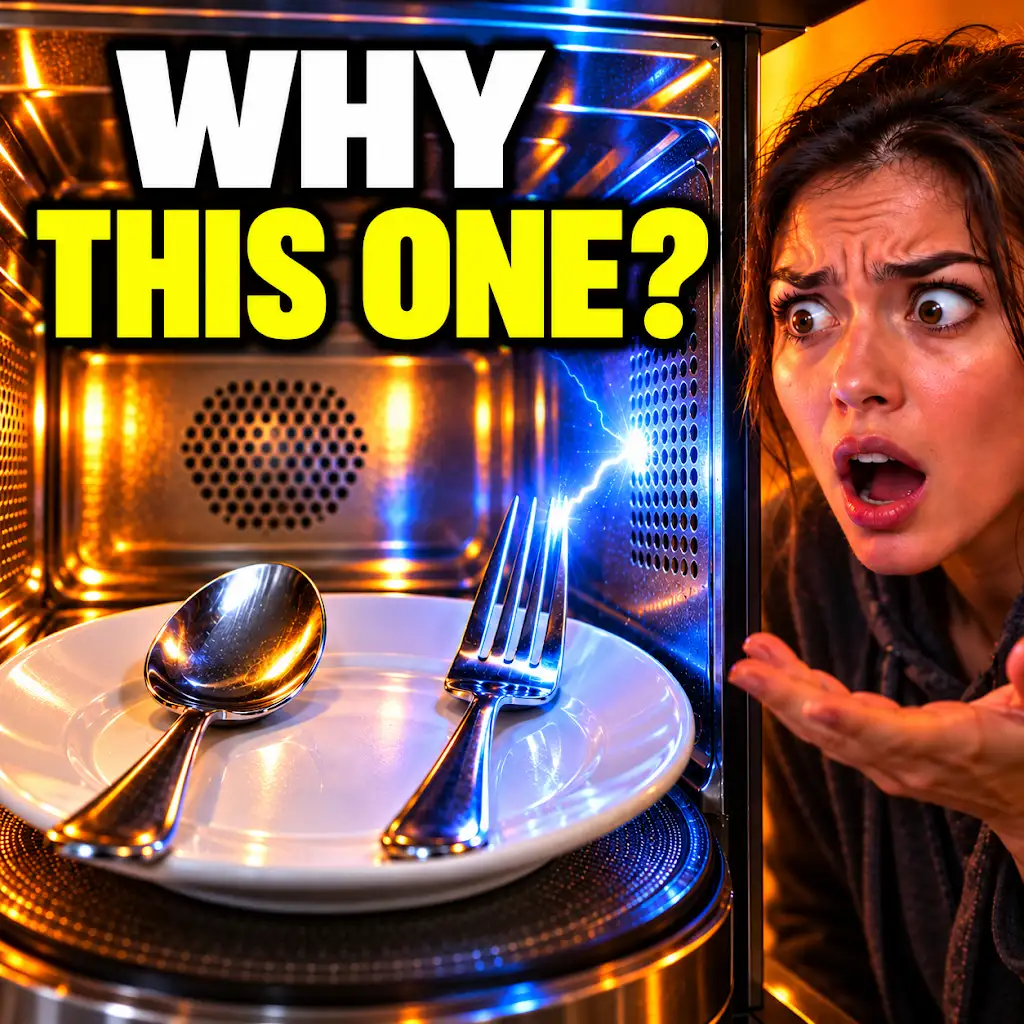
A Fork and a Spoon React Differently in a Microwave. Why?
FAQs
What happens when metal sparks in a microwave?
When metal sparks in a microwave, it can cause arcing, which is a discharge of electricity. This can potentially damage the microwave and create a fire hazard.
Why does metal spark in a microwave?
Metal sparks in a microwave because it reflects the microwaves, causing an accumulation of electrical energy. This can lead to arcing and potentially damage the microwave.
What types of metal can cause sparking in a microwave?
Any type of metal, including aluminum foil, metal utensils, and metal trim on dishes, can cause sparking in a microwave due to their ability to reflect microwaves.
Is it safe to put metal in a microwave?
It is not safe to put metal in a microwave as it can cause arcing, potentially damaging the microwave and creating a fire hazard. It is important to follow the manufacturer’s guidelines and only use microwave-safe materials.
How can I safely heat food with metal in a microwave?
To safely heat food with metal in a microwave, use microwave-safe containers and utensils. Avoid using metal foil or metal-trimmed dishes, and always follow the manufacturer’s guidelines for safe microwave use.