
You’ve probably experienced it yourself. You’re heating up leftovers, maybe some popcorn, and you accidentally leave a fork, a piece of tin foil, or even the metallic trim on your favorite mug inside the microwave. Suddenly, a dazzling display of electric blue sparks erupts from the metal. It’s a bit alarming, and you quickly shut the door, wondering what just happened and why your appliance is suddenly putting on a light show. You’re not alone in your curiosity. This phenomenon, the sparking of metal in microwaves, is a common occurrence, and it’s rooted in some fascinating scientific principles. Let’s dive into the “why” behind those unexpected flashes.
To understand why metal sparks, you first need to grasp how a microwave oven works. It’s not just a fancy box that magically heats your food. Inside that box is a complex system designed to bombard your food with a specific type of electromagnetic radiation: microwaves.
The Magnetron: The Heart of the Microwave
At the core of every microwave oven is a device called a magnetron. You can’t see it, but it’s the powerhouse that generates the microwaves. Think of it as a specialized vacuum tube. When electricity flows through it in the presence of strong magnetic fields, it oscillates at a very high frequency, producing those crucial microwave energy waves. These waves are typically around 2.45 gigahertz, a frequency that’s particularly good at interacting with water molecules in your food.
How Microwaves Heat Food
The magic of microwave heating lies in how these waves interact with the water, fat, and sugar molecules within your food. When microwaves penetrate the food, they cause these polar molecules to rotate rapidly. This rapid rotation creates friction, and it’s this friction that generates heat, cooking your food from the inside out. It’s an efficient process, but it relies on the microwaves being able to reach and interact with the food effectively.
What Happens When Metal Enters the Equation?
Here’s where things get interesting. The same electromagnetic waves that are so adept at agitating water molecules behave very differently when they encounter metal. Metal is a conductor of electricity, meaning electrons are free to move within its structure. This freedom of movement is precisely what leads to the dramatic sparking you observe.
When it comes to understanding why metal edges spark in microwave ovens, it’s essential to explore the underlying physics involved. A related article that delves into this phenomenon can be found at Freaky Science. The article explains how microwaves interact with metal surfaces, leading to the creation of electric fields that can cause arcing and sparks, particularly at sharp edges. This insight not only highlights the dangers of placing metal objects in microwaves but also sheds light on the fascinating science behind microwave technology.
Metal’s Peculiar Relationship with Microwaves
Metal, by its very nature, is a conductor. This fundamental property is the key to understanding the sparking phenomenon. Unlike your food, which absorbs and converts microwave energy into heat, metal reflects and interacts with these waves in a way that can become problematic.
Reflection: The Mirror Effect
When microwaves hit a smooth, flat surface of metal, they tend to reflect off it, much like light reflects off a mirror. This reflection isn’t uniform, however. The shape and size of the metallic object play a significant role in how the microwaves are reflected. This can lead to concentrated areas of microwave energy.
Absorption and Electron Flow
While metal reflects a lot of microwave energy, it also absorbs some. When microwaves are absorbed by the metal, they energize the free electrons within the metal’s structure. These electrons are then able to move around more freely. This movement of electrons can become quite intense, especially at sharp edges or points.
Impedance Mismatch: A Scientific Glitch
The interaction between microwaves and metal is also characterized by an “impedance mismatch.” In simple terms, the microwave energy “sees” the metal as a barrier it can’t easily pass through. This mismatch causes the energy to bounce back and build up, creating electrical charges.
The Birth of Electric Fields and Arcs
The intense build-up of electrical charge on the surface of the metal, especially at points, is what sets the stage for the dramatic sparking. This is where the electrical and physical properties of metal collide with the electromagnetic waves.
Charge Accumulation at Sharp Edges
Consider a piece of foil with a crinkled edge or a fork with pointed tines. These sharp points and edges act as focal points for the accumulated electrical charges. Imagine a crowd of people trying to get through a narrow doorway – they tend to bunch up. Similarly, electrons can concentrate at these sharp protrusions on the metallic surface.
Ionization of Air: The Spark’s Ignition
As these charges build up to incredibly high densities, they create incredibly strong electric fields. When these electric fields become powerful enough, they can overcome the insulating properties of the air surrounding the metal. The electric field rips electrons from the air molecules, creating a plasma – a superheated, ionized gas. This is the crucial step that allows the spark to form.
The Arc: A Tiny Lightning Bolt
Once the air is ionized, it becomes conductive. This allows the accumulated electrical charge on the metal to rapidly discharge through the ionized air. This rapid discharge is what you see as a bright flash of light – an electric arc, essentially a miniature lightning bolt occurring inside your microwave.
Why Different Metals Behave Differently
You might have noticed that not all metal objects cause the same level of sparking, or even spark at all. The type of metal, its thickness, its shape, and even its proximity to other objects can influence the outcome.
Conductivity and Reflection Properties
Different metals have varying degrees of electrical conductivity and reflective properties. For instance, aluminum foil is a good conductor and highly reflective. Its thinness also makes it prone to tearing and creating sharp edges, which are ideal for charge accumulation. Other metals, like stainless steel, might have slightly different reflectivity and conductivity, leading to variations in sparking behavior.
Shape and Surface Finish
The shape of a metallic object is a major factor. Smooth, rounded surfaces tend to reflect microwaves more uniformly, minimizing charge build-up. However, as mentioned, sharp edges, points, and even small holes can act as charge concentrators. The surface finish also plays a role. A rough surface might not reflect as cleanly as a polished one.
Proximity to Food and Other Objects
The way microwaves interact with metal can also be influenced by what else is inside the microwave. If a metallic object is very close to food, the microwaves might be absorbed by the food before they can significantly interact with the metal. Conversely, if the metal is placed strategically, it can even act as a shield, protecting certain parts of the food from the microwave energy. However, this is not a recommended practice for heating food efficiently or safely.
When using a microwave oven, many people may wonder why metal edges can create sparks. This phenomenon occurs due to the interaction between the metal and the microwave radiation, which can cause electric fields to build up at the sharp edges of the metal. For a deeper understanding of this topic, you can explore a related article that discusses the science behind these sparks and provides insights into safe microwave practices. To learn more, check out this fascinating article that delves into the intricacies of microwave technology.
Safety First: Avoiding the Sparking Menace
| Reasons for Metal Edges Sparking in Microwave Ovens | Explanation |
|---|---|
| Metal Reflection | When metal edges reflect microwaves, it can cause sparking due to the concentration of energy. |
| Arcing | If metal edges have sharp points or edges, it can cause arcing as the electric current jumps between the metal and the microwave’s interior. |
| Damage to the Oven | Metal edges can damage the interior of the microwave, leading to sparking and potential fire hazards. |
While watching sparks fly might be momentarily exciting, it’s crucial to understand that allowing metal in a microwave oven can be dangerous. It’s not just about the visual spectacle; there are real risks involved.
The Risk of Fire
The intense heat generated by arcing metal can ignite flammable materials inside the microwave, such as paper packaging or even dried food residue. This is a significant fire hazard that can potentially damage your appliance and even your home.
Damage to the Microwave
Repeated exposure to intense arcing can damage the internal components of your microwave oven, particularly the magnetron. The reflected microwave energy can bounce back and stress the magnetron, leading to reduced efficiency and eventual failure.
Uneven Heating and Food Safety
When metal objects are present, they can disrupt the even distribution of microwave energy. This can lead to some parts of your food being undercooked while others are overcooked. Undercooked food may not reach safe temperatures, posing a risk of foodborne illness.
What to Avoid
- Tin foil: While small, smooth pieces of foil used to shield specific parts of food are sometimes acceptable and intended by manufacturers, crinkled or crumpled foil, or large sheets, are a definite no-no.
- Utensils: Forks, knives, spoons, and any other metal cutlery should never be placed in the microwave.
- Metallic trim: Many ceramic dishes and mugs have decorative metallic trim. These should be avoided. Always check the packaging or the item itself for any metallic accents.
- Twist ties: Those little metallic twist ties on bread bags can also cause sparks.
- Certain containers: Some food packaging might contain metallic elements. Always check labels.
When in Doubt, Leave It Out
The golden rule of microwave use is: if you’re unsure whether an item is microwave-safe, err on the side of caution and leave it out. Stick to microwave-safe containers made of glass, ceramic (without metallic trim), or approved plastics.
Understanding the science behind why metal sparks in microwaves demystifies a common kitchen occurrence and highlights the importance of proper microwave usage. By respecting the electromagnetic forces at play and adhering to safety guidelines, you can ensure your microwave continues to be a safe and efficient tool for heating your meals. So next time you see a spark, you’ll know it’s not magic, but a fascinating interplay of physics – and a clear signal to remove that offending piece of metal.
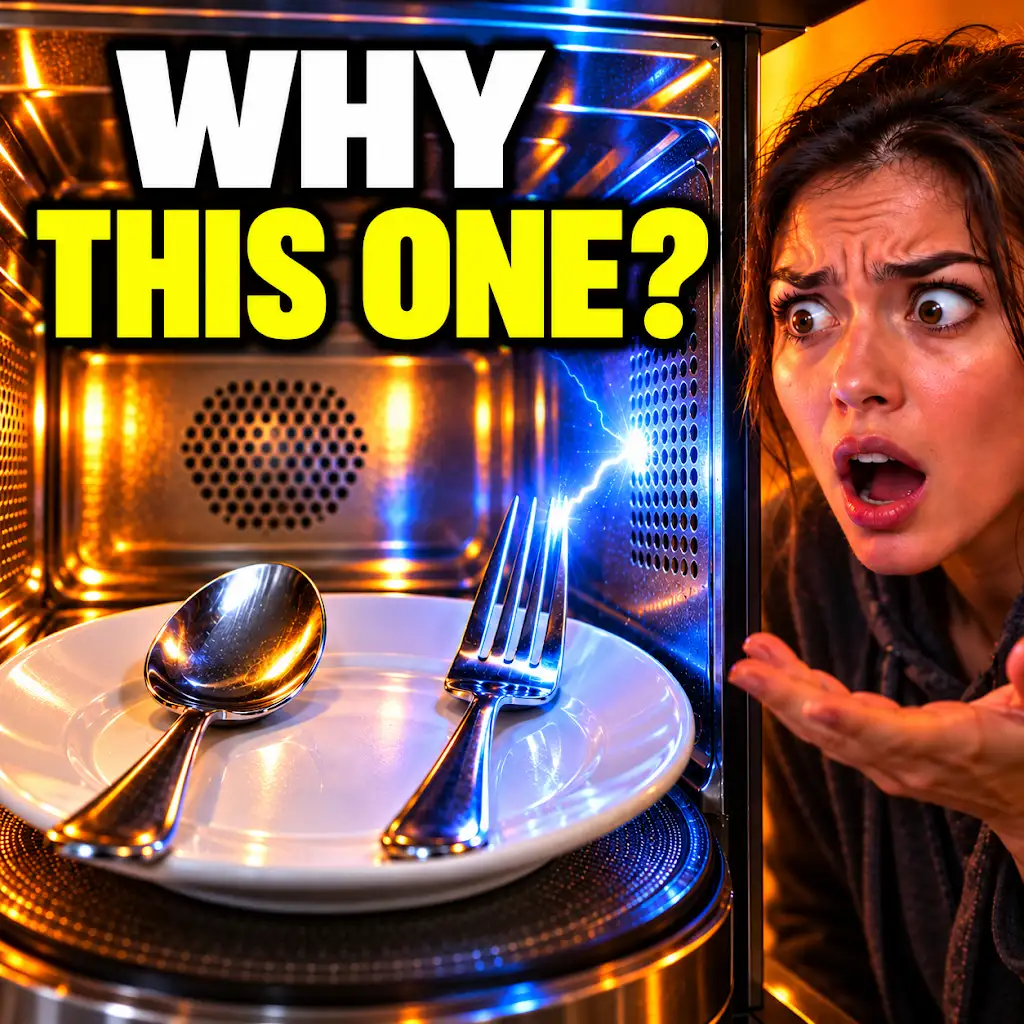
A Fork and a Spoon React Differently in a Microwave. Why?
FAQs
What causes metal edges to spark in microwave ovens?
Metal edges spark in microwave ovens because the microwaves cause electric currents to flow through the metal, which can lead to sparking and potentially damage the microwave.
Is it safe to put metal in a microwave oven?
It is generally not safe to put metal in a microwave oven, as it can cause sparking, arcing, and potentially damage the microwave. It can also pose a fire hazard.
What types of metal can cause sparking in a microwave oven?
Any type of metal can cause sparking in a microwave oven, but sharp or pointed metal edges are more likely to cause sparking due to the concentration of electric currents.
How can I safely heat food with metal in a microwave oven?
To safely heat food with metal in a microwave oven, it is best to use microwave-safe containers and utensils that are specifically designed for use in microwave ovens.
What should I do if metal sparks in my microwave oven?
If metal sparks in a microwave oven, immediately turn off the microwave and do not attempt to open the door until the sparking has stopped. Remove the metal object and inspect the microwave for any damage before using it again.