You’ve probably seen the dramatic arcs of lightning leap from forks, spoons, and even the crumpled foil you used to wrap leftovers. It’s a captivating, if slightly terrifying, spectacle. So, why doesn’t your trusty microwave oven turn into a miniature lightning storm every time you accidentally leave a metal lid on a dish? You might think it’s a simple oversight, a stroke of luck, or perhaps some invisible shield protecting your kitchen. The truth, however, is far more nuanced and rooted in the fundamental physics of how microwaves interact with matter, particularly the specific properties of metals and the way they are designed to be used within your microwave.
You’re likely familiar with the basic premise of your microwave oven. It’s a marvel of engineering that uses electromagnetic radiation in the microwave frequency range to heat food. These waves, typically around 2.45 gigahertz, are generated by a device called a magnetron. They bounce around inside the metal cavity of the oven, eventually penetrating your food and causing the water molecules within it to vibrate. This vibration generates heat, and voilà – your meal is cooked. It’s an efficient and relatively quick process.
The common wisdom, and for good reason, is to avoid putting metal in your microwave. The sparks, the potential for damage, the fire hazard – these are all valid concerns that are drilled into us. But the experience of seeing metal spark isn’t universal. Sometimes, metal can sit inside without incident, and it’s this discrepancy that often leads to confusion. You might have even done it yourself, perhaps forgetting a piece of cutlery, and breathed a sigh of relief when nothing dramatic happened. This article aims to demystify this phenomenon, explaining why certain metal objects can cause spectacular electrical discharges while others might remain stubbornly inert.
The Nature of Microwaves and Electrical Fields
The very essence of microwave cooking lies in the generation and manipulation of electromagnetic waves. These waves, as the name suggests, possess both electric and magnetic components that oscillate perpendicular to each other and to the direction of propagation. Inside your microwave oven, these waves are confined within a metal cavity. This cavity acts like a Faraday cage, reflecting the microwaves and causing them to bounce around, ensuring they are distributed throughout the cooking chamber.
Electric Field Oscillations
When you activate your microwave, the magnetron emits these high-frequency electromagnetic waves. The oscillating electric field component of these waves is the primary driver of heating. This electric field exerts a force on charged particles, primarily electrons, within the material it encounters. In food, these charged particles are mostly the polar molecules, especially water, which align themselves with the oscillating electric field. As the field reverses direction billions of times per second, these molecules rapidly rotate back and forth, generating frictional heat.
The Role of the Microwave Cavity
The inner walls of your microwave are constructed from conductive materials, typically stainless steel or aluminum. This metal lining is crucial for two main reasons. Firstly, it reflects the microwaves, preventing them from escaping the oven cavity. If the microwaves were to leak out, they could pose a safety hazard and would be less effective at cooking your food. Secondly, the metal cavity itself influences the behavior of the electromagnetic waves within. It creates a complex standing wave pattern, where certain points have high electric field intensity and others have low intensity.
Frequency and Wavelength
The specific frequency of the microwaves generated by your oven (around 2.45 GHz) is chosen for a reason. At this frequency, water molecules absorb energy very efficiently. The wavelength of these microwaves is also important, being roughly 12.2 cm. The dimensions of the microwave cavity are carefully designed to be a multiple of half wavelengths, which helps to create an efficient standing wave pattern and distribute the microwave energy effectively. This intricate dance of waves and cavity is what makes your microwave work, but it also lays the groundwork for understanding why metal can sometimes behave in unexpected ways.
While many people believe that metal always sparks in microwaves, this isn’t entirely accurate. The behavior of metal in microwaves can vary depending on the type and shape of the metal object. For a deeper understanding of this phenomenon, you can explore the article on Freaky Science that discusses the science behind microwaves and metal. To read more, visit Freaky Science.
Metals and Their Unique Electrical Properties
Metals are, by definition, excellent conductors of electricity. This is due to their atomic structure, where the outermost electrons are loosely bound and can move freely throughout the material, forming what is often described as an “electron sea.” This free movement of electrons is the key to understanding how metals interact with the electric fields of microwaves.
Free Electrons and Conductivity
The abundance of free electrons in metals makes them highly responsive to external electric fields. When an electric field is applied to a metal, these free electrons are easily pushed and pulled, creating an electric current. This is why metals are used in electrical wiring – they readily allow electricity to flow through them. In the context of microwaves, the oscillating electric field of the waves causes these free electrons in any metal object placed inside to move back and forth.
Reflection and Absorption of Microwaves
Because metals are such good conductors, they tend to reflect microwaves rather than absorb them. The free electrons in the metal rapidly rearrange themselves in response to the incoming electric field, effectively canceling out the field within the bulk of the metal. This reflected energy is what bounces around the cavity, contributing to the cooking process for your food. However, this reflection isn’t always perfect, and under certain conditions, it can lead to interesting phenomena.
Surface Properties and Impurities
While the bulk of a metal might be highly conductive, the surface properties can play a significant role. Rough surfaces, sharp edges, or the presence of insulating impurities can affect how microwaves interact with the metal. These imperfections can create localized areas where the electric field is more concentrated or where electrons are less able to move freely, which can be a precursor to sparking. The pristine, smooth surface of a solid metal rod will behave differently than a crumpled piece of foil with many jagged edges.
The Sparking Phenomenon: Charge Buildup and Discharge
When metal does spark in a microwave, it’s not magic; it’s a form of electrical discharge. This occurs when electrical charges accumulate on the surface of the metal to such an extent that they can no longer be contained by the material and overcome the insulating properties of the surrounding air.
Accumulation of Electric Charge
The oscillating electric field of the microwaves exerts a force on the free electrons within the metal. In a perfectly uniform metal object placed in a uniform field, these electrons would simply oscillate back and forth, and the net charge on the object would remain zero. However, the reality inside a microwave is far from uniform. The standing wave pattern creates areas of high and low electric field intensity. Furthermore, the shape of the metal object is critical. Sharp points and edges tend to concentrate electric fields. Imagine a lightning rod; its purpose is to concentrate the electric field to encourage a lightning strike at a safe point. Similarly, in a microwave, sharp edges on metal objects can act as focal points for charge accumulation.
Corona Discharge and Arcing
When electric charge builds up on these sharp points or edges, the electric field strength in the immediate vicinity can become extremely high. If this field strength exceeds the dielectric strength of the surrounding air (the maximum electric field that air can withstand before becoming conductive), a phenomenon known as a corona discharge can occur. This is a faint, bluish glow that can be seen around sharp metal points under high voltage. If the charge buildup continues and the electric field becomes even stronger, a more dramatic event can happen: arcing. This is essentially a miniature lightning bolt, where a conductive channel of ionized air forms between the metal object and another conductive surface (another piece of metal, the microwave wall, or even the food itself). This sudden, rapid discharge of electricity is what you see as sparks.
The Role of Shape: Points, Edges, and Thin Strips
The shape of the metal object is paramount in determining whether it will spark. Objects with sharp points, thin edges, or narrow gaps are far more prone to sparking. Think of a fork with its pointed tines or a piece of crinkled aluminum foil with its many sharp creases. These features create areas where electric field lines converge, leading to a higher concentration of electric charge. In contrast, a smooth, rounded metal object, or a large, solid piece of metal that is well-grounded to the microwave cavity, is less likely to develop sufficient charge density to spark.
Why Some Metal Doesn’t Spark: The Exceptions to the Rule
While the general advice is to avoid metal in microwaves, you might have noticed that not all metal objects behave the same way, and sometimes metal can be used. This is where the nuances come into play, and it often depends on the specific properties of the metal object and how it interacts with the microwave’s electromagnetic field.
Smooth, Rounded Edges and Bulk Metal
As mentioned, smooth, rounded edges on metal objects are less likely to concentrate electric fields. If you were to, hypothetically, place a perfectly smooth, solid metal sphere inside a microwave, it would be much less prone to sparking than a fork. The electric charge would distribute more evenly across its surface. Similarly, large, solid pieces of metal that are not close to other conductive surfaces can sometimes sit in a microwave without incident. The sheer mass of the metal might absorb some energy, and its large surface area might prevent extreme charge buildup at specific points. However, this is still a risky proposition, as even a slight imperfection or proximity to another conductor can trigger a spark.
Metal Designed for Microwave Use
The most significant exception, and the reason you see metal in some microwave-safe cookware, is when the metal is specifically designed to interact with microwaves in a controlled manner. This often involves thin layers of metal, particular shapes, or metallic coatings that are not continuous in a way that would lead to charge buildup and arcing.
While many people believe that metal always sparks in microwaves, this is not necessarily the case, as explained in a related article. The behavior of metal in microwaves can vary depending on factors such as the shape and size of the metal object. For a deeper understanding of this phenomenon, you can read more in this informative piece on Freaky Science, which explores the science behind why some metals can safely be used in microwaves without causing sparks.
Microwave-Safe Metal: A Closer Look
You’ve likely seen or even used microwave-safe cookware that features metallic elements. These items are a testament to the fact that not all metal is the enemy of your microwave. The key lies in the engineering and design of these products, which exploit the principles of microwave physics to their advantage.
Metalized Coatings and Insulating Layers
Many microwave-safe dishes with metallic accents utilize metalized coatings. These are extremely thin layers of metal, often aluminum or chromium, applied to the surface of glass, ceramic, or plastic. The thinness of the coating is crucial. It’s thin enough to reflect microwaves, preventing them from reaching and heating the material beneath, but not so thick or continuous that it can accumulate significant charge and spark. These coatings are often applied in a pattern, or have microscopic breaks, further inhibiting charge buildup. Furthermore, these metalized layers are typically surrounded by or bonded to insulating materials (glass, ceramic), which helps to dissipate any potential charge buildup and prevent it from reaching a critical level.
Faraday Cages for Shielding
In some instances, metal components are deliberately used to create localized Faraday cages within microwave-safe items. For example, a microwave-safe container might have a metal shield around a specific compartment. This shield is designed to reflect microwaves away from that particular area, perhaps to keep certain foods from overcooking or to achieve a specific cooking effect. The design of these shields ensures they are well-grounded within the microwave cavity, preventing significant charge buildup on the shield itself. The edges are typically rounded, and the entire structure is engineered to prevent arcing.
Waveguides and Antenna Effects
Certain microwave-safe designs might incorporate metallic elements that act as miniature waveguides or antennas. These components are carefully shaped and positioned to interact with the microwave field in a specific way, often to direct or focus the microwave energy for even cooking or browning. Their design prevents the accumulation of excess charge by ensuring that the electric field is distributed in a controlled manner, or by providing pathways for charge to dissipate safely.
The Importance of Manufacturer Testing and Certification
Crucially, any metal component that is labeled “microwave-safe” has undergone rigorous testing by the manufacturer. They understand the complex interactions between microwaves and materials and have engineered their products to be safe for use. They account for the frequency of microwaves, the power output of typical ovens, and the potential for charge buildup. Therefore, you can trust these certifications, as they are based on sound scientific principles and extensive testing.
The Physics of Non-Sparking Metal
So, what are the underlying physical reasons why a metal object doesn’t spark in your microwave, even if it’s not explicitly labeled as microwave-safe? It boils down to the absence of conditions that favor the buildup of sufficient electric charge and the subsequent discharge.
Uniform Charge Distribution
In some cases, metal objects might be so large and uniformly shaped that the electric charges induced by the microwaves are distributed relatively evenly across their surface. There are no sharp points or edges to act as charge concentrators. This even distribution prevents the electric field strength from reaching critical levels in any single location. Think of a solid, smooth metal bowl with rounded edges. While it’s still generally advised against, it’s less likely to spark than a fork.
Grounding and Charge Dissipation
If a metal object is in good electrical contact with the metal walls of the microwave oven, it can be considered “grounded.” In this scenario, any accumulated electric charge can dissipate into the larger conductive mass of the oven cavity. This prevents the charge from building up to a dangerous level. This is one reason why sometimes a metal rack placed in a microwave might not spark, as it’s designed to make good contact with the oven’s interior. However, this grounding is not always perfect, and the design of the object still plays a role.
Insufficient Electric Field Intensity
The specific location within the microwave cavity can also influence whether a metal object sparks. Microwaves create a complex standing wave pattern, with areas of high and low electric field intensity. If a metal object happens to be placed in a “null” or low-intensity area of the electric field, the induced charges will be minimal, and sparking will not occur. Conversely, placing the same object in a high-intensity area would be far more likely to lead to arcing. This is a matter of luck and placement, and not a reliable indicator of safety.
Thinness and Resistance
While metals are generally good conductors, extremely thin pieces of metal or metal with inherent resistive properties can behave differently. If a metal object is very thin, it might have a higher electrical resistance. This resistance can impede the rapid flow of electrons and prevent the extreme charge buildup necessary for sparking. While still conductive, it’s not as “perfect” a conductor as a thick chunk of metal. This is a factor in how metalized coatings on microwave-safe items function.
Conclusion: Understanding the Risks and Making Informed Choices
You’ve now explored the intricate dance between microwaves, electric fields, and the electrical properties of metals. The sparks you sometimes see are not a random occurrence but a predictable result of charge buildup and discharge on metal objects, particularly those with sharp points and edges, when exposed to the intense electric fields within a microwave oven.
The common advice to avoid metal in your microwave is not arbitrary; it’s a safety precaution based on sound physics. The dramatic arcing you might have witnessed from a fork or foil is a clear indication of the potential hazards, including damage to your microwave and the risk of fire.
However, the world of microwave-safe cookware demonstrates that metal doesn’t always have to be the enemy. Through clever engineering, metalized coatings, carefully designed shapes, and the incorporation of insulating materials, manufacturers can create metallic elements that interact with microwaves safely and even beneficially. These designs leverage the reflective properties of metals to shield or direct microwave energy without creating the conditions for dangerous electrical discharges.
When it comes to your microwave, knowledge is your best defense. Always err on the side of caution. If an item is not explicitly labeled “microwave-safe” and it contains metal, it’s best to assume it’s not suitable for microwave use. Understanding the principles of charge accumulation, electric field concentration, and the role of an object’s shape will help you make informed decisions about what you place in your microwave. By respecting the physics involved, you can ensure your microwave continues to be a safe and efficient tool for your culinary needs. Remember, the goal is a perfectly heated meal, not a light show!
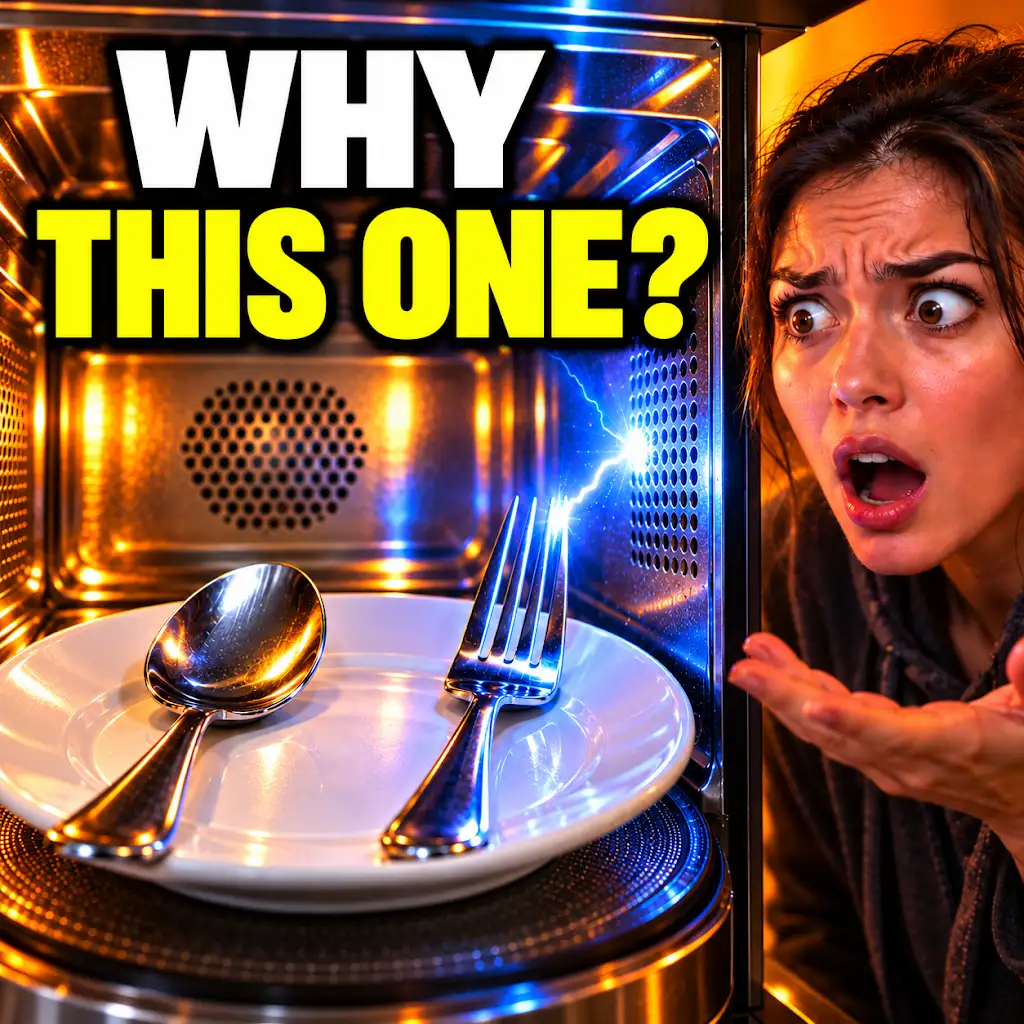
A Fork and a Spoon React Differently in a Microwave. Why?
FAQs
1. Why does metal not always spark in microwaves?
Metal does not always spark in microwaves because the shape and size of the metal object can affect its interaction with the microwave radiation. Small, smooth metal objects may not produce sparks because the electric field inside the microwave oven is not strong enough to cause arcing.
2. What happens when metal sparks in a microwave?
When metal sparks in a microwave, it creates a dangerous situation. The sparks can cause damage to the microwave, create a fire hazard, and potentially cause injury to anyone nearby. It is important to never put metal objects in a microwave.
3. Why do some metal objects spark in microwaves while others do not?
The ability of a metal object to spark in a microwave depends on its shape, size, and the presence of any sharp edges or points. Objects with sharp edges or points are more likely to produce sparks because they can concentrate the electric field and create a high voltage gradient.
4. Can any type of metal be safely used in a microwave?
No, it is not safe to use any type of metal in a microwave. Metal reflects microwaves, which can cause electrical arcing and potentially damage the microwave oven. It is important to only use microwave-safe cookware and utensils.
5. What are some safe alternatives to using metal in a microwave?
Safe alternatives to using metal in a microwave include microwave-safe glass, ceramic, and plastic containers. These materials do not reflect microwaves and are designed to withstand the heat and energy produced by microwave ovens. Always check the manufacturer’s guidelines for specific items to use in the microwave.