You’ve probably experienced it yourself. You’re reheating some leftovers, maybe soup or pasta, and you absentmindedly leave a metal spoon in the bowl. You turn on the microwave, and nothing happens. No sparks, no alarming crackles, just perfectly warm food. This might seem counterintuitive. After all, you’ve likely heard warnings about putting metal in microwaves, and you might have even witnessed the dramatic electrical discharges when it’s done incorrectly. So, why does that humble spoon, an object undeniably made of metal, seem to get a free pass?
To understand why your spoon usually remains a quiet observer in the microwave’s energetic performance, you need to delve into the fundamental principles of how microwaves work and how different shapes and sizes of metal interact with them. It’s not as simple as “metal = sparks.” The reality is far more nuanced, involving a delicate balance of conductivity, shape, and the specific environment within your microwave.
How Microwaves Generate Heat
Your microwave oven is a marvel of engineering that uses electromagnetic radiation to heat your food. Inside the oven’s cavity, a component called a magnetron generates microwaves, which are a form of radio wave with a frequency around 2.45 gigahertz. These waves are directed into the cooking compartment, where they bounce off the metal walls.
The Role of Dielectric Heating
The magic of microwave heating lies in its interaction with certain molecules in your food, primarily water. Water molecules are polar, meaning they have a slight positive charge on one end and a slight negative charge on the other. When microwaves bombard these polar molecules, they cause them to rapidly rotate back and forth, trying to align themselves with the oscillating electromagnetic field. This frantic spinning creates friction between the molecules, which generates heat. This process is known as dielectric heating.
Penetration and Absorption
Microwaves penetrate food to a certain depth, heating it from the inside out to some extent, although the penetration depth is limited. Foods with a high water content, like most fruits, vegetables, and meats, heat most effectively. Fats and sugars also absorb some microwave energy, but to a lesser degree than water.
The Metal Menace: When Things Go Wrong
So, if microwaves heat food by exciting polar molecules, what happens when they encounter metal? Metal is an excellent conductor of electricity. When microwaves strike a smooth, continuous surface of metal, the electrons within the metal are forced to move in response to the electromagnetic field.
Electron Avalanche and Arc Formation
In certain situations, particularly with sharp edges, thin wires, or metallic foils, these moving electrons can become highly concentrated. This concentration of charge can create a strong electric field. If this electric field becomes sufficiently intense, it can overcome the insulating properties of the air surrounding the metal, causing a breakdown of the air. This breakdown results in a sudden, energetic discharge of electricity – a spark or arc. This arc is essentially a miniature lightning strike within your microwave.
The Dangers of Arcing
These sparks are not just a visual spectacle; they can be harmful. They can damage the interior walls of your microwave, scorch the metal, and in extreme cases, potentially damage the magnetron itself. This is why you’re always warned against putting in things like fork tines, crumpled aluminum foil, or metallic trim on dishes.
When exploring the reasons why a spoon does not spark in a microwave, it’s interesting to consider the science behind microwave radiation and metal objects. For a deeper understanding of this phenomenon, you can read a related article that delves into the principles of microwave cooking and the behavior of different materials in such an environment. Check out this informative piece at Freaky Science to learn more about the interactions between microwaves and various substances.
The Spoon’s Sanctuary: Why It Often Escapes the Spark Show
Now, let’s bring it back to your humble spoon. The reason it usually doesn’t spark is a combination of its material properties, its shape, and the way it sits in your food. It’s not that metal is inherently safe; it’s that this specific type of metal in this specific configuration is less likely to trigger the dangerous conditions.
Material Matters: The Conductivity of Your Spoon
Your spoon is typically made of stainless steel, a common alloy that contains iron, chromium, and nickel. While stainless steel is a conductor of electricity, its conductivity isn’t as perfect as, say, pure copper or aluminum. However, this difference in conductivity alone isn’t the primary reason for its safety.
Resistivity and Current Flow
The electrical resistivity of stainless steel is higher than that of pure metals. This means it offers more resistance to the flow of electric current. When microwaves hit the spoon, they do induce electron movement. However, the higher resistivity means that the current doesn’t build up to the extreme densities required to create the intense electric fields that lead to arcing, especially in a larger, continuous mass like a spoon.
Shape is Key: The Smooth Curves of a Spoon
This is arguably the most significant factor. The shape of your spoon is designed for scooping and eating, not for conducting electricity in a way that creates hazards.
No Sharp Edges, No Points
Microwaves tend to concentrate their energy at sharp points and edges of metallic objects. Think of a fork tine – it’s a thin, pointed protrusion. When microwaves hit this, the electrons get pushed into a very small area, creating a significant charge density. A spoon, on the other hand, has smooth, rounded edges. The metal is distributed more evenly, and there are no sharp points for the electrical charge to accumulate.
Larger Surface Area and Uniformity
A spoon, being a relatively solid and continuous piece of metal with a substantial surface area, allows the induced currents to dissipate more broadly. The charge doesn’t get confined to a small, problematic area. The smooth curvature ensures that the electromagnetic field interacts with the metal in a way that prevents the extreme charge buildup necessary for arcing.
The Food’s Embrace: A Dampening Effect
The food you leave the spoon in also plays a crucial role. Your food, especially if it’s moist, is a good absorber of microwave energy.
Energy Absorption by Food
As the microwaves enter the food, they are absorbed and converted into heat, as we discussed earlier. This absorption process effectively “uses up” a significant portion of the microwave energy that would otherwise interact with the spoon.
Grounding and Dissipation
The food acts as a somewhat dampening medium. The moisture and other conductive components in the food can help to absorb some of the induced currents in the spoon, preventing them from building up to dangerous levels. In a sense, the food acts as a rudimentary grounding system for the electrical charges that might be induced on the spoon. This allows the charges to dissipate more gradually and safely.
When Your Spoon Might Decide to Spark
While it’s rare, there are circumstances where even a spoon could, in theory, contribute to an arcing event. These situations usually involve extreme conditions or intentional manipulation.
The Edge Case: A Damaged or Bent Spoon
If your spoon has been significantly bent, creating a sharp crease or a pointed edge, it could potentially become a point of charge concentration. Similarly, if the spoon has been damaged in a way that creates a very thin, exposed edge, it could behave more like a foil or wire.
Micro-Cracks and Sharp Folds
These imperfections can act as points where electric fields can become amplified. Even minor damage that creates a sharp fold in the metal can alter how microwaves interact with it, increasing the risk of arcing.
The Peril of “Floating” Metal Objects
If a spoon is positioned in such a way that it’s not fully immersed in food and has a significant portion exposed to the open air within the microwave cavity, it might be more prone to arcing.
Lack of Dampening
When a metal object is suspended or precariously balanced without adequate contact with microwave-absorbing material, the induced charges have more freedom to build up. The food’s dampening effect is minimized, making the metal more susceptible to the conditions that cause sparks.
The Impact of Microwave Power and Size
The power of your microwave and the size and configuration of the metallic object can also play a role.
High Power Settings
On very high power settings, the microwave energy is more intense, and the potential for generating strong electric fields is greater. While a spoon is generally safe, an exceptionally high-power microwave combined with an imperfectly shaped or positioned spoon might increase the risk.
Multiple Metal Objects
If you have multiple metal objects in the microwave, especially if they are close to each other, this can create a more complex electromagnetic environment. The interaction between these objects could, in rare cases, lead to unexpected arcing.
The Science Behind Other “Safe” Metals
It’s not just spoons that get a pass. You might notice that forks, if they’re not the thin, flimsy kind, and even some cutlery sets with rounded edges, often don’t spark. The principles remain the same: smooth, continuous surfaces and sufficient mass to dissipate induced charges.
The Case of the Fork
A standard dinner fork, with its rounded tines and a substantial handle, is generally safer than, say, a whisk or a piece of aluminum foil. The tines, while pointed, are usually thicker and more rounded than the sharp, thin edges that cause problems. The overall mass of the fork helps to distribute the induced currents. However, a very thin or sharp fork is always a risk.
Other Utensils and Cookware
Ceramic dishes with metallic trim are another common culprit for sparking. The metallic paint or glaze on the edges is thin and can act like a conductive wire, leading to arcs. Conversely, solid metal cookware designed for stovetops, like cast iron skillets, are generally not microwave-safe due to their conductivity and potential for uneven heating and arcing. However, some specialized microwave-safe cookware might incorporate metal elements in very specific, engineered ways to manage microwave interaction.
When considering why a spoon does not spark in a microwave, it’s interesting to explore the science behind microwave cooking and metal interactions. A related article on this topic can be found at Freaky Science, which delves into the principles of electromagnetic waves and how they interact with different materials. Understanding these concepts can help clarify why certain metals may cause sparks while others, like spoons, do not create the same reaction in a microwave environment.
Why the Warnings Are Still Crucial
| Reason | Explanation |
|---|---|
| Metal Composition | The spoon is made of non-ferrous metal, such as stainless steel, which does not spark in the microwave. |
| Shape and Size | The shape and size of the spoon do not create a concentrated electric field, reducing the likelihood of sparking. |
| Microscopic Surface | The surface of the spoon is not sharp or jagged, reducing the potential for electrical discharge. |
Despite the common safety of a spoon, the warnings about putting metal in microwaves are not arbitrary. They are there for a reason, to prevent potentially damaging and hazardous situations.
The Spectrum of Risk
The risk associated with metal in a microwave isn’t black and white. It exists on a spectrum. A spoon is at one end of the spectrum, with a very low risk. A crumpled piece of aluminum foil is at the other, with a very high risk. The warnings are designed to steer you away from the higher-risk items.
Understanding the Nuances
It’s important to understand that the rules are not absolute. The shape, size, thickness, and even the presence of other materials can influence the outcome. Relying solely on the assumption that “a spoon is safe” without understanding the underlying principles can lead to complacency.
Protecting Your Appliance and Yourself
The primary reason for these warnings is to protect both your microwave oven and your safety. Arcing can damage the appliance, leading to costly repairs or replacement. More importantly, a significant electrical discharge within a confined space can be startling and, in rare extreme cases, could pose a fire hazard.
Prevention is Better Than Cure
By adhering to the general guidelines of avoiding metal in your microwave, you are taking a simple yet effective step to ensure the longevity of your appliance and your safety. It’s always better to err on the side of caution when dealing with high-power electromagnetic radiation and conductive materials.
Conclusion: A Spoon’s Humble Triumph
So, the next time you find yourself about to microwave a bowl of soup with a spoon still in it, you can appreciate the subtle physics at play. Your spoon, with its smooth, rounded form, its conductive but not overly reactive material, and the buffering embrace of your food, usually manages to navigate the energetic landscape of your microwave without causing a dramatic show. It’s a testament to how even everyday objects can behave in complex and interesting ways when interacting with technology. While the spoon’s safety is a comforting reality, remember that the warnings about metal in microwaves are there for good reason, ensuring that you can continue to enjoy your warm meals without any unexpected, electrifying surprises. The spoon’s humble triumph is a reminder that sometimes, the most ordinary objects can teach us the most extraordinary lessons about science.
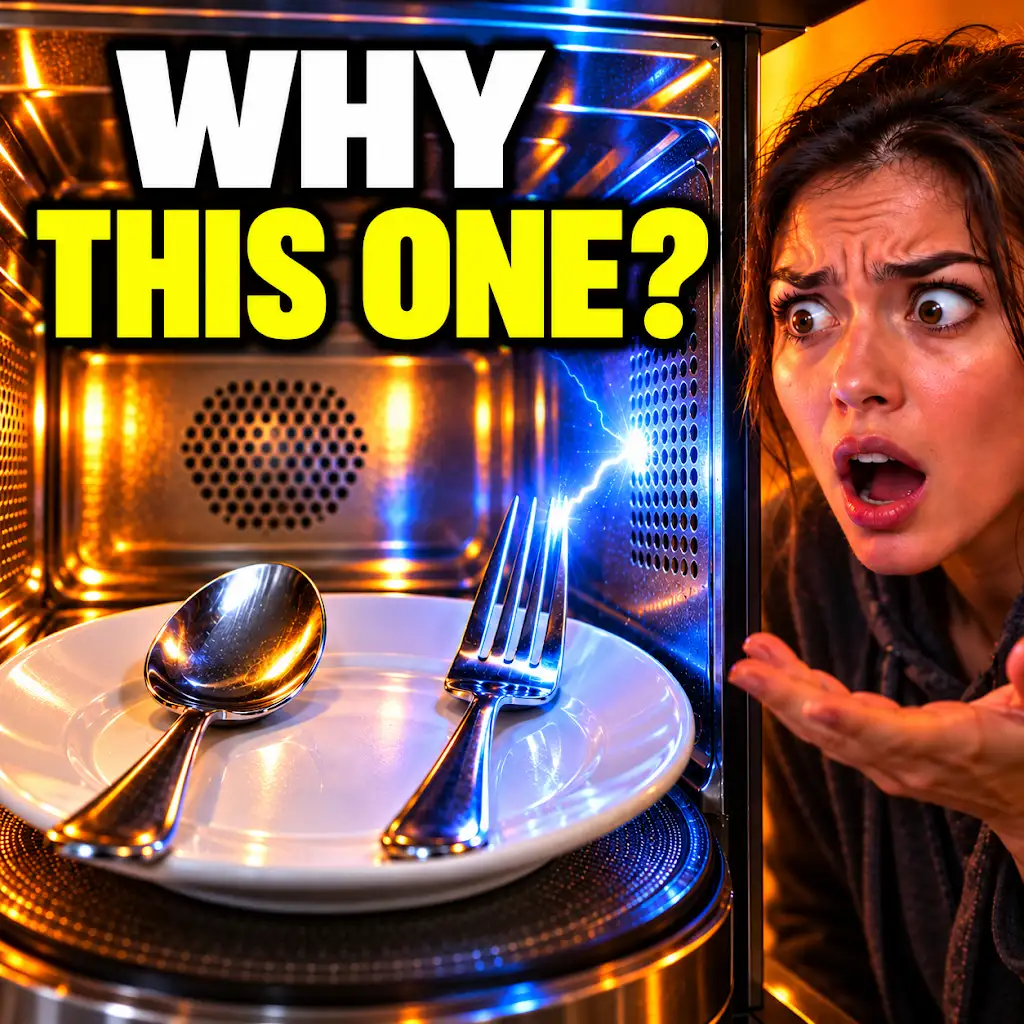
A Fork and a Spoon React Differently in a Microwave. Why?
FAQs
What happens when you put a spoon in a microwave?
When you put a metal spoon in a microwave, it can cause sparks and potentially damage the microwave. This is because metal reflects microwaves, causing the electrical charge to build up and discharge as sparks.
Why does a spoon not spark in a microwave?
A spoon does not spark in a microwave because it is not a perfect conductor of electricity. The shape and size of the spoon also play a role in preventing sparking, as they can affect the way the electrical charge builds up and discharges.
What materials can cause sparking in a microwave?
Materials that contain metal, such as aluminum foil, metal utensils, and metal-trimmed dishes, can cause sparking in a microwave. Additionally, materials with a high metal content or a metallic finish can also cause sparking.
Is it safe to put any metal object in a microwave?
It is not safe to put any metal object in a microwave, as it can cause sparking and potentially damage the microwave. It is important to only use microwave-safe materials and utensils when heating or cooking food in a microwave.
How can you safely heat food with metal in a microwave?
To safely heat food with metal in a microwave, use microwave-safe containers and utensils that are specifically designed for use in microwaves. Avoid using metal containers, foil, or utensils, and follow the manufacturer’s instructions for safe microwave use.