The velvety cloak of the night sky, studded with celestial jewels, has captivated humanity for millennia. From ancient stargazers charting constellations to modern scientists probing the furthest reaches of the cosmos, the allure of the universe remains potent. Among the most breathtaking ways to capture this grandeur is through astrophotography. While standard color images offer a beautiful glimpse, narrowband astrophotography unlocks a deeper, more nuanced understanding of celestial objects, revealing hidden structures and spectral signatures that are invisible to the naked eye and conventional cameras. This technique, by isolating specific wavelengths of light emitted by nebulae and galaxies, allows astrophotographers to paint the cosmos with a palette of scientific significance.
Narrowband astrophotography, at its core, is about selective observation. Instead of capturing the full spectrum of visible light, this technique employs specialized filters that transmit only a very narrow band of wavelengths. These bands typically correspond to the specific emission lines of ionized gases found in nebulae, most notably oxygen [OIII], hydrogen alpha [Ha], and sulfur [S II]. By isolating these individual wavelengths, astrophotographers can capture distinct layers of emission from a celestial object, each representing a different atomic process or chemical composition. This meticulous isolation is crucial because these emission lines, while present in the overall light of a nebula, can be incredibly faint and overwhelmed by the broader spectrum of light pollution and the general glow of the night sky.
Understanding Emission Lines
The universe, particularly nebulae, is a vast chemical laboratory. When atoms of certain elements are energized, for instance by the ultraviolet radiation from hot, young stars, their electrons jump to higher energy levels. As these electrons return to their ground state, they release energy in the form of photons. Critically, this energy release occurs at very specific wavelengths, unique to each element and ionization state. These specific wavelengths are known as emission lines. For example, doubly ionized oxygen emits light predominantly at 500.7 nanometers (nm) and 495.9 nm, collectively referred to as the OIII line. Hydrogen alpha, the most prominent emission line from hydrogen, is at 656.3 nm. Sulfur II emissions are found around 672.4 nm. These lines are the fingerprints of the gases that make up nebulae.
The Role of Narrowband Filters
To capture these faint emission lines, astrophotographers utilize narrowband filters. These filters are designed with extremely precise bandwidths, often as narrow as 3nm or 5nm. This means they only allow light within a very specific, small range of wavelengths to pass through. Imagine trying to listen to a specific instrument in a symphony; a narrowband filter is like having a highly selective ear that can tune out all other sounds and focus solely on that one instrument. In astrophotography, this translates to filtering out ambient light pollution, starlight from stars not emitting in the target wavelength, and light from other nebulae, effectively isolating the light from the specific element or ion of interest.
Why Narrowband? The Advantages Over Broadband
The advantages of narrowband imaging over traditional broadband (color) imaging are profound, especially when dealing with emission nebulae. Broadband filters, like those found in standard digital cameras, capture a wide range of wavelengths simultaneously. While this provides a natural-looking color representation, it can also lead to several challenges for astrophotography:
Overcoming Light Pollution
Modern astronomy is increasingly challenged by light pollution from artificial sources. This pervasive glow can overwhelm the faint signals from deep-sky objects. Narrowband filters are exceptionally good at rejecting broad spectrum light pollution, allowing the specific emission lines to stand out prominently. This significantly improves the signal-to-noise ratio, leading to cleaner and more detailed images.
Revealing Hidden Details
Many emission nebulae are complex structures composed of various gases and ionization states. Broadband images often blend these different components, obscuring subtle details and intricate filaments. By capturing each emission line separately, narrowband imaging allows for the visualization of these distinct structures. For example, an Ha image might highlight the areas of active star formation, while an OIII image could reveal cooler, more diffuse gas.
Enhanced Contrast and Signal-to-Noise Ratio
Because narrowband filters block out a vast amount of unwanted light, the light that passes through is primarily from the target object’s emission lines. This significantly increases the contrast between the nebula and the background sky. Furthermore, by acquiring longer individual exposures for each narrowband filter (as they gather more specific signal relative to noise), the overall signal-to-noise ratio of the final image is dramatically improved, leading to much cleaner and more detailed results.
Scientific Data Acquisition
Beyond aesthetics, narrowband imaging provides valuable scientific data. The relative intensity of different emission lines can be used to determine the temperature, density, and chemical composition of nebulae. This information is crucial for understanding the physical processes occurring within these cosmic nurseries and the evolution of stars and galaxies.
For those interested in delving deeper into the fascinating world of narrowband astrophotography, I recommend checking out this informative article that provides a comprehensive overview of the techniques and equipment used in this specialized field. You can read more about it here: Narrowband Astrophotography Explained. This resource will enhance your understanding and help you capture stunning images of celestial objects.
The Technical Toolkit for Narrowband Astrophotography
Embarking on a narrowband astrophotography journey requires specific equipment tailored to its unique demands. While the fundamental principles of astrophotography – a telescope, a mount, and a camera – remain the same, the pursuit of narrowband imaging necessitates an upgraded arsenal. The key lies in the specialized filters and the camera’s capability to capture monochrome data effectively.
The Essential Telescope and Mount
The foundation of any astrophotography setup, the telescope, needs to be capable of gathering enough light from faint celestial objects. Larger aperture telescopes generally collect more light, leading to brighter images and the ability to resolve finer details. However, the focal length of the telescope also plays a role in framing the target object. A longer focal length will magnify the object, making it appear larger in the image, which can be desirable for detailed studies of smaller nebulae. Equally important is a stable, equatorial mount. This mount is designed to track the apparent motion of stars across the night sky due to Earth’s rotation. Precise tracking is absolutely critical for long exposures, ensuring that stars remain as sharp points and preventing trailing, which would degrade the image quality.
The Monochrome Camera: A Cornerstone of Narrowband
Unlike color cameras that have a Bayer matrix overlaid on their sensor (a pattern of red, green, and blue filters), monochrome cameras have a sensor that is sensitive to all wavelengths of light without any built-in color filtering. This is a significant advantage for narrowband imaging for several reasons:
Maximizing Light Gathering
Each pixel on a monochrome sensor is dedicated to capturing light. In a color camera, a Bayer matrix means that each pixel only records one color (red, green, or blue), and the final color image is constructed through interpolation. With a monochrome camera, every pixel contributes to the final brightness of the image, leading to significantly higher light-gathering efficiency and thus, better signal acquisition, especially for faint emission lines.
Superior Quantum Efficiency
Monochrome cameras generally boast higher quantum efficiency (QE) than color cameras. QE refers to the percentage of photons that hit the sensor and are converted into an electrical signal. Higher QE means more of the faint light from the nebula is actually recorded, which is paramount when dealing with the subtle emissions captured by narrowband filters.
Flexibility in Data Processing
Capturing individual Ha, OIII, and SII data streams from a monochrome camera offers unparalleled flexibility in post-processing. Astrophotographers can choose how to combine these channels to create their final image, experimenting with different color palettes and emphasizing specific features of the nebula. This level of control is not possible with raw data from a color camera in a narrowband context.
The Crucial Narrowband Filter Set
The heart of narrowband imaging lies in the specialized filters. These are not simple colored pieces of glass; they are sophisticated optical components designed to transmit only a very narrow band of light. The most common set for narrowband imaging includes filters for:
Hydrogen Alpha (Ha) Filter
This filter transmits light at approximately 656.3 nm, corresponding to the most prominent emission line of hydrogen. Ha is a fundamental building block of nebulae and is often associated with regions of active star formation. Capturing Ha data reveals the intricate filamentary structures and the red glow characteristic of many emission nebulae.
Oxygen III (OIII) Filter
This filter isolates light emitted by doubly ionized oxygen, typically around 500.7 nm. OIII emissions often appear bluish-green in scientific visualizations and are indicative of hotter, more energetic regions within nebulae, often delineating the edges of planetary nebulae or highlighting shells of expelled gas.
Sulfur II (SII) Filter
The SII filter targets the emission line of singly ionized sulfur, usually around 672.4 nm. SII emissions are often seen in regions where there is a significant interaction between ionized gas and shock fronts. This filter adds another layer of information, often revealing structures that are not prominent in Ha or OIII.
Other Essential Equipment
Beyond the core components, a few other pieces of equipment enhance the narrowband astrophotography experience:
Filter Wheel
A filter wheel automagically cycles through the different narrowband filters, allowing for seamless acquisition of sequential exposures for each color channel without manual intervention. This is crucial for long imaging sessions.
Off-Axis Guider (OAG) or Guide Scope
Precise tracking is paramount. An OAG or a dedicated guide scope with a guide camera is used to monitor the telescope’s tracking accuracy and make minute corrections in real-time, ensuring pin-sharp stars throughout the entire imaging session.
The Art and Science of Data Acquisition
Narrowband imaging is not merely about pointing and shooting; it involves a meticulous and systematic approach to data acquisition. The process is driven by the need to gather sufficient high-quality data for each emission line, which then forms the building blocks of the final image. This requires careful planning, patience, and an understanding of how to maximize the signal from these faint celestial sources.
Planning Your Imaging Session
Before venturing out under the stars, thorough planning is essential. This involves:
Object Selection
Choosing the right celestial object is the first step. Emission nebulae are the primary targets for narrowband imaging, as they are rich in the specific emission lines that these filters are designed to capture. Popular targets include the Orion Nebula, the North America Nebula, and the Veil Nebula, which display a wealth of intricate structures.
Understanding the Object’s Composition
Researching the object’s spectral characteristics can inform the imaging strategy. Knowing which emission lines are most prominent in a particular nebula can help prioritize acquisition time and determine the optimal filter order.
Weather and Sky Conditions
Optimal imaging conditions are crucial. Clear, dark skies with minimal atmospheric turbulence (seeing) are paramount for capturing sharp details. Light pollution is a significant enemy of narrowband imaging, so selecting locations away from urban centers is highly recommended.
Acquiring Each Channel: The Foundation of Detail
The core of narrowband data acquisition involves capturing multiple, long exposures for each of the selected filters. The process typically involves acquiring data in a sequential manner:
Hydrogen Alpha (Ha) Exposures
The Ha filter is often the first to be deployed. Because Ha is usually the most abundant emission line in many nebulae and is associated with active star formation, it provides a fundamental “red” layer to the image. Long exposures are taken, typically ranging from 10 to 30 minutes per sub-exposure, depending on the camera, telescope, and the object’s brightness. Multiple sub-exposures are stacked to reduce noise.
Oxygen III (OIII) Exposures
Next, the OIII filter is used. This will capture the bluish-green spectral component of the nebula. Similar long exposures are acquired, ensuring that the total OIII data is comparable in duration to the Ha data for balanced results.
Sulfur II (SII) Exposures
Finally, the SII filter is employed. This will capture the sulfur emissions, which often provide additional textural detail and can be mapped to specific colors in post-processing. Again, long exposures are taken to build up a robust dataset.
Optimizing Exposure Times and Gain Settings
Determining the correct exposure times and gain settings is a balancing act. Longer exposures generally yield more signal but also increase the risk of tracking errors or cosmic ray artifacts. The gain setting on the camera controls the amplification of the signal. It needs to be set to a point where the signal is adequately amplified without introducing excessive read noise. Astrophotographers often use test exposures to find the optimal settings for their equipment and target.
Calibration Frames: Essential for Image Quality
To produce clean, artifact-free images, calibration frames are indispensable. These are special types of exposures taken under controlled conditions:
Bias Frames
Bias frames are very short exposures taken with the camera sensor at operating temperature but with the lens cap on and the exposure time set to the minimum possible. They capture the electronic noise inherent in the camera’s readout process.
Dark Frames
Dark frames are exposures taken with the lens cap on and the exposure time identical to the actual light frames. They record thermal noise generated by the camera sensor over time, which increases with longer exposures and higher temperatures.
Flat Frames
Flat frames are taken by imaging a uniformly illuminated surface, such as a white t-shirt stretched over the telescope’s aperture or a specialized light panel. They record vignetting (uneven illumination across the sensor) and dust motes on the optical path, allowing these imperfections to be corrected in the final image.
The Alchemy of Post-Processing: Painting with Light
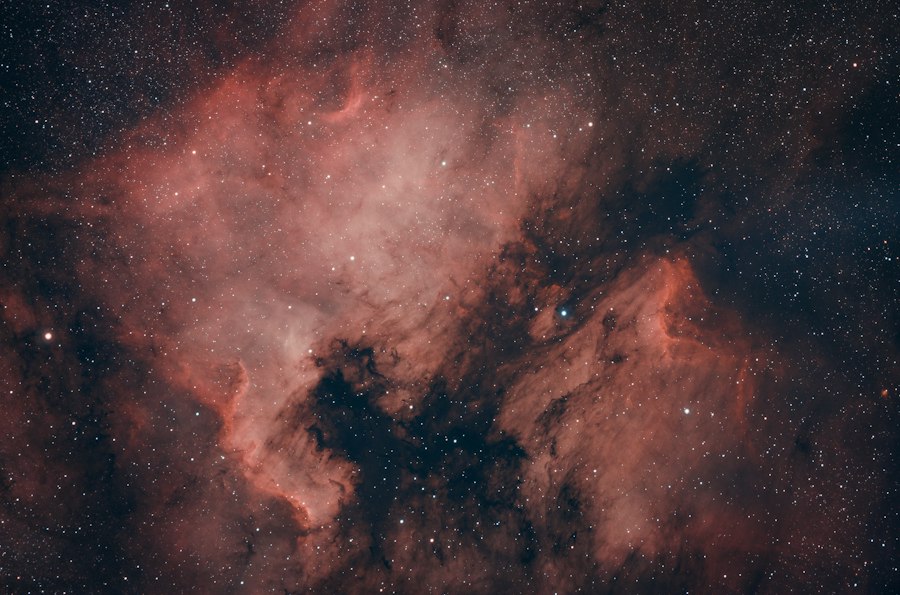
Once the raw data has been meticulously acquired, the true artistry of narrowband astrophotography unfolds in the post-processing stage. This is where the separate monochromatic datasets, each representing a specific emission line, are combined and colorized to create a visually stunning and scientifically meaningful image. It is a process that blends technical skill with creative vision, transforming abstract data into a breathtaking portrayal of the cosmos.
Stacking and Aligning the Data
The first step in post-processing is to “stack” the individual sub-exposures for each filter. This involves aligning all the sub-exposures based on star positions and then averaging them together. Stacking significantly reduces random noise while preserving the faint signal from the nebula. Sophisticated astronomical processing software is used for this task, ensuring that subtle details are not lost and that the final stacked image is as clean as possible.
Color Mapping: The Hubble Palette and Beyond
The magic of narrowband lies in its ability to assign colors to different emission lines, creating vibrant and informative images. The most common color mapping scheme is the “Hubble Palette,” which assigns specific colors to the Ha, OIII, and SII data.
The Canonical Hubble Palette (SHO)
In the traditional SHO (Sulfur, Hydrogen, Oxygen) mapping, the SII data is assigned a red channel, the Ha data to the green channel, and the OIII data to the blue channel. This results in a striking image where SII emissions appear reddish-brown, Ha appears green, and OIII appears bluish. This mapping is often preferred as it emphasizes the interplay between different ionized gases.
Variations and Custom Palettes
While the SHO palette is popular, astrophotographers are not limited to it. They can experiment with different color assignments. For example, some may choose to map Ha to red, OIII to green, and SII to blue. Others might assign a specific color to a single channel and then combine it with broadband data for a hybrid image. The choice of color mapping can dramatically alter the visual appearance of the nebula and emphasize different features. For instance, mapping Ha to red, OIII to blue, and SII to green will produce a very different aesthetic.
Enhancing Detail and Contrast
After color mapping, the image often requires further processing to bring out its full potential. This involves a series of adjustments aimed at enhancing detail and contrast:
Stretching the Histogram
Raw astronomical images have a very compressed dynamic range, meaning the brightest and darkest parts of the image are very close together. Histogram stretching is a technique used to expand this range, revealing faint details in the nebula that would otherwise be hidden in the shadows or blown out in the highlights.
Sharpening and Noise Reduction
Careful application of sharpening algorithms can enhance the definition of nebular structures. However, this must be balanced with noise reduction techniques to avoid introducing artificial artifacts or smoothing out fine details.
Level Adjustments and Curves
Fine-tuning the brightness and contrast of specific color channels and the overall image can further refine the visual impact. Adjustments to levels and curves allow for precise control over the tonal range of the image.
Adding Artistic Touches and Interpretation
The final stages of post-processing can involve adding artistic touches that reflect the astrophotographer’s interpretation of the celestial object. This might include:
Local Contrast Enhancement
Targeted adjustments to contrast in specific areas of the nebula can help define delicate structures and add depth to the image.
Vignette Correction and Artifact Removal
Ensuring that any remaining vignetting or minor artifacts are addressed leads to a polished final product.
Artistic Color Blending
Beyond the standard palettes, creative blending of colors can lead to unique and captivating aesthetic outcomes, while still aiming to maintain scientific accuracy in representing the emission lines.
Narrowband astrophotography is a fascinating technique that allows enthusiasts to capture stunning images of celestial objects by isolating specific wavelengths of light. For those looking to deepen their understanding of this method, a related article can be found on Freaky Science, which delves into the intricacies of narrowband imaging and its applications in revealing details that are often missed in traditional photography. You can explore this informative piece by following this link, where you’ll find valuable insights and tips to enhance your astrophotography skills.
Beyond the Visual: Scientific Insights from Narrowband
| Aspect | Explanation |
|---|---|
| Definition | Narrowband astrophotography involves capturing images of celestial objects using specific narrowband filters that isolate particular wavelengths of light, such as hydrogen-alpha, oxygen III, and sulfur II. |
| Benefits | Enhances contrast and detail of nebulae and other emission nebulae, reduces effects of light pollution, and allows for imaging in moonlit conditions. |
| Equipment | Requires specialized narrowband filters, a telescope or camera lens, a mount, and a camera capable of long exposures. |
| Processing | Post-processing techniques such as stacking and combining multiple exposures are often used to enhance the final narrowband astrophotography image. |
| Challenges | Requires longer exposure times, precise tracking of celestial objects, and careful calibration of equipment to achieve optimal results. |
Narrowband astrophotography is far more than just creating aesthetically pleasing images of the cosmos; it is a powerful tool for scientific discovery and understanding. By isolating specific wavelengths of light, astronomers can glean valuable information about the physical conditions, chemical composition, and evolutionary processes occurring within celestial objects. The data gathered through narrowband imaging serves as a critical foundation for numerous astrophysical studies.
Analyzing Elemental Abundances
The relative intensity of emission lines from different elements within a nebula provides a direct measure of their abundance. By comparing the strength of Ha emissions to OIII and SII emissions, astronomers can determine the proportions of hydrogen, oxygen, and sulfur in a given region. This is crucial for understanding the chemical evolution of galaxies and the processes that lead to the formation of new stars and planetary systems.
Determining Electron Temperatures and Densities
The intensity ratios of specific emission lines are sensitive to the temperature and density of the ionized gas. For example, the ratio of emission lines from different ionization states of the same element can be used to infer the electron temperature of the plasma. Similarly, the strength of certain lines can indicate the density of the gas. This information is vital for building models of nebular structure and dynamics.
Understanding Shock Waves and Stellar Winds
Narrowband imaging is particularly adept at revealing the intricate structures sculpted by powerful stellar winds and shock waves. These phenomena, often invisible in broadband images, can create complex filaments, shells, and outflows that are clearly delineated in narrowband exposures. By studying the morphology and spectral characteristics of these structures, astronomers can learn about the energy output of massive stars and the dynamic processes that shape interstellar environments.
Tracing Star Formation Regions
The Hydrogen alpha emission line is a strong indicator of ionized hydrogen, which is typically found in regions where new stars are being born. Young, hot stars emit copious amounts of ultraviolet radiation that ionizes the surrounding hydrogen gas, causing it to glow brightly at the Ha wavelength. Narrowband Ha images are therefore invaluable for identifying and studying active star-forming regions within nebulae and galaxies.
Mapping the Interstellar Medium
Narrowband imaging allows astronomers to map the distribution and properties of the interstellar medium (ISM) with unprecedented detail. The ISM is the diffuse material between stars, composed of gas and dust, which is the raw material for star formation. By observing the emission from various ionized gases, scientists can understand the complex structure and dynamics of the ISM and its role in galactic evolution.
The Evolving Landscape of Narrowband Imaging
As technology advances, narrowband astrophotography continues to evolve, pushing the boundaries of what is possible in capturing and interpreting the universe. Innovations in equipment, software, and processing techniques are constantly refining the art and science of revealing celestial wonders.
The Rise of Dedicated Astronomy Cameras
The market for dedicated astronomical cameras has exploded, offering a wide range of sensors with varying sizes, resolutions, and cooling capabilities. These cameras are specifically designed for low-light imaging and often feature advanced cooling systems to minimize thermal noise, enabling longer exposures and better signal-to-noise ratios.
Advances in Filter Technology
Filter manufacturers are continually developing new and improved narrowband filters. This includes filters with even narrower bandwidths for enhanced signal isolation, as well as filters for less common emission lines, expanding the spectral information that can be captured. The development of multi-band filters, which capture multiple emission lines simultaneously, is also an exciting area of progress.
The Impact of AI and Machine Learning
Artificial intelligence and machine learning are beginning to play a significant role in astrophotography. AI-powered software can assist with tasks such as stacking images, removing artifacts, and even identifying and classifying celestial objects. Machine learning algorithms are also being explored for their potential to enhance detail, reduce noise, and even reconstruct missing data in astronomical images.
Citizen Science and Collaborative Astronomy
Narrowband astrophotography has become an accessible pursuit for amateur astronomers worldwide. Many contribute their data to citizen science projects, where their images are analyzed by researchers to advance scientific understanding. Collaborative astronomy, where multiple individuals pool their resources and data, is also becoming increasingly common, allowing for the capture of more extensive datasets and the study of more challenging objects. The democratization of powerful imaging tools has opened up the universe to a new generation of explorers.
In conclusion, narrowband astrophotography offers a profound way to engage with the cosmos. It transcends the simple aesthetic appeal of celestial objects, providing a window into their fundamental composition and physical processes. By meticulously isolating specific wavelengths of light, astrophotographers, both professional and amateur, are not only creating breathtaking imagery but also contributing to our ever-growing understanding of the universe. The journey from a dark night sky to a vibrant, scientifically informative image is a testament to human ingenuity, patience, and an unyielding curiosity about our place in the grand tapestry of existence.

The Space Photos Are Real—But Your Eyes Would See This
FAQs
What is narrowband astrophotography?
Narrowband astrophotography is a technique used by astrophotographers to capture images of deep-sky objects using specific narrowband filters that isolate particular wavelengths of light emitted by celestial objects.
How does narrowband astrophotography differ from traditional astrophotography?
Traditional astrophotography captures a broad range of wavelengths of light, while narrowband astrophotography uses specialized filters to isolate specific wavelengths, such as those emitted by hydrogen, oxygen, and sulfur.
What are the benefits of narrowband astrophotography?
Narrowband astrophotography allows for the capture of detailed images of nebulae and other deep-sky objects, even in areas with significant light pollution. It also enhances the contrast and visibility of certain features within the images.
What equipment is needed for narrowband astrophotography?
To engage in narrowband astrophotography, photographers need a telescope, a camera capable of long exposures, narrowband filters, and a tracking mount to compensate for the Earth’s rotation.
What are some popular targets for narrowband astrophotography?
Common targets for narrowband astrophotography include the Orion Nebula, the Veil Nebula, the Rosette Nebula, and the North America Nebula, among others. These objects emit strong emissions in the specific wavelengths captured by narrowband filters.