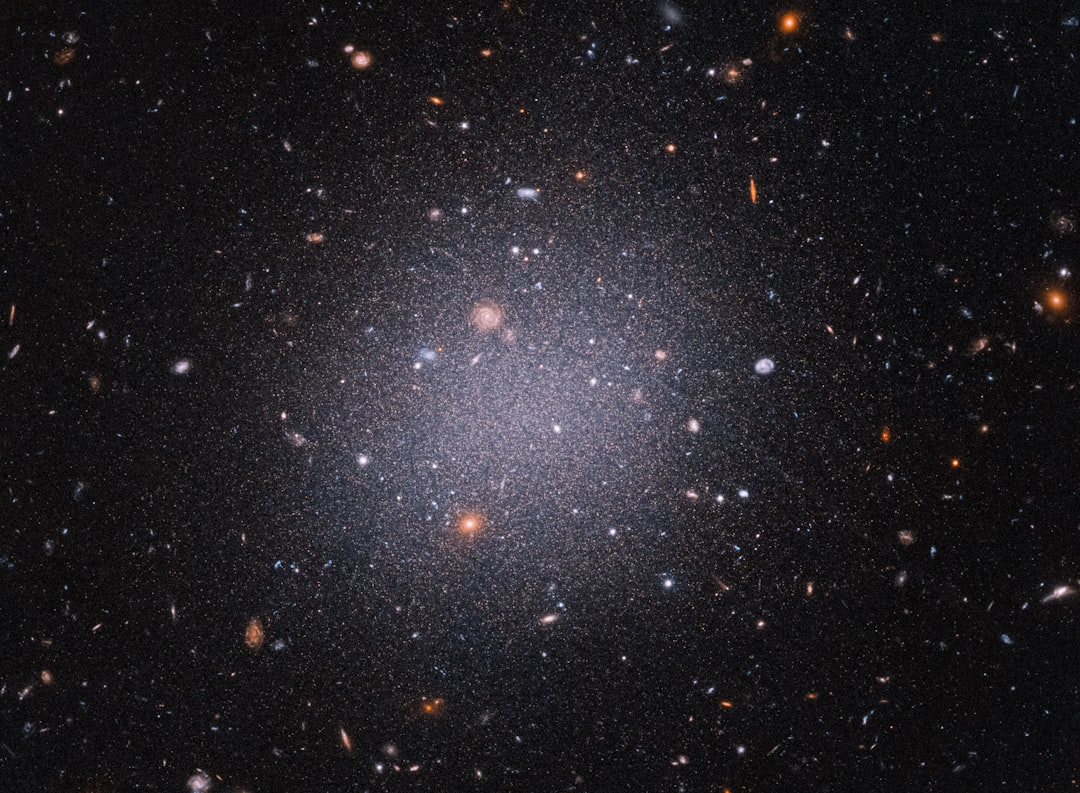
The vast expanse of the cosmos is a tapestry woven with luminous threads of stars and galaxies, but these visible components represent only a fraction of the universe’s total mass. For decades, astronomers have grappled with an enigma, a pervasive presence whose gravitational influence is undeniable, yet whose nature remains stubbornly elusive. This invisible constituent, dubbed “dark matter,” first hinted at its existence through meticulous observations of the Coma Cluster, a colossal assembly of galaxies some 321 million light-years away. The story of dark matter’s inception is inextricably linked to the work of Fritz Zwicky, a Swiss astronomer whose keen intellect and unconventional approach led him to propose a radical solution to a cosmic puzzle.
The Coma Cluster: A Gravitational Enigma
The Coma Cluster, also cataloged as Abell 1656, is one of the most massive and luminous galaxy clusters known in the universe. Its sheer scale and the intricate dynamics of its constituent galaxies have made it a prime target for astronomical study since its initial cataloging in the early 20th century. Located in the constellation Coma Berenices, it is a veritable metropolis of galaxies, a celestial city housing thousands of individual galactic islands, each containing billions of stars. The cluster is not merely a static collection; rather, its galaxies are in constant, tumultuous motion, orbiting a common center of gravity.
Early Observations and the Challenge of Kinematics
The initial descriptions of the Coma Cluster highlighted its extraordinary richness and the apparent speed at which its member galaxies were moving. As telescopes and observational techniques advanced, astronomers gained the ability to measure the velocities of these galaxies. This was a crucial step, as the speed of objects within a gravitational system provides a direct indication of the mass that binds them. The faster the objects move, the stronger the gravitational pull required to keep them from scattering into the void.
The Virial Theorem: A Theoretical Framework
To interpret these velocity measurements, scientists turned to the Virial Theorem, a fundamental principle in physics that relates the kinetic and potential energies of a stable system. For a system in equilibrium, the Virial Theorem states that twice the average kinetic energy of the particles is equal to the average potential energy. In the context of a galaxy cluster, the kinetic energy is related to the motion of the galaxies, and the potential energy is determined by the gravitational forces exerted by the total mass of the cluster. By applying the Virial Theorem, astronomers could, in principle, estimate the total mass of the Coma Cluster based on the observed velocities of its galaxies.
The Coma Cluster, a prominent galaxy cluster located in the constellation Coma Berenices, has been pivotal in advancing our understanding of dark matter, particularly through the groundbreaking work of Fritz Zwicky in the 1930s. Zwicky’s observations of the cluster’s dynamics led him to propose the existence of unseen mass, which he termed “dark matter,” to explain the gravitational effects observed. For a deeper exploration of this fascinating topic and its implications for modern astrophysics, you can read a related article at Freaky Science.
Fritz Zwicky’s Bold Hypothesis
It was within this context of observed galactic velocities and theoretical frameworks that Fritz Zwicky, then working at the California Institute of Technology, embarked on his seminal investigations of the Coma Cluster in the 1930s. Zwicky was known for his sharp mind, his independent spirit, and his willingness to challenge established scientific dogma. His work on the Coma Cluster would become a testament to these qualities, leading to one of the most profound and enduring mysteries in modern cosmology.
Measuring Galactic Velocities: A Laborious Task
Zwicky’s research involved painstakingly measuring the velocities of a significant number of galaxies within the Coma Cluster. This was not a simple undertaking in the era before digital detectors and sophisticated spectrographs. It required the laborious analysis of photographic plates, measuring the redshift of light from each galaxy – a phenomenon where light from objects moving away from us is stretched towards longer, redder wavelengths. The greater the redshift, the faster the galaxy was receding.
The Unexpected Revelation: Anomalously High Speeds
As Zwicky compiled his data and applied the Virial Theorem, a striking discrepancy emerged. The calculated velocities of the galaxies in the Coma Cluster were far higher than what would be expected if the visible matter – the stars and gas within the galaxies themselves – constituted the entirety of the cluster’s mass. The galaxies were moving too fast, and the visible mass was insufficient to gravitationally bind them. They should have been flying apart, dissipating into the cosmos.
The “Missing Mass” Problem: An Unseen Gravitational Anchor
The discrepancy between the inferred gravitational mass and the observed luminous mass led Zwicky to postulate the existence of an unseen form of matter. He reasoned that if the galaxies were indeed bound together and moving at such high speeds, there must be a significant amount of additional mass present, exerting a gravitational pull that was not accounted for by the stars and gas that could be directly observed. This concept, initially termed the “missing mass,” was a revolutionary idea that challenged the prevailing understanding of the universe.
Applying the Virial Theorem to the Coma Cluster
Zwicky’s application of the Virial Theorem to the Coma Cluster was a critical step in formulating his hypothesis. He calculated the kinetic energy of the galaxies based on their measured velocities and then used the Virial Theorem to estimate the total gravitational potential energy required to keep the cluster in equilibrium. This potential energy is directly proportional to the total mass of the cluster. The subsequent comparison between the mass inferred from the dynamics and the mass accounted for by visible matter revealed a profound deficit.
The Scale of the Discrepancy: Orders of Magnitude
The “missing mass” problem wasn’t a minor inconvenience; it was a profound deficit that suggested the visible matter accounted for only a small fraction of the total mass. Zwicky’s calculations indicated that the required mass was, in fact, hundreds of times greater than the mass of the visible galaxies. This implied that the universe was far more massive than its luminous components suggested, and that the vast majority of its mass was invisible.
Dark Matter: A Novel Solution to a Cosmic Puzzle
Zwicky’s radical proposal was that this unseen mass was composed of a new, non-luminous form of matter. He coined the term “dark matter” to describe this pervasive, gravitationally influential substance. This was a bold departure from existing cosmological models, which primarily considered observable baryonic matter (protons and neutrons) as the building blocks of the universe.
The Nature of Dark Matter: Speculation and Early Theories
At the time of Zwicky’s discovery, the nature of dark matter was purely speculative. He entertained various possibilities, including faint stars, brown dwarfs, or even rogue planets. However, these baryonic candidates, while possibly contributing a small amount to the total mass, were unlikely to account for the enormous deficit observed in the Coma Cluster and, as would later be discovered, in other cosmic structures. The implications were that dark matter was something fundamentally different, something that did not interact with light.
The Resistance to a Radical Idea
As is often the case with groundbreaking scientific ideas, Zwicky’s hypothesis was met with considerable skepticism. The concept of a universe dominated by invisible matter was difficult to accept, especially given the prevailing focus on observable phenomena. Many scientists found it easier to question the accuracy of the measurements or the validity of the Virial Theorem’s application rather than embrace the existence of a substance that could not be directly detected.
Fritz Zwicky’s groundbreaking discovery of dark matter in the Coma Cluster has paved the way for numerous studies in astrophysics, shedding light on the mysterious components of our universe. A related article explores the implications of Zwicky’s findings and how they have influenced modern cosmology, emphasizing the ongoing quest to understand dark matter’s role in galaxy formation and evolution. For more insights on this fascinating topic, you can read the full article here.
Legacy and Subsequent Evidence: Confirming the Unseen
Fritz Zwicky’s work on the Coma Cluster laid the groundwork for a revolution in our understanding of the cosmos. While his initial hypothesis was met with resistance, subsequent observations and theoretical developments have consistently pointed towards the existence of dark matter, solidifying its place as a fundamental component of the universe.
Gravitational Lensing: A Visualizing Tool
One of the most potent forms of evidence for dark matter comes from the phenomenon of gravitational lensing. Massive objects, including galaxy clusters, warp spacetime, bending the path of light from more distant objects. The degree of this bending is directly proportional to the mass of the lensing object. By studying the distorted images of background galaxies observed through foreground clusters like Coma, astronomers can map the distribution of mass. These lensing studies consistently reveal a much larger mass distribution than can be accounted for by visible matter alone, strongly supporting the presence of dark matter.
Galaxy Rotation Curves: Evidence in Motion
Further evidence for dark matter emerged from the study of individual galaxies. Astronomers observed that stars in the outer regions of spiral galaxies were orbiting the galactic center at unexpectedly high speeds. According to the laws of gravity and the visible mass distribution, these stars should be moving much slower. The persistence of these high velocities implies the presence of a massive, unseen halo of dark matter extending far beyond the visible disk of the galaxy, providing the necessary gravitational scaffolding to hold these stars in their orbits.
Cosmic Microwave Background Radiation: A Universal Fingerprint
The Cosmic Microwave Background (CMB) radiation, the afterglow of the Big Bang, provides another powerful line of evidence. The subtle temperature fluctuations within the CMB reveal the initial density variations in the early universe. The patterns of these fluctuations are exquisitely sensitive to the composition of the universe, including the relative proportions of baryonic matter and dark matter. Precise measurements of the CMB have consistently indicated that dark matter constitutes approximately 27% of the total mass-energy of the universe, far exceeding the roughly 5% attributed to baryonic matter.
Conclusion: The Enduring Mystery of Dark Matter
Fritz Zwicky’s groundbreaking observations of the Coma Cluster and his audacious hypothesis of “dark matter” marked the beginning of one of the most significant scientific quests of our time. While the exact nature of dark matter remains one of the most profound unsolved mysteries in physics, its gravitational influence is undeniable and its presence is supported by a growing body of evidence from diverse astronomical observations. The Coma Cluster, once just a distant celestial gathering, stands as a silent monument to Zwicky’s insight and a constant reminder that the universe we perceive is only a glimpse of its true, enigmatic composition. The ongoing search for dark matter continues to push the boundaries of our understanding, promising further revelations about the fundamental constituents of the cosmos.
FAQs
What is the Coma Cluster?
The Coma Cluster is a large cluster of galaxies located in the constellation Coma Berenices. It is one of the richest and most massive galaxy clusters known, containing thousands of galaxies.
Who is Fritz Zwicky and what is his dark matter discovery?
Fritz Zwicky was a Swiss astronomer who, in the 1930s, observed that the mass of the Coma Cluster galaxies was much greater than could be accounted for by the visible matter. He proposed the existence of “dark matter” to explain the gravitational effects observed in the cluster.
How did Fritz Zwicky’s discovery of dark matter impact our understanding of the universe?
Fritz Zwicky’s discovery of dark matter revolutionized our understanding of the universe. It led to the realization that the majority of the matter in the universe is invisible and has fundamentally shaped our current understanding of cosmology and the structure of the universe.
What evidence supports the existence of dark matter in the Coma Cluster?
The evidence for dark matter in the Coma Cluster comes from observations of the velocities of galaxies within the cluster. These velocities indicate that there is much more mass present than can be accounted for by the visible matter, providing strong evidence for the existence of dark matter.
What are the implications of dark matter for our understanding of the universe?
The existence of dark matter has significant implications for our understanding of the universe. It affects the formation and evolution of galaxies, the large-scale structure of the universe, and the overall dynamics of cosmic expansion. Understanding dark matter is a key challenge in modern astrophysics and cosmology.