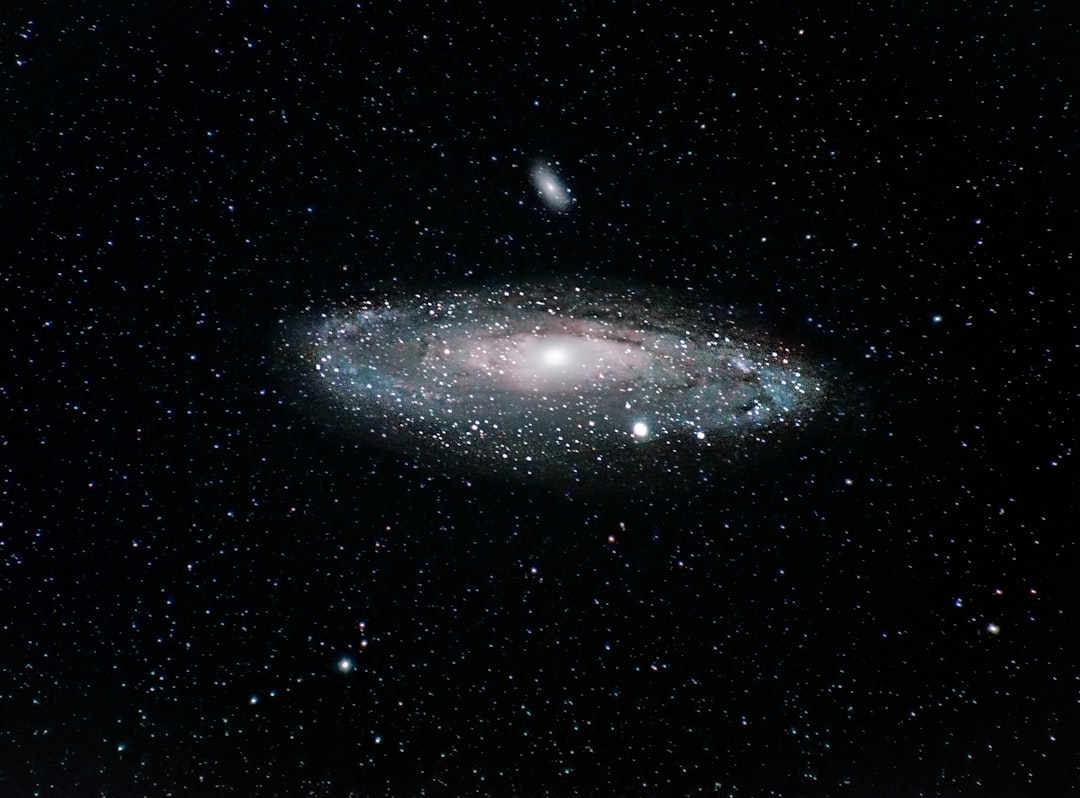
You’ve probably gazed up at the night sky, a canvas of scattered diamonds, and wondered about the sheer immensity of it all. Among those celestial jewels, one distant smudge often captures the imagination: the Andromeda Galaxy. It’s a sister galaxy, our closest major galactic neighbor, and the idea of it, so vast and so far away, sparks a unique kind of awe. But what does “far away” truly mean when we’re talking about interstellar distances? Today, you’re going to unravel the light travel time to Andromeda, a journey measured not in miles or kilometers, but in the mind-bending speed of light itself.
Before you can even begin to grasp the distance to Andromeda, you need to understand the yardstick used for such cosmic scales. We’re not talking about your average ruler or even the miles between cities. When astronomers discuss distances beyond our solar system, they speak in light-years.
What Exactly is a Light-Year?
A light-year isn’t a measure of time, despite its name. Instead, it’s a unit of distance. It represents the distance that light, the fastest thing in the universe, travels in one Earth year. To truly appreciate this, you need to consider the speed of light.
The Unwavering Speed of Light
Light, as defined by the laws of physics, travels at an astonishing speed of approximately 299,792,458 meters per second in a vacuum. That’s nearly 300 million meters, or about 186,282 miles, every single second. To put that into perspective, light could circle the Earth about 7.5 times in just one second. It’s a speed so profound that it forms the ultimate speed limit of the cosmos.
Calculating the Distance of a Light-Year
Now, let’s do the math to understand what a light-year truly encompasses. You know the speed of light per second. You also know there are 60 seconds in a minute, 60 minutes in an hour, 24 hours in a day, and approximately 365.25 days in a year (accounting for leap years).
- Seconds in a year: $60 \times 60 \times 24 \times 365.25 \approx 31,557,600$ seconds
- Distance of one light-year: Speed of light $\times$ Seconds in a year
$299,792,458 \text{ m/s} \times 31,557,600 \text{ s} \approx 9.461 \times 10^{15}$ meters
That’s roughly 9.461 trillion kilometers, or about 5.879 trillion miles. When you think about it, a single light-year is an almost incomprehensibly vast distance. It’s a scale designed to make the vastness of space comprehensible, or at least, to provide a common language for discussing it.
The concept of light travel time is fascinating, especially when considering our closest galactic neighbor, Andromeda. An insightful article that delves into the implications of light travel time in the context of Andromeda can be found on Freaky Science. This piece explores how the vast distances in space affect our understanding of astronomy and the universe. For more information, you can read the article here: Freaky Science.
Pinpointing Andromeda: Our Galactic Neighbor
So, you’ve got the concept of a light-year. Now, let’s turn your attention to Andromeda, officially known as Messier 31 (M31) or NGC 224. It’s not just another distant galaxy; it’s a celestial entity that holds a special place in our cosmic neighborhood.
The Andromeda Galaxy: A Brief Overview
Andromeda is a spiral galaxy, much like our own Milky Way, though it’s slightly larger. It’s a sprawling collection of stars, gas, dust, and dark matter, containing an estimated one trillion stars, significantly more than the Milky Way’s estimated 100-400 billion. Its spiral arms are evident, though from our perspective on Earth, it appears as a faint, elongated fuzzy patch of light.
Andromeda’s Appearance in the Night Sky
If you’re in a location with minimal light pollution, you can actually spot Andromeda with the naked eye. It’s best observed during autumn in the Northern Hemisphere. It won’t look like the detailed, swirling images you see from telescopes, of course. Instead, you’ll see a subtle, diffuse smudge, a ghost of a galaxy that hints at the immense structure beyond. This faintness is precisely because of the vast distance separating you from it.
Andromeda’s Cosmic Significance
Andromeda is significant not only because it’s our closest major galactic neighbor but also because it’s on a collision course with the Milky Way. Don’t worry, this isn’t an immediate concern for humanity. The collision is predicted to occur in about 4.5 billion years, resulting in the eventual formation of a single, larger elliptical galaxy, sometimes nicknamed “Milkomeda.”
The Measurement Mission: How Astronomers Gauge Distance

Determining the distance to celestial objects is a cornerstone of astronomy. For objects within our solar system, you can use methods like parallax and radar. But when you’re looking at objects as distant as galaxies, you need more sophisticated techniques. Astronomers have developed a “cosmic distance ladder,” where each rung relies on the accuracy of the previous one.
The Importance of Standard Candles
For measuring distances to galaxies like Andromeda, astronomers heavily rely on what are called “standard candles.” These are astronomical objects that have a known intrinsic brightness, meaning you know how luminous they actually are.
Cepheid Variables: Cosmic Beacons
One of the most crucial types of standard candles are Cepheid variable stars. These are pulsating stars that exhibit a remarkable relationship between their period of pulsation (how long it takes to brighten and dim) and their intrinsic luminosity.
The Period-Luminosity Relationship
Henrietta Swan Leavitt, a pioneering astronomer, discovered this fundamental relationship at the beginning of the 20th century. She observed that brighter Cepheids have longer periods of pulsation. By measuring the pulsation period of a Cepheid variable in another galaxy, astronomers can determine its absolute magnitude (its true brightness).
From Absolute Magnitude to Distance
Once you know a star’s absolute magnitude and you measure its apparent magnitude (how bright it appears to you from Earth), you can use the inverse square law of light to calculate its distance. The dimmer a star appears, the farther away it is, assuming its intrinsic brightness is known.
Type Ia Supernovae: Exploding Cosmic Lighthouses
Another powerful standard candle is the Type Ia supernova. These are incredibly bright explosions that occur when a white dwarf star in a binary system accretes enough mass from its companion to exceed a critical limit (the Chandrasekhar limit), triggering a runaway nuclear fusion reaction.
The Uniformity of Type Ia Supernovae
Crucially, Type Ia supernovae are thought to explode with a remarkably consistent peak luminosity. This makes them incredibly valuable for measuring distances to very far-off galaxies, where even Cepheid variables might be too faint to observe accurately.
Parallax: The Foundation of the Ladder
While parallax isn’t used directly for Andromeda, it’s the fundamental first rung of the cosmic distance ladder. By observing the apparent shift in a star’s position against the background of more distant stars as the Earth orbits the Sun, astronomers can calculate its distance. This method is incredibly accurate for nearby stars and provides the calibration for other, more distant measurement techniques.
The Journey of Light: Calculating Andromeda’s Distance

Now, you have all the pieces: the understanding of light-years and the methods astronomers use to measure cosmic distances. It’s time to put them together and arrive at the light travel time to Andromeda.
The Established Distance to Andromeda
Based on decades of observations and refined measurements using Cepheid variables and other standard candles, the accepted distance to the Andromeda Galaxy is approximately 2.537 million light-years.
Breaking Down the Number
This means that the light you see from Andromeda today left that galaxy a staggering 2.537 million years ago. It has been traveling across the vast emptiness of intergalactic space for all that time, finally reaching your eyes in this present moment.
The Implications of Such a Distance
Consider what this implies:
- A Glimpse into the Past: When you look at Andromeda, you are literally looking back in time. The galaxy you are observing is not as it is now, but as it was 2.537 million years ago.
- A Long Commute for Photons: Every single photon of light that makes up the image you perceive has undertaken an immense journey, a marathon measured in millions of years.
- The Scale of the Universe: This distance underscores the sheer, mind-boggling scale of the universe. Our closest major galactic neighbor is millions of light-years away, highlighting how much empty space there is between galaxies.
Historical Measurements and Refinements
The measurement of Andromeda’s distance has evolved over time. Early estimates were often much smaller, sometimes only a few hundred thousand light-years. As astronomers developed more precise instruments and refined their understanding of standard candles, particularly Cepheid variables, the distance estimate steadily increased. Edwin Hubble himself played a pivotal role in the 1920s, using Cepheid variables in Andromeda to prove it was indeed a separate galaxy and not part of the Milky Way, and to estimate its distance. Modern measurements, utilizing advanced telescopes like the Hubble Space Telescope and the Gaia spacecraft, have further refined this figure to the current estimate.
The concept of light travel time is fascinating, especially when considering the distance between our Milky Way galaxy and the Andromeda galaxy. Understanding how long it takes for light to travel from Andromeda to Earth can provide insights into our cosmic neighborhood. For a deeper exploration of this topic, you can read a related article that discusses the implications of light travel time and its effects on our perception of the universe. Check it out here to learn more about the wonders of space and time.
Experiencing the Past: The Light Travel Time in Context
| Data/Metric | Value |
|---|---|
| Distance to Andromeda Galaxy | 2.537 million light years |
| Speed of Light | 299,792,458 meters per second |
| Light Travel Time to Andromeda | 2.537 million years |
You’ve heard the number: 2.537 million light-years. But what does that truly feel like, or mean, in a tangible sense? How does this cosmic time capsule affect our perception of the universe?
A Window to Prehistoric Earth
The light from Andromeda embarked on its journey when Earth was in a vastly different state. This was long before the appearance of modern humans.
The Pleistocene Epoch
The light you see from Andromeda began its voyage during the Pleistocene Epoch, a geological period characterized by repeated glaciations. Early hominins, the ancestors of modern humans, were already present on Earth. If you could somehow “send a message” to Andromeda at the time its light left, it would take 2.537 million years for that message to arrive.
The Unchanging Nature of Light’s Speed
This temporal lag is a direct consequence of the finite speed of light. Unlike objects moving through space, which can accelerate and decelerate, light travels at a constant speed, dictated by the fundamental properties of spacetime. This constancy is what makes it such a reliable cosmic clock.
Our Cosmic Perspective Shift
The vast light travel time to Andromeda forces a profound shift in your perspective. It moves you from thinking about immediate proximity to contemplating deep time.
The Illusion of Simultaneity
In our everyday lives, we operate under the assumption of simultaneity – that events happening “now” are happening at the same instant for everyone. However, on cosmic scales, this assumption breaks down. The universe is a collection of vastly separated moments in time, observed through the slow-motion journey of light.
The Evolution of Celestial Objects
When you observe Andromeda, you’re not seeing its current state. You’re seeing a snapshot from millions of years ago. The galaxy has continued to evolve, stars have been born and died, and its structure has undoubtedly changed since that light began its voyage.
The Andromeda Telescope Analogy
Imagine a telescope that doesn’t just magnify but also travels backward in time. That’s essentially what observing distant galaxies does. The farther away the object, the deeper into the past you are peering. Andromeda, at 2.537 million light-years, offers you a glimpse into a very distant past of our universe.
The Future of Andromeda: A Collision Course with Time
The journey of light to Andromeda is a one-way street for photons, but the story of the Andromeda Galaxy itself is far from over. Its future, and its interaction with our own Milky Way, is a tale of cosmic forces and an incredibly long timeline.
The Approaching Galactic Dance
As mentioned earlier, Andromeda and the Milky Way are on a collision course. This isn’t a dramatic, star-shattering impact in the way you might imagine. Galaxies are mostly empty space, so individual stars are unlikely to collide.
Gravitational Interactions
Instead, the collision will be a slow, graceful dance orchestrated by gravity over billions of years. The two galaxies will pass through each other, their gravitational fields distorting their shapes and triggering bursts of star formation.
Merging into Milkomeda
Eventually, in about 4.5 billion years, the two galaxies will merge to form a single, larger elliptical galaxy. The sky as you know it will be unrecognizable. Our Sun will likely have evolved into a red giant by then, and its fate within this new, larger galaxy is uncertain.
The Significance of This Cosmic Event
This future collision is a testament to the dynamic nature of the universe. It’s a reminder that even seemingly static celestial bodies are in constant motion and are subject to immense gravitational forces.
A Long-Term Perspective
Contemplating this event encourages a long-term perspective on cosmic evolution. It shows that galaxies are not immutable entities but are constantly changing, growing, and interacting.
The Universe as a Living System
From this viewpoint, the universe can be seen as a vast, interconnected, and living system, where events unfold over timescales that dwarf human comprehension.
Studying Andromeda Today for Insights into Our Future
By studying Andromeda now, even though we are seeing it as it was millions of years ago, astronomers can learn about the processes that govern galaxy evolution. This knowledge can inform our understanding of our own galaxy’s past and potential future, even if that future is billions of years away. The light traveling to us today is a messenger, carrying information not just about Andromeda’s past, but also about the universal laws that shape galactic destinies. Your journey to unravel the light travel time to Andromeda has revealed not just a distance, but a profound connection to the deep past and a glimpse into the distant, yet inevitable, future of our cosmic neighborhood.

Einstein Says There Is No Universal “Now” in the Universe
FAQs
What is light travel time in relation to Andromeda?
Light travel time refers to the amount of time it takes for light to travel from Andromeda to Earth. Since Andromeda is approximately 2.537 million light-years away from Earth, the light we see from Andromeda today actually left the galaxy 2.537 million years ago.
How do scientists measure light travel time from Andromeda?
Scientists measure light travel time from Andromeda using the concept of light-years, which is the distance light travels in one year. By observing the light from Andromeda and calculating the distance it has traveled, scientists can determine the light travel time.
What can we learn from studying light travel time from Andromeda?
Studying light travel time from Andromeda allows scientists to gain insights into the history and evolution of the universe. By analyzing the light from Andromeda, scientists can study the galaxy’s past and better understand the processes that have shaped it over millions of years.
How does light travel time from Andromeda impact our understanding of the universe?
The light travel time from Andromeda provides valuable information about the vastness and age of the universe. It also allows scientists to study the behavior of light and the effects of cosmic phenomena on the propagation of light over immense distances.
What are some future implications of studying light travel time from Andromeda?
Studying light travel time from Andromeda can lead to advancements in our understanding of cosmology, astrophysics, and the nature of the universe. It may also provide insights into the potential for intergalactic travel and communication in the distant future.