You’ve probably done it a hundred times, maybe more. Reached into your kitchen drawer, grabbed a fork, a spoon, maybe even a knife, and absentmindedly tossed them into the microwave. A quick zap, a beep, and your leftovers are steaming. But have you ever stopped to wonder what’s really going on in there? It’s not just about heating food anymore; you’re dabbling in a surprisingly complex dance of physics, where seemingly ordinary utensils become unlikely protagonists in a microwave drama. Forget the mystique; it’s time to unravel the fork and spoon microwave physics, and you’re about to become the expert.
The heart of your microwave, and the silent orchestrator of this metallic ballet, is the magnetron. This ingenious device generates electromagnetic radiation, specifically microwaves, typically at a frequency of 2.45 GHz. You can’t see them, you can’t feel them directly, but they are the invisible energy that heats your food.
How Microwaves Interact with Food
Microwaves work by causing polar molecules within your food to rotate rapidly. Water, fat, and sugar molecules are polar, meaning they have a slightly positive and a slightly negative end, much like tiny magnets. When the microwaves bombard these molecules, they try to align with the oscillating electromagnetic field. This rapid spinning and jostling generates friction, and it’s this friction that translates into heat. Imagine a microscopic dance party where every waltz and spin creates a tiny burst of warmth. This is how your meal transforms from tepid to toasty.
The Role of Frequency and Wavelength
The specific frequency of 2.45 GHz is not arbitrary. It’s chosen because it’s highly effective at exciting water molecules, which are abundant in most foods. This frequency corresponds to a specific wavelength of about 12.2 centimeters. This wavelength is crucial because it determines how deeply the microwaves can penetrate into the food. Too short a wavelength, and they might only heat the surface. Too long, and they might not penetrate effectively at all. It’s a delicate balance that ensures efficient cooking.
Penetration Depth and Even Heating Challenges
While microwaves are great at exciting water molecules, they don’t always penetrate evenly. Denser or wetter parts of food will absorb more energy and heat faster than drier or less dense parts. This is why you might find a microwave meal with a perfectly hot center and a lukewarm edge, or vice versa. This uneven heating is one of the primary challenges of microwave cooking, and it’s a problem that utensils can inadvertently exacerbate.
In exploring the fascinating world of microwave physics, one can gain deeper insights by reading the related article on the principles behind everyday kitchen utensils. The article discusses how the shapes and materials of forks and spoons can influence microwave interactions, leading to unexpected results when using these items in a microwave. For more detailed information, you can check out the article here: Microwave Physics Explained.
The Metallic Menace: Why Utensils Don’t Play Nice
Now, let’s bring in your chosen metallic companions: the fork, the spoon, and the knife. These shiny objects, so commonplace in your kitchen, react very differently to microwave radiation than your food. And this is where things get interesting, and potentially problematic.
The Principle of Reflection
Metals are excellent conductors of electricity. When microwaves strike a metallic surface, they are largely reflected. Think of it like shining a flashlight on a mirror; the light bounces right back. This reflection has several consequences for your microwave’s interior.
Reflection of Microwaves Within the Cavity
The interior walls of your microwave are often made of metal, and they are designed to reflect microwaves back into the food, maximizing energy absorption. However, when you introduce additional metallic objects, you create more surfaces for reflection. This can lead to unpredictable patterns of microwave energy bouncing around the cavity, creating hot spots and cold spots in ways that are not conducive to even cooking.
Interference and Standing Waves
The reflected microwaves can interfere with the incoming microwaves. This interference can create what are known as “standing waves” – areas where the microwave energy is either amplified or canceled out. These standing waves can lead to very intense heating in specific locations, potentially damaging the utensil or even the microwave itself.
The Electron Avalanche: Sparking and Arcing
This is the most dramatic and visually striking consequence of putting metal in the microwave. The rapid oscillation of the electric field within the microwave can cause free electrons in the metal to accelerate. If the metal has sharp edges, points, or is thin and curved (like the tines of a fork or the edge of a knife), these accelerated electrons can accumulate and become concentrated.
Free Electrons and Electric Fields
In a metal, electrons are not rigidly bound to atoms and can move relatively freely. When subjected to the strong, rapidly changing electric field of the microwaves, these electrons are pushed and pulled.
Charge Accumulation at Sharp Edges and Points
At sharp points or thin edges, the surface area is very small relative to the volume. This can lead to a concentration of electric charge. Imagine trying to squeeze a large group of people through a tiny doorway; they’re going to get bunched up. Similarly, the electrons bunch up at these points.
Dielectric Breakdown and Ionization
When the electric field at these concentrated points becomes strong enough, it can exceed the dielectric strength of the air surrounding the metal. This means the electric field is so intense that it can rip electrons away from air molecules, a process called ionization. The air becomes a conductor, and a spark, or arc, jumps between the metal and another conductive surface, often the microwave wall or another part of the utensil. This is the visible flash you see and the crackling sound you hear.
Faraday Cage Effect (Partial)
While not a perfect Faraday cage, the metal of your microwave cavity, and the utensils within it, can create a partial Faraday cage effect. A Faraday cage is an enclosure made of conductive material that blocks external electromagnetic fields. In the context of a microwave, the metal walls reflect microwaves, preventing them from escaping. However, when you introduce additional metal objects, especially those with gaps or openings, the situation becomes more complex.
How a Faraday Cage Works
A Faraday cage works by redistributing electric charges on its surface in response to an external electric field. This redistribution creates an opposing electric field that cancels out the external field within the cage.
Utensils as Disruptors
Instead of contributing to a uniform reflection, metal utensils can disrupt the intended microwave field distribution. They can reflect microwaves in unpredictable ways, creating interference patterns that are not beneficial for cooking. In some cases, the tines of a fork could even act as small, independent antennas, resonating with specific microwave frequencies and leading to localized, intense heating.
The Fork’s Tale: A Study in Sharp Angles
The fork, with its distinct tines, presents a particularly interesting case study in microwave physics. It’s the quintessential example of a utensil that’s begging for trouble.
The Tines as Miniature Antennas
Each tine of a fork can act like a short antenna. When microwaves hit these tines, they induce oscillating currents in the metal. These currents, in turn, generate their own electromagnetic fields.
Resonance and Amplification
If the length of a tine is close to a fraction of the microwave wavelength (or a harmonic thereof), it can resonate. This resonance amplifies the induced currents and the resulting electromagnetic fields, leading to significantly higher energy absorption and potential for arcing at the tips of the tines. It’s like blowing on a whistle; if you blow at the right frequency, you get a loud, clear note. Here, the microwave is “blowing” at the tines, and if they’re the right “pitch,” they sing – with sparks.
The Pointy Predicament: Concentration of Electric Fields
The sharp tips of the fork tines are prime locations for the concentration of electric fields, as discussed earlier. The curvature of these points is very small, leading to a very high charge density and a significantly increased electric field strength.
Geometry and Field Enhancement
The geometry of sharp points inherently leads to field enhancement. This is a fundamental principle in electrostatics. The smaller the radius of curvature, the greater the electric field strength at that point for a given charge distribution.
The “Sparking Dance”
When you put a fork in the microwave, you’re essentially inviting a chaotic spark show. The tines will try to absorb and reflect microwaves, and the sharp points will be the first to experience the dielectric breakdown of the air, initiating those characteristic arcs.
Visualizing the Arcing Process
Imagine the tines glowing red hot for a split second as electrons jump from their tips, creating miniature lightning bolts within your microwave. It’s a dramatic, albeit unwanted, display of physics in action.
The Spoon’s Sophistication: A Smoother Operator (Mostly)
The spoon, with its smooth, curved bowl and rounded handle, is generally less prone to sparking than a fork. However, it’s not entirely innocent.
The Bowl’s Reflective Surface
The curved bowl of a spoon acts primarily as a reflective surface. It will bounce microwaves around, contributing to the general disruption of the microwave field within the cavity.
Diffuse Reflection vs. Direct Reflection
Unlike a flat mirror, the curved surface of a spoon can cause more diffuse reflection, scattering the microwaves in various directions rather than a single, predictable beam.
The Handle’s Potential Pitfalls
While the bowl is relatively safe, the handle of a spoon, especially if it’s thin or has a sharp edge where it connects to the bowl, can still pose a risk.
Edge Effects and Thin Metal
If the handle is made of thin metal or has a sharp seam, it can still experience charge accumulation and arcing, though typically less intensely than the tines of a fork.
The Case of the Floating Spoon
Occasionally, you might see a spoon suspended in a peculiar way, seemingly untouched by the microwave’s action. This can be due to specific conditions of microwave field distribution and the spoon’s position, creating a point of minimum energy where it’s not heated or induced to spark. It’s a rare phenomenon, but another testament to the complex wave patterns within the microwave.
In exploring the intriguing world of microwave physics, one might find it fascinating how everyday objects like forks and spoons can influence the behavior of microwaves. For a deeper understanding of this phenomenon, you can check out a related article that delves into the science behind these utensils and their interaction with microwave radiation. This article provides insights that can enhance your knowledge of microwave cooking and safety. If you’re curious to learn more, visit Freaky Science for a comprehensive explanation.
The Knife’s Cutting Edge: A Sharp Warning
| Concept | Explanation |
|---|---|
| Fork and Spoon | Utensils used for eating and serving food. |
| Microwave Physics | The study of electromagnetic waves and their interaction with matter in the context of microwave ovens. |
| Explained | The behavior of fork and spoon in a microwave, where they can cause sparks and potential damage to the microwave and should not be used. |
The knife, with its thin blade and often sharp edges, is arguably the most dangerous utensil to put in a microwave.
The Blade’s Thinness and Conductivity
The thinness of a knife blade means that any accumulated charge can very quickly lead to a strong electric field. Coupled with its conductivity, this makes it a prime candidate for arcing.
Surface Area to Volume Ratio (Again)
Similar to the fork tines, the thin blade of a knife has a high surface area to volume ratio, facilitating charge build-up.
The Sharp Edges: Spark Generators
The sharp edges of a knife blade are ideal points for dielectric breakdown. They concentrate the electric field to an extreme degree, guaranteeing a spark when exposed to microwave radiation.
Induced Currents and Field Intensification
The oscillating microwaves induce strong currents in the knife blade. These currents, in conjunction with the sharp edges, create extremely high electric field strengths, readily ionizing the surrounding air.
The Danger of a Fully Loaded Microwave
When you put multiple metallic objects in the microwave, you create a recipe for disaster. The reflections and arcing from one object can interact with others, leading to a cascade of sparks and potentially damaging your microwave. It’s like a chain reaction, but with electricity and heat.
Safety First: What You Should and Shouldn’t Do
Understanding the physics is one thing; applying it safely is another. You wouldn’t play with electricity, and putting metal in a microwave is essentially playing with a controlled, albeit powerful, electromagnetic field.
The Golden Rule: When in Doubt, Leave It Out
This is the most important rule. If you’re unsure whether a metallic object is microwave-safe, the answer is almost certainly no. Stick to what you know is safe.
Microwave-Safe Materials: Glass, Ceramic, and Certain Plastics
Glass, ceramic (without metallic glazes), and microwave-safe plastics are your friends. These materials don’t conduct electricity in the same way as metal and won’t cause the same dangerous reactions.
Understanding “Microwave-Safe” Labels
Look for the “microwave-safe” symbol on your cookware and containers. This indicates that the material has been tested and deemed safe for use in a microwave oven.
The Myth of the “Metallic Glaze”
Some ceramic dishes have decorative metallic glazes. Even a thin layer of metallic paint can cause sparking and should be avoided in the microwave. Always check the rim and any decorative elements.
The Purpose of Microwave Ovens: Food Heating, Not Metal Cooking
Microwave ovens are designed to heat food by exciting water molecules. They are not designed to heat or interact with metallic objects. Introducing metal goes against the fundamental principles of their operation and can lead to damage and safety hazards.
What to Do if You Accidentally Put Metal in the Microwave
If you accidentally put metal in the microwave and it starts to spark, immediately stop the microwave. Do not open the door while it’s arcing. Once it has stopped, carefully remove the metal object. Inspect your microwave for any signs of damage, such as burn marks or melted components. If you notice any damage, it’s best to have it inspected by a professional or consider replacing the appliance.
By understanding the underlying physics of how microwaves interact with metal, you can make informed decisions and keep your kitchen safe and your food perfectly heated, without the unexpected fireworks. The fork and spoon might be everyday tools, but in the microwave, they reveal a fascinating and important lesson in physics.
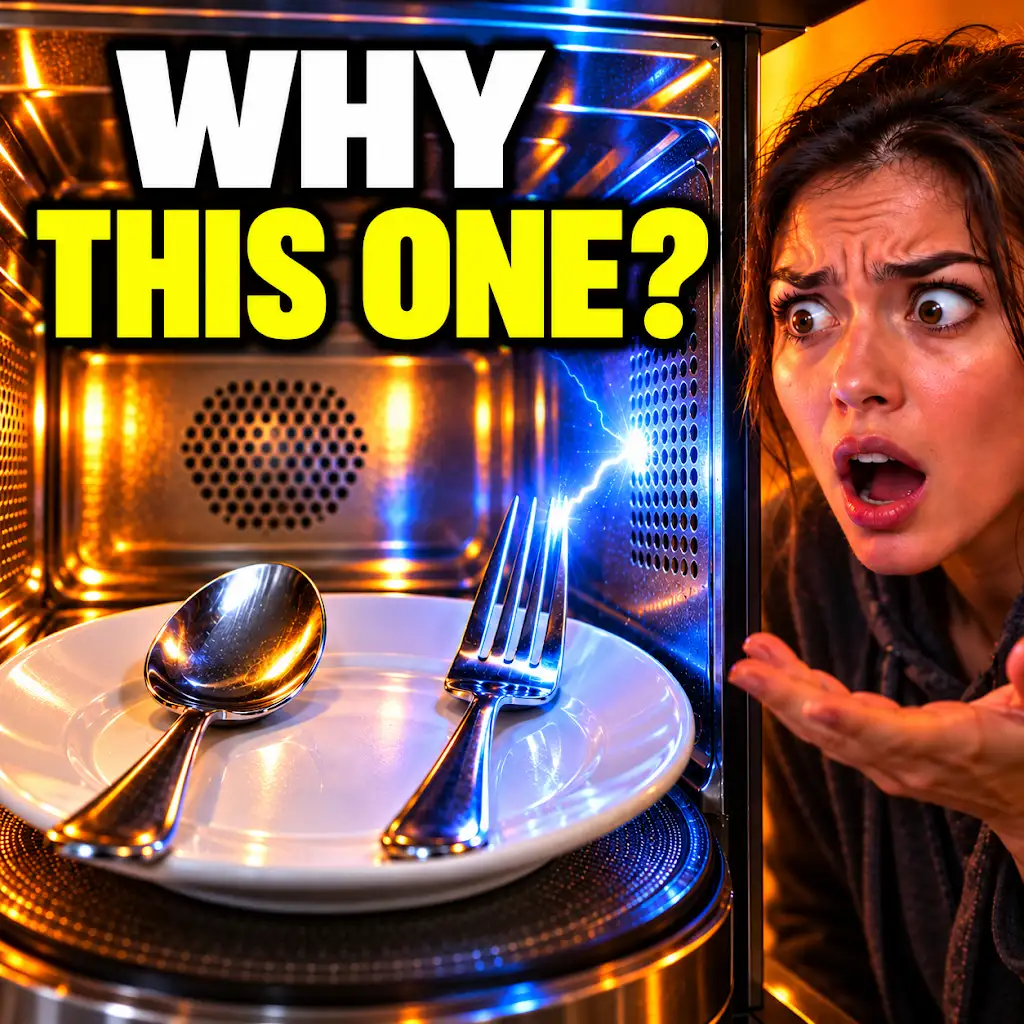
A Fork and a Spoon React Differently in a Microwave. Why?
FAQs
What is the physics behind using a fork and spoon in the microwave?
The physics behind using a fork and spoon in the microwave is related to the behavior of electromagnetic waves. When metal objects like forks and spoons are placed in the microwave, they can cause sparks and potentially damage the microwave due to the way the metal reflects and absorbs the microwave radiation.
Why should you not put metal objects in the microwave?
Metal objects should not be put in the microwave because they can cause sparks, arcing, and potentially damage the microwave. This is due to the way the metal reflects and absorbs the microwave radiation, leading to a build-up of electrical charges and potential fire hazards.
What happens when you put a fork in the microwave?
When you put a fork in the microwave, the metal in the fork can cause sparks and arcing due to the way it interacts with the microwave radiation. This can potentially damage the microwave and pose a fire hazard.
Can you put a spoon in the microwave?
It is generally not recommended to put a metal spoon in the microwave, as it can cause sparks and potentially damage the microwave due to the way the metal interacts with the microwave radiation.
What are safe alternatives for heating food in the microwave?
Safe alternatives for heating food in the microwave include using microwave-safe glass or ceramic containers, microwave-safe plastic wrap, and microwave-safe paper towels. It is important to always follow the manufacturer’s instructions for safe microwave use.