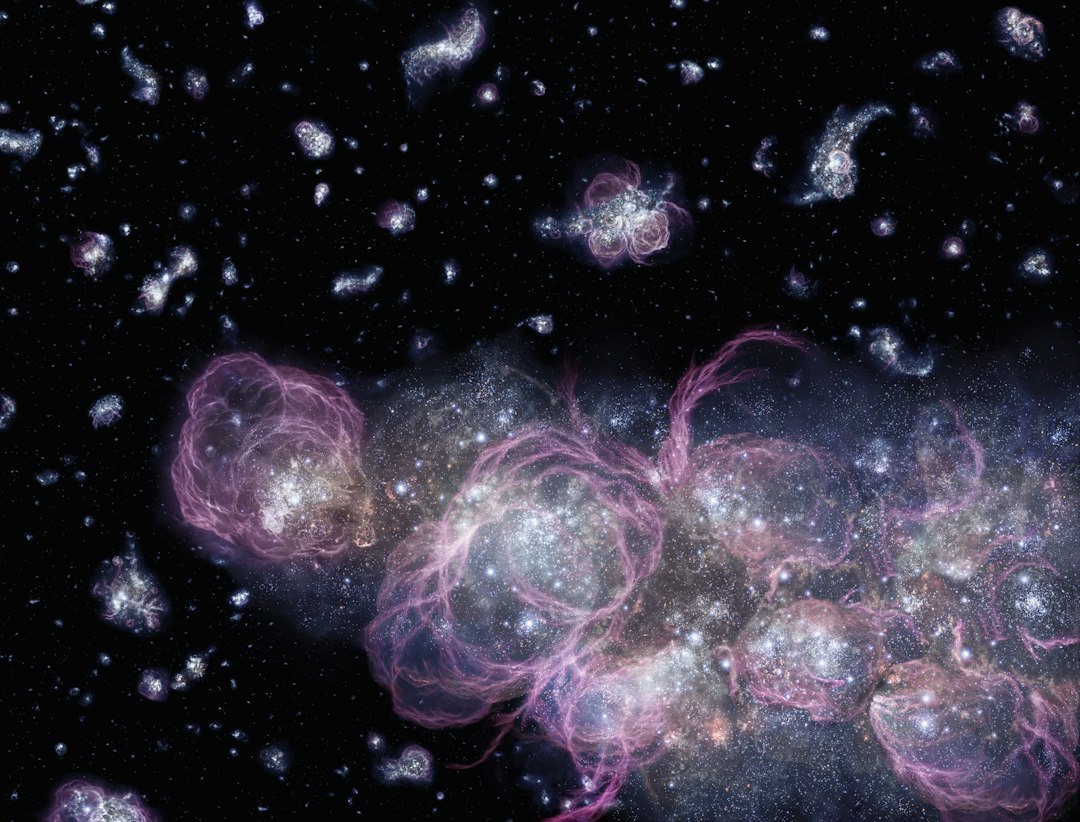
The Primordial Echo: Peering into the Cosmic Dawn
The universe, in its vast and enigmatic expanse, whispers tales of its birth. These whispers are not carried by sound waves, but by faint, pervasive radiation that bathes every corner of the cosmos. This is the Cosmic Microwave Background (CMB), a relic from the universe’s infancy, a snapshot of a time when it was a mere fraction of its current age. For astrophysicists, the CMB is not just a faint glow; it is a Rosetta Stone, holding the keys to understanding the universe’s fundamental properties, its evolution, and the very laws that govern it. Unraveling its mysteries has been a cornerstone of modern cosmology, pushing the boundaries of our knowledge and revealing a universe far more intricate and fascinating than once imagined.
The CMB is a triumph of scientific observation and interpretation. Discovered serendipitously in 1964 by Arno Penzias and Robert Wilson, this uniform bath of microwave radiation, with a temperature of approximately 2.7 Kelvin, was initially a baffling anomaly. However, it was soon recognized as the predicted afterglow of the Big Bang – the residual heat from the intensely hot and dense early universe. As the universe expanded and cooled, this radiation stretched, shifting from visible light to infrared and eventually to microwaves, permeating all of space. The significance of this discovery cannot be overstated; it provided compelling observational evidence for the Big Bang theory, solidifying its place as the dominant cosmological model.
Decoding the Tiny Fluctuations: Seeds of Structure
While the CMB is remarkably uniform, its true treasure lies in the minuscule temperature fluctuations, or anisotropies, that pepper its surface. These variations, on the order of one part in 100,000, are not random noise. Instead, they represent the subtle density differences in the primordial plasma that eventually, under the relentless pull of gravity, coalesced to form the galaxies, stars, and planets we observe today. Understanding these fluctuations is paramount to understanding the origin of cosmic structure.
The Role of Acoustic Oscillations
The early universe was a hot, dense soup of photons, electrons, and baryons. In this primordial plasma, pressure waves, akin to sound waves, propagated. These oscillations, known as acoustic oscillations, played a crucial role in shaping the pattern of anisotropies in the CMB. Regions of slightly higher density would attract more matter, increasing pressure, which in turn would push back, creating oscillations. The characteristic scale of these oscillations, imprinted on the CMB, provides a “standard ruler” allowing cosmologists to measure distances and infer cosmological parameters. The precise locations and amplitudes of the peaks and troughs in the CMB’s power spectrum are a direct consequence of these acoustic oscillations.
Polarization as a Cosmic Compass
Beyond temperature variations, the CMB also exhibits polarization, a property that describes the orientation of its electric field. This polarization carries even more information about the early universe. There are two main types of CMB polarization: E-modes and B-modes. E-modes are relatively straightforward to generate from density fluctuations, while B-modes are more elusive and are primarily produced by gravitational waves, ripples in spacetime predicted by Einstein’s theory of general relativity. The detection of B-modes would be a revolutionary discovery, providing direct evidence for inflation, a hypothetical period of rapid expansion in the universe’s first moments, and offering insights into the physics at incredibly high energies.
Astrophysics continues to unravel the mysteries of the cosmos, and one intriguing area of study is the Cosmic Microwave Background (CMB). For those interested in exploring this topic further, a related article can be found at Freaky Science, which delves into the significance of the CMB and its implications for our understanding of the universe’s origins and evolution. This resource provides valuable insights into how scientists interpret the faint afterglow of the Big Bang and what it reveals about the structure and fate of the cosmos.
Probing the Inflationary Epoch: The Universe’s First Jump
One of the most profound mysteries the CMB helps us unravel is the nature of cosmic inflation. The standard Big Bang model, while successful, faced several challenges, such as the horizon problem (why is the universe so uniform on large scales?) and the flatness problem (why is the universe so spatially flat?). Inflation, a period of exponential expansion occurring fractions of a second after the Big Bang, elegantly addresses these issues. The CMB provides crucial observational tests for inflationary theories.
Signatures of Primordial Gravitational Waves
As mentioned, B-mode polarization in the CMB is considered a smoking gun for inflation. During inflation, the rapid expansion of spacetime would have generated a spectrum of gravitational waves. These primordial gravitational waves, if detected in the CMB’s polarization pattern, would directly confirm the inflationary paradigm and allow us to probe the energy scale of inflation, which is thought to be incredibly high, far beyond the reach of terrestrial particle accelerators. The search for these B-modes has been a major focus of CMB experiments, with ongoing efforts to improve sensitivity and reduce foreground contamination.
Testing Inflationary Models with Anisotropy Patterns
The specific pattern of temperature anisotropies in the CMB is also sensitive to different inflationary models. Different models predict distinct spectral indices and relationships between the scalar (density) and tensor (gravitational wave) perturbations. By precisely measuring these properties in the CMB, cosmologists can constrain the vast landscape of possible inflationary scenarios, narrowing down the viable explanations for the universe’s initial conditions. The success of experiments like WMAP and Planck in accurately mapping the CMB anisotropies has provided invaluable data for this purpose.
Unveiling the Dark Universe: Cosmic Ingredients
The CMB is not only a window into the universe’s past but also a powerful tool for understanding its present composition. The subtle variations in the CMB’s temperature and polarization allow us to infer the relative abundances of the universe’s fundamental constituents: ordinary matter, dark matter, and dark energy. These invisible components make up the overwhelming majority of the universe’s mass-energy, and the CMB is our most direct probe of their influence.
The cosmic microwave background (CMB) holds many mysteries that continue to intrigue astrophysicists, as it provides a snapshot of the universe just after the Big Bang. Recent studies have delved into the anomalies present in the CMB, leading to new theories about the early universe and its expansion. For those interested in exploring these fascinating developments further, you can read a related article that discusses the implications of these findings in detail. Check it out here to learn more about the ongoing research in this captivating field.
The Dominance of Dark Matter
The gravitational effects of dark matter are clearly imprinted on the CMB anisotropies. Dark matter, which interacts gravitationally but not electromagnetically, played a crucial role in the formation of structure. Regions of slightly higher dark matter density would have attracted ordinary matter, acting as gravitational seeds for the eventual formation of galaxies. The observed amplitudes and distribution of CMB anisotropies are best explained by models that include a significant component of cold dark matter. Without dark matter, the structures we see today would not have had enough time to form since the Big Bang.
The Enigma of Dark Energy
The CMB also provides constraints on the nature and abundance of dark energy, the mysterious force driving the accelerated expansion of the universe. By studying how the CMB photons travel through the expanding universe and how their anisotropies evolve, cosmologists can infer the geometry of spacetime and the total energy density. These measurements, combined with observations of distant supernovae, have solidified the evidence for dark energy and are helping to refine our understanding of its properties, such as its equation of state. The ongoing tension between different CMB-derived and other cosmological measurements of parameters like the Hubble constant highlights the need for further precision.
Future Frontiers: Precision Cosmology and Beyond
The quest to unravel the CMB’s mysteries is far from over. Future experiments are poised to achieve unprecedented precision, pushing the boundaries of our cosmological understanding even further and potentially revealing new physics. The pursuit of more accurate measurements of CMB anisotropies and polarization promises to shed light on some of the universe’s most enduring questions.
The Next Generation of CMB Observatories
Upcoming CMB experiments, such as the Simons Observatory and CMB-S4, are designed to dramatically improve sensitivity and angular resolution. These observatories will aim to detect the faint B-mode polarization signals from primordial gravitational waves with greater certainty, potentially distinguishing between different inflationary models. They will also provide more precise measurements of the CMB’s temperature anisotropies, leading to tighter constraints on cosmological parameters and a deeper understanding of the universe’s composition and evolution. These instruments represent a significant leap forward in our ability to probe the early universe.
Unveiling Non-Gaussianity and Beyond
While the CMB is largely described by a Gaussian distribution of fluctuations, the presence of non-Gaussianity – deviations from this statistical distribution – could offer clues to more complex physics in the early universe, such as specific inflationary models or the presence of primordial non-Gaussian initial conditions. Future observations aim to detect subtle levels of non-Gaussianity in the CMB. Furthermore, the study of CMB spectral distortions, deviations from the perfect blackbody spectrum, could provide a unique window into the very early universe, potentially revealing signatures of processes that occurred before recombination, the epoch when the CMB was formed. The CMB continues to be a fertile ground for discovery, holding secrets that may fundamentally alter our perception of the cosmos and its origins.

The Universe’s Cold Spot Has an Explanation. It’s Not Enough.

FAQs
What is CMB and why is it important in astrophysics?
The Cosmic Microwave Background (CMB) is the afterglow of the Big Bang, which is the oldest light in the universe. It provides crucial information about the early universe, such as its age, composition, and evolution.
How is the CMB used to study the universe’s history?
Scientists study the CMB to understand the early universe’s conditions and how it has evolved over time. By analyzing the CMB’s temperature fluctuations, they can learn about the universe’s expansion, structure formation, and the distribution of matter.
What are some mysteries surrounding the CMB in astrophysics?
Some mysteries surrounding the CMB include anomalies in its temperature fluctuations, such as the Cold Spot and the Axis of Evil. These anomalies challenge our current understanding of the universe’s evolution and may hint at new physics beyond the standard cosmological model.
How is the CMB measured and observed by scientists?
Scientists use specialized instruments, such as telescopes and satellites, to observe the CMB. These instruments detect the faint microwave radiation coming from all directions in the sky. By mapping the CMB’s intensity and polarization, scientists can extract valuable information about the universe’s history.
What are some recent discoveries or advancements related to CMB research in astrophysics?
Recent advancements in CMB research include improved measurements of the CMB’s polarization, which can provide insights into the early universe’s inflationary period. Scientists are also studying the CMB to better understand dark matter, dark energy, and the large-scale structure of the universe.