The Mpemba Effect, a seemingly counterintuitive phenomenon where hot water freezes faster than cold water under certain conditions, has puzzled scientists for decades. This peculiar behavior challenges our everyday understanding of thermodynamics and has sparked a great deal of debate and investigation. While the exact mechanisms are still being explored, several compelling theories attempt to explain this perplexing quirk of nature. The effect, named after Tanzanian schoolboy Erasto Mpemba who brought it to the attention of physicists in the 1960s, has a rich history of anecdotal reports and scientific inquiry, highlighting its enduring fascination.
The Enigma of the Mpemba Effect
The observation that hot water can freeze faster than cold water is not a universal truth. It’s a conditional phenomenon, meaning it doesn’t always happen, and the conditions under which it does occur are crucial to understanding its potential causes. Erasto Mpemba’s own experience, recounted in a 1969 paper co-authored with Denis Osborne, described how ice cream mixture, when heated before being placed in a freezer, solidified faster than the unheated mixture. This personal anecdote, initially met with skepticism, was the spark that ignited a renewed scientific interest in the effect. Early dismissals often attributed the phenomenon to experimental error or flawed observation. However, as more researchers began to replicate the results under controlled laboratory conditions, it became clear that something more profound was at play. The Mpemba Effect is not a mere illusion; it’s a tangible physical process that demands a scientific explanation. The question isn’t if it happens, but why it happens, and under what precise circumstances. This has led to a multifaceted approach to its study, drawing on principles from physics, chemistry, and even biology.
Historical Roots and Early Observations
While Erasto Mpemba is credited with popularizing the effect, historical accounts suggest that similar observations were made much earlier. Ancient Greek philosophers like Aristotle noted that water that had been boiled might freeze faster. Later, in the 17th century, Francis Bacon also documented observations related to water’s freezing behavior, though not as explicitly as Mpemba. These early mentions, often steeped in philosophical rather than empirical investigation, laid the groundwork for future scientific inquiry. The challenge for early observers was the lack of precise measurement tools and controlled environments. Without the ability to accurately measure temperature, purity of water, and container properties, distinguishing genuine phenomena from experimental artifacts was difficult. The scientific method, as we know it today, was still in its nascent stages, making definitive conclusions elusive. However, these historical footnotes are significant because they indicate that the Mpemba Effect is not a modern invention but a long-observed anomaly that has persisted through centuries of human curiosity. The persistence of these anecdotal reports underscores the intuitive strangeness of the effect, prompting further investigation even before the advent of sophisticated scientific tools.
The Scientific Sensation and Modern Research
The formal presentation of the Mpemba Effect by Mpemba and Osborne in 1969 marked a turning point. Their work, though initially met with some resistance, stimulated a wave of rigorous scientific investigation. Researchers across the globe began designing experiments to isolate variables and test various hypotheses. The core of this modern research lies in the meticulous control of experimental parameters. This includes the initial temperatures of the water, the volume and material of the containers, the purity of the water, the ambient temperature of the freezer, and the presence of dissolved substances. Modern scientific equipment, such as high-precision thermometers, spectrophotometers, and rapid data logging systems, have been instrumental in gathering accurate and repeatable data. This has allowed scientists to move beyond qualitative observations to quantitative analysis, paving the way for a deeper understanding of the underlying physical processes. The continued research into the Mpemba Effect highlights its status as an active and ongoing area of scientific exploration, with new findings and refined theories emerging regularly.
The Mpemba effect, which describes the phenomenon where hot water can freeze faster than cold water under certain conditions, has intrigued scientists and curious minds alike for decades. For a deeper exploration of this fascinating topic, you can read a related article that delves into the various theories and experiments surrounding the Mpemba effect. Check it out here: Freaky Science.
Exploring the Potential Mechanisms
The complexity of the Mpemba Effect arises from the fact that several factors can contribute to its occurrence. No single explanation universally accounts for all observed instances. Instead, a combination of physical processes, often interacting in subtle ways, is believed to be responsible. Understanding these mechanisms requires delving into the fundamental properties of water and its phase transitions. The state of water, including its temperature, dissolved impurities, and dissolved gases, can significantly influence its freezing behavior. The rate at which heat is lost from the water is a critical factor, and various phenomena can affect this rate differently for hot and cold water.
Evaporative Cooling: A Significant Contributor
One of the most widely accepted explanations for the Mpemba Effect involves evaporative cooling. When water is exposed to the air, particularly in a less-than-sealed container, some of it will evaporate. Evaporation is an endothermic process, meaning it absorbs heat from its surroundings. If hot water evaporates at a faster rate than cold water, it will lose heat more quickly through this process, thus cooling down faster. Several factors can enhance evaporation from hot water:
- Higher Vapor Pressure: Hot water has a higher vapor pressure than cold water, meaning more water molecules have enough energy to escape into the gaseous phase.
- Convection Currents: Warmer water tends to exhibit stronger convection currents. These currents bring water molecules from the interior to the surface, where they are more readily available for evaporation.
- Reduced Surface Tension (Potentially): While debated, some theories suggest that elevated temperatures might slightly reduce surface tension, facilitating evaporation.
The significance of evaporative cooling is amplified in environments with lower humidity and good air circulation, such as a typical freezer. The loss of mass due to evaporation also means there is less water to freeze, which, coupled with the cooling effect, can lead to faster solidification. However, evaporative cooling alone may not fully explain the Mpemba Effect, especially in sealed containers where evaporation is limited.
Convection and Heat Transfer Dynamics
Convection plays a crucial role in how heat is distributed within a body of water. When water is heated, it becomes less dense and rises, while cooler, denser water sinks. This creates convection currents that help to transfer heat throughout the liquid.
- Initial Cooling Phase: In the initial stages of cooling, hot water may exhibit more vigorous convection. This enhanced convection can lead to more efficient heat transfer to the surrounding environment, especially through the sides and top of the container. The rapid movement of water molecules helps to equalize temperature gradients.
- Stratification in Cold Water: Conversely, cold water might stratify more readily. As it cools, the top layer becomes denser and sinks, creating a less efficient heat transfer mechanism compared to the dynamic convection in initially hot water. This can create insulating layers of colder water that slow down the overall cooling process.
- The Role of the Ice Layer: As freezing begins, a layer of ice may form on the surface. The dynamics of this ice layer can also differ. In the case of initially hot water, the more vigorous initial convection might lead to a more uniform distribution of cooling, potentially resulting in a more stable and faster-forming ice layer compared to the potentially less uniform cooling of initially cold water.
The interplay between convection currents and the cooling environment is a complex dance of heat transfer that can favor the faster freezing of hot water under specific circumstances. The shape of the container and the cooling surface also interact with these convection patterns.
The Mpemba effect, which describes the phenomenon where hot water freezes faster than cold water under certain conditions, has intrigued scientists for decades. For those interested in exploring this fascinating topic further, a related article can be found at Freaky Science, where various scientific explanations and experiments surrounding the Mpemba effect are discussed in detail. This effect challenges our conventional understanding of thermodynamics and continues to spark curiosity in both researchers and enthusiasts alike.
Dissolved Gases and Impurities
The presence of dissolved substances in water, such as gases and dissolved salts, can significantly influence its freezing point and the way it freezes. This is an area where the Mpemba Effect shows particular sensitivity.
- Degassing of Hot Water: Hot water can hold less dissolved gas than cold water. When water is heated, dissolved gases like oxygen and nitrogen are expelled. As this degassed hot water cools, it may be more prone to freezing because the absence of dissolved gases can alter the nucleation process – the initial formation of ice crystals. Nucleation is often inhibited by dissolved gases.
- Effect on Freezing Point: Dissolved impurities, such as salts, generally lower the freezing point of water. If hot water, due to evaporation or other processes, ends up with a lower concentration of dissolved impurities than the initially colder water, its freezing point might be higher, paradoxically leading to faster freezing.
- Altering Crystal Formation: Dissolved substances can also act as nucleation sites or inhibitors for ice crystal formation. The presence or absence of specific dissolved species, influenced by the initial temperature, can affect the speed and structure of ice growth. For instance, some dissolved impurities might hinder the formation of a solid ice lattice, while others might facilitate it.
The purity of the water used in experiments is therefore a critical variable. Tap water, containing a variety of dissolved minerals and gases, will behave differently from distilled or deionized water. The Mpemba Effect is often observed more readily with tap water, suggesting the role of dissolved components.
Supercooling and Nucleation Sites
Supercooling is a phenomenon where a liquid cools below its freezing point without solidifying. This occurs because nucleation sites – surfaces or particles upon which ice crystals can form – are absent or insufficient. The Mpemba Effect can be linked to differences in supercooling behavior between hot and cold water.
- Reduced Supercooling in Hot Water: It is hypothesized that hot water might be less prone to supercooling than cold water. This could be due to the vigorous convection that brings dissolved gases to the surface and potentially out of the water, or changes in the molecular structure of water at higher temperatures that make it more conducive to nucleation. If hot water has fewer instances of supercooling, it will begin to form ice sooner once it reaches its freezing point.
- Effect of Impurities on Nucleation: As mentioned earlier, dissolved impurities can act as nucleation sites. If the heating process alters the distribution or nature of these impurities (e.g., causing them to precipitate out or aggregate), it could affect the number and effectiveness of available nucleation sites.
- Cellular Structures in Freezing: The way ice crystals form can also be influenced by initial conditions. In some cases, hot water might form a more stable ice structure that allows for faster propagation of the freezing front, whereas cold water might undergo more erratic ice formation.
Understanding the subtle interplay between temperature, dissolved substances, and the very act of ice crystal formation is key to unraveling the Mpemba Effect. Differences in nucleation and supercooling are considered fundamental aspects of this puzzle.
The Role of the Container and Environment
Beyond the properties of the water itself, the container it is placed in and the surrounding environment play a significant role in determining whether the Mpemba Effect manifests. These external factors influence the rate and manner in which heat is lost from the water.
Heat Transfer Through the Container Walls
The material and shape of the container can influence how quickly heat is conducted away from the water.
- Thermal Conductivity: Containers made of materials with high thermal conductivity, such as metal, will transfer heat more efficiently than those made of materials with low thermal conductivity, like plastic or Styrofoam. If hot water can lose heat more effectively through a conductive container than cold water, it could lead to faster freezing.
- Surface Area to Volume Ratio: A container with a larger surface area relative to its volume will facilitate faster heat loss. If the initial heating of the water leads to a shape or state that, upon cooling, presents a more favorable surface area for
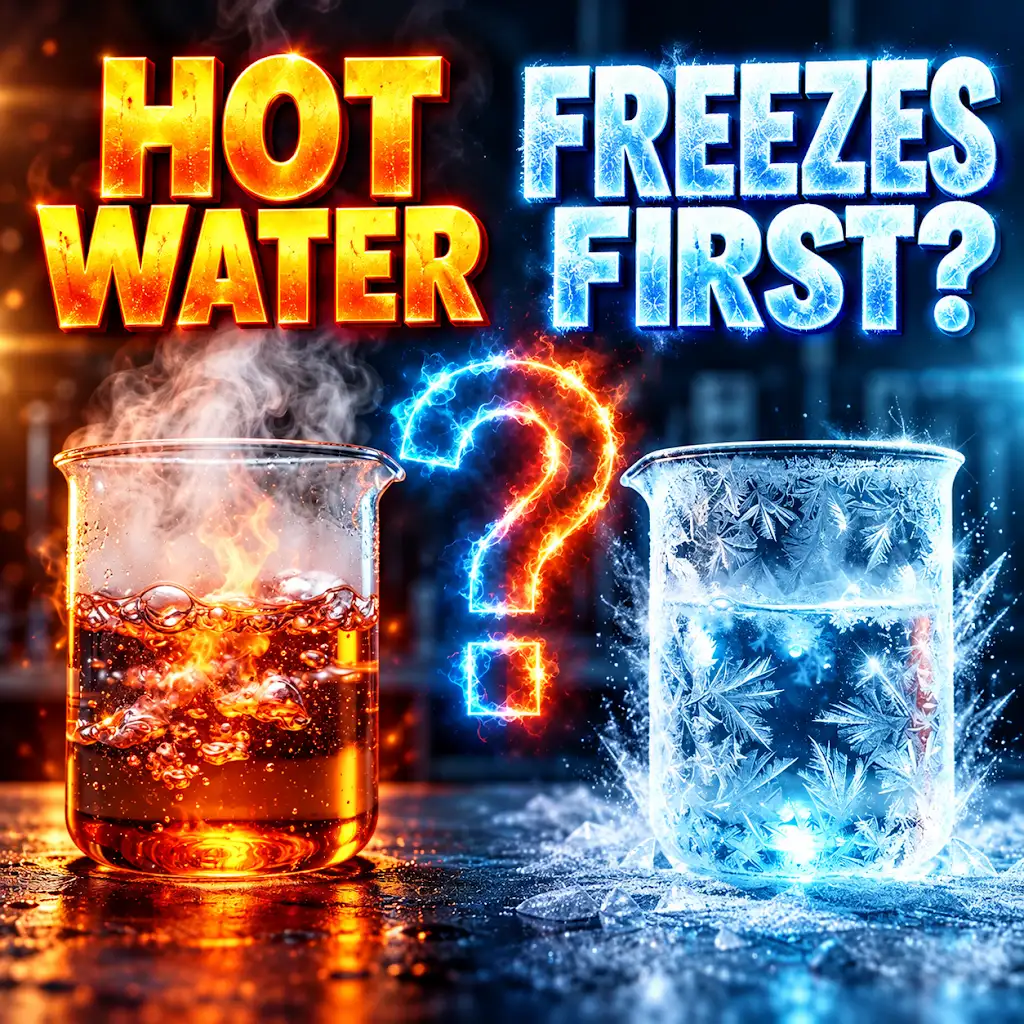
Why Hot Water Freezes Faster Than Cold (The Mpemba Effect)
FAQs
What is the Mpemba effect?
The Mpemba effect is the phenomenon where hot water freezes faster than cold water under certain conditions.
Who discovered the Mpemba effect?
The Mpemba effect was named after Erasto Mpemba, a Tanzanian student who first observed it in the 1960s during a physics experiment.
What are some possible explanations for the Mpemba effect?
Possible explanations for the Mpemba effect include evaporation, dissolved gases, supercooling, and differences in the rate of heat transfer.
Are there any practical applications of the Mpemba effect?
While the Mpemba effect is still not fully understood, it has potential applications in industries such as food preservation and cryogenics.
Can the Mpemba effect be replicated consistently?
Replicating the Mpemba effect consistently has proven to be challenging due to the various factors that can influence the freezing process, such as the initial temperature and purity of the water.