You’ve likely encountered them every day, perhaps without even realizing their fundamental role in your modern life. From heating your leftovers to connecting you wirelessly to the world, microwaves are ubiquitous. But what exactly are these invisible waves that permeate your existence? This article is your personal tour of the microwave portion of the electromagnetic spectrum, demystifying its properties, applications, and the science behind its invisible power. Prepare to understand the unseen forces that shape your daily routine.
Microwaves are a fascinating part of the electromagnetic spectrum, occupying a frequency range between 300 MHz and 300 GHz. For a deeper understanding of how microwaves interact with matter and their various applications, you can explore the article on the electromagnetic spectrum explained in detail. This resource provides insights into the properties of microwaves and their significance in technology and communication. To read more, visit this article.
The Electromagnetic Spectrum: A Universal Highway of Energy
Before we zoom in on microwaves, it’s crucial to understand their broader context: the electromagnetic spectrum. Imagine it as a vast, continuous highway of energy, stretching from incredibly low-energy radio waves to extraordinarily high-energy gamma rays. Each point on this highway represents a different type of electromagnetic radiation, distinguished by its wavelength and frequency, which in turn dictate its energy and how it interacts with matter.
What is Electromagnetic Radiation?
At its core, electromagnetic radiation is a form of energy that travels in waves. These waves consist of oscillating electric and magnetic fields that are perpendicular to each other and propagate through space at the speed of light. Unlike sound waves, which require a medium to travel (like air or water), electromagnetic waves can travel through the vacuum of space. Think of the sunlight reaching your skin; it’s a prime example of electromagnetic radiation traversing the void.
Wavelength and Frequency: The Dual Nature of Waves
Two fundamental properties define any electromagnetic wave: its wavelength and its frequency.
Wavelength: The Distance Between Peaks
Wavelength ($lambda$) refers to the spatial distance between two consecutive crests (or troughs) of a wave. It’s typically measured in meters (m), centimeters (cm), or even nanometers (nm) for higher-energy radiation. Longer wavelengths mean the waves are more spread out, while shorter wavelengths indicate they are more compressed.
Frequency: The Rate of Oscillation
Frequency ($f$) measures how many complete wave cycles pass a given point in one second. It’s measured in Hertz (Hz), where 1 Hz equals one cycle per second. Higher frequencies mean the waves are oscillating more rapidly.
The Interplay: The Speed of Light Constant
Crucially, wavelength and frequency are inversely related. This relationship is governed by the speed of light ($c$), a universal constant approximately equal to 299,792,458 meters per second in a vacuum. The equation that connects them is:
$c = lambda times f$
This means if you know the wavelength, you can calculate the frequency, and vice versa. A wave with a very long wavelength will have a low frequency, and a wave with a very short wavelength will have a high frequency.
Energy and Interactions: The Consequences of Frequency
The energy carried by an electromagnetic wave is directly proportional to its frequency (and therefore inversely proportional to its wavelength). Higher frequency waves carry more energy, while lower frequency waves carry less. This difference in energy is what determines how these waves interact with matter. For example, low-energy radio waves can pass through walls with little effect, while high-energy X-rays can penetrate soft tissues but are absorbed by bones.
Unveiling Microwaves: A Specific Band on the Spectrum

Now, let’s hone in on our subject: microwaves. They occupy a specific, yet incredibly important, portion of the electromagnetic spectrum, nestled between radio waves and infrared radiation. This placement is not arbitrary; it defines their unique characteristics and the diverse applications they enable.
Where Do Microwaves Fit In?
The microwave portion of the spectrum typically ranges from about 300 megahertz (MHz) to 300 gigahertz (GHz). To put this into perspective:
- Compared to Radio Waves: Microwaves have shorter wavelengths and higher frequencies than most radio waves. Think of them as a more “compact” and energetic subset of the radio wave family.
- Compared to Infrared Radiation: Microwaves have longer wavelengths and lower frequencies than infrared radiation. They are less energetic than the heat-generating infrared waves.
Wavelengths and Frequencies of Interest
Within the broad microwave band, specific frequencies are often designated for particular purposes due to their unique interaction properties.
Typical Wavelengths
The wavelengths of microwaves are generally in the range of approximately 1 meter down to 1 millimeter. This means:
- A frequency of 300 MHz corresponds to a wavelength of 1 meter.
- A frequency of 300 GHz corresponds to a wavelength of 1 millimeter.
You can see how the inverse relationship between wavelength and frequency holds true here.
Key Frequency Bands and Their Significance
Various industries and technologies have carved out specific frequency bands within the microwave spectrum. You might encounter terms like:
- L-band (1 to 2 GHz): Often used for radar systems and GPS.
- S-band (2 to 4 GHz): Common in weather radar and some satellite communications.
- C-band (4 to 8 GHz): Frequently used for satellite TV broadcasting and telecommunications.
- X-band (8 to 12 GHz): Utilized in radar, including marine and aviation radar, and some scientific applications.
- Ku-band (12 to 18 GHz): Widely used for satellite broadcasting (like satellite internet and TV) and some radar systems.
- Ka-band (26.5 to 40 GHz): Increasingly employed for high-speed satellite internet and advanced radar applications.
Each of these bands is carefully regulated to prevent interference between different users, ensuring the efficient and reliable operation of various technologies.
The Power of Resonance: How Microwaves Interact with Water
The defining characteristic that makes microwaves so useful, particularly in cooking, is their remarkable ability to interact with polar molecules, especially water. This interaction is a form of resonance, where the microwave’s oscillating electric field causes these molecules to rotate back and forth at the same frequency.
Polar Molecules: The Key to Microwave Absorption
Water molecules are a prime example of polar molecules. They have a slightly positive charge on one end and a slightly negative charge on the other, much like tiny magnets. When exposed to the rapidly oscillating electric field of a microwave, these water molecules try to align themselves with the field. As the field rapidly switches direction, the water molecules are forced to flip back and forth millions of times per second.
Frictional Heating: Turning Oscillation into Heat
This rapid back-and-forth motion of water molecules creates friction. It’s this friction that generates heat, cooking your food from the inside out. The more water present in a substance, the more efficiently it will absorb microwave energy and heat up. This is why foods with high water content, like vegetables and meats, cook quickly in a microwave oven.
Other Polar Molecules and Dielectric Heating
While water is the most significant, other polar molecules like fats and sugars also absorb microwave energy, contributing to the heating process. This phenomenon, where electromagnetic radiation is used to heat a dielectric material, is known as dielectric heating. The effectiveness of microwave heating depends on the dielectric properties of the material being heated.
Applications of Microwaves: Beyond the Kitchen

While the humble kitchen microwave oven is perhaps the most familiar application, the microwave spectrum is a workhorse for a vast array of technologies that underpin our modern world. Its ability to penetrate certain materials, carry information efficiently, and generate localized heat makes it indispensable.
Communication: Connecting the Globe Wirelessly
Microwaves play a pivotal role in modern telecommunications, enabling us to communicate across vast distances without the need for physical wires.
Satellite Communications
Satellites orbiting the Earth act as relays for microwave signals. They receive signals from ground stations, amplify them, and then re-transmit them to other ground stations, enabling global television broadcasting, telephone calls, and internet access. The Ku-band and Ka-band are particularly important for these applications due to their ability to carry large amounts of data.
Terrestrial Microwave Links
These are point-to-point communication systems that use microwave antennas to transmit data between two locations on Earth. They are often used for backbone networks, connecting cell towers, or providing high-speed internet to remote areas. You might see large dish antennas on tall towers or buildings, these are often part of terrestrial microwave communication systems.
Wi-Fi and Bluetooth: Your Personal Wireless Networks
The wireless technologies that allow you to connect your devices to the internet and to each other operate within specific microwave frequency bands. Your Wi-Fi router broadcasts a signal in the 2.4 GHz and 5 GHz bands, and your Bluetooth devices communicate in the 2.4 GHz band. These frequencies offer a good balance between range and data carrying capacity for short-to-medium distances.
Radar Systems: Seeing the Unseen
Radar (Radio Detection and Ranging) systems utilize microwaves to detect the presence, distance, direction, and speed of objects.
Weather Radar
Meteorologists use Doppler radar, which operates in the S-band and C-band, to detect precipitation, measure wind speed, and predict storm movement. The microwaves emitted by the radar bounce off raindrops, ice crystals, and hail, providing valuable information about atmospheric conditions.
Aviation and Maritime Navigation
Air traffic control and ships at sea rely heavily on radar systems to detect other aircraft, vessels, and obstacles. These systems help ensure safe navigation and prevent collisions, especially in low visibility conditions. X-band and S-band are commonly used for these applications.
Military and Surveillance
Radar systems are critical for defense applications, including missile detection, target tracking, and surveillance. The specific frequencies and power levels used are often classified.
Medical Applications: Diagnosing and Treating with Waves
Microwaves are not just for heating; they also have important roles in the medical field.
Medical Imaging
While not as common as X-rays or MRI, microwave imaging is an emerging technology that holds promise for certain diagnostic applications, such as detecting breast cancer. Microwaves can penetrate tissues and are differentially absorbed by different tissue types.
Cancer Treatment (Hyperthermia)
In some cancer treatments, microwaves are used to heat cancerous tumors, a process called hyperthermia. This can make cancer cells more susceptible to radiation therapy or chemotherapy.
Industrial Heating and Drying
Beyond cooking, microwaves are used in various industrial processes for rapid heating and drying.
Drying Processes
From drying wood and paper products to curing coatings and ceramics, microwave heating offers a faster and more energy-efficient alternative to conventional methods. The ability to heat materials internally is a significant advantage.
Food Processing
Beyond home cooking, microwaves are used in industrial food processing for pasteurization, sterilization, and puffing of snacks.
Understanding the microwave electromagnetic spectrum can be quite fascinating, especially when you delve into its various applications in everyday technology. For those interested in exploring this topic further, a related article can be found at Freaky Science, which provides a comprehensive overview of how microwaves are utilized in communication and cooking. This resource not only explains the science behind microwaves but also highlights their significance in modern life, making it a valuable read for anyone curious about this aspect of physics.
The Physics of Microwave Ovens: A Detailed Look
| Frequency Range | Wavelength Range | Applications |
|---|---|---|
| 300 MHz – 300 GHz | 1 mm – 1 m | Wireless communication, radar, satellite communication, microwave ovens, medical treatments |
Your kitchen appliance is a sophisticated piece of engineering that harnesses specific microwave frequencies to achieve its culinary magic. Understanding its internal workings reveals the practical application of the principles we’ve been discussing.
The Magnetron: The Heart of the Microwave Oven
The crucial component that generates the microwaves is called a magnetron. This is a high-powered vacuum tube that uses a combination of magnetic and electric fields to accelerate electrons.
How the Magnetron Works
- Electron Emission: A filament in the magnetron heats up, causing electrons to be emitted from a cathode.
- Magnetic Field: A strong permanent magnet surrounds the cathode. This magnetic field causes the emitted electrons to spiral outwards.
- Electric Field: An electric field is applied between the cathode and an anode, which has several resonant cavities.
- Oscillation and Generation: As the spiraling electrons pass by these cavities, they excite the electromagnetic field within them, causing the generation of high-frequency microwave radiation. The electrons continuously oscillate, transferring energy to the cavities, and this energy is outputted as microwaves.
The Waveguide: Directing the Energy
Once generated by the magnetron, the microwaves are directed into the cooking cavity through a component called a waveguide.
Guiding the Waves
The waveguide is a hollow metal conduit designed to efficiently channel the microwave energy. Its dimensions are precisely calculated to match the wavelength of the microwaves being produced, preventing them from escaping or reflecting back into the magnetron.
The Cavity: Containing and Reflecting the Energy
The cooking compartment of your microwave oven is essentially a metal box, known as a resonant cavity.
Creating a Standing Wave Pattern
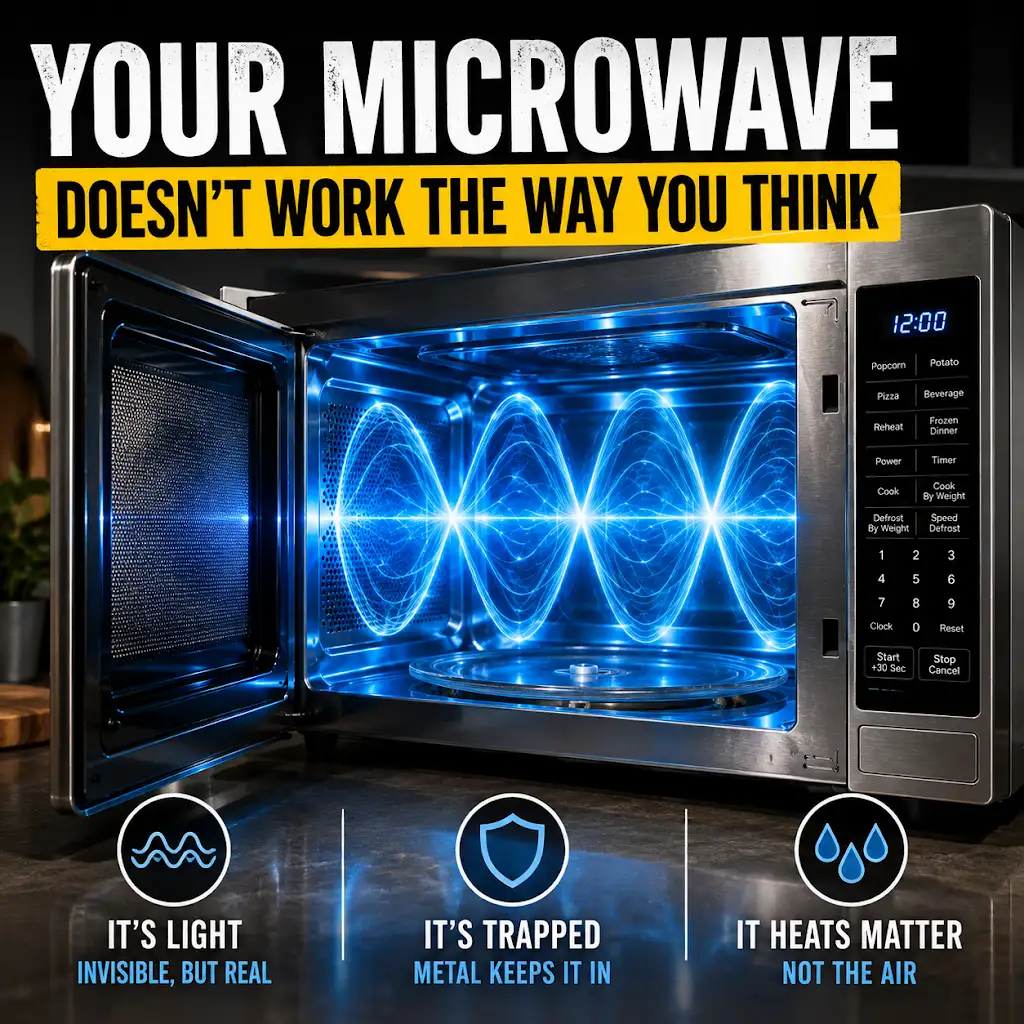
The metal walls of the cavity reflect the microwaves. These reflections, combined with the incoming waves, create a complex pattern of electromagnetic energy within the cavity known as a standing wave. This standing wave has areas of high and low energy.
The Turntable: Ensuring Even Cooking
Because of the standing wave pattern, some areas within the cavity will receive more microwave energy than others, leading to uneven heating. This is why most microwave ovens have a turntable. By rotating the food, the turntable ensures that different parts of the food pass through the high-energy zones of the standing wave, promoting more uniform cooking.
Control and Safety: Sophisticated Systems
Modern microwave ovens incorporate sophisticated control systems and safety features to ensure efficient and safe operation.
Power Levels and Timers
Electronic controls allow you to select different power levels (by cycling the magnetron on and off) and set precise cooking times.
Safety Interlocks
Multiple interlock switches are strategically placed on the door. If the door is opened even slightly, these interlocks immediately shut off the magnetron, preventing the escape of harmful microwave radiation.
Faraday Cage Effect
The metal enclosure of the microwave oven, along with the metal mesh in the door window, acts as a Faraday cage. This cage effectively blocks the microwaves from escaping into the surrounding environment.
Safety and Regulations: Responsible Use of Microwaves
While microwaves are incredibly useful, like any form of energy, it’s important to understand and adhere to safety guidelines and regulations to ensure their responsible use.
Understanding Microwave Exposure
The primary concern regarding microwave exposure is its heating effect on biological tissues. High levels of microwave radiation can cause burns.
Biological Effects
- Heating of Tissues: The most significant effect is the heating of tissues, especially those with high water content like the eyes and testes, which have less blood flow to dissipate heat.
- No Known Long-Term Health Risks from Low-Level Exposure: Extensive research has been conducted, and there is no scientific consensus that low-level microwave exposure from properly functioning appliances or general environmental sources poses long-term health risks like cancer.
Regulatory Standards and Limits
Governments and international bodies have established strict regulations for microwave-emitting devices, including consumer appliances and telecommunications equipment.
Microwave Ovens
- Leakage Limits: Regulatory bodies like the U.S. Food and Drug Administration (FDA) set limits on the amount of microwave radiation that can leak from a microwave oven. These limits are far below levels that could cause harm.
- Testing and Certification: Manufacturers are required to test their ovens to ensure they meet these safety standards before they can be sold.
Telecommunications and Other Devices
- Specific Absorption Rate (SAR): For devices like mobile phones that are held close to the body, regulations often focus on the Specific Absorption Rate (SAR), which measures the rate at which the body absorbs radiofrequency energy.
- Frequency Allocation and Power Limits: Regulatory agencies worldwide (like the FCC in the U.S. and Ofcom in the U.K.) manage the use of the radio frequency spectrum, including microwave frequencies, allocating specific bands for different applications and setting power limits to prevent interference and ensure safety.
Best Practices for Safe Microwave Use
Following these simple guidelines will ensure you continue to benefit from microwave technology safely:
- Inspect Your Microwave Oven: Regularly check your microwave oven for any signs of damage, especially to the door seal, hinges, or latch. If you notice any damage, discontinue use and have it repaired by a qualified technician.
- Do Not Operate an Empty Oven: Running a microwave oven with nothing inside can damage the magnetron.
- Use Microwave-Safe Cookware: Only use cookware specifically designed for microwave use. Metal objects, or cookware with metal trim, can cause arcing and damage the oven.
- Avoid Tampering with Safety Features: Never attempt to bypass or disable the safety interlocks on your microwave oven.
- Maintain a Safe Distance: While standing very close to an operating microwave oven is generally not harmful due to low leakage levels, it’s good practice to avoid prolonged, direct proximity.
- Follow Manufacturer Instructions: Always read and follow the operating instructions provided by the manufacturer of any microwave-emitting device.
By understanding these safety aspects and adhering to regulations, you can confidently utilize the power of microwaves in your daily life.
The Future of Microwaves: Expanding Horizons
The microwave spectrum is far from a static domain. Ongoing research and technological advancements are continuously pushing the boundaries of its applications, promising even more innovative uses in the years to come.
Higher Frequencies, Higher Bandwidth
The push towards higher frequencies within the microwave spectrum (like the aforementioned Ka-band and even into millimeter waves) is driven by the ever-increasing demand for data. These higher frequencies can carry significantly more information, enabling faster internet speeds, more immersive communication experiences, and advanced sensing capabilities.
Advanced Radar and Sensing
Beyond traditional radar, future applications are exploring the use of microwaves for highly detailed imaging and sensing. This could include:
- Through-Wall Imaging: Developing radar systems capable of “seeing” through walls, with applications in search and rescue, security, and construction.
- Material Analysis: Using microwave spectroscopy to identify and analyze the composition of materials with high precision.
5G and Beyond: The Evolution of Wireless Communication
The fifth generation of wireless technology (5G) already utilizes a range of microwave frequencies to deliver higher speeds, lower latency, and the ability to connect a massive number of devices simultaneously. Future generations of wireless communication will likely continue to leverage and expand upon these microwave bands.
Industrial Innovations
The efficiency and precision of microwave heating are leading to new industrial applications:
- Sustainable Manufacturing: Exploring microwave-assisted synthesis for creating new materials and chemicals more efficiently and with less waste.
- Advanced Drying Techniques: Developing highly specialized drying processes for delicate materials like pharmaceuticals and advanced composites.
Medical Frontiers
The medical field continues to explore novel uses of microwaves:
- Minimally Invasive Therapies: Developing more targeted and less invasive treatments for a range of conditions using focused microwave energy.
- Advanced Diagnostics: Refining microwave imaging techniques for earlier and more accurate disease detection.
The microwave electromagnetic spectrum, once a niche area of study, is now an integral part of your technologically advanced world. From the convenience of your kitchen to the global connectivity that defines our era, these invisible waves are silently at work. By understanding their fundamental properties, their diverse applications, and the principles that govern them, you gain a deeper appreciation for the invisible forces that shape your everyday existence. Continue to explore, to learn, and to marvel at the power and versatility of the microwave spectrum – it’s a journey that is still unfolding.
Your Microwave Doesn’t Work the Way You Think
FAQs
What is the electromagnetic spectrum?
The electromagnetic spectrum is the range of all types of electromagnetic radiation. It includes radio waves, microwaves, infrared, visible light, ultraviolet, X-rays, and gamma rays.
Where do microwaves fall on the electromagnetic spectrum?
Microwaves fall between radio waves and infrared radiation on the electromagnetic spectrum. They have wavelengths ranging from about one meter to one millimeter.
How are microwaves used in everyday life?
Microwaves are commonly used for cooking food in microwave ovens, as well as in communication devices such as cell phones and Wi-Fi routers. They are also used in radar systems and medical imaging.
What are the potential health risks associated with microwaves?
Exposure to high levels of microwaves can cause tissue heating and burns. However, the levels of microwaves used in household appliances and communication devices are considered safe and do not pose a significant health risk.
How are microwaves different from other types of electromagnetic radiation?
Microwaves have longer wavelengths and lower frequencies than visible light, making them suitable for various applications such as cooking, communication, and radar. Unlike X-rays and gamma rays, microwaves are non-ionizing radiation, meaning they do not have enough energy to remove electrons from atoms or molecules.