
The Cosmological Principle is a fundamental concept in cosmology that states the universe is homogeneous and isotropic on large scales. This means that when observed at sufficiently large distances, the distribution of matter and energy appears uniform throughout space, and looks the same in all directions. This principle serves as a critical simplification for mathematical models describing cosmic structure and evolution.
This concept has significant practical applications in astronomy and cosmology. By assuming large-scale uniformity, scientists can develop consistent models for interpreting observational data from distant galaxies and cosmic background radiation. The Cosmological Principle has been essential in formulating theories about universal expansion and has provided the theoretical framework for major cosmological discoveries, including insights about the origin, current state, and potential future of the universe.
One fascinating concept explored in modern science is simulation theory.
Key Takeaways
- The Cosmological Principle asserts that the universe is homogeneous and isotropic on large scales.
- Observational evidence, such as the cosmic microwave background, supports this principle.
- Dark matter and dark energy play crucial roles in shaping the large scale structure of the universe.
- The cosmic web illustrates the complex distribution of galaxies formed through gravitational evolution.
- Despite its success, the Cosmological Principle faces challenges and ongoing research aims to refine our understanding.
Historical Development of the Cosmological Principle
The roots of the Cosmological Principle can be traced back to ancient civilizations, where early astronomers began to contemplate the nature of the cosmos. However, it wasn’t until the 20th century that this principle gained significant traction in scientific discourse. Pioneering figures such as Albert Einstein and Alexander Friedmann laid the groundwork for modern cosmology by introducing mathematical models that incorporated this principle.
Einstein’s General Theory of Relativity, published in 1915, revolutionized our understanding of gravity and space-time, allowing for a more profound exploration of the universe’s structure. As you delve deeper into history, you’ll discover that the Cosmological Principle was further refined through observational evidence. Edwin Hubble’s discovery of the expanding universe in the 1920s provided a crucial validation of this principle.
By observing distant galaxies and their redshifts, Hubble demonstrated that the universe is not static but rather expanding uniformly in all directions. This pivotal moment in cosmology solidified the Cosmological Principle’s role in understanding the universe’s large-scale structure.
Key Concepts of the Cosmological Principle
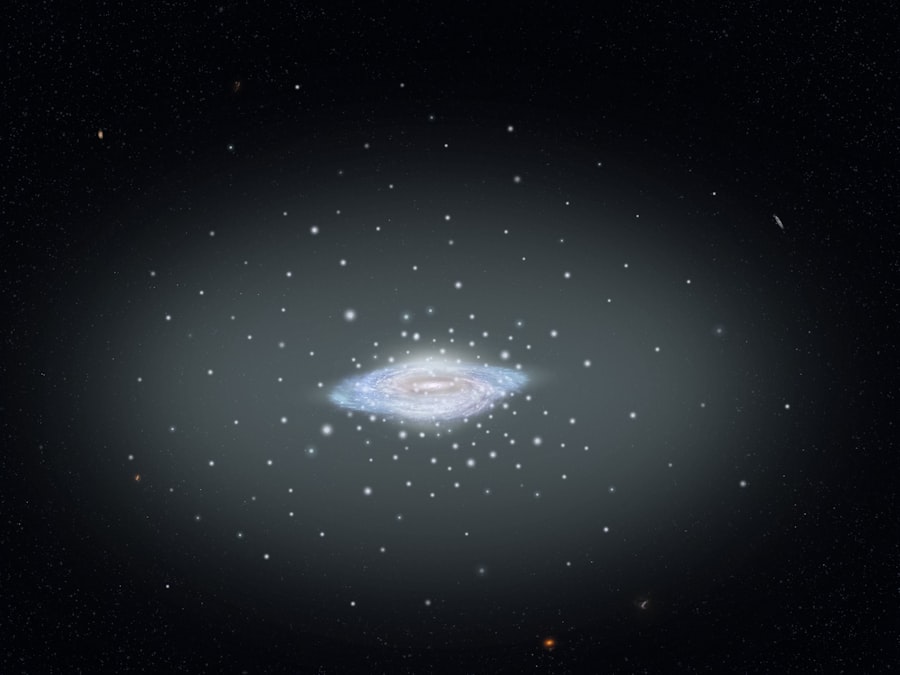
At its core, the Cosmological Principle encompasses two key concepts: homogeneity and isotropy. Homogeneity suggests that matter is evenly distributed throughout the universe when viewed on a grand scale. This means that if you were to take a sufficiently large volume of space, you would find a similar density of galaxies and cosmic structures regardless of where you looked.
Isotropy, on the other hand, implies that the universe looks the same in all directions. If you were to gaze into the night sky from any point in space, you would observe a similar distribution of galaxies and cosmic phenomena. These concepts are not merely abstract ideas; they have profound implications for your understanding of cosmic evolution.
By assuming homogeneity and isotropy, cosmologists can simplify complex equations governing gravitational interactions and cosmic expansion. This simplification allows for more accurate predictions about how structures form and evolve over time, ultimately leading to a deeper comprehension of the universe’s history.
Observational Evidence for the Cosmological Principle
As you explore the vastness of space, you’ll encounter a wealth of observational evidence supporting the Cosmological Principle. One of the most compelling pieces of evidence comes from the Cosmic Microwave Background (CMB) radiation. Discovered in 1965 by Arno Penzias and Robert Wilson, this faint afterglow of the Big Bang provides a snapshot of the universe when it was just 380,000 years old.
The uniformity of the CMB across the sky supports the idea that the universe is homogeneous and isotropic on large scales. Additionally, large-scale galaxy surveys have revealed patterns consistent with the Cosmological Principle. Observations from projects like the Sloan Digital Sky Survey (SDSS) have mapped millions of galaxies, revealing a web-like structure known as the cosmic web.
This intricate arrangement of galaxies and voids aligns with predictions made by cosmological models based on homogeneity and isotropy. As you consider these findings, it becomes clear that observational evidence plays a crucial role in validating the Cosmological Principle and enhancing your understanding of cosmic structure.
Implications of the Cosmological Principle on Large Scale Structure
| Metric | Description | Typical Value / Range | Relevance to Cosmological Principle |
|---|---|---|---|
| Homogeneity Scale | Scale above which the universe appears uniform in matter distribution | ~100-300 Megaparsecs (Mpc) | Supports the assumption that the universe is homogeneous on large scales |
| Isotropy | Uniformity of the universe in all directions | Observed Cosmic Microwave Background (CMB) temperature fluctuations ~10⁻⁵ | Confirms isotropy, a key part of the cosmological principle |
| Two-Point Correlation Function | Measures clustering of galaxies as a function of scale | Correlation length ~5 Mpc | Shows structure on small scales but approaches zero at large scales, consistent with homogeneity |
| Power Spectrum of Matter Density Fluctuations | Quantifies distribution of matter density variations across scales | Peaks at ~100 Mpc scale (Baryon Acoustic Oscillations) | Provides evidence for large scale structure formation consistent with cosmological principle |
| Galaxy Cluster Distribution | Spatial distribution of galaxy clusters | Clusters separated by tens to hundreds of Mpc | Clusters trace large scale structure but distribution is statistically uniform on large scales |
The implications of the Cosmological Principle extend to your understanding of large-scale structures in the universe. By assuming homogeneity and isotropy, cosmologists can develop models that describe how galaxies cluster together and form larger structures like galaxy groups and clusters. These models help explain why galaxies are not randomly distributed but instead form intricate patterns influenced by gravitational interactions.
As you contemplate these large-scale structures, you’ll realize that they are not static entities; they evolve over time due to gravitational forces and cosmic expansion. The Cosmological Principle allows scientists to predict how these structures will change as the universe continues to expand. This understanding is vital for grasping not only how galaxies interact but also how they influence one another through gravitational pull, ultimately shaping the cosmic landscape you observe today.
The Role of Dark Matter and Dark Energy in Large Scale Structure

As you delve deeper into cosmology, you’ll encounter two enigmatic components: dark matter and dark energy. These elements play a pivotal role in shaping large-scale structures within the universe while remaining largely invisible to direct observation. Dark matter, which constitutes about 27% of the universe’s total mass-energy content, exerts gravitational influence on visible matter, helping to bind galaxies together within clusters.
Dark energy, on the other hand, accounts for approximately 68% of the universe’s energy density and is responsible for its accelerated expansion. As you consider their roles, it becomes evident that both dark matter and dark energy are essential for understanding how large-scale structures form and evolve over time. The interplay between these components creates a dynamic environment where galaxies cluster together while simultaneously being pushed apart by dark energy’s repulsive force.
Formation and Evolution of Large Scale Structure
The formation and evolution of large-scale structures are complex processes influenced by various factors, including gravity, dark matter, and cosmic expansion. Initially, small density fluctuations in the early universe led to regions where matter began to clump together under gravitational attraction. As you explore this process, you’ll find that dark matter played a crucial role in providing the necessary gravitational scaffolding for galaxies to form.
Over billions of years, these clumps grew larger as they attracted more matter, leading to the formation of galaxies and galaxy clusters. As structures evolved, they interacted with one another through gravitational forces, resulting in mergers and collisions that shaped their current forms. The ongoing evolution of these structures is a testament to the dynamic nature of the universe, where change is constant and influenced by both visible and invisible forces.
The Cosmic Web: Understanding the Distribution of Galaxies
As you gaze into the night sky or explore detailed maps of galaxy distributions, you’ll encounter what is known as the cosmic web—a vast network of interconnected galaxies, clusters, and voids. This intricate structure arises from gravitational interactions among galaxies influenced by dark matter’s presence. The cosmic web is characterized by filaments of galaxies connected by vast empty regions known as voids.
Understanding this cosmic web is essential for grasping how galaxies are distributed throughout space. The patterns observed align with predictions made by cosmological models based on homogeneity and isotropy. As you contemplate this web-like structure, you’ll appreciate how it reflects both the history of cosmic evolution and ongoing processes shaping our universe today.
Challenges and Limitations of the Cosmological Principle
While the Cosmological Principle has proven invaluable in advancing our understanding of cosmology, it is not without its challenges and limitations. One significant challenge arises from observations at smaller scales where homogeneity may break down. For instance, within galaxy clusters or even within our own Milky Way galaxy, matter is not evenly distributed; instead, it exhibits significant variations in density.
Anomalies such as large-scale structures that appear too massive or too clustered challenge traditional interpretations based on homogeneity and isotropy. As you consider these challenges, it’s essential to recognize that scientific inquiry is an evolving process—one that continually seeks to refine our understanding while addressing limitations inherent in existing models.
Future Directions in Understanding Large Scale Structure
As you look toward future explorations in cosmology, exciting possibilities await regarding our understanding of large-scale structures in the universe. Advances in observational technology will enable astronomers to probe deeper into cosmic history than ever before. Upcoming missions like NASA’s James Webb Space Telescope promise to unveil new insights into galaxy formation and evolution by observing distant galaxies at unprecedented resolutions.
Moreover, ongoing research into dark matter and dark energy will continue to shape our understanding of large-scale structures. As scientists develop new theoretical frameworks and conduct experiments aimed at detecting these elusive components directly, your comprehension of their roles will deepen significantly. The future holds immense potential for unraveling mysteries surrounding cosmic evolution while refining or even redefining aspects of the Cosmological Principle itself.
The Importance of the Cosmological Principle in Understanding the Universe
In conclusion, as you reflect on your journey through cosmology and explore concepts like homogeneity and isotropy embodied by the Cosmological Principle, you’ll recognize its profound significance in shaping our understanding of the universe. This principle serves as a guiding framework for interpreting observations while providing insights into large-scale structures’ formation and evolution. The interplay between dark matter, dark energy, and cosmic expansion further enriches this narrative—offering glimpses into an intricate tapestry woven over billions of years.
Ultimately, embracing these concepts will deepen your appreciation for both our place within this vast cosmos and humanity’s quest to understand its mysteries.
The cosmological principle, which posits that the universe is homogeneous and isotropic on large scales, plays a crucial role in our understanding of the large-scale structure of the cosmos. For a deeper exploration of this concept and its implications, you can read more in the article available at