You’re probably using a microwave right now, or at least have one in your kitchen. It’s a ubiquitous appliance, a miracle of modern convenience that heats your leftovers or pops your popcorn in a matter of minutes. But have you ever stopped to consider what’s actually happening inside that humming box? You might have heard terms like “wavelength” and “frequency” thrown around in relation to microwaves, often in a technical context. While these concepts might sound intimidating, understanding them is key to appreciating the science behind your culinary wizard. It’s not just about setting a timer; it’s about harnessing electromagnetic waves at specific frequencies to cook your food efficiently.
The Electromagnetic Spectrum: Your Microwave’s Home
Imagine a vast, invisible landscape of energy. This is the electromagnetic spectrum, and it’s where your microwave finds its place. It’s a continuum of waves, each with its own unique properties. You’re already familiar with parts of this spectrum, even if you don’t think about it that way. Visible light, the very thing that allows you to read this article, is just a tiny sliver of this spectrum. Radio waves, which carry music and news to your car, are on one end, while X-rays and gamma rays, used in medical imaging and with significant power, are on the other. Microwaves occupy a specific band within this spectrum, nestled between radio waves and infrared radiation. This positioning is crucial because it dictates their behavior and their ability to interact with matter in a way that’s perfect for cooking.
Radio Waves: The Long and Winding Road
On one end of the spectrum, you have radio waves. These are the longest wavelengths, and as such, they have the lowest frequencies. Think of them as slow, gentle undulations across the electromagnetic landscape. Their long wavelengths allow them to travel great distances, bouncing off the ionosphere and circumventing obstacles. This is why you can receive radio signals from far away. Their low frequency means they carry less energy per wave. They’re excellent for broadcasting information, but not particularly good at making things hot.
Infrared Radiation: The Warm Embrace
Moving up the spectrum, you encounter infrared radiation. You might feel this as heat radiating from a warm object or a fire. Infrared waves are shorter than radio waves and carry more energy. They are responsible for the feeling of warmth because they efficiently transfer energy to molecules, causing them to vibrate and generate heat. While infrared can heat things up, it’s not the primary mechanism for cooking in a microwave oven.
Visible Light: The Spectrum You See
This is the part of the spectrum that your eyes are designed to detect. From the reds and oranges to the blues and violets, visible light allows you to perceive the world around you. The wavelengths here are much shorter than radio waves, and the frequencies are higher, carrying more energy. While visible light can interact with matter, its primary function for us is illumination, not cooking.
Microwave wavelengths and frequencies play a crucial role in various applications, from communication technologies to cooking. For a deeper understanding of how these concepts are interrelated, you can explore the article available at Freaky Science, which provides a comprehensive explanation of microwave radiation and its practical implications. This resource will enhance your knowledge of the electromagnetic spectrum and the significance of microwaves in everyday life.
Decoding the Terms: Wavelength and Frequency Explained
Now, let’s dive into the two key terms you need to understand to grasp how your microwave works: wavelength and frequency. These two concepts are intrinsically linked, like two sides of the same coin. One cannot exist without the other, and their relationship is governed by a fundamental constant.
Wavelength: The Distance Between Peaks
Imagine waves on the surface of water. The wavelength is simply the distance between one crest of a wave and the next crest. In the context of electromagnetic waves, it’s the spatial distance occupied by one complete cycle of the wave. It’s usually measured in meters, centimeters, or even nanometers for shorter waves. Microwaves, for instance, have wavelengths typically in the range of centimeters. This relatively short wavelength is a critical factor in their ability to interact with food molecules effectively. Think of it as the “size” of the wave. A longer wavelength means a bigger, more spread-out wave, while a shorter wavelength means a more compressed, tighter wave.
Frequency: How Often Waves Pass By
Frequency, on the other hand, tells you how many complete wave cycles pass a given point in one second. It’s measured in Hertz (Hz), where 1 Hz means one cycle per second. Larger units like kilohertz (kHz), megahertz (MHz), and gigahertz (GHz) are commonly used. A microwave oven typically operates at a frequency of around 2.45 GHz. This means that 2.45 billion wave cycles are passing through your food every single second. Imagine standing on a pier and counting how many waves crash onto the shore each minute. That’s analogous to frequency. Higher frequency means more waves passing by in the same amount of time.
The Intertwined Relationship: Speed of Light as the Bridge
The relationship between wavelength and frequency is defined by the speed of light, a universal constant denoted by the letter ‘c’. The equation is simple:
$$c = lambda times f$$
Where:
- $c$ is the speed of light (approximately 299,792,458 meters per second)
- $lambda$ (lambda) is the wavelength
- $f$ is the frequency
This equation tells you that wavelength and frequency are inversely proportional. If you increase the frequency of an electromagnetic wave, its wavelength must decrease to maintain the constant speed of light, and vice versa. This is a fundamental principle that applies to all electromagnetic radiation, including the microwaves that heat your food. So, when your microwave oven operates at a specific frequency, it inherently means it’s working with a corresponding specific wavelength. You can’t change one without affecting the other.
Why Microwaves and Not Other Waves? The Magic of Water Molecules
The reason microwaves are so effective at cooking lies in their specific frequency and wavelength and how they interact with water molecules. Water is a polar molecule, meaning it has a slightly positive charge on one end and a slightly negative charge on the other. This makes it like a tiny magnet.
The Dielectric Heating Process: A Molecular Dance
When microwaves of the correct frequency encounter water molecules, they cause them to rapidly rotate back and forth, trying to align themselves with the oscillating electric field of the microwave. Imagine holding a bunch of tiny bar magnets and rapidly moving the north and south poles of a larger magnet in front of them. The tiny magnets would try to twist and turn to follow the changing poles. This constant jostling and rotation of water molecules generates friction. And as you know, friction creates heat. This process is called dielectric heating, and it’s the primary mechanism by which your microwave cooks food.
The Resonance Effect: Hitting the Sweet Spot
The frequency of 2.45 GHz is particularly effective because it’s close to the resonant frequency of water molecules. This means that at this frequency, the microwaves can efficiently transfer energy to the water molecules, causing them to vibrate with maximum amplitude. If the frequency were too low or too high, the interaction would be less efficient, and the heating wouldn’t be as rapid or uniform. It’s like hitting a tuning fork with the right frequency to make it resonate – the microwaves “resonate” with the water molecules, making them vibrate intensely.
Other Polar Molecules: A Supporting Cast
While water is the star of the show, other polar molecules in food, such as fats and sugars, also absorb microwave energy and contribute to the heating process. However, water is present in the highest concentration in most foods, making it the dominant factor in microwave cooking. This is why foods with a higher water content tend to cook faster and more evenly in a microwave. Dry foods, with less water, often require longer cooking times or may benefit from the addition of moisture.
The Anatomy of a Microwave Oven: How it Generates and Directs Waves
Your microwave oven isn’t just a simple box. It’s a sophisticated piece of engineering designed to generate and precisely direct those crucial microwaves into your food. Understanding its components will demystify the process further.
The Magnetron: The Heartbeat of the Microwave
The key component responsible for generating microwaves is the magnetron. This is a vacuum tube that, through a clever interplay of magnetic fields and electron streams, produces high-frequency electromagnetic waves. Think of it as the power source that “manufactures” the microwaves. It converts electrical energy into microwave energy. The magnetron is a powerful device, and its output is carefully controlled to ensure safe and effective cooking.
The Waveguide: The Highway for Microwaves
Once generated, the microwaves need to be channeled into the cooking cavity. This is the job of the waveguide. It’s a hollow metal tube that directs the microwaves from the magnetron to the oven cavity. The dimensions of the waveguide are precisely designed to match the wavelength of the microwaves, ensuring efficient transmission without significant loss of energy. It’s essentially a controlled pathway, preventing the microwaves from escaping before they reach your food.
The Cavity: The Cooking Chamber
The cooking cavity is the metal box where you place your food. The metal walls of the cavity are designed to reflect the microwaves. This bouncing and reflection of waves within the cavity ensures that the microwaves are distributed throughout the food, penetrating it from multiple directions. This is why the interior of your microwave is made of metal – to trap and reflect the waves.
The Turntable and Stirrer: Ensuring Even Cooking
Despite the reflection within the cavity, there can still be areas of uneven heating, known as hot spots and cold spots. To combat this, most microwaves incorporate a turntable or a stirrer fan. The turntable rotates your food, ensuring that different parts of it are exposed to the microwave energy over time. A stirrer fan, often located at the top of the cavity, is a rotating metal blade that disperses the microwaves more evenly throughout the cavity, further reducing hot spots. Both mechanisms aim to achieve a more uniform cooking experience.
Microwave technology plays a crucial role in various applications, from communication systems to cooking appliances. Understanding the relationship between microwave wavelength and frequency is essential for optimizing these technologies. For a deeper insight into this topic, you can explore a related article that explains these concepts in detail. This resource can enhance your comprehension of how these electromagnetic waves function in practical scenarios. To read more, visit this article.
Safety and Best Practices: Understanding the Limits
While microwaves are incredibly useful, it’s essential to understand their limitations and use them safely. The very properties that make them effective for cooking also necessitate certain precautions.
Material Matters: What to Put In and What to Avoid
Not all materials are created equal when it comes to microwave use. Metal, for example, can reflect microwaves and cause arcing, which can damage your microwave and be a fire hazard. This is why you should never put metal objects in your microwave. Certain plastics can melt or leach chemicals into your food when heated. Always use microwave-safe containers, typically labeled as such. Glass and ceramic are generally safe, but be mindful of any metallic trim or decorative elements.
The Importance of Proper Sealing: Venting is Key
When heating foods with a sealed casing, like eggs or potatoes, it’s crucial to pierce them or vent them. The rapid heating of the water inside can create steam pressure, which can build up and cause the food to explode. Venting allows the steam to escape, preventing this potentially dangerous situation. Always prick the skins of items like baked potatoes or sausages before microwaving.
Radiation Leakage: Understanding the Shielding
Microwave ovens are designed with shielding to prevent radiation from escaping. The metal cavity, the door seal, and the mesh on the viewing window all work together to contain the microwaves. However, like any electronic device, they are not infallible. It’s important to ensure that your microwave door closes properly and that the seal is intact. Damaged doors or seals can compromise the shielding and lead to microwave leakage. Reputable manufacturers adhere to strict safety standards, but regular inspection of your appliance is always a good practice.
Cooking Times and Power Levels: Mastering the Art
Understanding how to use power levels and cooking times is crucial for optimal results and safety. Higher power levels deliver more intense microwave energy, leading to faster cooking. Lower power levels provide a gentler heat, suitable for defrosting or simmering. Overcooking can lead to dry, tough food and can even damage your microwave. Always refer to recipe guidelines or experiment cautiously to find the right settings for your specific needs.
Conclusion: Empowered by Knowledge
You’ve now taken a significant step in understanding the seemingly magical appliance in your kitchen. By grasping the concepts of wavelength and frequency, you can appreciate how microwaves harness electromagnetic energy to cook your food. You know that the specific frequency of 2.45 GHz allows for efficient dielectric heating by making water molecules dance. You understand the roles of the magnetron, waveguide, and cavity in generating and directing these waves, and the importance of turntables and stirrers for even cooking. Most importantly, you’re equipped with the knowledge to use your microwave safely and effectively, appreciating the science behind every heated meal. So, the next time you pop your popcorn or reheat your dinner, you can do so with a newfound understanding and appreciation for the invisible forces at play.
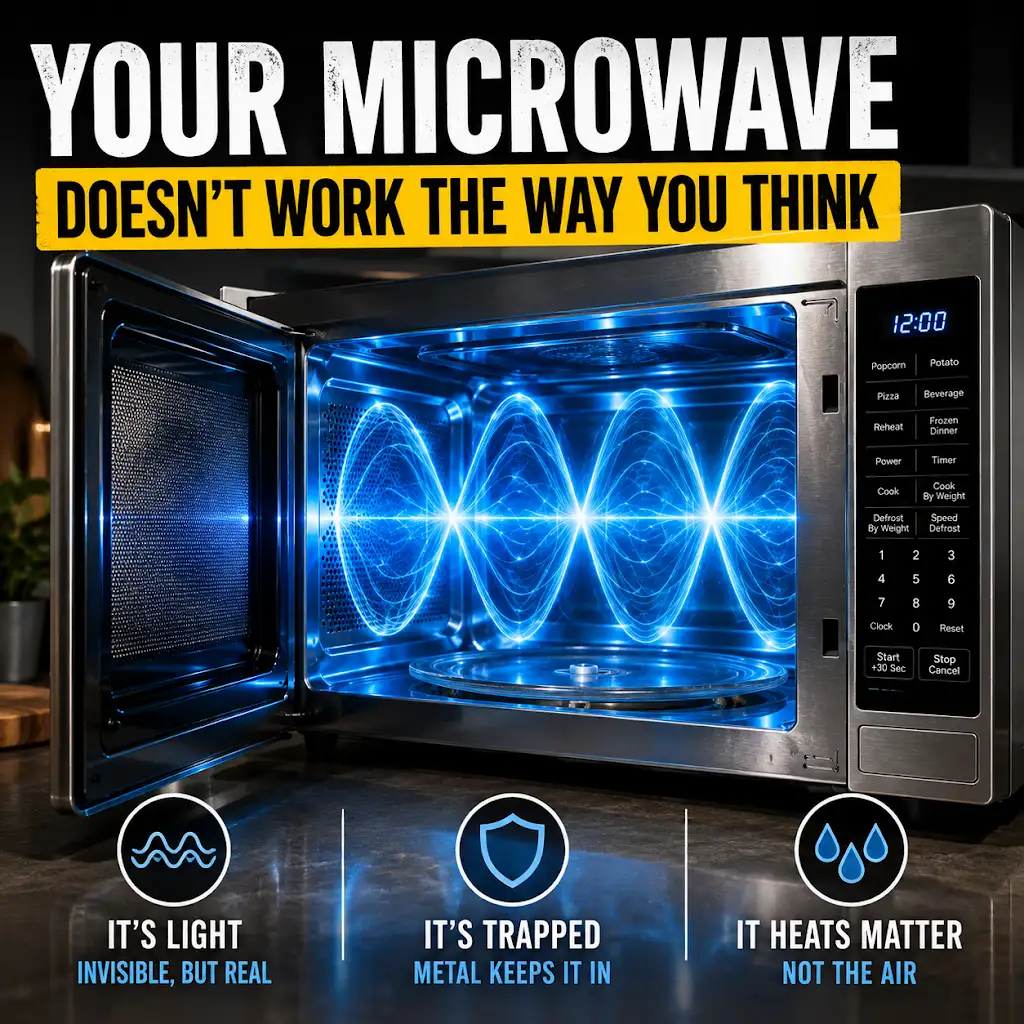
Your Microwave Doesn’t Work the Way You Think
FAQs

What is the wavelength of a microwave?
The wavelength of a microwave typically ranges from 1 millimeter to 1 meter.
What is the frequency of a microwave?
The frequency of a microwave ranges from 300 megahertz (MHz) to 300 gigahertz (GHz).
How are microwaves used in everyday life?
Microwaves are commonly used in microwave ovens for cooking food, in communication systems such as cell phones and Wi-Fi, and in radar systems for navigation and weather forecasting.
What are the properties of microwaves?
Microwaves have the ability to penetrate clouds, smoke, and fog, making them useful for communication and radar systems. They are also absorbed by water and certain other molecules, which is why they are effective for heating food in microwave ovens.
How do microwaves compare to other types of electromagnetic waves?
Microwaves have longer wavelengths and lower frequencies than visible light, but shorter wavelengths and higher frequencies than radio waves. They fall between the two on the electromagnetic spectrum.