You’ve probably experienced it. You pop your popcorn, and some kernels are perfectly popped, while others remain stubbornly unpopped. Or maybe your leftovers get heated unevenly, with scalding hot spots and cold, unappetizing patches. The culprit? Microwave standing waves. They’re an invisible force shaping your microwave’s heating performance, and understanding them is key to achieving perfectly cooked meals.
Microwaves, by their very nature, generate electromagnetic radiation at a specific frequency, typically around 2.45 gigahertz. This energy is designed to excite water molecules within your food, causing them to vibrate and generate heat. However, the enclosed metal box of your microwave oven isn’t an infinite expanse; it’s a confined space. This confinement leads to a fascinating phenomenon: the waves don’t just travel unimpeded. They bounce off the walls, interact with themselves, and create intricate patterns of high and low energy. These patterns are known as standing waves, and they are the reason behind those frustrating hot and cold spots.
The Basics of Wave Reflection
To grasp standing waves, you first need to understand how waves behave when they encounter a boundary. Imagine dropping a pebble into a still pond. Ripples, which are essentially waves, spread outwards. If these ripples reach the edge of the pond, they don’t simply disappear. They reflect back into the pond, interacting with the incoming waves.
In a microwave, the metal walls act as highly reflective surfaces. When the microwave radiation, generated by the magnetron (the heart of your microwave), is directed into the oven cavity, it bounces off these walls. This reflection isn’t a single, simple bounce. The waves interact with each other in complex ways due to the geometry of the oven and the wavelength of the microwaves.
Microwave standing waves are a fascinating phenomenon that can significantly impact the efficiency of microwave ovens and other applications. For a deeper understanding of this topic, you can explore a related article that delves into the science behind these waves and their practical implications. To read more about it, visit Freaky Science, where you will find comprehensive explanations and insights into the behavior of microwaves and their interactions with various materials.
Constructive and Destructive Interference
The key to understanding standing waves lies in the principle of interference. When two or more waves meet, their amplitudes can either add up (constructive interference) or cancel each other out (destructive interference).
Constructive Interference: Building Up the Energy
When two waves meet in phase – meaning their crests align with crests and their troughs align with troughs – their amplitudes combine. This results in a wave with a larger amplitude, and therefore, higher energy. In a microwave, this constructive interference leads to areas of intense microwave energy. These are your notorious hot spots, where food heats up much faster than in surrounding areas.
Destructive Interference: Canceling Out the Energy
Conversely, when two waves meet out of phase – meaning the crest of one wave aligns with the trough of another – they cancel each other out. This results in a wave with a reduced amplitude, and consequently, lower energy. In a microwave, this destructive interference creates areas of minimal microwave energy, the dreaded cold spots, where food remains undercooked or entirely raw.
The Formation of Standing Waves
Standing waves are the result of this continuous interplay of reflection and interference within the microwave cavity. Imagine a wave traveling from the magnetron towards one wall. It reflects, travels back, reflects off another wall, and so on. At specific points within the oven, these reflected waves will consistently align or oppose each other, creating stable regions of high and low energy.
Antinodes: The Peaks of Energy
The points where constructive interference is maximized are called antinodes. At an antinode, the microwave field oscillates with its maximum amplitude, leading to intense heating. These are the hot spots you often discover when you stir or cut into your microwaved food.
Nodes: The Valleys of Energy
Conversely, the points where destructive interference leads to the cancellation of the wave are called nodes. At a node, the microwave field amplitude is at its minimum, meaning very little energy is delivered to the food. These are your cold spots, where food remains significantly cooler.
The Wavelength and Oven Dimensions
The specific pattern of standing waves is determined by the wavelength of the microwaves and the dimensions of the microwave oven cavity. The wavelength ($\lambda$) of a microwave is inversely proportional to its frequency ($f$) and the speed of light ($c$): $\lambda = c/f$. For the typical 2.45 GHz frequency, the wavelength is approximately 12.2 cm.
Resonance and Oven Geometry
The microwave oven is essentially a resonant cavity. Standing waves are most pronounced when the dimensions of the cavity are in specific ratios to the wavelength. If the oven cavity were a perfect cube and its dimensions were an integer multiple of half wavelengths, you would theoretically have a very uniform standing wave pattern. However, real microwave ovens are not perfect cubes, and the placement of the turntable further complicates the situation.
Microwave standing waves are a fascinating phenomenon that can significantly impact the efficiency of microwave ovens and other applications. For a deeper understanding of this topic, you might find the article on the principles of microwave technology particularly enlightening. It explores how standing waves are formed and their implications in various devices. To read more about it, click on this link.
The Role of the Turntable
You might have wondered why your microwave has a turntable. Its primary purpose is to combat the uneven heating caused by standing waves. By rotating the food, the turntable ensures that different parts of the food are exposed to varying levels of microwave energy over time.
Continuous Movement Through Hot and Cold Spots
As the food rotates, it moves through the antinodes (hot spots) and nodes (cold spots) of the standing wave pattern. This continuous movement helps to average out the heating, allowing for more uniform cooking. Without a turntable, your food would likely develop very pronounced hot and cold regions, making it difficult to cook anything evenly.
Limitations of the Turntable
While the turntable is a crucial component, it’s not a perfect solution. The standing wave pattern itself is static. The turntable simply moves the food through this static pattern. If the food is very large or dense, or if it’s not placed correctly on the turntable, some parts might still spend more time in hotter or colder areas than others, leading to some unevenness.
The Impact on Cooking and Food
The presence of standing waves has a direct and noticeable impact on your cooking experience. Understanding these effects can help you adapt your microwave cooking techniques.
Uneven Heating: The Most Common Complaint
As we’ve discussed, uneven heating is the hallmark of microwave standing waves. You’ll see this in the form of:
- Partially cooked food: Some areas might be perfectly done, while others are still cold or raw.
- Overcooked and burnt edges: High-energy antinodes can quickly overheat and even burn the outer edges of your food while the center remains cool.
- Rubber-like textures: Overheating of certain foods, especially proteins, due to concentrated energy can lead to a tough and rubbery texture.
Efficiency and Power Distribution
The uneven distribution of energy means that your microwave isn’t always operating at peak efficiency. While the magnetron is delivering a consistent amount of power, that power is not being distributed uniformly throughout the cavity. This can lead to longer cooking times as you try to compensate for the cold spots, or it can result in wasted energy heating up specific areas that don’t effectively contribute to cooking.
The Importance of Food Placement
How you place your food in the microwave can influence how it interacts with the standing waves.
Centering is Key
For most microwaveable items, centering them on the turntable is generally the best approach. This allows the food to rotate through the most varied parts of the standing wave pattern.
Spreading Food Out
If you’re microwaving multiple items or a large dish, try to spread the food out as evenly as possible. Avoid piling food up in the center or stacking it too high, as this can create areas that are shielded from the microwave energy or that are predominantly exposed to a single hot or cold spot.
Smaller, Thicker Items
For smaller, thicker items like a single chicken breast or a dense vegetable, consider cutting them into smaller, more uniform pieces. This will allow the microwave energy to penetrate more evenly and reduce the likelihood of extreme hot or cold spots.
Strategies for Overcoming Standing Waves
Fortunately, you’re not entirely at the mercy of these invisible wave patterns. Several strategies can help you mitigate the effects of microwave standing waves and achieve more even cooking.
Stirring and Rotating
This is perhaps the most fundamental technique. As mentioned, the turntable does some of this automatically, but active stirring or rotating your food halfway through the cooking process is highly recommended.
Manual Stirring for Soups and Sauces
For dishes like soups, stews, or sauces, manually stirring them halfway through the cooking time is essential. This redistributes the hot and cold liquid, ensuring that all parts of the food are exposed to similar heating.
Rotating Larger Items
For larger food items that don’t need to be stirred, manually rotating them 90 or 180 degrees during cooking can help. This ensures that different sides of the food face the areas of highest and lowest energy.
Arranging Food Strategically
How you arrange food within the microwave can significantly impact its cooking.
Ring Arrangement
For foods like pastries or items that benefit from even heating throughout, arrange them in a ring on the turntable. Leave a small gap in the center. This allows the microwave energy to reach the edges of the food more effectively.
Placing Denser Foods Towards the Center
In some cases, placing denser, thicker parts of your food closer to the center of the plate (where the turntable’s rotation might offer slightly more variation) can help them cook more thoroughly. However, this is a nuanced technique and depends heavily on the specific food.
Using Microwave-Safe Cookware
The material and shape of your cookware can also play a role, though its effect on standing waves is less direct than other factors.
Choosing the Right Materials
Always use microwave-safe dishes. Avoid metal or dishes with metallic trim, as these can reflect microwaves in unpredictable ways, potentially causing arcing or damaging your microwave.
Understanding Shape and Surface Area
Round or oval dishes tend to heat more evenly than square or rectangular ones because they have fewer sharp corners where energy can concentrate or dissipate unevenly. The surface area exposed to the microwaves also matters; thinner, spread-out foods will heat faster than thick, compact ones.
Covering Food
Covering your food can help to trap steam and promote more even cooking.
Using Microwave-Safe Lids or Plastic Wrap
Covering dishes with a microwave-safe lid or plastic wrap (ensure it’s vented to allow steam to escape) helps to create a more humid environment. This steam distribution can help to equalize temperatures throughout the food.
Venting is Crucial
Always ensure that your cover is vented. Trapped steam can build up pressure and cause the lid to blow off, or worse, lead to an explosion of hot food. A small slit in plastic wrap or a slightly ajar lid is usually sufficient.
Power Levels and Cooking Times
Adjusting the power level of your microwave can be a surprisingly effective way to combat standing waves.
Lowering the Power for Delicate Foods
For delicate foods like fish or certain vegetables, using a lower power setting for a longer duration can be beneficial. At lower power, the magnetron cycles on and off more frequently, and the food has more time to absorb heat and redistribute it through conduction and convection. This “gentler” approach helps to minimize the impact of intense hot spots.
Understanding the Magnetron Cycle
Remember that even at lower power settings, the magnetron still generates microwaves at its full power when it’s on. The “lower power” is achieved by cycling the magnetron on and off for shorter durations, creating periods of heating followed by periods of rest. This intermittent heating can help to prevent extreme overheating in localized areas.
Microwave Ovens with Turntable Alternatives
While most household microwaves rely on a rotating turntable, some higher-end models incorporate alternative technologies to address standing waves.
Stirrer Fans
Some microwaves have a built-in “stirrer fan” that is a metallic fan located at the top of the oven cavity. This fan rotates, reflecting the microwaves in different directions to help distribute the energy more evenly throughout the oven cavity, effectively scrambling the standing wave pattern.
Convection and Grill Features
More advanced microwaves often include convection and grill functions. While these are separate heating mechanisms, they can complement microwave heating. The convection fan can help to circulate air and distribute heat more evenly, and the grill element can provide surface browning and aid in cooking. When using the microwave function in conjunction with these, it can contribute to a more balanced cooking result.
The Future of Microwave Heating
While standing waves are an inherent characteristic of current microwave oven design, research and development continue to explore ways to overcome this limitation.
Advanced Cavity Designs
Engineers are constantly experimenting with different cavity shapes and reflector designs to create more uniform microwave distribution. The goal is to minimize the formation of strong, localized nodes and antinodes.
Multiple Magnetrons and Antenna Arrays
Some experimental designs involve using multiple magnetrons or sophisticated antenna arrays that can dynamically adjust the direction and intensity of microwave radiation. This could allow for more targeted and uniform heating of food.
Smart Microwave Technology
The integration of sensors and AI is also paving the way for “smart” microwaves. These devices could potentially detect the density and moisture content of food and adjust the microwave power and delivery pattern in real-time to ensure optimal and even cooking. Imagine a microwave that “sees” where the cold spots are and directs more energy there!
Conclusion: Mastering the Microwave
You’ve now delved into the invisible world of microwave standing waves. You understand how these waves are generated, how they reflect and interfere to create patterns of high and low energy, and how these patterns lead to the frustrating hot and cold spots we often encounter.
The key takeaway is that standing waves are not a flaw in your microwave, but a fundamental consequence of its design. By understanding them, you gain the power to control your microwave cooking. Embrace the techniques of stirring, rotating, strategic placement, and using lower power levels. With this knowledge, you can transform your microwave from a source of unevenly cooked meals into a versatile and efficient cooking tool. So, the next time you pop popcorn, remember the waves at play, and apply your newfound understanding to achieve a perfectly popped batch every time. You are now equipped to tame the standing waves and enjoy more consistent, delicious results from your microwave oven.
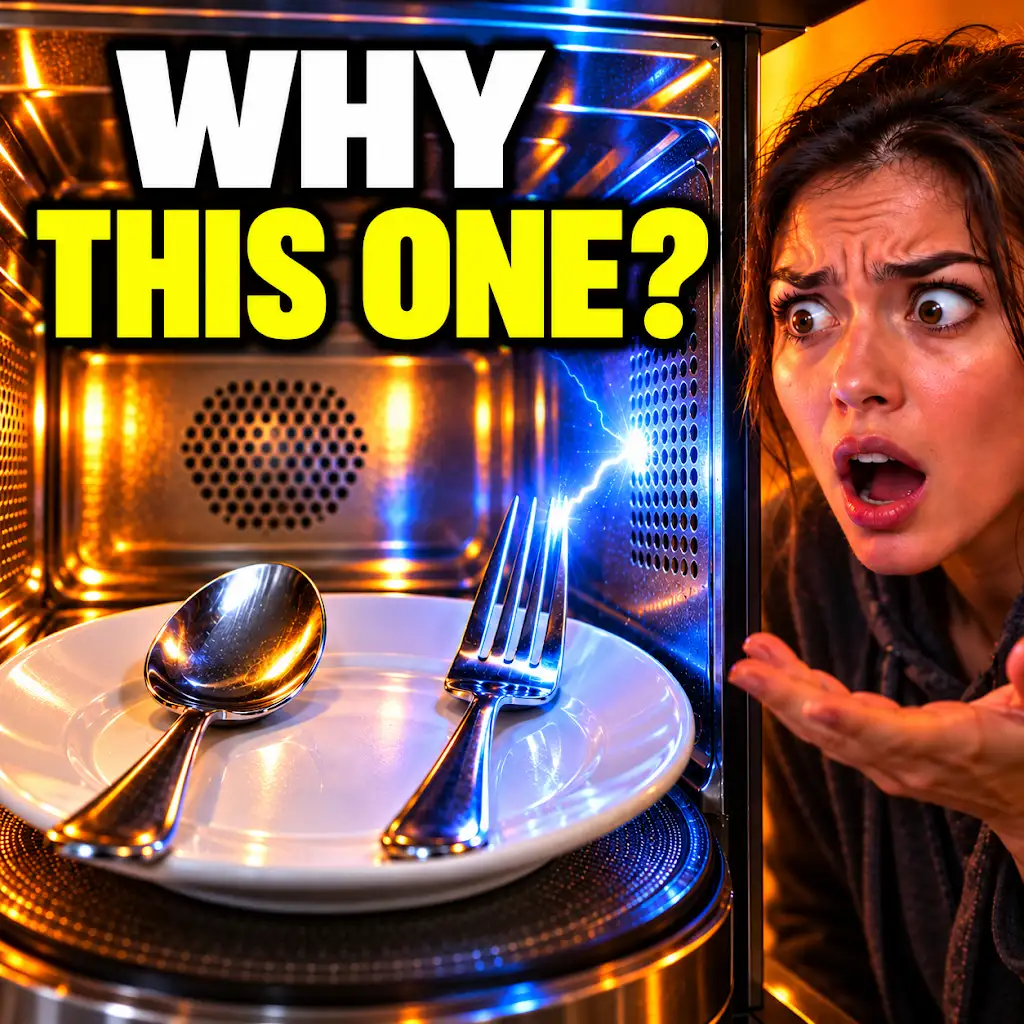
A Fork and a Spoon React Differently in a Microwave. Why?
FAQs

What are microwave standing waves?
Microwave standing waves are a pattern of electromagnetic fields that occur when microwaves reflect back and forth between two parallel surfaces, creating areas of maximum and minimum energy.
How are microwave standing waves formed?
Microwave standing waves are formed when the wavelength of the microwaves matches the distance between the two reflecting surfaces, causing constructive and destructive interference.
What are the applications of microwave standing waves?
Microwave standing waves are used in microwave ovens to evenly heat food, in wireless communication systems to transmit and receive signals, and in scientific research for studying electromagnetic phenomena.
What is the significance of microwave standing waves in microwave ovens?
In microwave ovens, standing waves ensure that the food is heated evenly by creating nodes and antinodes where the microwaves either reinforce or cancel each other out, preventing hot spots.
How can microwave standing waves be controlled or adjusted?
The formation of microwave standing waves can be controlled or adjusted by changing the dimensions of the reflecting surfaces, altering the frequency of the microwaves, or using waveguides and other components to manipulate the wave patterns.