You’re probably familiar with the idea of heating things up. You might use a stove, an oven, or a microwave. But have you ever considered how some incredibly precise and efficient heating processes work without direct contact or visible flames? This is where induction heating comes in, a fascinating application of electromagnetism that allows you to heat conductive materials with remarkable speed and control. Understanding the physics behind it is key to appreciating its power and versatility.
At its core, induction heating is all about harnessing the power of electromagnetic induction. This principle, first described by Michael Faraday, states that a changing magnetic field will induce an electromotive force (EMF) in a conductor. This EMF, in turn, drives a flow of electrical current within the conductor. Think of it like this: you’re not directly applying heat; you’re creating a situation where the material itself generates its own internal heat.
Faraday’s Law of Induction: The Foundation
The mathematical heart of this phenomenon is Faraday’s Law of Induction. It’s often expressed as:
$ mathcal{E} = -frac{dPhi_B}{dt} $
Where:
- $ mathcal{E} $ represents the induced electromotive force (EMF), measured in volts.
- $ Phi_B $ is the magnetic flux, which is a measure of the total magnetic field passing through a given area. It’s measured in webers (Wb).
- $ frac{dPhi_B}{dt} $ is the rate of change of magnetic flux with respect to time.
The negative sign, often called Lenz’s Law, is crucial. It indicates that the induced current will flow in a direction that opposes the change in magnetic flux that produced it. This is a fundamental aspect of energy conservation.
The Role of the Changing Magnetic Field
In induction heating, you’re not dealing with static magnetic fields. Instead, you’re using an alternating current (AC) to power a coil. This AC current, flowing through the coil, generates a constantly changing magnetic field. As this magnetic field fluctuates, it permeates the workpiece you want to heat.
Generating the Alternating Magnetic Field
The generation of the alternating magnetic field is the first step in the induction heating process. This is typically achieved by an induction heating power supply. This supply converts mains electricity (usually 50 or 60 Hz) to a much higher frequency, often ranging from a few kilohertz (kHz) to several megahertz (MHz), depending on the application. The higher the frequency, the faster the magnetic field changes, leading to more efficient heating of smaller or thinner materials.
The Coil: The Inductor
The coil, often made of copper tubing, is the component that actually generates the magnetic field. It’s shaped to surround or be close to the workpiece. As the high-frequency AC current flows through the coil, it creates a strong, oscillating magnetic field. The geometry and winding of the coil are critical for concentrating the magnetic flux effectively onto the target material.
Induced Currents: The Source of Heat
When the workpiece, which must be electrically conductive (metals are ideal), is placed within the influence of this changing magnetic field, two main phenomena occur:
Eddy Currents: The Primary Heating Mechanism
The most significant source of heating in induction heating is the generation of eddy currents. As the magnetic field from the coil oscillates, it cuts through the conductive material of the workpiece. According to Faraday’s Law, this induces circulating currents within the workpiece itself. These currents are called eddy currents because they flow in miniature, swirling loops, much like eddies in a stream.
The Skin Effect: Concentrating the Currents
A crucial aspect of eddy current heating is the “skin effect.” This phenomenon dictates that at higher frequencies, the induced eddy currents tend to flow more concentratedly near the surface of the conductor. This is because the eddy currents at different depths oppose each other, with the deeper currents being attenuated by the opposing currents above them.
- Low Frequencies: At lower frequencies (e.g., 50-400 Hz), the skin effect is less pronounced, and eddy currents can penetrate deeper into the material. This is beneficial for heating larger, thicker workpieces where uniform heating throughout the volume is desired.
- High Frequencies: At higher frequencies (e.g., 100 kHz to several MHz), the skin effect becomes very significant, confining the eddy currents to a very thin layer at the surface. This is excellent for surface hardening, brazing, and other applications where only a specific portion of the material needs to be heated. The depth of penetration is inversely proportional to the square root of the frequency.
Hysteresis Losses: A Secondary Effect in Ferromagnetic Materials
If the workpiece is made of a ferromagnetic material (like iron or steel), another heating mechanism comes into play: hysteresis losses. Ferromagnetic materials have magnetic domains that align themselves with an external magnetic field. As the alternating magnetic field from the coil oscillates, these magnetic domains are constantly being realigned.
The Reorientation of Magnetic Domains
This rapid reorientation and reversal of magnetic domains within the material requires energy. This energy is dissipated as heat due to internal friction between the domains. Hysteresis losses are particularly significant at lower frequencies and can contribute substantially to the overall heating of ferromagnetic materials, often even before significant eddy currents are generated.
Resistance Heating: The Ultimate Conversion
Once eddy currents are induced within the workpiece, they flow through the material’s inherent electrical resistance. This resistance is described by Ohm’s Law ($ V = IR $). As these currents flow, they encounter opposition, and this opposition causes energy to be converted into heat. This is a fundamental principle of electrical resistance heating, often referred to as Joule heating or I²R heating.
The Power of I²R
The amount of heat generated by eddy currents is directly proportional to the square of the current and the material’s resistance. This is expressed by the formula for power dissipation:
$ P = I^2 R $
Where:
- $ P $ is the power dissipated as heat (in watts).
- $ I $ is the magnitude of the induced current (in amperes).
- $ R $ is the electrical resistance of the path the current flows through (in ohms).
Since the induced currents are driven by the changing magnetic field, and the resistance is an intrinsic property of the material, induction heating is a highly efficient way to transfer electrical energy directly into thermal energy within the workpiece.
Induction heating is a fascinating topic that delves into the principles of electromagnetism and thermal energy transfer. For those interested in exploring this subject further, a related article can be found at Freaky Science, which provides an in-depth explanation of the physics behind induction heating, its applications, and the technology that makes it possible. This resource is perfect for anyone looking to deepen their understanding of how induction heating works and its significance in various industries.
The Induction Heating System: Components and Functionality
To harness these physical principles, a complete induction heating system is required. It’s not just the workpiece and a coil; there’s a sophisticated interplay of components that ensures efficient and controlled heating.
The Power Supply: The Engine of Induction
The power supply is the heart of the induction heating system. Its primary role is to convert the incoming mains electricity into the high-frequency, high-power electrical energy needed to drive the induction coil.
Frequency Conversion
As mentioned earlier, mains power is typically at line frequency (50/60 Hz). Induction heating often requires much higher frequencies to achieve the desired heating characteristics, especially due to the skin effect. Power supplies employ various techniques for frequency conversion:
- Line Frequency Systems: For very large workpieces or specific applications, line frequency induction heating can be used, but it’s less common for precise or rapid heating.
- Inverter Systems: These are the most common type today. They use solid-state electronics (transistors like MOSFETs or IGBTs) to convert DC power (derived from rectified AC) into high-frequency AC. These are highly efficient and offer excellent control.
- Motor-Generator Sets: Older systems might use a motor to drive a generator that produces the required high-frequency AC. These are less efficient and are being phased out by inverter technology.
Matching the Impedance
Another crucial function of the power supply is impedance matching. The induction coil and the workpiece present a specific electrical impedance to the power supply. For maximum power transfer, the impedance of the power supply needs to be matched to the impedance of the induction circuit. This is often achieved through matching networks, which can include capacitors and inductors.
The Induction Coil: The Field Former
The induction coil is the direct interface between the power supply and the workpiece. Its design is paramount to the success of the induction heating process.
Coil Design and Geometry
The coil’s shape is tailored to the geometry of the workpiece and the desired heating pattern. Common coil types include:
- Solenoidal Coils: These are cylindrical coils that are often used to heat rods, tubes, or shafts.
- Coaxial Coils: Used for heating hollow cylindrical parts.
- Pancake Coils: Flat, spiral coils used for heating flat surfaces or localized areas.
- Custom Coils: For complex shapes, custom-designed coils are fabricated to ensure optimal flux linkage.
Coil Materials and Construction
Coils are typically made from high-conductivity copper tubing. This tubing is often water-cooled to prevent the coil from overheating, as significant amounts of current flow through it. The number of turns, the diameter, and the spacing of the turns all influence the magnetic field distribution and the heating pattern.
Workpiece Handling and Fixturing: Guiding the Process
The way the workpiece is positioned relative to the coil and how it’s moved during the heating process are critical for achieving consistent and controlled results.
Fixturing for Positioning
Workpiece fixturing ensures that the part is held securely and accurately positioned within the coil. This is important for maintaining consistent coupling between the coil’s magnetic field and the workpiece, which directly affects heating efficiency.
Automation and Motion Control
For many applications, automation is key. This can involve:
- Rotating Workpieces: Rotating the workpiece ensures more uniform heating, especially for cylindrical parts.
- Moving Workpieces: Moving the workpiece through the coil allows for selective heating or hardening of specific zones. This is common in induction hardening lines where parts are passed through a coil at a controlled speed.
- Quenching Systems: Often, induction heating is followed by a quenching process to rapidly cool the heated material and achieve desired metallurgical properties. Automated quench systems are integrated into the overall process.
Factors Affecting Heating Efficiency and Effectiveness
Several physical and electrical parameters influence how efficiently and effectively induction heating works. Understanding these factors allows for optimization of the process for specific applications.
Material Properties: The Foundation of Heating
The inherent properties of the material being heated are fundamental to induction heating.
Electrical Conductivity
The higher the electrical conductivity of the material, the more readily eddy currents can be induced, leading to more efficient heating. Excellent conductors like copper and aluminum heat well, though their lack of ferromagnetic properties means they rely solely on eddy currents.
Magnetic Permeability
For ferromagnetic materials, magnetic permeability plays a significant role. High permeability means that the material can be easily magnetized, leading to stronger induced magnetic fields and substantial hysteresis losses. This allows for rapid heating of materials like steel and iron, especially at lower frequencies.
Resistivity
The electrical resistivity of the material determines how much opposition eddy currents face, and thus how much heat is generated. Higher resistivity leads to more heat for a given current.
Thermal Conductivity
While not directly involved in generating heat, thermal conductivity affects how that heat is distributed within the workpiece. Materials with high thermal conductivity will distribute heat more evenly, potentially leading to less localized overheating.
Frequency Selection: The Key to Control
The frequency of the alternating current applied to the induction coil is one of the most critical parameters for controlling the heating process.
Penetration Depth and Skin Effect
As discussed earlier, frequency directly influences the penetration depth of eddy currents due to the skin effect.
- Low Frequencies (e.g., 1-10 kHz): Deeper penetration, suitable for through-heating of larger cross-sections or bulk heating.
- Medium Frequencies (e.g., 10-100 kHz): Moderate penetration, good for general heat treatment and brazing.
- High Frequencies (e.g., 100 kHz – 1 MHz+): Very shallow penetration, ideal for surface hardening, thin layer annealing, and heating small components.
Hysteresis Losses and Frequency
Hysteresis losses are generally more significant at lower frequencies. As frequency increases, the rate at which magnetic domains can reverse direction becomes a limiting factor, and hysteresis losses tend to decrease relative to eddy current losses.
Coil Design and Coupling: Optimizing Energy Transfer
The way the induction coil interacts with the workpiece is known as “coupling.” Good coupling is essential for efficient energy transfer.
Geometric Fit
The coil should be designed to fit closely around or to the workpiece. A tighter fit generally results in better coupling and more concentrated magnetic flux.
Coil-to-Workpiece Spacing
The distance between the coil and the workpiece is critical. If the gap is too large, the magnetic field will diffuse, and heating will be less efficient. If the gap is too small, it can lead to arcing or the workpiece touching the coil, which can damage both.
Number of Turns and Coil Geometry
The number of turns in the coil, the diameter of the coil, and the spacing between the turns all influence the strength and distribution of the magnetic field. Optimizing these parameters for a specific workpiece shape is crucial.
Power Input and Heating Time: The Equation for Temperature Rise
The amount of power delivered by the supply and the duration for which it is applied directly determine the total energy delivered to the workpiece and, consequently, its temperature rise.
Power Density
Power density refers to the amount of power delivered per unit volume or surface area of the workpiece. Higher power density leads to faster heating rates.
Heating Time
The heating time is the duration for which the induction coil is energized. This is often adjusted to achieve a specific target temperature or to heat to a specific depth.
Applications of Induction Heating: Where Physics Meets Practicality

The elegant physics of induction heating translate into a vast array of practical applications across numerous industries. Its ability to heat rapidly, precisely, and without direct contact makes it a preferred method for many manufacturing processes.
Heat Treatment: Altering Material Properties
Induction heating is a cornerstone of various heat treatment processes, allowing for precise control over the metallurgical structure of metals.
Hardening: Increasing Surface Strength
Induction hardening is widely used to create a hard, wear-resistant surface layer on components like gears, shafts, and tools. The high frequency and rapid heating create a thin, hardened case, while the core remains tough and ductile.
- Surface Hardening: This involves heating the surface layer of a ferromagnetic material to its austenitizing temperature, followed by rapid quenching. The shallow penetration of eddy currents at high frequencies is ideal for this.
- Through Hardening: For some applications, deeper hardening is required. This is achieved using lower frequencies, allowing the heat to penetrate further into the material before quenching.
Annealing: Softening and Relieving Stress
Annealing is a process of heating and slowly cooling a material to reduce hardness, improve ductility, and relieve internal stresses. Induction annealing can be performed quickly and selectively, making it efficient for specific sections of a part.
Tempering: Adjusting Hardness and Toughness
Tempering follows hardening and involves reheating the hardened material to a lower temperature to reduce brittleness and increase toughness. Induction tempering can provide precise temperature control for optimal results.
Brazing and Soldering: Joining Dissimilar Materials
Induction brazing and soldering offer rapid and localized heating, making them ideal for joining components with high precision and minimal distortion.
Precision Joining
The ability to precisely control the heated zone allows for joining delicate or complex assemblies where surrounding materials must remain unaffected.
Automation and Repeatability
Induction heating lends itself well to automated brazing and soldering operations, ensuring consistent joint quality across large production runs.
Melting and Forging: Shaping Metals with Ease
Induction furnaces are a common sight in foundries and metalworking facilities for their efficiency and control over melting processes.
Induction Melting
Induction furnaces use electromagnetic fields to directly heat and melt metals. This process is fast, efficient, and allows for precise control over the melt temperature.
- Coreless Induction Furnaces: These are widely used for melting a variety of ferrous and non-ferrous metals. They rely on induced eddy currents and hysteresis losses (in ferromagnetic materials) to melt the charge.
- Channel Induction Furnaces: These are typically used for holding and duplexing molten metal, but can also be used for melting. They have a molten metal channel that acts as the secondary of a transformer, being heated by induced currents.
Induction Heating for Forging
Before forging, metal billets or bars are heated to their plastic deformation temperature. Induction heating provides a rapid and uniform heating solution, minimizing scale formation and energy waste compared to traditional furnaces.
Other Specialized Applications
The versatility of induction heating extends to numerous other niche applications:
- Shrink Fitting: Heating a ring component before placing it over another part. As the ring cools, it shrinks, creating a tight, interference fit.
- Glass-to-Metal Sealing: Precisely heating areas for creating hermetic seals.
- Semiconductor Processing: Used in specific manufacturing steps for silicon wafer production.
- Laboratory and Research: For controlled heating experiments and material synthesis.
Induction heating is a fascinating topic that delves into the principles of electromagnetism and its applications in various industries. For those looking to deepen their understanding of this technology, a related article can be found at Freaky Science, which explains the underlying physics in a clear and engaging manner. This resource not only covers the basics of induction heating but also explores its practical uses, making it an excellent starting point for anyone interested in the subject.
Advantages and Limitations: A Balanced Perspective
| Parameter | Description | Typical Values | Units |
|---|---|---|---|
| Frequency (f) | Alternating current frequency used to generate magnetic field | 10 kHz – 1 MHz | Hertz (Hz) |
| Magnetic Field Strength (B) | Intensity of the magnetic field inducing eddy currents | 0.1 – 1.5 | Tesla (T) |
| Skin Depth (δ) | Depth at which current density falls to 1/e of surface value | 0.01 – 1 | Millimeters (mm) |
| Electrical Conductivity (σ) | Material’s ability to conduct electric current | 1.0 x 10⁶ – 6.0 x 10⁷ | Siemens per meter (S/m) |
| Permeability (μ) | Material’s ability to support magnetic field | 1 – 5000 (relative permeability) | Dimensionless |
| Power Density (P) | Power delivered per unit volume in the heated material | 104 – 107 | Watts per cubic meter (W/m³) |
| Heating Time | Time required to reach desired temperature | Seconds to minutes | Seconds (s) |
Like any technology, induction heating has its strengths and weaknesses. Understanding these helps in determining its suitability for a particular task.
Advantages: Why Induction Heating Excels
- Speed: Induction heating is incredibly fast, capable of heating materials to high temperatures in seconds or minutes.
- Efficiency: It’s highly energy-efficient as heat is generated directly within the workpiece, minimizing heat loss to the surroundings.
- Precision and Control: The heating process can be precisely controlled by adjusting frequency, power, and heating time, allowing for selective heating and minimal distortion.
- Cleanliness: Induction heating is a clean process with no direct combustion or exhaust fumes.
- Non-Contact Heating: The workpiece is heated without physical contact, preventing contamination and allowing for heating of delicate or finished parts.
- Repeatability: With proper setup and automation, induction heating offers high repeatability and consistency in production.
- Compactness: Induction heating equipment can be relatively compact compared to some other heating methods.
Limitations: When Other Methods Might Be Better
- Material Conductivity Requirement: Induction heating only works efficiently on electrically conductive materials. Non-conductive materials cannot be heated directly by this method.
- Initial Investment Cost: The initial purchase price of induction heating equipment can be higher than some simpler heating methods.
- Complexity: Designing and optimizing induction coils for complex shapes can require specialized knowledge and expertise.
- Ferromagnetic Materials are Easier: While induction heating works on non-ferromagnetic conductors, ferromagnetic materials generally heat more readily due to hysteresis losses.
- Uniformity Challenges: Achieving perfectly uniform heating in very complex geometries can sometimes be challenging, requiring careful coil design.
In conclusion, induction heating is a powerful and sophisticated technology rooted in fundamental electromagnetic principles. By understanding the interplay of changing magnetic fields, induced currents, and material properties, you can appreciate its ability to revolutionize industrial processes, offering speed, precision, and efficiency that are hard to match. Whether you’re hardening a vital engine component, brazing a delicate circuit, or melting tons of metal, the physics of induction heating is quietly and effectively at work.
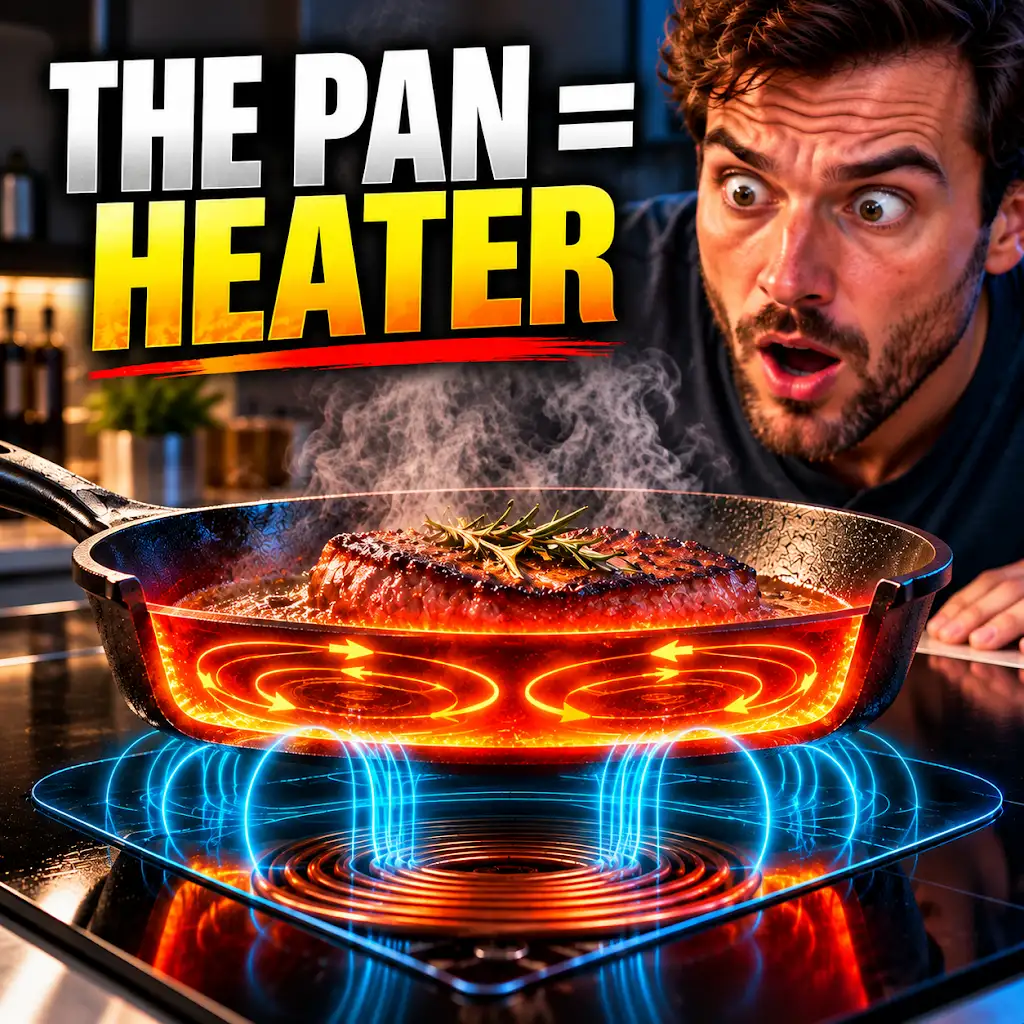
The Pan Is the Heater: How Induction Cooking Really Works
FAQs
What is induction heating?
Induction heating is a process where an electric current is passed through a conductive material, generating heat due to resistance in the material. This heat is used for various industrial applications such as metal melting, welding, and heat treatment.
How does induction heating work?
An alternating current is passed through a coil, creating a changing magnetic field. When a conductive material is placed within this magnetic field, eddy currents are induced in the material, causing it to heat up due to resistance. This is known as induction heating.
What are the advantages of induction heating?
Induction heating offers several advantages such as fast heating rates, precise temperature control, energy efficiency, and localized heating. It is also a clean and environmentally friendly process as it does not involve burning fossil fuels.
What materials can be heated using induction heating?
Induction heating is commonly used for heating materials such as metals and alloys that are good electrical conductors. Examples include steel, copper, aluminum, and brass. Non-conductive materials like plastics and ceramics cannot be heated using induction heating.
What are some common applications of induction heating?
Induction heating is widely used in various industries for applications such as brazing, soldering, annealing, forging, and hardening of metals. It is also used in induction cooktops, induction sealing, and induction melting of metals.