
You’ve probably marveled at how quickly your induction cooktop heats up, transforming raw ingredients into delicious meals in a flash. It’s a marvel of modern technology, and a key player in its efficiency is a phenomenon known as hysteresis loss. While it might sound like a complex scientific term, understanding hysteresis loss is crucial to appreciating the ingenious design of your induction cooker and why it’s such an energy-efficient appliance.
The Electrifying Dance: How Induction Cooking Works
Before we dive into the nuances of hysteresis loss, let’s first establish a foundational understanding of how induction cooking itself operates. It’s a fascinating process that relies on the principles of electromagnetism, creating heat directly within the cookware rather than through a separate heating element.
The Magnetic Field Generation
Your induction cooktop isn’t just a flat surface; beneath it lies a carefully designed coil of wire. When you turn on your cooktop and place a compatible pot or pan on it, an alternating current (AC) is passed through this coil. This alternating current, by its very nature, creates a rapidly fluctuating magnetic field. Imagine an invisible force field that is constantly switching its direction, oscillating back and forth.
The Role of Alternating Current
The key here is the alternating nature of the current. A direct current (DC) would create a static magnetic field, which wouldn’t induce any eddy currents. It’s the continuous change in the magnetic field’s strength and direction that sets the stage for heat generation. The frequency of this alternating current is typically in the tens of kilohertz range, far higher than the 50 or 60 Hz found in your home’s electrical outlets. This higher frequency allows for a more rapid and efficient induction process.
The Induction Coil’s Design
The induction coil itself is a sophisticated component. Its shape, material, and the way it’s wound are all optimized to produce the strongest possible fluctuating magnetic field. Manufacturers spend considerable effort in designing these coils to maximize their efficiency and minimize any energy wastage before it even reaches your cookware.
The Magnetic Induction Phenomenon
Now, this fluctuating magnetic field doesn’t just disappear into thin air. It extends outwards and interacts with the base of your cookware. For induction to work, your cookware must be made of a ferromagnetic material – essentially, materials that are attracted to magnets. This includes cast iron and certain types of stainless steel.
Eddy Currents: The Heat Generators
When the fluctuating magnetic field from the induction coil penetrates the ferromagnetic base of your cookware, it induces something called eddy currents. These are essentially circular currents of electricity that flow within the metal of the pot or pan. Think of them as tiny whirlpools of electricity swirling within the metal.
What are Eddy Currents?
Eddy currents are a direct consequence of Faraday’s Law of Induction. This law states that a changing magnetic flux through a circuit induces an electromotive force (EMF), which in turn drives a current. In the case of induction cooking, the changing magnetic field is the changing magnetic flux, and the metal of your cookware acts as the circuit.
The Resistance Factor
As these eddy currents flow through the metal of your cookware, they encounter resistance. This resistance is an inherent property of the material. Just like when electricity flows through a wire and causes it to heat up, these eddy currents flowing through the cookware’s metal also generate heat due to this resistance. This is the primary mechanism by which induction cooking produces heat – it’s direct resistive heating within the cookware itself.
The Importance of Ferromagnetic Cookware
It’s crucial to reiterate why only certain types of cookware work with induction. Non-ferromagnetic materials like aluminum or copper, while excellent conductors of heat, are not sufficiently magnetic to efficiently interact with the induction coil’s magnetic field. While they might experience some minimal eddy current induction, the amount of heat generated would be negligible. This is why you’ll often see the induction symbol (sometimes depicted as a spiral with lines radiating from it) on cookware designed for induction cooktops.
Hysteresis loss in induction cooking is an important factor that affects the efficiency and performance of induction cooktops. Understanding this phenomenon can help consumers make informed choices about their cooking appliances. For a deeper insight into the principles of hysteresis loss and its implications in various applications, you can read a related article at Freaky Science. This resource provides valuable information that can enhance your understanding of how hysteresis impacts energy consumption in induction cooking systems.
Unveiling Hysteresis: The Magnetic Memory
Now, let’s introduce hysteresis, a term that describes a system’s tendency to lag behind its driving forces. In the context of magnetism, hysteresis refers to the phenomenon where the magnetization of a ferromagnetic material lags behind the applied magnetic field. This means that even when you remove the magnetic field, the material retains some level of magnetization.
The Nature of Magnetic Materials
Ferromagnetic materials, such as iron and nickel, possess a unique atomic structure. Their atoms have unpaired electrons, which act like tiny magnets themselves. In an unmagnetized state, these atomic magnets are randomly oriented. However, when an external magnetic field is applied, these atomic magnets align themselves with the field, causing the material to become magnetized.
Domains of Magnetization
Within a ferromagnetic material, atoms don’t all align independently. Instead, they group together into regions called magnetic domains. Within each domain, the atomic magnets are all aligned in the same direction. When an external magnetic field is applied, the boundaries of these domains shift, and the domains that are aligned with the field grow, while those that are not shrink.
The Hysteresis Loop
The relationship between the applied magnetic field (H) and the resulting magnetization (M) in a ferromagnetic material is not a simple linear one. If you plot M against H, you get a characteristic curve called a hysteresis loop. As the magnetic field increases, the magnetization increases. However, when you decrease the magnetic field, the magnetization doesn’t retrace the same path. It lags behind.
Applying and Reversing the Field
Imagine starting with an unmagnetized piece of iron. As you apply a magnetic field, the domains align, and the iron becomes magnetized. If you then remove the field, the iron remains magnetized to some extent – this is called remanence. To demagnetize it completely, you need to apply a magnetic field in the opposite direction, called the coercive force. The shape of this loop, particularly its width, indicates the amount of hysteresis. A wider loop signifies more hysteresis.
Hysteresis Loss: The Energy Drain in Magnetic Materials
So, what does this magnetic lag have to do with induction cooking? Hysteresis loss is the energy that is dissipated as heat within the magnetic material itself due to this repeated process of magnetization and demagnetization. Each time the magnetic field from the induction coil flips direction, the magnetic domains within your cookware are forced to realign. This constant struggle of the domains to keep up with the rapidly changing magnetic field is not perfectly efficient.
The Repeated Magnetic Domain Flipping
In induction cooking, the magnetic field from the coil is alternating at a high frequency. This means the magnetic domains within your ferromagnetic cookware are constantly being pulled in one direction, then the other, as the external field changes. This continuous process of alignment and realignment is the root cause of hysteresis loss.
The Energy Conversion Process
When the magnetic domains flip, some of the energy that was used to align them is converted into heat. This is because the movement of these domains within the material is not perfectly frictionless. There are internal forces and interactions that resist this movement, and the energy expended to overcome these resistances is released as heat.
Microscopic Friction and Vibrations
Think of it as a microscopic form of friction. As the domains shift, there’s a tiny amount of energy lost at the boundaries between them, and as they vibrate and settle into new orientations. This energy is released in the form of thermal energy, meaning it makes the cookware hotter.
The Impact of Material Properties
The extent of hysteresis loss is highly dependent on the specific magnetic material of your cookware. Some materials are more prone to hysteresis than others. For instance, materials with a wider hysteresis loop will generally exhibit higher hysteresis losses. Manufacturers carefully select materials for induction cookware that balance good ferromagnetic properties with minimized hysteresis.
Soft vs. Hard Magnetic Materials
In general, “soft” magnetic materials, which are easily magnetized and demagnetized, tend to have narrower hysteresis loops and therefore lower hysteresis losses. “Hard” magnetic materials, which retain their magnetism once magnetized, have wider loops and higher losses. Induction cookware is designed using soft magnetic materials to optimize energy transfer.
Quantifying Hysteresis Loss in Induction Cookers
While hysteresis loss is an inherent part of induction cooking, it’s important to understand that it’s a relatively small contributor to the overall energy conversion. The dominant factor in heat generation is eddy current losses, which directly heat the cookware. However, hysteresis loss still plays a role in the overall efficiency of the system.
The Role of the Hysteresis Loop Width
The area enclosed by the hysteresis loop is a direct measure of the energy lost per cycle per unit volume of the magnetic material. A larger area means more energy is dissipated as heat. Therefore, cookware made from materials with narrower hysteresis loops will experience less hysteresis loss.
Understanding the Units
The area of the hysteresis loop is typically measured in Joules per cubic meter (J/m³). This represents the energy lost in the material for each complete cycle of magnetization and demagnetization. In the context of induction cooking, this energy loss occurs very rapidly due to the high frequency of the alternating current.
Factors Affecting Hysteresis Loss
Several factors influence the amount of hysteresis loss in your induction cookware:
- Material Composition: As discussed, the specific alloy and composition of the ferromagnetic material are paramount. Different types of stainless steel, for example, will exhibit varying degrees of hysteresis.
- Frequency of Alternating Current: While the frequency is primarily chosen for efficient eddy current generation, a higher frequency can, in some cases, lead to increased hysteresis loss as the domains are forced to flip more rapidly.
- Magnetic Field Strength: The strength of the magnetic field applied by the induction coil also influences hysteresis loss. Stronger fields can lead to more significant domain movement and thus potentially higher losses.
- Temperature: The magnetic properties of materials can change with temperature, which can, in turn, affect hysteresis loss.
The Trade-off in Material Selection
Manufacturers face a delicate balancing act. They need materials that are strongly ferromagnetic to efficiently generate eddy currents, but also have low hysteresis to minimize energy wastage. This often involves using specific grades of stainless steel or composite materials that are optimized for induction applications.
Hysteresis loss in induction cooking is an important factor that affects the efficiency and performance of these cooking systems. For a deeper understanding of this phenomenon, you can explore a related article that discusses the principles of electromagnetic induction and its implications in various applications. This article provides valuable insights into how hysteresis loss impacts energy consumption and cooking efficiency. To read more about it, visit Freaky Science.
Minimizing Hysteresis Loss: The Quest for Efficiency
While hysteresis loss cannot be entirely eliminated in ferromagnetic materials, there are strategies employed in the design of induction cooktops and cookware to minimize its impact and maximize the overall energy efficiency of the cooking process.
Material Engineering and Selection
The most significant approach to minimizing hysteresis loss lies in the careful selection and engineering of the ferromagnetic materials used in cookware.
Advanced Alloy Development
Researchers and manufacturers continually develop advanced alloys for cookware. These alloys are designed to have specific magnetic properties, including narrow hysteresis loops, excellent conductivity for eddy current generation, and durability. This often involves precise control over the grain structure and composition of the metal.
The Role of Microstructure
The microstructure of the metal, which refers to the size, shape, and arrangement of its grains and grain boundaries, plays a crucial role in magnetic behavior. By controlling the microstructure through processes like annealing and heat treatment, manufacturers can influence the magnetic domain behavior and reduce hysteresis losses.
Induction Coil Optimization
While the primary role of the induction coil is to generate the magnetic field, its design can also indirectly influence hysteresis loss by affecting the field’s uniformity and penetration into the cookware.
Field Uniformity
A more uniform magnetic field across the base of the cookware can lead to more even eddy current generation and potentially more consistent domain movement, which might help in managing hysteresis effects.
Design for Optimal Penetration
The design of the induction coil also considers how effectively its magnetic field penetrates the cookware. Optimizing this penetration ensures that the eddy currents are generated in the most effective part of the cookware’s base for heat transfer.
Cookware Design Features
Beyond the material itself, the design of the cookware can also play a role in managing heat distribution and, consequently, the impact of hysteresis loss.
Base Thickness and Layering
The thickness of the cookware’s base is important. Too thin, and it might overheat unevenly. Too thick, and the magnetic field might not penetrate effectively. Some cookware features layered bases, which can include different materials to optimize both eddy current generation and heat distribution, indirectly mitigating the localized effects of hysteresis.
Thermal Conductivity and Distribution
While hysteresis loss directly generates heat within the metal, the way this heat is then distributed throughout the cookware is also important. Cookware with good thermal conductivity ensures that the heat generated is spread efficiently, preventing hotspots that could exacerbate localized material stress and, in theory, further influence magnetic properties over time.
The Bottom Line: Efficient Cooking Through Smart Design
In conclusion, hysteresis loss is a fundamental phenomenon in ferromagnetic materials that contributes to energy dissipation as heat when subjected to a changing magnetic field. In the context of induction cooking, it’s a consequence of the rapid magnetization and demagnetization of your cookware’s base as it interacts with the induction coil’s fluctuating magnetic field.
Understanding the Trade-offs
While eddy current losses are the primary drivers of heat generation in induction cooking, hysteresis loss is an unavoidable byproduct of using ferromagnetic materials. However, it’s important to remember that compared to older heating technologies, induction cooking is remarkably efficient.
The Dominance of Eddy Currents
The energy converted into heat through eddy currents is significantly greater than that lost through hysteresis. This is why induction cooktops are celebrated for their energy efficiency. The goal of manufacturers is to maximize eddy current heating while minimizing other losses, including hysteresis.
A Small but Present Contributor
Hysteresis loss, therefore, represents a smaller but still present avenue for energy dissipation. By understanding the principles behind it, you can better appreciate the sophisticated material science and engineering that goes into creating effective and energy-efficient induction cookware.
Your Role in Maximizing Efficiency
While you can’t directly control hysteresis loss, you can contribute to the overall efficiency of your induction cooking experience by:
- Using Induction-Compatible Cookware: Ensure your pots and pans are specifically designed for induction and are made of ferromagnetic materials.
- Proper Cookware Placement: Ensure your cookware is centered on the induction zone for optimal magnetic field interaction.
- Choosing Quality Cookware: Invest in well-made induction cookware, as manufacturers of quality products often use materials optimized for minimal hysteresis.
By understanding hysteresis loss, you gain a deeper appreciation for the intricate workings of your induction cooktop. It’s a testament to how science and engineering come together to create kitchen appliances that are not only powerful and fast but also remarkably efficient, transforming the way you cook and reducing your energy footprint.
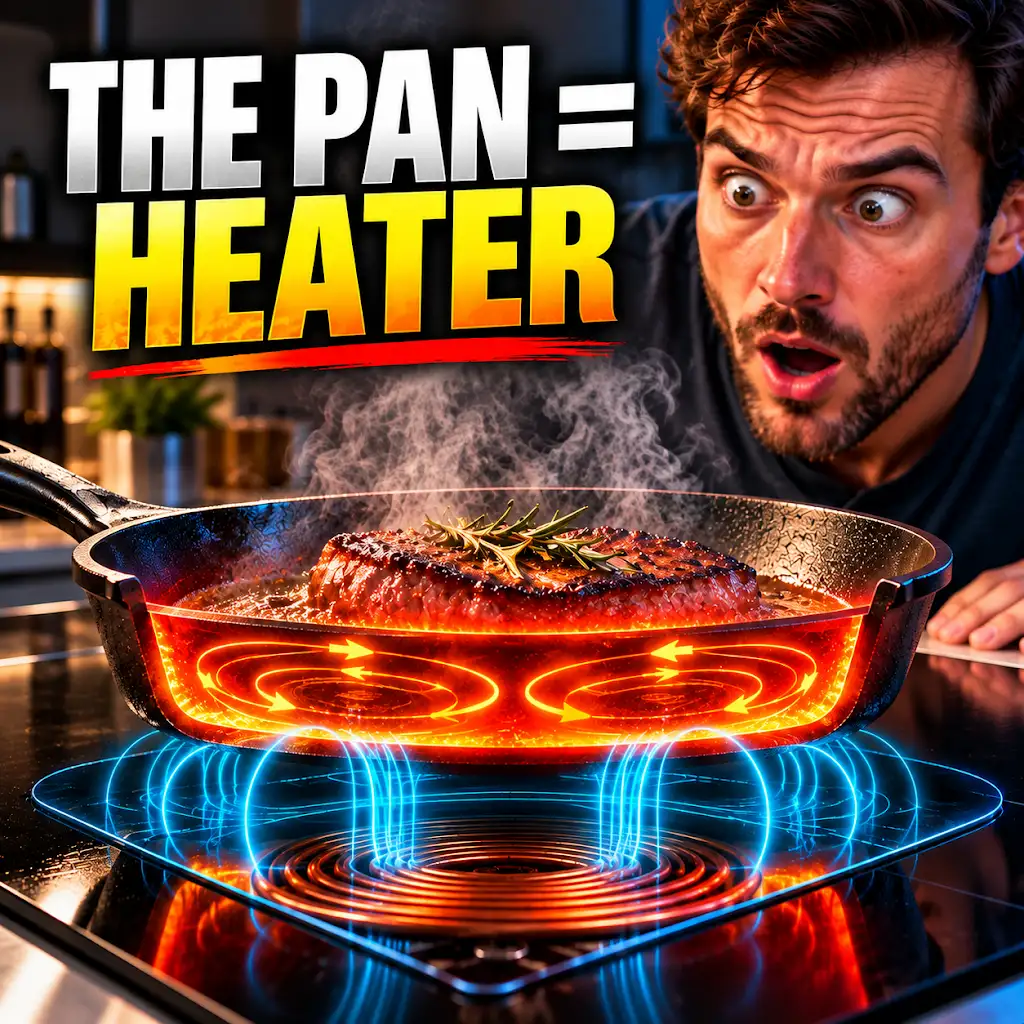
The Pan Is the Heater: How Induction Cooking Really Works
FAQs
What is hysteresis loss in induction cooking?
Hysteresis loss in induction cooking refers to the energy lost as heat when the magnetic field in the cookware repeatedly changes direction due to the alternating current in the induction cooktop.
How does hysteresis loss affect the efficiency of induction cooking?
Hysteresis loss contributes to a decrease in the overall efficiency of induction cooking as it results in energy being wasted as heat instead of being transferred to the cookware to heat up the food.
Can hysteresis loss be reduced in induction cooking?
While hysteresis loss cannot be completely eliminated, it can be minimized by using cookware made of materials with lower magnetic hysteresis, such as stainless steel or cast iron.
What are some common materials used in cookware that can help reduce hysteresis loss?
Cookware materials such as stainless steel, cast iron, and enameled steel are known to have lower magnetic hysteresis, making them more efficient for use on induction cooktops.
Is hysteresis loss the only factor affecting the efficiency of induction cooking?
No, hysteresis loss is just one of the factors that can affect the efficiency of induction cooking. Other factors include eddy current losses, cookware size and shape, and the design of the induction cooktop itself.