
You’ve probably never given it much thought beyond a quick glance to check if your popcorn is perfectly popped or if your leftovers are adequately heated. But have you ever wondered how you can see what’s happening inside that metal box while it’s humming away, blasting food with invisible waves? It’s a seemingly simple act, but the engineering behind your microwave door’s visibility is a clever interplay of materials, design, and fundamental physics. You might imagine a clear glass pane, much like a regular oven door, but that would be a recipe for disaster, allowing those powerful microwaves to escape and potentially harm you. The reality is far more sophisticated, employing a strategy that allows light to pass through while effectively containing the microwave radiation.
This article will delve into the fascinating science behind how your microwave door achieves this dual purpose: allowing you to witness your culinary experiments while keeping you safe from the very energy that’s cooking your food. We’ll explore the materials involved, the ingenious design principles at play, and the physics that make it all possible. So, the next time you’re peeking into your microwave, you’ll have a newfound appreciation for the invisible shield and the visible window it provides.
Have you ever wondered why you can see through a microwave door while it’s in operation? The answer lies in the design of the door and the materials used, which allow certain wavelengths of light to pass through while keeping microwaves contained. For a deeper understanding of this phenomenon, you can check out a related article that explores the science behind microwave technology and its safety features. To learn more, visit Freaky Science.
The Electromagnetic Veil: Why a Plain Window Won’t Cut It
The very core of your microwave oven’s functionality lies in its ability to generate and direct electromagnetic radiation – specifically, microwaves. These waves are designed to excite water molecules within your food, causing them to vibrate rapidly and generate heat. However, these same microwaves, if allowed to escape the confines of the oven, can pose a significant hazard. They can heat living tissue, leading to burns, and even cause more serious damage over time. Therefore, the primary function of the microwave door is not just to keep the food contained, but critically, to act as a Faraday cage, an enclosure that prevents electromagnetic radiation from entering or leaving.
The Faraday Cage Principle: An Invisible Force Field
You might have encountered the term “Faraday cage” in relation to lightning storms or sensitive electronic equipment. Invented by Michael Faraday in the 19th century, a Faraday cage is essentially an enclosure made of conductive material. When an external electric field or electromagnetic wave encounters such a cage, the free electrons within the conductive material redistribute themselves in a way that cancels out the external field inside the cage. Think of it like a shield, pushing the waves away.
Why Glass Isn’t Enough: The Microwave’s Escape Route
A standard glass window, while opaque to visible light, is largely transparent to microwaves. If your microwave door were simply a sheet of glass, those cooking waves would freely escape, rendering the appliance ineffective and dangerous. Microwaves operate at a specific frequency (typically around 2.45 GHz), and glass offers no significant impedance to waves at this frequency. This is why you can’t just install any old window in your microwave.
The Marvel of the Mesh: How Conductive Grids Create the Barrier

The secret to your microwave door’s visibility lies in its construction: a sandwich of materials with a crucial layer of metallic mesh embedded within the glass. This isn’t just any mesh; it’s a precisely engineered grid that acts as the primary barrier against microwave radiation.
The Grid Spacing: The Key to Selective Passage
The effectiveness of the mesh lies in the spacing between its conductive strands. Microwaves, with their specific wavelengths, are significantly larger than the gaps in this mesh. When microwaves strike the mesh, the conductive strands cause the electromagnetic field to be disrupted and reflected back into the oven cavity. However, visible light, with its much shorter wavelengths, can easily pass through these small openings. It’s a brilliant example of how the physical properties of a material can be manipulated to control the passage of different types of electromagnetic waves.
Wavelength and Size: The Fundamental Relationship
The relationship between the wavelength of electromagnetic radiation and the size of the openings in a conductive enclosure is fundamental to how Faraday cages work. For a mesh to effectively block microwaves, the size of the holes must be significantly smaller than the wavelength of the microwaves. The typical wavelength of microwaves used in ovens is around 12.2 cm. The mesh in your microwave door has openings that are fractions of a millimeter, making it a formidable barrier to these cooking waves.
The Role of the Metal Strands: Reflecting and Absorbing
The metal strands themselves play a dual role. They are conductive, meaning they can readily carry electric currents. When microwaves hit these strands, they induce currents that generate opposing electromagnetic fields, effectively canceling out the incoming waves. Some minor absorption of microwave energy by the metal can also occur, but the primary mechanism is reflection due to the conductive nature of the mesh.
The Layered Defense: Building the Microwave-Proof Window
The mesh isn’t the only component. The entire door assembly is a carefully constructed system designed to maximize both visibility and safety. You’ll typically find several layers of materials, each contributing to the overall integrity of the door.
The Outer Pane: Protection and Aesthetics
The outermost layer of your microwave door is usually made of tempered glass. This provides a smooth, easy-to-clean surface and protects the more delicate inner components. Tempered glass is also stronger and more resistant to shattering than regular glass, which is important for safety.
The Inner Pane: Heat Resistance and Durability
Closer to the oven cavity, you’ll find another layer of glass, often also tempered. This inner pane is designed to withstand the heat generated by the cooking process and any potential condensation or splatters. It also helps to contain the microwave radiation, working in conjunction with the mesh.
The Embedded Mesh: The Heart of the Shield
Sandwiched between these glass panes is the crucial metallic mesh. This mesh is typically made of steel or aluminum, materials that are excellent conductors of electricity. The manufacturing process carefully embeds this mesh within the glass layers, ensuring a continuous and robust barrier.
Sealing and Gaskets: Preventing Leaks
The entire door assembly is sealed meticulously to prevent any microwave leakage. Rubber or silicone gaskets around the perimeter of the door create a tight seal against the oven frame when the door is closed. This ensures that even if there were microscopic imperfections in the glass or mesh, the gaskets would help to prevent any escape.
Have you ever wondered why you can see through a microwave door while it cooks your food? This intriguing phenomenon is due to the design of the microwave’s door, which typically features a mesh screen that allows light to pass through while keeping the microwaves contained. For a deeper understanding of this topic, you can explore a related article that explains the science behind microwave technology and its safety features. Check it out here to learn more about how these appliances work and why they are safe to use in your kitchen.
Beyond the Mesh: Other Design Considerations for Visibility and Safety
| Reason | Explanation |
|---|---|
| Glass Material | The microwave door is made of a special type of glass that allows microwaves to pass through while still being visible to the human eye. |
| Metal Mesh | The door also contains a metal mesh that helps to contain the microwaves inside the oven, but still allows visibility through the gaps in the mesh. |
| Safety | Being able to see through the microwave door allows users to monitor the cooking process and ensure that food is heating properly without the need to open the door. |
While the mesh is the primary hero, other design elements contribute to your ability to see inside and the overall safety of the microwave door.
The Tinting and Coatings: Enhancing Visibility and Reducing Glare
Sometimes, the glass in your microwave door might appear slightly tinted or have a subtle coating. These treatments can serve multiple purposes. They can help to reduce glare from the internal light, making it easier to see the food. They can also filter out some of the visible light spectrum, subtly enhancing the contrast of your food. Some coatings might also offer minor additional shielding properties, although the mesh remains the dominant barrier.
The Interior Light: Illuminating Your Culinary Canvas
The internal light is a seemingly simple feature, but it’s essential for visibility. This light is strategically placed and illuminates the cooking cavity, allowing you to see your food clearly through the meshed window. The light source itself is designed to operate within the safe confines of the oven and does not interfere with the microwave radiation.
The Door Interlock System: A Crucial Safety Switch
Perhaps one of the most critical safety features, often overlooked, is the door interlock system. This is a complex mechanism involving multiple switches that detect whether the door is properly closed. If the door is even slightly ajar, these switches will immediately cut off the power to the magnetron – the component that generates the microwaves. This ensures that microwaves are never activated when the door is not securely shut, regardless of the mesh’s effectiveness.
The “See-Through” Effect: Optical Illusions and Perception
It’s important to remember that what you perceive as “seeing through” is a sophisticated optical effect. The small holes in the mesh allow visible light to pass through, creating the illusion of a clear window. However, the mesh is always there, performing its protective function. Your brain interprets the light that reaches your eyes as an image of the food inside. The density of the mesh, the size of the openings, and the lighting conditions all play a role in how clear or obscured your view appears.
The Physics Behind the Veil: Refraction, Diffraction, and Reflection
To truly understand how your microwave door works, we need to touch upon some fundamental physics principles that govern the behavior of light and electromagnetic waves.
Light as Waves: The Small Wavelength Advantage
Visible light, like microwaves, is a form of electromagnetic radiation. However, its wavelength is drastically different. The wavelengths of visible light range from approximately 400 nanometers (violet) to 700 nanometers (red). As we’ve discussed, the openings in the microwave mesh are significantly larger than these wavelengths. This allows visible light photons to pass through the gaps with minimal interaction.
Refraction: Bending of Light
When light passes from one medium to another (like from air to glass, or through the mesh), it can bend. This phenomenon is called refraction. While refraction occurs as light passes through the glass panes of your microwave door, the primary mechanism for visibility through the mesh is not refraction. The mesh’s openings are large enough that light can pass through them directly, rather than being significantly bent.
Diffraction: Spreading of Waves
Diffraction is the phenomenon where waves bend or spread out as they pass through an opening or around an obstacle. While diffraction does occur with light passing through the mesh openings, the openings
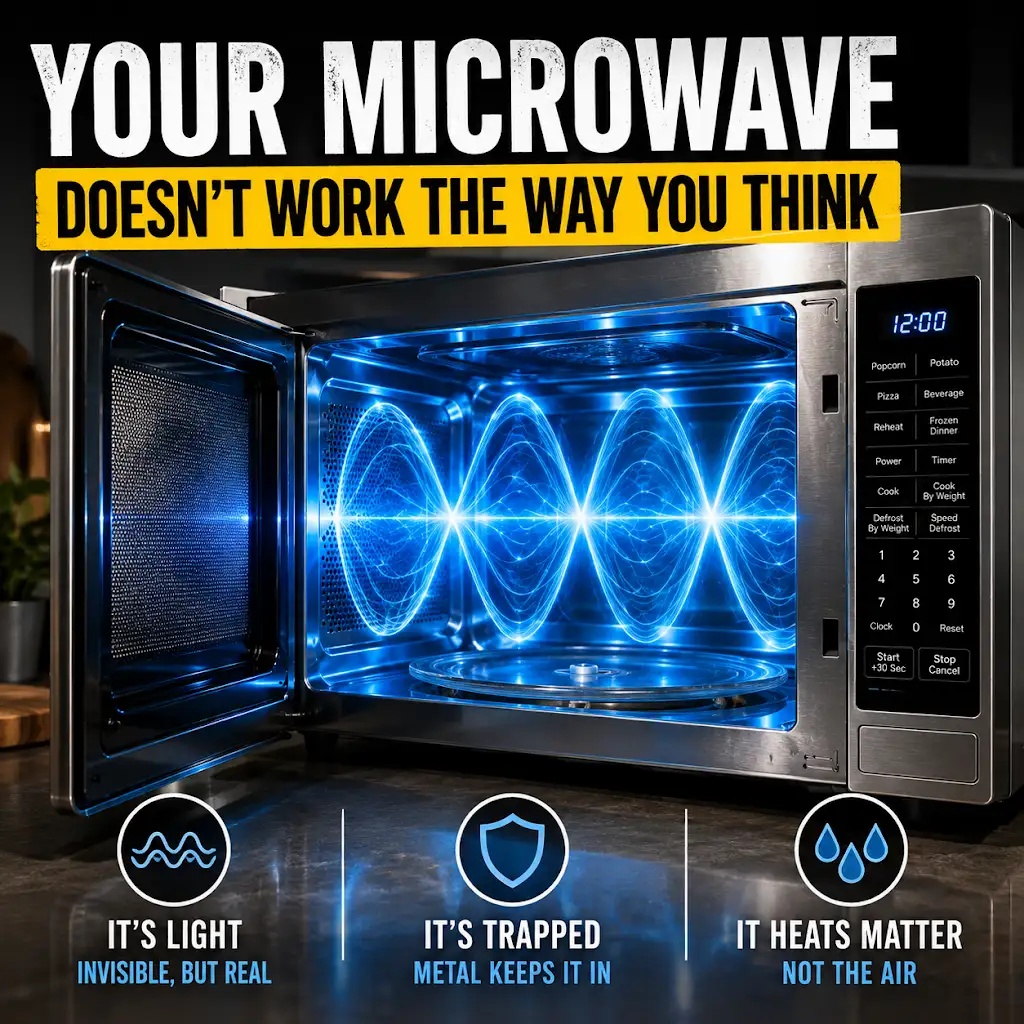
Your Microwave Doesn’t Work the Way You Think
FAQs
1. Why can you see through a microwave door?
Microwave doors are made of a special type of glass called “leaded glass” which allows you to see through it. This glass is designed to contain the microwaves inside the oven while still allowing you to monitor the food as it cooks.
2. Is it safe to see through a microwave door?
Yes, it is safe to see through a microwave door. The design of the door and the type of glass used ensures that the microwaves are contained within the oven and do not pose any risk to the person observing the food inside.
3. Can microwaves escape through the door?
No, microwaves cannot escape through the door of a microwave oven. The design and construction of the door, along with the special glass used, prevent the microwaves from leaking out and exposing the user to any potential harm.
4. How does the glass in a microwave door work?
The glass in a microwave door is made of leaded glass, which is a type of glass that contains lead oxide. This glass is specially designed to block the passage of microwaves while still allowing visible light to pass through, allowing you to see inside the oven.
5. Can the glass in a microwave door be damaged?
The glass in a microwave door can be damaged if it is subjected to excessive force or impact. It is important to handle the microwave door with care to avoid any damage to the glass, which could potentially compromise the safety and functionality of the oven.