You know, you probably have a whole arsenal of physics marvels humming away in your kitchen, a symphony of forces and principles that make your morning coffee, your perfectly toasted bread, and your chilled beverages possible. You might think of them as mere appliances, simple tools to get the job done. But if you look closer, truly look, you’ll find that each one is a testament to human ingenuity, a miniature laboratory where fundamental laws of physics play out every single day. This isn’t about complex equations or abstract theories; it’s about demystifying the everyday, about seeing the science that’s been right under your nose, powering your life. Prepare to have your perception of the mundane transformed as you uncover the hidden physics in your everyday appliances.
You probably use your microwave every day, zapping leftovers or popping popcorn without a second thought. But have you ever stopped to consider how it actually heats your food? It’s not magic, though it can certainly feel like it sometimes. The microwave oven is a brilliant application of electromagnetic radiation, specifically in the microwave frequency range.
The Genesis of Microwaves: The Magnetron’s Dance
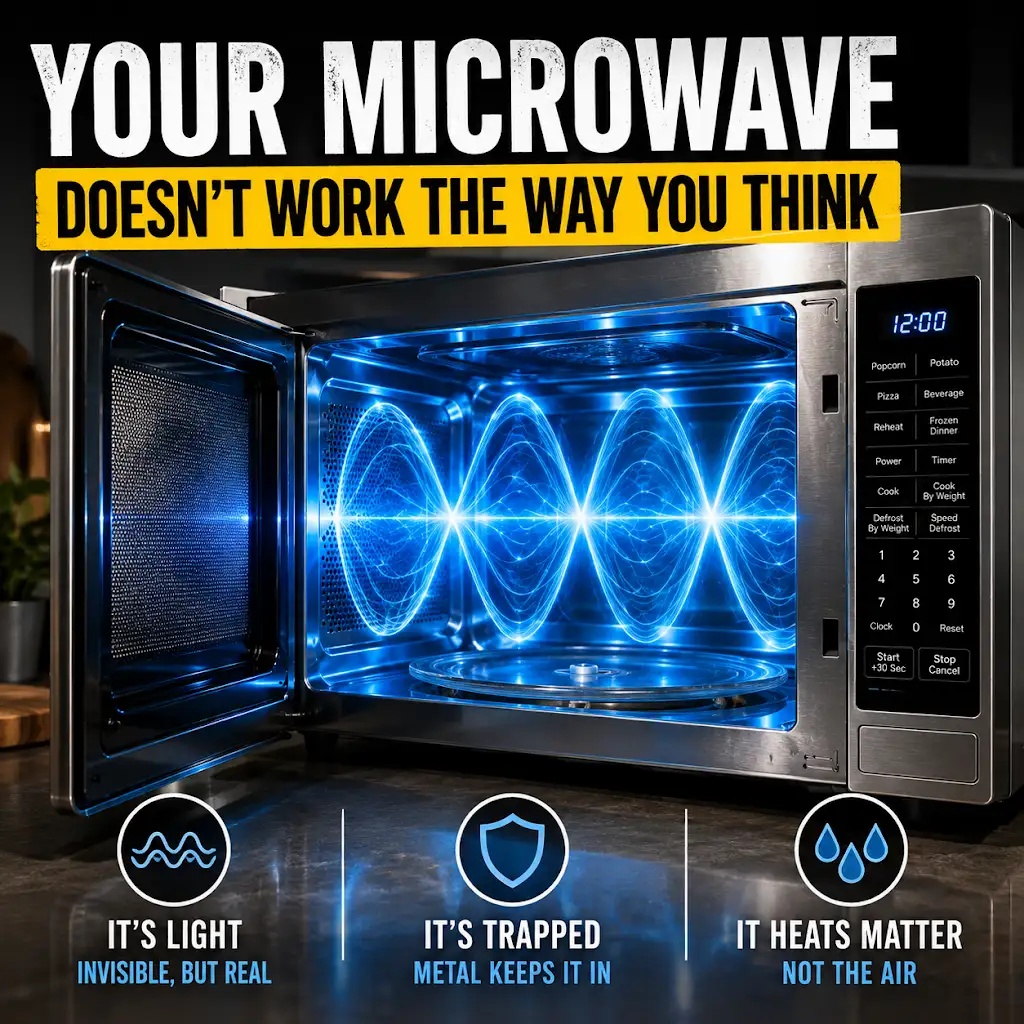
At the core of your microwave lies a device called a magnetron. This is where the magic truly begins. Think of it as a specially designed vacuum tube that generates high-frequency radio waves. Inside the magnetron, a powerful magnetic field interacts with a stream of electrons. This interaction forces the electrons to move in a circular, oscillating path, much like a tiny, incredibly fast carousel. As these electrons whip around, they emit electromagnetic radiation – microwaves – at a very specific frequency, usually around 2.45 gigahertz. This frequency is crucial because it’s highly effective at interacting with water molecules, the primary component of most foods.
The Dance of Water Molecules: Dielectric Heating
Now, how do these microwaves heat your food? This is where the concept of dielectric heating comes into play. Water molecules, you see, are polar. This means they have a slight positive charge on one side and a slight negative charge on the other, like tiny magnets. When the microwaves, which are essentially oscillating electromagnetic fields, enter your food, they exert a force on these polar water molecules.
Imagine the microwaves as a rapidly changing electric field. This field tries to align the positive end of the water molecule with the negative part of the field and vice-versa. But the field is flipping its direction billions of times per second. So, the water molecules are constantly trying to twist and turn to keep up with this rapidly changing electric field. This ceaseless wriggling and vibrating generates kinetic energy, which translates directly into heat. It’s like having a tiny personal masseuse for every water molecule in your food, and that massage is what cooks it.
The Cavity’s Role: Containing the Energy
The metal interior of your microwave oven isn’t just for aesthetics; it’s a critical component. This metal cavity acts as a Faraday cage, designed to contain the microwaves within the oven. The microwaves bounce off the metal walls, reflecting and scattering in all directions. This ensures that the energy is distributed throughout the food, leading to more even cooking. Without this reflective interior, the microwaves would simply escape, and your food would remain cold. You might also notice a rotating turntable or a stirrer fan. These are there to further improve the uniformity of heating, preventing cold spots by ensuring that different parts of the food are exposed to the microwave energy at different angles and intensities.
Beyond Heating: The Science of Defrosting and Popcorn
The same principles that heat your food also allow for defrosting and the marvel of popcorn. When you defrost, the microwaves are set at a lower power level, delivering energy more gently. This allows the ice crystals within the food to thaw gradually, preventing the outer layers from cooking before the inside is defrosted.
And popcorn? That’s a beautiful demonstration of phase transitions and pressure. The corn kernel contains a small amount of moisture. When heated by the microwaves, this water turns into steam. As the steam expands within the hard, unyielding hull of the kernel, pressure builds up. Eventually, the pressure becomes too great for the hull to contain, and it explosively ruptes, turning the starchy interior inside out – that’s the popcorn we know and love. It’s a miniature explosion, all thanks to the power of contained steam and the ingenuity of physics.
In exploring the fascinating world of physics that operates within our everyday appliances, you might find the article “Surprising Physics Inside Everyday Appliances” particularly enlightening. This piece delves into the unexpected scientific principles that govern the functionality of common household items, revealing how they utilize fundamental laws of physics to perform their tasks efficiently. To read more about these intriguing concepts, visit the article here: Surprising Physics Inside Everyday Appliances.
The Gentle Hum of Preservation: The Refrigerator and Freezer
Your refrigerator and freezer are the unsung heroes of your kitchen, diligently working day and night to keep your food fresh. You probably take their consistent chill for granted, but behind that cool facade lies a fascinating application of thermodynamics and the principles of heat transfer. They aren’t simply “cold boxes”; they are sophisticated systems designed to move heat from one place to another.
The Thermodynamic Cycle: A Journey of Heat
At the heart of every refrigerator and freezer is a refrigeration cycle, a closed loop that continuously moves heat. This cycle involves four main components: a compressor, a condenser, an expansion valve (or capillary tube), and an evaporator.
The process begins with the compressor. This is essentially a pump that compresses a refrigerant gas, increasing its pressure and temperature. Think of it as squeezing the gas, making it hotter and more energetic. This hot, high-pressure gas then flows into the condenser coils, usually located at the back of your refrigerator. Here, the hot gas releases its heat into the surrounding air of your kitchen. As it loses heat, the refrigerant condenses into a high-pressure liquid. You can often feel the warmth radiating from the back of your fridge – that’s the heat being expelled from your food.
The Phase Change: From Liquid to Gas, and Back Again
Next, this high-pressure liquid refrigerant passes through an expansion valve. This is a narrow opening that causes a sudden drop in pressure. As the pressure drops, the liquid refrigerant begins to vaporize, turning back into a gas. This vaporization process is endothermic, meaning it absorbs heat from its surroundings.
This now cold, low-pressure gaseous refrigerant flows into the evaporator coils, which are located inside your refrigerator and freezer compartments. As the refrigerant circulates through these coils, it absorbs heat from the air and food within the appliance. This is the crucial step where the cooling happens. The refrigerant essentially “steals” the heat from the inside of your fridge. As it absorbs this heat, it evaporates completely, becoming a low-pressure gas.
This now cooled, low-pressure gas returns to the compressor, and the cycle begins anew. This continuous cycle of compression, condensation, expansion, and evaporation is what maintains the consistently cold temperatures within your refrigerator and freezer, preserving your food.
Insulation: The Guardian of Coldness
While the refrigeration cycle is actively moving heat, the insulation of your refrigerator and freezer plays an equally vital role. The walls of these appliances are packed with insulating materials, typically foam or fiberglass. These materials are designed to be poor conductors of heat, effectively slowing down the rate at which heat from your warmer kitchen environment can enter the colder interior.
Think of it as a barrier. The refrigeration cycle is constantly fighting to keep the inside cold, and good insulation helps it win that fight by minimizing the amount of heat that needs to be removed. Without effective insulation, your refrigerator would have to work much harder and consume significantly more energy to maintain its temperature. You might also notice a rubber gasket around the door. This creates an airtight seal, preventing warm air from leaking in and cold air from escaping, further enhancing the efficiency of your appliance.
The Ice Maker’s Ingenuity: Freezing Point Depression
Even something as simple as an ice maker is a marvel of applied physics. When water freezes, it’s a process of phase transition where molecules arrange themselves into a crystalline structure. In a freezer, the evaporator coils within the ice maker tray draw heat away from the water, lowering its temperature to below its freezing point. The removal of heat causes the water molecules to slow down and lock into place, forming ice.
The speed at which ice forms can be influenced by factors like impurities in the water. While pure water freezes at 0°C (32°F), dissolved substances can lower the freezing point – a phenomenon known as freezing point depression. This is why the ice cubes in your freezer are pure water, and the tiny bit of liquid that might remain at the bottom of a glass of melting ice is slightly more concentrated with dissolved minerals.
The Dynamic Duo of the Kitchen: The Blender and the Mixer

Your blender and mixer, while serving different purposes, both rely on the fundamental principle of rotational kinetic energy to transform raw ingredients into delicious creations. They are powered by electric motors, efficient devices that convert electrical energy into mechanical energy, driving their blades or beaters with impressive speed and force.
The Electric Motor: The Heart of the Action
At the core of both your blender and mixer is an electric motor. These motors operate based on the principles of electromagnetism. They typically consist of a rotor (the part that spins) and a stator (the stationary part). The stator contains electromagnets or permanent magnets. When you plug in your appliance and switch it on, an electric current flows through coils within the motor.
This electric current creates magnetic fields. The interaction between the magnetic field of the stator and the magnetic field generated by the current in the rotor is what generates the torque, the rotational force that makes the motor spin. Think of it as a constant push and pull of magnetic forces, designed to keep the rotor turning in a specific direction. Different speeds on your blender or mixer correspond to different amounts of electrical current being supplied to the motor, controlling the rate at which the magnetic fields interact and thus the speed of rotation.
The Blade or Beater: The Workhorse of Transformation
In a blender, sharp, fast-spinning blades are the workhorses. Their high rotational speed, coupled with their sharp edges, creates a powerful vortex within the blender jar. This vortex draws ingredients down towards the blades, where they are repeatedly chopped, pureed, and liquefied. The efficiency of a blender is a combination of blade design, motor power, and the shape of the blending container, all working in concert to create a smooth mixture.
A mixer, on the other hand, typically uses beaters or dough hooks. These attachments are designed for slower, more sustained action. They are meant to aerate ingredients, incorporate air, and develop gluten in dough. The slower rotation allows for more thorough mixing and kneading, rather than pureeing. The shape and speed of the beaters are crucial for achieving the desired texture, whether it’s for whipping cream or kneading bread dough. You can see how the physics of motion, the interaction of rotating objects with their contents, is tailored to the specific culinary task.
Aeration and Emulsification: More Than Just Spinning
Beyond simply spinning, the actions of blenders and mixers facilitate important chemical and physical processes. In baking, for example, a mixer’s ability to aerate ingredients is crucial. Whipping egg whites or cream incorporates air bubbles, creating a lighter, fluffier texture. This is a direct result of the mechanical energy input from the mixer, forcing air into the liquid.
Similarly, blenders can help create emulsions. An emulsion is a mixture of two liquids that don’t typically mix, like oil and water. By rapidly breaking down the oil into tiny droplets and dispersing them throughout the water, a blender can create a stable emulsion, like in salad dressings or mayonnaise. This is a physical process of reducing surface tension and increasing the surface area of one liquid within the other.
The Warm Embrace of Comfort: The Toaster and the Electric Kettle

Your toaster and electric kettle are simple appliances, yet they harness powerful principles of electrical resistance and heat transfer to deliver hot food and drinks with remarkable speed and efficiency. They represent some of the earliest and most successful applications of electricity in the home.
The Resistive Element: The Source of Heat
The magic behind both your toaster and electric kettle lies in their heating elements. These elements are typically made of a resistive wire, often a nichrome alloy (a mixture of nickel and chromium). This material is chosen for its high electrical resistance.
When you plug in and switch on your toaster or kettle, electrical current flows through this resistive wire. According to Ohm’s Law, the resistance to the flow of electric current causes energy to be dissipated in the form of heat. The higher the resistance, the more heat is generated for a given amount of current. This is known as the Joule heating effect. The wires in your toaster glow red hot because they are reaching very high temperatures due to this resistance.
Heat Transfer in Action: Radiation and Conduction
In a toaster, the primary mode of heat transfer to the bread is radiation. The glowing hot nichrome wires emit infrared radiation, which is absorbed by the surface of the bread, toasting it. The proximity of the bread to the heating elements and the reflective interior of the toaster help to maximize this radiative heat transfer. You can feel the warmth radiating from a toaster even before it pops.
In an electric kettle, the heating element is submerged in water. Here, the primary modes of heat transfer are conduction and convection. The hot heating element directly transfers heat to the surrounding water through conduction. As the water near the element heats up, it becomes less dense and rises, while cooler, denser water sinks to take its place. This creates a continuous circulation of water, known as convection currents, which efficiently distribute the heat throughout the kettle, bringing the water to a boil.
The Thermostat: A Precise Control of Temperature
Both toasters and electric kettles often feature thermostats to regulate the temperature and prevent overheating or overcooking. In a toaster, a bimetallic strip is commonly used. This strip is made of two different metals with different rates of thermal expansion. As the strip heats up, one metal expands more than the other, causing the strip to bend. This bending action can be used to trip a switch, shutting off the heating element once the desired toastiness is achieved.
Electric kettles use similar mechanisms. Some have a simple thermal cutout switch that activates when the water reaches boiling point, causing it to produce steam that trips the switch. Others use more sophisticated thermostats that can be set to specific temperatures for different types of beverages. This precise control of heat is a testament to the applied physics of thermal expansion and electrical switching.
Many people are unaware of the fascinating physics that operates within their everyday appliances, which can often lead to surprising discoveries about how these devices function. For instance, a recent article explores the intricate science behind common household items, revealing the unexpected principles at play. If you’re curious to learn more about the hidden mechanics of your appliances, you can check out this insightful piece on Freaky Science. Understanding these concepts not only enhances our appreciation for technology but also sparks curiosity about the world around us.
Beyond the Kitchen: The Ubiquity of Applied Physics
| Appliance | Surprising Physics |
|---|---|
| Refrigerator | The cooling process involves the compression and expansion of a refrigerant gas, which absorbs and releases heat, allowing the inside of the refrigerator to stay cool. |
| Microwave | Microwaves use electromagnetic radiation to heat food by causing water molecules to vibrate, generating heat through friction. |
| Washing Machine | The spinning motion of the washing machine drum creates centrifugal force, which helps to remove water from the clothes during the spin cycle. |
| Electric Kettle | The heating element inside the kettle uses electrical resistance to generate heat, boiling the water through the transfer of energy. |
While we’ve focused on the kitchen, the principles of physics are woven into the fabric of countless other appliances you use daily. From the washing machine’s understanding of rotational dynamics and buoyancy to the vacuum cleaner’s mastery of air pressure and fluid dynamics, physics is silently at work, making your life easier and more comfortable.
The Washing Machine: Buoyancy and Centrifugal Force
Your washing machine is a testament to the interplay of forces. When you fill it with water, the principle of buoyancy comes into play, lifting the clothes and allowing them to move more freely. The washing action itself, whether it’s a tumbling drum or an agitator, relies on rotational motion to create friction between the clothes and the water, dislodging dirt.
The spin cycle is a prime example of centrifugal force in action. As the drum spins at high speed, the clothes are pushed outwards. However, it’s actually inertia that keeps the clothes moving in a straight line, and the drum’s wall pushing inwards to force them into a circular path. This outward push, often colloquially referred to as centrifugal force, effectively presses the water out of the clothes, leaving them damp rather than sopping wet. The design of the drum’s perforations also plays a role, allowing the expelled water to drain away efficiently.
The Vacuum Cleaner: Pressure Gradients and Airflow
The seemingly simple act of vacuuming is a sophisticated application of air pressure. A vacuum cleaner works by creating a low-pressure area inside its motor and bag or canister. The fan within the motor rapidly expels air, reducing the pressure within the cleaner.
This significant pressure difference between the outside atmosphere (higher pressure) and the inside of the vacuum cleaner (lower pressure) creates a powerful suction. Air, like any fluid, always flows from an area of higher pressure to an area of lower pressure. So, the higher atmospheric pressure outside the vacuum cleaner pushes air, along with dirt and debris, into the nozzle and up into the cleaner’s collection system. The efficiency of your vacuum cleaner is a direct result of the strength of this pressure gradient and the design of its nozzle and airflow system.
The Hair Dryer: Convection and the Bernoulli Principle
Even your hairdryer, a tool for personal grooming, is a mini-physics lab. It combines a heating element with a fan. The fan draws in ambient air, blows it over the heating element (creating hot air through convection), and then expels it at high speed.
The high-speed expulsion of air from the nozzle also demonstrates a principle related to the Bernoulli principle. While not a perfect application, the rapid movement of air can create a slight area of lower pressure immediately in front of the nozzle. This contributes to the forceful stream of hot air that dries your hair. The different heat settings on your hairdryer directly relate to how much current is supplied to the heating element, thus controlling the amount of heat generated.
By understanding the physics behind these everyday appliances, you unlock a new appreciation for the ingenuity that surrounds you. You’re not just using a toaster; you’re witnessing the controlled application of electrical resistance and radiative heat transfer. You’re not just microwaving leftovers; you’re observing the resonant interaction of electromagnetic waves with polar molecules. This journey into the hidden physics of your home reveals that science isn’t confined to laboratories; it’s the invisible force that powers your world, one appliance at a time. So, the next time you flick a switch or press a button, take a moment to marvel at the elegant physics that makes it all possible.
Your Microwave Doesn’t Work the Way You Think
FAQs
What are some examples of everyday appliances that contain surprising physics?
Some examples of everyday appliances that contain surprising physics include refrigerators, microwaves, washing machines, and vacuum cleaners. These appliances rely on various principles of physics to function efficiently.
How does physics play a role in the operation of a refrigerator?
Refrigerators rely on the principles of thermodynamics and heat transfer to cool the interior. The refrigeration cycle involves the compression and expansion of a refrigerant, which absorbs and releases heat, allowing the refrigerator to maintain a cold temperature inside.
What physics principles are at work in a microwave oven?
Microwave ovens use electromagnetic radiation to heat food. The microwaves cause water molecules in the food to vibrate, generating heat through friction. This process is based on the principles of electromagnetism and wave-particle duality.
How does physics contribute to the functioning of a washing machine?
Washing machines use principles of mechanics and fluid dynamics to agitate and clean clothes. The rotation of the drum creates centrifugal forces that help remove dirt and water from the clothes, while the use of detergents involves principles of surface tension and chemistry.
What surprising physics phenomena are involved in the operation of a vacuum cleaner?
Vacuum cleaners rely on principles of fluid dynamics and air pressure to create suction. The motor creates a low-pressure area inside the vacuum, causing air and dirt to be drawn in. The filtration system also involves principles of particle physics and airflow.