
The vast expanse of the cosmos, a tapestry woven with galaxies, nebulae, and the faint whispers of ancient light, holds within it phenomena that continue to perplex and inspire. Among these cosmic enigmas, the Cosmic Microwave Background (CMB) stands as a foundational pillar of our understanding of the universe. Yet, even within this well-studied relic of the Big Bang, subtle anomalies persist, hinting at deeper mysteries. One such anomaly, the “Void Imprint” or sometimes referred to as the “Cold Spot,” has been a subject of intense scrutiny and debate, challenging conventional cosmological models and sparking a quest for exotic explanations.
The Echo of Creation: Understanding the Cosmic Microwave Background
The CMB is not merely a faint glow; it is the afterglow of the Big Bang, a snapshot of the universe when it was a mere 380,000 years old. At this epoch, known as recombination, the universe had cooled enough for electrons and protons to combine and form neutral atoms. This event allowed photons, which had been scattering off charged particles, to travel freely, thus creating the uniform bath of microwave radiation that permeates all of space. This radiation, remarkably uniform in temperature, carries invaluable information about the early universe, its composition, and its evolution.
The Early Universe and the Genesis of Structure
The prevailing cosmological model, the Lambda-CDM (ΛCDM) model, posits that the early universe was an incredibly hot, dense plasma. Tiny quantum fluctuations, stretched to cosmic scales by an explosive period of inflation, served as the seeds for all the structure we observe today. These primordial density variations, imprinted on the CMB as minuscule temperature fluctuations, are the reason why the universe is not perfectly homogeneous. Denser regions eventually attracted more matter, leading to the formation of galaxies, clusters, and the large-scale cosmic web.
Decoding the CMB Fluctuations: A Cosmological Blueprint
The precise pattern of these temperature fluctuations, as measured by missions like the Wilkinson Microwave Anisotropy Probe (WMAP) and the Planck satellite, has been instrumental in confirming and refining the ΛCDM model. The power spectrum of these fluctuations reveals the relative abundance of dark matter, dark energy, and baryonic matter, as well as the geometry of the universe. It’s a cosmic fingerprint, allowing cosmologists to reconstruct the universe’s past and predict its future. However, within this seemingly ordered pattern, certain features have emerged that don’t quite fit the expected picture.
Recent studies on cosmic microwave background (CMB) radiation have revealed intriguing void imprints that could provide insights into the early universe’s structure. These voids, which are large, underdense regions in the cosmos, may hold clues about the distribution of dark matter and the evolution of galaxies. For a deeper understanding of this phenomenon, you can read a related article that explores the implications of voids on cosmic evolution at Freaky Science.
The Anomalous Shadow: The Mysterious “Cold Spot”
Among the myriad of small temperature variations in the CMB, one region stands out for its unusual characteristic: it is significantly colder than its surroundings. This phenomenon, dubbed the “Cold Spot,” has been a persistent thorn in the side of standard cosmology. While the CMB is remarkably uniform, with temperature variations on the order of microkelvins, the Cold Spot exhibits a deficit of temperature that is larger than predicted by random chance within the framework of the ΛCDM model.
Quantifying the Cold Spot: Statistical Significance and Observational Evidence
The statistical significance of the Cold Spot has been a subject of ongoing research. While initial observations suggested it was a rare fluke, more detailed analysis, particularly from the Planck satellite data, has reinforced its unusual nature. The probability of observing a region as cold as the Cold Spot, purely due to the natural statistical fluctuations expected in the CMB, is estimated to be low, leading to questions about its origin. It represents a statistical outlier, prompting cosmologists to explore potential explanations that go beyond the standard cosmological narrative.
Distinguishing from Expected Variations: The Nuances of CMB Anisotropies
It is crucial to differentiate the Cold Spot from expected anisotropies in the CMB. The universe is not perfectly smooth. There are regions that are slightly denser or less dense, and these variations manifest as temperature differences. However, the Cold Spot appears to be an unusually large and deep dip in temperature, suggesting a more profound underlying cause than simple statistical variance or the gravitational influence of known structures. The search is on for a phenomenon that can explain this specific, unusually cold region.
Seeking Explanations: From Known to the Unknown

The discovery of the Cold Spot ignited a flurry of theoretical investigations, ranging from modifications to existing cosmological models to entirely new physics. Scientists have explored various avenues, attempting to reconcile this anomaly with our current understanding of the universe. The range of proposed explanations reflects the scientific community’s commitment to understanding every facet of our cosmic origins.
Conventional Cosmological Scenarios: Re-evaluating the Standard Model
Some researchers have attempted to explain the Cold Spot within the confines of the ΛCDM model by invoking less likely, but still permissible, cosmic configurations. These include the possibility of a vast supervoid – a region of space with significantly less matter than average – lying in the direction of the Cold Spot. If such a supervoid existed, its gravitational influence would be weaker, causing photons passing through it to lose less energy and thus appear slightly cooler.
The Supervoid Hypothesis: A Gravitational Shadow
The supervoid hypothesis suggests that the Cold Spot is not an intrinsic anomaly of the CMB itself, but rather a consequence of the gravitational lensing effect of a massive void situated between us and the CMB surface. Photons traveling through a less dense region of space experience a slight redshift as they climb out of the gravitational potential well, resulting in a lower observed temperature. While such voids are expected to exist, the specific characteristics of the Cold Spot have led some to question whether a single supervoid could account for its magnitude and extent. Further observational efforts are underway to map the intervening space and search for such a structure.
Other Standard Model Extensions: Inflationary Quirks
Other explanations within extensions of the standard model involve subtle features in the inflationary epoch itself. For example, models with specific inflationary potentials or inhomogeneities during inflation could, in theory, produce larger-than-expected cold spots. However, these explanations often require fine-tuning of parameters and may have other observable consequences that are not yet confirmed.
Exotic Physics and Beyond: Pushing the Boundaries of Understanding
When conventional explanations fall short, scientists naturally turn to more speculative, yet potentially groundbreaking, theories. The Cold Spot has provided a fertile ground for such investigations, pushing the boundaries of theoretical physics.
Cosmic Strings: Relics of Early Universe Phase Transitions
One particularly intriguing hypothesis involves cosmic strings. These are hypothetical one-dimensional topological defects that could have formed during phase transitions in the very early universe, analogous to the cracks that form when water freezes. If a dense network of cosmic strings were present in the direction of the Cold Spot, their gravitational field could potentially explain the observed temperature deficit. However, the existence of cosmic strings remains unconfirmed, and their specific arrangement to produce the Cold Spot would be highly coincidental.
Extradimensional Warping: The Shadow of Another Realm
Another far-reaching idea suggests that the Cold Spot might be a consequence of interactions with other dimensions. If our universe is embedded in a higher-dimensional space, and there’s a large region of lower energy density or a different curvature in another dimension that influences our own, it could manifest as a cold spot in the CMB. This is a highly speculative idea, but it highlights the willingness of cosmologists to consider radical explanations when faced with persistent anomalies.
Alternative Cosmological Models: A Universe Without Our Standard Paradigm
Some researchers have proposed that the Cold Spot might be a hint that our entire cosmological model is incomplete or fundamentally flawed. Perhaps the universe is not as isotropic or homogeneous as assumed, or maybe the Big Bang itself was not the singular event we currently understand. These are sweeping statements that require robust evidence, but the persistence of the Cold Spot fuels these discussions, encouraging a critical re-examination of our foundational assumptions.
The Search for Evidence: Mapping the Intervening Universe
The quest to understand the Cold Spot is not purely theoretical; it involves intensive observational efforts to gather more data and test the various hypotheses. Scientists are employing different techniques to probe the universe between us and the CMB surface, hoping to find the missing piece of the puzzle.
Galactic Surveys: Charting the Cosmic Landscape
One crucial approach involves conducting detailed surveys of galaxies and other cosmic structures in the direction of the Cold Spot. By mapping the distribution of matter, astronomers can identify potential supervoids or other large-scale structures that might be responsible for the observed temperature deficit. These surveys use advanced telescopes and sophisticated data analysis techniques to build a three-dimensional map of the universe.
Galaxy Redshift Studies: Measuring Cosmic Distances
Redshift measurements of galaxies provide essential information about their distances and velocities. By analyzing the redshift of galaxies in the direction of the Cold Spot, scientists can determine if there is a significant void or a large collection of matter that could influence the CMB photons. The further away a potential void is, the more time photons would have had to travel through it, potentially leading to a more pronounced cold spot.
Advanced CMB Observations: Refining the Data
Future CMB missions are also poised to play a vital role. More sensitive instruments with higher angular resolution can provide a more detailed map of the CMB, allowing scientists to scrutinize the Cold Spot with greater precision and search for subtle patterns that might be indicative of its origin. These observations can also help to rule out or confirm certain theoretical explanations by providing more precise measurements of the CMB’s statistical properties.
Recent studies have explored the intriguing concept of void imprints on the cosmic microwave background (CMB), shedding light on the large-scale structure of the universe. These voids, which are vast regions with significantly fewer galaxies than average, can leave subtle signatures on the CMB that researchers are eager to decode. For a deeper understanding of this phenomenon, you can read more in the related article found here: Freaky Science. This exploration not only enhances our comprehension of cosmic evolution but also opens up new avenues for investigating the fundamental nature of dark energy and matter.
The Philosophical Implications: Redefining Our Cosmic Place
| Metric | Description | Typical Value / Range | Unit | Relevance to Void Imprint on CMB |
|---|---|---|---|---|
| Void Radius | Characteristic size of cosmic voids causing CMB imprint | 10 – 300 | Megaparsecs (Mpc) | Determines angular scale of temperature fluctuations in CMB |
| Temperature Fluctuation (ΔT) | Change in CMB temperature due to void presence | -10 to -50 | Microkelvin (μK) | Measures the cold spot or imprint caused by voids |
| Redshift (z) | Distance indicator of void location | 0.1 – 1.0 | Dimensionless | Helps determine void’s effect on CMB photons over cosmic time |
| Integrated Sachs-Wolfe (ISW) Effect | Change in photon energy passing through evolving voids | Positive or Negative | Dimensionless (relative temperature shift) | Primary mechanism for void imprint on CMB temperature anisotropies |
| Angular Size | Apparent size of void imprint on CMB sky | 1 – 10 | Degrees | Relates void physical size and distance to observed CMB feature |
| Density Contrast (δ) | Relative underdensity inside the void compared to average cosmic density | -0.3 to -0.9 | Dimensionless | Determines strength of gravitational potential affecting CMB photons |
The pursuit of an explanation for the Cold Spot extends beyond mere scientific curiosity. It touches upon fundamental questions about the nature of reality, the limitations of our current knowledge, and our place in the vast cosmic tapestry. The persistence of such anomalies serves as a humbling reminder of the immense mysteries that still lie hidden within the universe.
The Scientific Method in Action: Embracing Uncertainty
The Cold Spot exemplifies the scientific method at its finest. An observation, initially perceived as an anomaly, sparks intense theoretical debate and drives further empirical investigation. This process of hypothesis, testing, and refinement is the engine of scientific progress. Even if the Cold Spot is eventually explained by a prosaic phenomenon, the journey of discovery will have deepened our understanding of the universe. If it requires a paradigm shift, the implications will be even more profound.
The Quest for a Complete Picture: From Theory to Observation
Ultimately, the goal is to construct a complete and consistent picture of the universe. The Cold Spot, whether a trivial statistical fluke or a profound hint of new physics, represents a challenge to that goal. Its resolution will undoubtedly refine our cosmological models, potentially leading to new theories
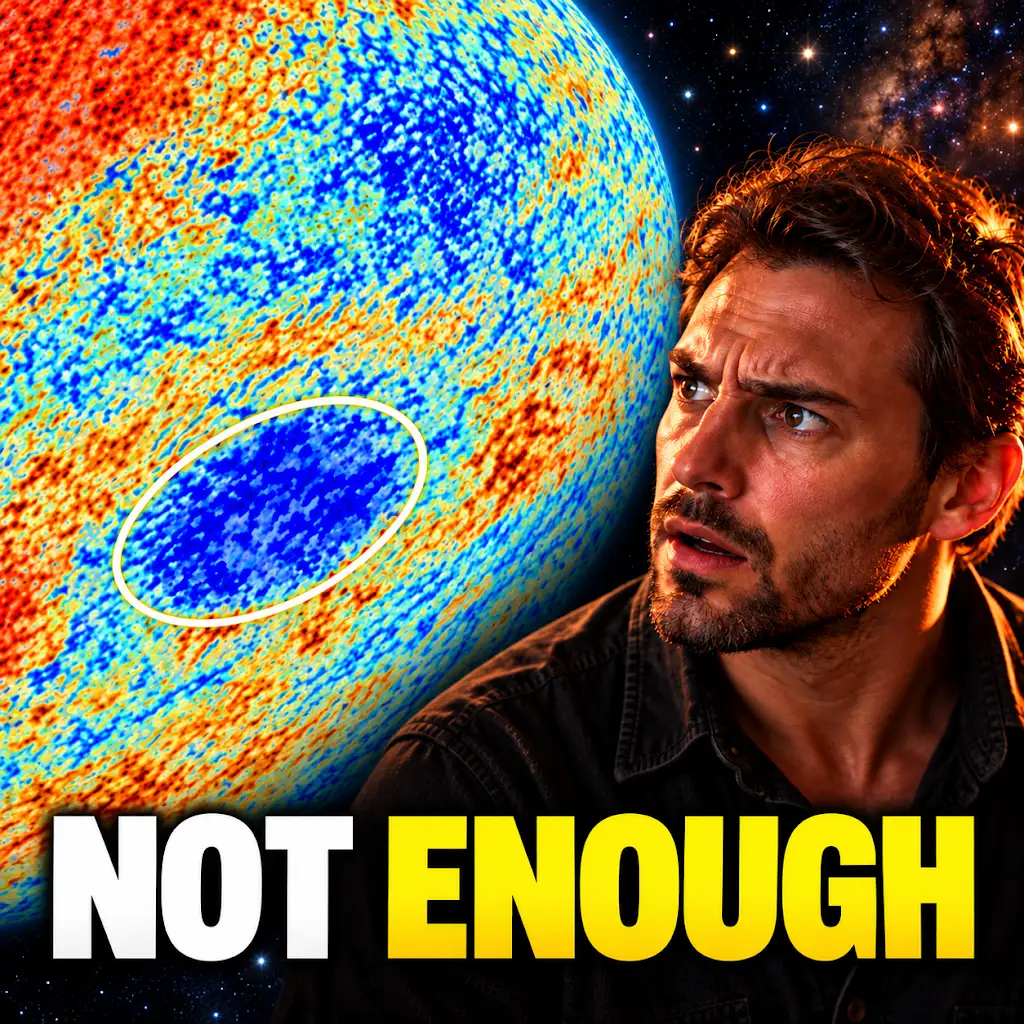
The Universe’s Cold Spot Has an Explanation. It’s Not Enough.
FAQs
What is a void imprint on CMB?
A void imprint on CMB refers to a phenomenon where the presence of large cosmic voids in the universe leaves a distinct signature on the Cosmic Microwave Background (CMB) radiation.
How are void imprints on CMB detected?
Void imprints on CMB are detected through analyzing the temperature fluctuations in the CMB radiation. These fluctuations can reveal the presence of cosmic voids by showing patterns of lower temperature regions corresponding to the voids.
What information can void imprints on CMB provide about the universe?
Void imprints on CMB can provide valuable information about the large-scale structure of the universe, the distribution of matter, and the evolution of cosmic voids. Studying these imprints can help astronomers better understand the dynamics of the universe.
Why are void imprints on CMB important in cosmology?
Void imprints on CMB are important in cosmology because they offer insights into the nature of dark energy, dark matter, and the overall composition of the universe. By studying these imprints, scientists can gain a deeper understanding of the fundamental forces shaping the cosmos.
What are some current research areas related to void imprints on CMB?
Current research areas related to void imprints on CMB include investigating the impact of cosmic voids on the large-scale structure of the universe, exploring the connection between voids and galaxy formation, and using void imprints to test cosmological models and theories.