
The human experience of space is fundamentally a visual one. From the earliest flickers of awareness in an infant to the complex navigational feats of seasoned explorers, sight has been the primary conduit through which we perceive, understand, and interact with the vast expanse around us. This article delves into the intricate ways in which our visual system shapes our perception of space, exploring the biological underpinnings, the psychological constructs, and the cultural influences that color our understanding of the cosmos.
The human visual system is a marvel of evolutionary engineering, exquisitely tuned to detect and interpret light. This intricate biological machinery forms the bedrock of our spatial awareness, providing the raw data that our brains then process into a coherent perception of the world.
The Retina: A Canvas of Light and Shadow
The journey of visual information begins in the retina, a light-sensitive layer at the back of the eye. Here, photoreceptor cells – rods and cones – convert photons of light into electrochemical signals. Rods, highly sensitive to low light, are crucial for scotopic vision, enabling us to navigate in dim environments and to perceive the broad strokes of spatial layouts. Their abundance in the peripheral retina contributes to our ability to sense movement and the overall shape of our surroundings. Cones, on the other hand, are responsible for photopic vision, providing us with the sharp detail and color discrimination necessary for discerning objects and their spatial relationships in brighter conditions. The distribution and density of cones in the fovea, the central region of the retina, grant us our highest visual acuity, allowing us to fixate on specific points and meticulously analyze their spatial characteristics.
Depth Perception: Triangulating the Three Dimensions
Our ability to perceive depth, the crucial third dimension of space, is a sophisticated process involving multiple cues.
Binocular Vision: The Power of Two Eyes
The most fundamental cue for depth perception is binocular disparity. Because our eyes are separated by a small distance, they receive slightly different images of the same object. The brain compares these two images, calculating the degree of disparity to infer the object’s distance. Objects closer to us will have a larger disparity than those further away. This precise triangulation is essential for tasks ranging from catching a ball to appreciating the scale of a landscape.
Monocular Cues: A Symphony of Visual Hints
Even with one eye closed, we can still perceive depth, thanks to a suite of monocular cues. These include:
- Relative Size: Larger objects are generally perceived as closer than smaller objects, assuming they are of similar actual size. This allows us to gauge distances in a scene by comparing the apparent sizes of familiar objects.
- Interposition (Occlusion): When one object partially blocks the view of another, we perceive the blocking object as being closer. This simple overlap provides a powerful indicator of relative depth.
- Linear Perspective: Parallel lines, such as railroad tracks or the edges of a road, appear to converge in the distance. This phenomenon, known as foreshortening, creates a sense of depth and recession into the scene.
- Texture Gradient: As surfaces recede into the distance, the texture of those surfaces appears to become finer and less detailed. This gradient in texture provides a visual cue for increasing distance.
- Aerial Perspective: Distant objects often appear hazier, less distinct, and bluer than nearby objects due to the scattering of light by atmospheric particles. This atmospheric softening contributes to our perception of depth in vast landscapes.
- Motion Parallax: When we move, objects closer to us appear to move faster and in the opposite direction of our movement, while objects further away appear to move slower and in the same direction, or not at all. This dynamic cue is particularly effective in conveying relative distances.
The vastness of space presents a mesmerizing spectacle that is often beyond the comprehension of the human eye. For those curious about how our eyes perceive the cosmos, an insightful article can be found at Freaky Science. This resource explores the limitations of human vision in the context of astronomical phenomena, shedding light on how advanced technologies and instruments enhance our understanding of the universe.
The Psychological Interpretation: Building Meaning from Visual Input
The raw sensory data from our eyes is only the starting point. Our brains actively interpret this information, constructing a meaningful representation of space based on learned associations, cognitive biases, and attentional processes.
Gestalt Principles: Organizing the Visual Field
The Gestalt psychologists identified fundamental principles that govern how we perceive visual organization. These principles highlight our innate tendency to group elements into coherent wholes, shaping our understanding of spatial relationships.
- Proximity: Elements that are close to each other are perceived as belonging together, forming groups or clusters. This influences how we see individual objects within a larger environment or how we parse a complex scene.
- Similarity: Elements that share similar visual characteristics, such as shape, color, or orientation, are perceived as being related. This helps us to identify patterns and categorize objects within our spatial awareness.
- Continuity: We tend to perceive smooth, continuous lines and patterns rather than broken or discontinuous ones. This principle aids in tracing the boundaries of objects and understanding the flow of lines and forms in space.
- Closure: Our brains tend to fill in missing gaps to perceive complete figures and shapes. This allows us to recognize incomplete objects and to perceive solid forms even when parts of their outlines are obscured.
- Common Fate: Elements that move in the same direction and at the same speed are perceived as belonging together, forming a unified group. This principle is particularly relevant for understanding the movement of objects within a spatial context.
Spatial Cognition: The Mental Map
Beyond immediate visual perception, our minds construct and manipulate mental representations of space – often referred to as cognitive maps. These internal models allow us to navigate familiar environments, plan routes, and understand the relationships between different locations.
Landmark-Based Navigation: Familiar Anchors
A significant portion of our spatial cognition relies on recognizing and remembering landmarks. These prominent features – a distinctive building, a unique tree, a street corner – serve as anchor points in our mental maps, guiding our navigation and providing a sense of orientation. The visual distinctiveness of these landmarks is crucial for their memorability and utility.
Route Knowledge: The Sequential Path
Route knowledge refers to our understanding of the sequence of turns and paths required to travel between two points. This is often learned through repeated experience and is heavily reliant on visual cues encountered along the way, such as street signs, building facades, and intersections.
Survey Knowledge: The Bird’s-Eye View
At a more abstract level, survey knowledge represents a more abstract, bird’s-eye view of an environment, allowing for flexible navigation and estimation of distances and directions between any two points, regardless of a specific route. This type of spatial understanding is crucial for planning efficient travel and for comprehending the overall layout of a city or region.
The Influence of Light and Color: Shaping Our Perception of Space
Light and color are not merely passive elements of our visual environment; they actively shape our perception of space, influencing our sense of distance, volume, and even emotional state.
The Role of Luminance and Contrast
The intensity of light (luminance) and the differences in light intensity between objects (contrast) are fundamental to our ability to perceive spatial relationships. High contrast areas often delineate edges and boundaries, helping us to define the forms of objects and their separation from the background. Gradations in luminance can also signal depth and the curvature of surfaces. For instance, subtle changes in light across a spherical object indicate its three-dimensional form.
Color as a Spatial Indicator
Color plays a more nuanced role in spatial perception. Warm colors, such as reds and oranges, tend to appear to advance visually, making objects seem closer. Conversely, cool colors, like blues and greens, tend to recede, creating a sense of distance. This effect is often exploited in interior design and art to manipulate the perceived size and depth of spaces. Furthermore, color saturation can also influence perceived distance; more vibrant colors often appear closer than muted or desaturated ones.
Atmospheric Perspective and Color
As mentioned earlier, aerial perspective relies on the color shifts that occur with distance. The scattering of light in the atmosphere causes distant objects to appear bluer and less saturated. Our brains are so attuned to this phenomenon that even in the absence of actual atmosphere, artists can evoke a sense of depth by using cooler, desaturated colors for elements that are intended to be perceived as far away.
Beyond the Immediate: Cultural and Technological Augmentations of Spatial Vision

Our visual experience of space is not static; it is continually shaped by cultural contexts, learned behaviors, and the technological tools we employ to extend our perceptual capabilities.
Cultural Lenses on Spatial Representation
Different cultures develop distinct ways of representing and understanding space, which are often reflected in their visual arts, architecture, and language.
Perspective in Western Art
The development of linear perspective in Renaissance art, for example, represented a significant shift in how Western cultures visually depicted three-dimensional space on a two-dimensional surface. This standardized system of representing depth and scale became deeply ingrained in our visual language.
Non-Western Spatial Representations
In contrast, some East Asian art traditions have historically employed more layered and overlapping perspectives, emphasizing the multiplicity of viewpoints rather than a single vanishing point. This highlights how cultural frameworks can influence the very principles by which we visually construct spatial realities.
Technology as a Spatial Enhancer
Throughout history, humans have developed technologies to augment their visual perception of space, from simple lenses to sophisticated imaging systems.
Optics and Telescopes: Expanding the Horizon
The invention of the telescope revolutionized our ability to visually explore the cosmos, revealing celestial bodies and vast structures that were previously invisible. This technological leap literally expanded our perceived spatial boundaries.
Photography and Film: Capturing and Manipulating Space
Photography and film have provided new ways of capturing and presenting spatial information. Techniques like wide-angle lenses can exaggerate perceived depth, while telephoto lenses can compress it, demonstrating how technology can actively manipulate our visual experience of space.
Virtual and Augmented Reality: Immersive Spatial Experiences
The advent of virtual reality (VR) and augmented reality (AR) represents the pinnacle of technological augmentation, creating entirely new, immersive spatial experiences. VR allows us to inhabit entirely simulated environments, while AR overlays digital information onto our perception of the real world, fundamentally altering our interaction with and understanding of spatial relationships. These technologies bypass traditional visual limitations, offering profound new ways to explore, learn, and engage with space.
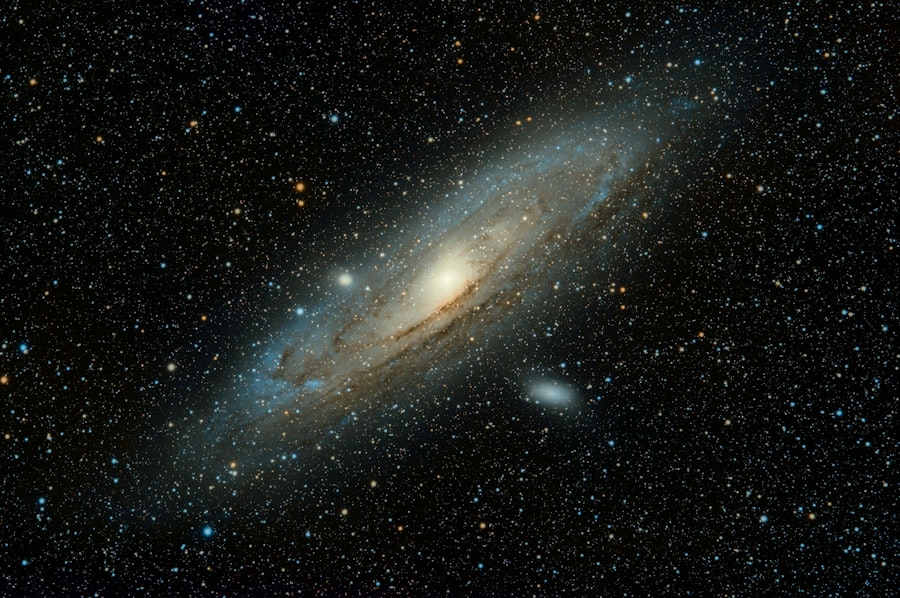
When we gaze into the vastness of space, our human eyes perceive a stunning array of colors and patterns, shaped by the light emitted from distant stars and galaxies. This fascinating phenomenon is explored in a related article that delves into how our vision interprets the cosmos. For a deeper understanding of this topic, you can read more about it in this insightful piece on the science of space perception. The interplay of light and darkness in the universe not only captivates our imagination but also reveals the intricate workings of celestial bodies.
The Future of Visual Spatial Experience: Navigating the Unseen and the Imagined
| Aspect | Description |
|---|---|
| Color | Space appears black to human eyes due to the absence of light and lack of atmosphere to scatter light. |
| Size | Space is vast, with distances between celestial objects measured in light years. |
| Depth | Space appears three-dimensional, with stars and galaxies appearing at varying distances. |
| Texture | Space appears smooth and featureless to the human eye, with no visible surface details. |
As our understanding of the visual system and our technological capabilities continue to advance, the human experience of space is poised for further transformation.
Decoding the Unseen: Beyond the Visible Spectrum
Future advancements in imaging technologies will likely allow us to perceive aspects of space that are currently invisible to the human eye. From the infrared signatures of distant galaxies to the subtle electromagnetic fields that permeate our environment, we may soon have a visual vocabulary for phenomena previously confined to scientific models.
The Art of Navigating Imagined Spaces
The increasing sophistication of VR and AR suggests a future where the lines between the physical and the imagined blur. Our ability to navigate and interact within purely digital or digitally augmented spaces will become increasingly sophisticated, demanding new forms of spatial literacy and cognitive flexibility. This could lead to novel forms of art, communication, and even therapy that are deeply rooted in the visual experience of designed or simulated spaces.
Personalizing Spatial Perception
With the rise of AI and personalized algorithms, it is conceivable that our visual experience of space could become increasingly tailored to individual needs and preferences. Imagine environments that dynamically adjust their visual presentation based on our mood, cognitive load, or specific tasks. This future promises a highly personalized and responsive spatial world, curated by algorithms that understand our visual and psychological responses. The human perspective on space, always a dynamic interplay of biology, psychology, and culture, is set to evolve in ways that are as boundless as the space we continue to explore.

The Space Photos Are Real—But Your Eyes Would See This
FAQs
What is space?
Space is the vast, seemingly infinite expanse that exists beyond Earth’s atmosphere. It is filled with stars, planets, galaxies, and other celestial bodies.
How does space appear to human eyes?
In space, human eyes perceive a dark, black void with scattered points of light. The absence of atmosphere means there is no scattering of light, resulting in a pitch-black background with bright stars and other celestial objects.
Why does space appear black to human eyes?
Space appears black to human eyes because there is no atmosphere to scatter light. Without scattering, the light from distant stars and galaxies does not reach our eyes, creating the appearance of darkness.
Can humans see colors in space?
Yes, humans can see colors in space. Stars emit light of different colors, and some celestial objects, such as nebulae, also exhibit vibrant colors. However, the colors may not be as vivid as they appear in photographs due to the limitations of human vision in the low-light conditions of space.
How does the lack of atmosphere affect human perception of space?
The lack of atmosphere in space affects human perception by eliminating the scattering of light, resulting in a dark background with bright points of light. Additionally, without an atmosphere, there is no air to distort or block the view, allowing for clearer visibility of celestial objects.