
You stare at your supposedly perfectly heated meal, a sigh escaping your lips. Some parts are scalding hot, others barely warm, and a few stubborn corners remain stubbornly chilly. You’re not alone. This culinary conundrum, the uneven heating of microwaves, is a universal frustration, a perplexing dance between science and your dinner plate. You’ve probably tried everything: stirring, rotating, arranging your food in a specific pattern. Yet, the mystery persists. Why, in this age of advanced technology, does your microwave insist on playing culinary roulette with your leftovers?
You might think of your microwave as a magical box that zaps food with invisible waves. While that’s not entirely wrong, the reality is far more nuanced and, frankly, quite ingenious. To understand the uneven heating, you first need to grasp the fundamental principles of how a microwave oven operates. It’s a fascinating interplay of electromagnetic radiation and the molecular structure of your food.
The Heart of the Operation: The Magnetron
At the core of every microwave oven lies a device called a magnetron. This is where the magic, or rather, the science, truly begins. The magnetron is a high-powered vacuum tube that generates microwaves, a form of electromagnetic radiation. Think of it like the engine of your microwave, producing the energy that cooks your food. These microwaves have a specific frequency, typically around 2.45 gigahertz (GHz). This frequency is crucial because it’s particularly effective at interacting with water molecules, which are abundant in most foods.
The Wave Dance: How Microwaves Interact with Food
When the magnetron generates microwaves, these waves are directed into the cooking cavity of your microwave. They bounce off the metallic walls, creating a complex pattern of electromagnetic energy. This energy then penetrates your food. The key to microwave cooking isn’t about heating the air around the food, as in a conventional oven; it’s about directly heating the food itself.
The Magic of Molecular Agitation
Microwaves work by causing polar molecules, most notably water, to vibrate. Water molecules have a positive end and a negative end, making them electric dipoles. When these molecules are exposed to the oscillating electric field of the microwaves, they try to align themselves with the field. As the field rapidly flips direction (billions of times per second at 2.45 GHz), the water molecules are forced to twist and turn, trying to keep up. This rapid rotation and friction between the molecules generates heat. It’s like rubbing your hands together really fast – the friction creates warmth.
Beyond Water: Fats and Sugars Get Involved
While water is the primary target, microwaves can also affect other polar molecules, including fats and sugars, albeit to a lesser extent. Fats, being less polar than water, heat up more slowly. Sugars, depending on their structure, can also absorb microwave energy and contribute to the overall heating process. This is why some foods with a higher fat or sugar content might seem to cook differently or even burn more easily in a microwave.
Microwaves are known for their convenience, but one common issue many users face is uneven heating of food. This phenomenon can be attributed to several factors, including the design of the microwave, the shape of the food, and the way microwaves penetrate different materials. For a deeper understanding of this topic, you can read a related article that explores the science behind microwave heating and offers insights into how to achieve more even results. Check it out here: Why Microwaves Heat Food Unevenly.
The Uneven Distribution: The Physics of Wave Propagation
Now that you understand the basic mechanism, you can start to see why the heating isn’t always uniform. The way microwaves behave within the confines of your microwave oven is not a simple, even spread. It’s a chaotic, reflecting, interfering phenomenon that creates hot spots and cold spots.
The Standing Wave Phenomenon
This is arguably the biggest culprit behind your unevenly heated meals. Microwaves, like all waves, can interfere with each other. As the waves bounce off the walls of the microwave, they travel in multiple directions. When these waves meet, they can either reinforce each other (constructive interference) or cancel each other out (destructive interference). This creates what are known as standing waves – areas where the microwave energy is concentrated and areas where it is significantly weaker.
Peaks and Troughs of Energy
Imagine dropping two pebbles into a pond at the same time. The ripples that spread out will interact, creating areas of higher waves and calmer patches. Standing waves in a microwave are similar. There are peaks of intense microwave energy and troughs where the energy is minimal. If a part of your food happens to land in a trough, it won’t absorb much energy and will remain relatively cool. Conversely, food in a peak area will heat up quickly, often leading to overcooking in that specific spot.
The Role of the Turntable
This is precisely why most microwaves come with a turntable. The turntable rotates your food, attempting to move it through these hot and cold spots, thus averaging out the heating over time. However, it’s not a perfect solution. The pattern of standing waves is fixed within the oven, and while rotation helps, it can’t eliminate the inherent unevenness entirely. Think of it as trying to get an even tan by slowly rotating yourself under a single spotlight – some areas will still get more direct exposure.
Reflections and Absorption Inconsistencies
The metallic interior of your microwave is designed to reflect microwaves, keeping them contained within the cooking cavity. However, these reflections are not always perfect or predictable. The shape of the oven, the presence of the food itself, and even the placement of the food can influence how the waves reflect and interact.
The Shape of the Cavity
The interior geometry of your microwave plays a role. Corners and edges can create more complex reflection patterns than flat surfaces. These variations can lead to areas where microwave energy is focused or dissipated in ways that aren’t immediately obvious.
Food as an Obstacle
Your food isn’t just passively sitting there; it actively interacts with the microwaves. Denser parts of the food will absorb more energy than less dense parts. Similarly, foods with a higher water content will heat up faster. This inherent difference in absorption characteristics within the food itself contributes to uneven heating. Imagine trying to heat a sponge with a spray of water – the outer layers will get wet first, and the water will take time to penetrate to the core. Microwave heating can be similar.
The Food Factor: Why Some Foods Fare Worse
It’s not just the microwave that’s to blame. The type of food you’re trying to heat, its composition, and how it’s prepared can significantly influence how evenly it heats. Some foods are inherently more susceptible to the unevenness of microwave cooking than others.
Water Content is King (and Queen)
As we’ve established, water is the primary driver of microwave heating. Foods with a high and evenly distributed water content, like a bowl of soup, tend to heat more evenly than foods with pockets of moisture or varying densities.
Soups and Stews: A Relative Success Story
A well-stirred bowl of soup, with its relatively uniform distribution of liquid, is often a good candidate for even microwave heating. The liquid acts as a medium for heat transfer, and the movement of the soup helps to distribute the absorbed energy. However, even here, the edges of the bowl might get hotter than the center, or the thicker chunks might remain cooler than the broth.
Dense and Dry Foods: A Challenge
Foods that are dense or have a low moisture content, like a piece of bread or a dense cake, are more challenging. The microwaves have to work harder to penetrate these foods, and the heat generated might not reach the center effectively. You might end up with a burnt exterior and a cold interior.
The Importance of Surface Area and Shape
The shape and surface area of your food also play a crucial role in how it absorbs microwave energy.
Uniform Shapes for Uniform Heating
Foods that are roughly uniform in shape and size tend to heat more evenly. A small, evenly distributed portion of rice is more likely to heat uniformly than a large, clumpy mass. This is because the microwaves can reach all parts of the food more effectively.
Edges and Corners: The First to Sizzle
Think about a plate of fries. The tips of the fries are exposed to more direct microwave energy than the middle sections. This leads to those dreaded hot, crispy ends and lukewarm, limp middles. The same applies to the edges and corners of any dish – they have a greater surface area exposed to the microwaves and are often the first to cook.
The Role of Fat and Sugar
While water is the main player, fats and sugars also absorb microwave energy. Their presence can influence the heating pattern.
Fatty Foods: A Double-Edged Sword
Fat molecules are less polar than water, so they heat up more slowly. However, they can also absorb microwave energy and become very hot. This can lead to areas of very intense heat within fatty foods, potentially causing them to cook unevenly or even burn. You might notice that the fatty parts of your chicken tend to cook faster than the leaner parts.
Sugary Foods: The Risk of Burning
Sugars can caramelize and burn quite easily in a microwave. If you’re heating something with a lot of sugar, like a pastry or a dessert, you need to be particularly careful. The concentrated sugar can absorb a lot of microwave energy and reach very high temperatures, leading to burning even if the rest of the food isn’t fully heated.
Strategies for Survival: Mastering the Microwave
While you can’t fundamentally alter the physics of your microwave, you can employ several strategies to mitigate the uneven heating problem and achieve more satisfactory results. It’s about working with the microwave’s limitations, not against them.
The Art of Arrangement and Rotation
This is your first line of defense. How you arrange and rotate your food within the microwave can make a significant difference.
The Ring or Doughnut Method
For foods like rice, pasta, or even small vegetables, arrange them in a ring or doughnut shape on your plate, leaving a gap in the center. This allows the microwaves to reach the center more effectively, preventing it from remaining cold while the outer edges overcook.
Layering and Spacing
If you’re heating multiple items, try to layer them strategically. Place denser, cooler items at the bottom and lighter, warmer items on top. Ensure there’s some space between items to allow the microwaves to circulate freely. Avoid stacking food too high, as this can create shadows where microwaves can’t penetrate.
Manual Rotation and Stirring
Don’t underestimate the power of manual intervention. Halfway through the cooking time, pause the microwave, stir your food, and rearrange the pieces. This breaks up the standing wave patterns and helps to distribute the heat more evenly. If you’re heating something like a casserole, stir from the edges towards the center.
The Importance of Coverings
Using the right type of cover can also influence how your food heats.
Venting is Crucial
When covering food, always ensure there’s a vent for steam to escape. If you seal food completely, the steam can build up pressure and potentially cause your food to explode or unevenly cook. You can achieve this by lifting a corner of the plastic wrap or by using a lid that isn’t airtight.
Microwave-Safe Materials
Always use microwave-safe covers. Avoid using aluminum foil, as it can reflect microwaves and cause arcing, which can damage your microwave. Plastic wrap, paper towels, and microwave-safe lids are generally safe options.
The Power Level Adjustment
Many modern microwaves offer variable power settings. This feature can be your secret weapon against uneven heating.
Lower Power for Longer Cooking
Instead of blasting your food on high power for a short time, try using a lower power setting for a longer duration. This allows the heat to penetrate more gradually and evenly throughout the food, reducing the risk of overcooking certain areas while leaving others cold. It’s akin to a slow cook rather than a quick blast.
Specific Food Settings
Some microwaves have pre-programmed settings for different types of food. While these aren’t always perfect, they are often designed to optimize heating based on the food’s characteristics, taking into account factors like density and water content.
Microwaves are known for their convenience, but many people have experienced the frustration of unevenly heated food. This phenomenon occurs due to the way microwaves interact with different materials and the food itself. For a deeper understanding of this topic, you can explore an insightful article that discusses the science behind microwave heating and offers tips for achieving more uniform results. Check out this informative piece on Freaky Science to learn more about why your leftovers might not be warming up evenly.
Beyond the Kitchen: The Science Behind the Spots
| Reasons for Uneven Heating in Microwaves |
|---|
| 1. Standing waves: Microwaves create standing waves that can cause uneven heating patterns in the food. |
| 2. Food composition: Different parts of the food may have varying compositions, leading to uneven heating. |
| 3. Microwave penetration: Microwaves may not penetrate food evenly, resulting in uneven heating. |
| 4. Reflection and absorption: Some areas of the food may reflect or absorb microwaves differently, causing uneven heating. |
| 5. Size and shape: The size and shape of the food can affect how microwaves distribute and heat the food. |
The uneven heating of microwaves isn’t just a culinary annoyance; it’s a fascinating demonstration of wave physics and electromagnetism. Understanding the underlying scientific principles can demystify the problem and empower you to tackle it with more confidence.
The Geometry of Interference
The interaction of waves is a fundamental concept in physics. In the case of microwaves, the constructive and destructive interference of electromagnetic waves within the oven cavity creates predictable, albeit complex, patterns of energy distribution.
Constructive Interference: The Hot Spots
When the crests of two waves align, they add up, creating a larger amplitude – a stronger wave. In your microwave, this means areas of intensified microwave energy, leading to hot spots.
Destructive Interference: The Cold Spots
When the crest of one wave meets the trough of another, they cancel each other out, resulting in a weaker or non-existent wave. This creates the cold spots where your food remains unheated.
The Absorption Spectrum of Food Molecules
Different molecules absorb electromagnetic radiation at different frequencies and with varying efficiencies. This is the basis of spectroscopy, a scientific technique used to identify and quantify substances.
Resonance Frequencies
Just as a tuning fork vibrates at a specific frequency, molecules have natural resonant frequencies at which they absorb energy most effectively. The 2.45 GHz frequency of microwave ovens is specifically chosen because it’s close to the resonant frequency of water molecules, making them highly susceptible to heating.
The Complexity of Real-World Food
While water is the primary focus, real food is a complex mixture of molecules. The presence of fats, sugars, proteins, and other compounds can all influence how microwave energy is absorbed, leading to further variations in heating.
The Future of Microwave Heating: Towards Uniformity
Scientists and engineers are constantly working to improve microwave oven technology and address the persistent issue of uneven heating. While a perfectly uniform heating experience might remain an elusive ideal, progress is being made.
Advanced Antenna Designs and Cavity Shaping
Researchers are exploring new antenna designs and cavity shapes that can create more uniform microwave distribution. This includes using multiple antennas or employing more sophisticated internal geometries to scatter the waves in a way that reduces the formation of extreme hot and cold spots.
Intelligent Heating Systems
The integration of sensors and intelligent algorithms is another promising avenue. Future microwaves might be able to “read” the food placed inside and adjust the microwave power and pattern in real-time to ensure even cooking. Imagine a microwave that can detect the density and water content of your food and tailor its heating accordingly.
Improved Turntable and Agitation Mechanisms
While current turntables are helpful, more advanced mechanisms for food agitation and rotation are being developed. These might involve oscillating plates or more complex multi-directional rotation systems to ensure every part of the food gets adequate exposure to the microwave energy.
You might still find yourself occasionally digging into a lukewarm center of your meal, but with a better understanding of the “uneven heating mystery,” you’re now better equipped to combat it. It’s a reminder that even in our technologically advanced world, the simple act of heating food can be a fascinating dance between invisible forces and the very molecules that make up our sustenance. So, the next time you pull out a slightly unevenly heated dish, you can at least ponder the physics behind the phenomenon with a knowing smile.
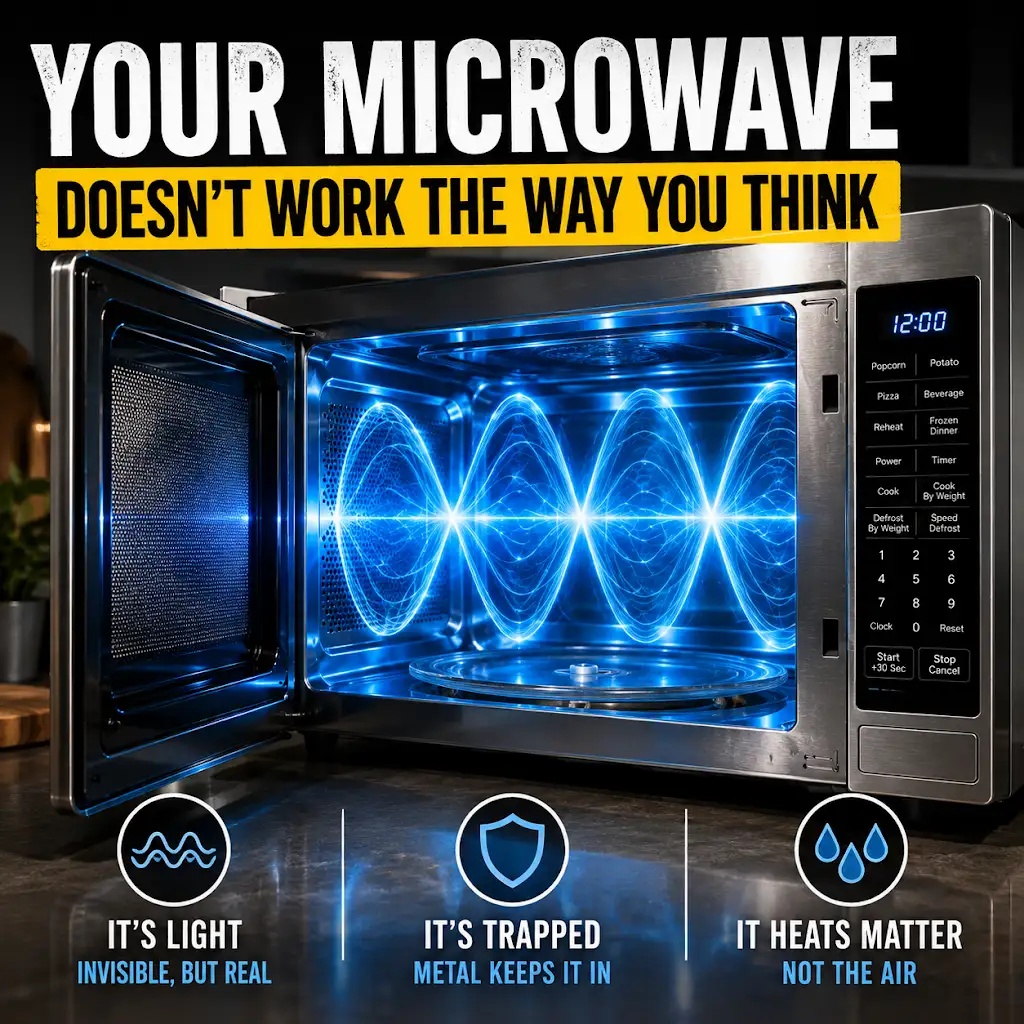
Your Microwave Doesn’t Work the Way You Think
FAQs
1. Why do microwaves heat food unevenly?
Microwaves heat food unevenly because they work by causing water molecules in the food to vibrate, creating heat. However, the distribution of these microwaves can be uneven, leading to uneven heating of the food.
2. What factors contribute to uneven heating in microwaves?
Factors such as the shape and size of the food, the placement of the food in the microwave, and the microwave’s power and design can all contribute to uneven heating in microwaves.
3. How can uneven heating in microwaves be minimized?
To minimize uneven heating in microwaves, it is recommended to use microwave-safe containers, stir or rotate the food during heating, and use lower power settings for longer periods of time.
4. Are there certain types of food that are more prone to uneven heating in microwaves?
Yes, foods with different densities and moisture levels, such as meats and vegetables, are more prone to uneven heating in microwaves compared to homogeneous foods like soups or liquids.
5. Can the uneven heating in microwaves be harmful to health?
Uneven heating in microwaves can result in hot spots and cold spots in the food, which may lead to foodborne illness if not heated to the proper temperature. It is important to ensure that food is heated thoroughly and evenly to minimize health risks.