The seemingly simple act of an ice skate gliding effortlessly across a frozen surface is, in reality, a testament to a fascinating scientific principle: pressure melting. This phenomenon, where ice melts under increased pressure, is not just a curiosity of physics; it plays a crucial role in everything from the movement of glaciers to the mechanics of winter sports. Understanding the science behind pressure melting requires delving into the molecular structure of ice and the delicate balance of forces that govern its state.
At its core, the science of pressure melting lies in the peculiar way water molecules arrange themselves when they freeze. Unlike many substances that become denser when solid, water exhibits an anomaly: ice is less dense than liquid water. This characteristic is directly linked to the hydrogen bonds that form between water molecules.
Hydrogen Bonding: The Architect of Ice’s Structure
Liquid water molecules are in constant motion, with hydrogen bonds forming and breaking rapidly. However, as water cools and begins to freeze, this motion slows down, allowing the hydrogen bonds to stabilize. Each water molecule (H₂O) can form up to four hydrogen bonds with neighboring water molecules. Two of these bonds are formed through the lone pair electrons on the oxygen atom, and the other two are formed through the hydrogen atoms.
In the solid state of ice, these hydrogen bonds arrange the water molecules into a hexagonal crystal lattice structure. This arrangement is not tightly packed; there are significant empty spaces within the lattice. Imagine a scaffolding where the building blocks are held together by flexible connections. This open structure is precisely why ice floats and why it occupies more volume than the same mass of liquid water.
Polymorphs of Ice: More Than Just One Frozen State
While most people are familiar with the hexagonal form of ice (Ice Ih), the reality is far more complex. Under varying pressures and temperatures, water can solidify into numerous different crystalline structures, known as polymorphs. Over twenty different phases of ice have been identified, each with its own unique arrangement of molecules.
The Familiar Hexagonal Lattice (Ice Ih)
Ice Ih, the most common form of ice found on Earth’s surface, is characterized by its hexagonal symmetry. This is the ice we encounter in our freezers, on frozen lakes, and in snowflakes. The specific arrangement of hydrogen bonds in Ice Ih leads to its relatively open and crystalline structure.
Beyond Hexagonal: Other Ice Phases
Under extreme pressure, water molecules can be forced into more compact arrangements. For instance, Ice II, Ice III, and Ice V exhibit different crystal structures with varying densities. These high-pressure polymorphs are not typically encountered in everyday life but are crucial for understanding the behavior of water in the deep interiors of planets or in specialized laboratory conditions. The transition between these different ice phases is governed by complex thermodynamic principles, where pressure and temperature dictate the most stable arrangement of water molecules.
Pressure melting is a fascinating phenomenon that occurs when ice melts under pressure, which can significantly impact glacial movement and stability. For a deeper understanding of this topic, you can explore a related article that delves into the science behind pressure melting and its implications for climate change. Check it out here: Freaky Science.
The Role of Pressure: Disrupting the Equilibrium
Pressure, in the context of pressure melting, refers to the force applied per unit area. When an external force is applied to ice, it attempts to compress the ice structure. This is where the unique properties of water’s solid phase become relevant.
Compression and the Open Lattice
The hexagonal lattice of Ice Ih, with its inherent empty spaces, is not easily compressed. However, increased pressure does have an effect. It begins to distort the hydrogen bond network, forcing the molecules closer together. This compression is not a simple squeezing of an incompressible solid. Instead, it involves a subtle rearrangement of the molecules and their hydrogen bonds.
Melting Point Depression: The Key Effect
The most significant consequence of applying pressure to ice is the depression of its melting point. This means that under increased pressure, ice will melt at a temperature lower than its standard melting point of 0° Celsius (32° Fahrenheit). This phenomenon is counterintuitive to what one might expect, as heat is typically associated with melting.
The Thermodynamic Explanation: Gibbs Free Energy
The behavior of ice under pressure can be explained using thermodynamic principles, specifically the concept of Gibbs free energy. Gibbs free energy (G) is a thermodynamic potential that measures the “useful” energy available to do work in a thermodynamic system at constant temperature and pressure. For a system to be in equilibrium, its Gibbs free energy must be at a minimum.
The Gibbs free energy of ice and liquid water are functions of temperature and pressure. At standard atmospheric pressure, the Gibbs free energy of solid ice is lower than that of liquid water below 0°C, indicating that ice is the stable phase. However, as pressure increases, the relationship between the Gibbs free energies of ice and water changes.
For many substances, the solid phase is denser than the liquid phase. In such cases, increasing pressure favors the denser solid phase, and the melting point increases. However, because ice is less dense than liquid water, increasing pressure favors the denser liquid phase. This shift in favorability means that to maintain equilibrium (where the Gibbs free energies are equal), the temperature must decrease. In essence, the system needs to be colder for ice to remain solid under higher pressure.
The Clapeyron Equation: Quantifying the Change
The relationship between pressure, temperature, and the phase transition of a substance can be mathematically described by the Clapeyron equation. For the solid-liquid phase transition of water, the Clapeyron equation can be simplified to show the rate of change of the melting point with respect to pressure:
$$ \frac{dT}{dP} = \frac{T(v_l – v_s)}{(L)} $$
Where:
- $dT/dP$ is the change in temperature with respect to pressure (the slope of the phase boundary on a phase diagram).
- $T$ is the absolute temperature at which the phase transition occurs.
- $v_l$ is the specific volume of the liquid phase.
- $v_s$ is the specific volume of the solid phase.
- $L$ is the latent heat of fusion (the energy required to melt a unit mass of the substance).
Since for water, $v_l > v_s$ (liquid water is denser than ice), the term $(v_l – v_s)$ is negative. Also, $T$ and $L$ are positive. Therefore, the term $dT/dP$ is negative. This negative slope confirms that as pressure ($P$) increases, the melting temperature ($T$) decreases. This is the mathematical basis for pressure melting.
The Mechanics of Pressure Melting in Action: Real-World Examples
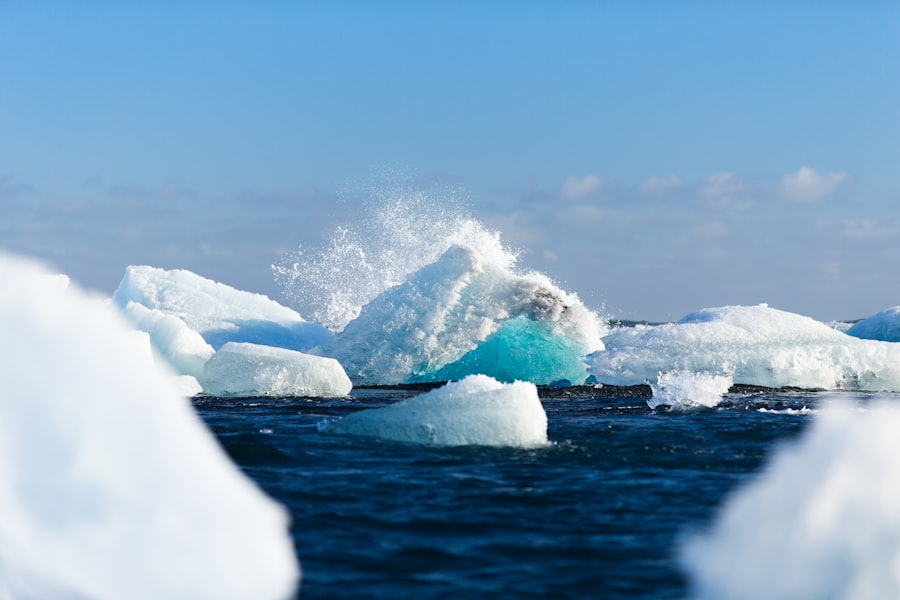
The principles of pressure melting are not confined to theoretical discussions; they have tangible impacts on phenomena observed in nature and human activities.
Ice Skates and the Glide
The most iconic example of pressure melting is the effortless glide of an ice skate. The blade of an ice skate is incredibly thin, meaning that the weight of the skater is concentrated over a very small area. This concentration of force results in significant pressure being applied to the ice directly beneath the blade.
Thin Blades, High Pressure
The sharp edges of an ice skate blade have a radius of curvature that is very small. When a skater stands on the ice, their entire body weight is distributed across this narrow contact area. This creates a pressure of hundreds or even thousands of pounds per square inch.
A Thin Layer of Water
This intense pressure, even at temperatures below freezing, causes a thin layer of ice to melt directly under the skate blade. This thin film of water acts as a lubricant, dramatically reducing friction between the skate and the ice. It is this lubrication that allows the skater to glide with such ease. Without pressure melting, skating would be significantly more difficult, akin to trying to slide on solid ice without any lubrication.
The Speed of Melting and Recrystallization
The melting under the blade is a dynamic process. As the skate moves forward, the pressure is momentarily applied and then removed. The water layer instantly refreezes as the pressure is relieved, or as it comes into contact with the surrounding colder ice. This continuous cycle of melting and refreezing is what allows for sustained motion.
Glaciers and Ice Sheets: The Power of Immense Pressure
On a much grander scale, pressure melting plays a critical role in the movement of glaciers and ice sheets. The sheer weight of overlying ice creates immense pressure at the base of these colossal frozen masses.
Basal Melting
At the bottom of a thick glacier, the pressure can be so significant that it causes the ice to melt, even if the ambient temperature is well below freezing. This phenomenon is known as basal melting.
Subglacial Water and Glacier Flow
The resulting meltwater at the base of the glacier forms a thin layer. This subglacial water acts as a lubricant, allowing the massive ice sheet to slide over the bedrock beneath it. The rate at which glaciers flow is heavily influenced by the amount of basal melting and the presence of this lubricating water layer. In some cases, this basal sliding can account for a significant portion of a glacier’s movement.
Crevasses and Pressure Changes
Pressure variations within a glacier can also lead to localized melting and refreezing. For example, as ice flows over uneven terrain, stresses build up, leading to the formation of crevasses. The pressure changes associated with these deformations can also influence the melting behavior of the ice.
Other Applications and Phenomena
Beyond ice skates and glaciers, pressure melting finds applications and explains other observed phenomena:
- Ice Fishing: In extremely cold conditions, the weight of an ice fisherman standing on the ice might create enough localized pressure to cause a very slight melting, making the ice slightly less slippery directly under their feet. While not as significant as the effect of an ice skate, it demonstrates the principle.
- Rock Glaciers: In permafrost regions, the pressure exerted by saturated rock debris can also lead to some degree of ice melt within the debris, contributing to the slow movement of rock glaciers.
Factors Influencing Pressure Melting: Beyond Just Pressure

While pressure is the primary driver of melting point depression, several other factors can influence the extent and effectiveness of pressure melting.
Temperature: The Starting Point
The ambient temperature of the ice is a crucial starting point. Pressure melting is most effective when the ice is already close to its melting point. If the ice is extremely cold, the pressure would need to be exceptionally high to induce melting.
Proximity to the Melting Point
When ice is at 0°C, even a moderate increase in pressure can cause it to melt. If the ice is significantly below 0°C, the energy required to overcome the intermolecular forces and transition to a liquid state is much higher. Therefore, the initial temperature dictates the minimum pressure required for melting to occur.
The Purity of the Ice: Impurities and Freezing Point Depression
The presence of impurities in ice, such as salt or dissolved minerals, can significantly affect its melting point. This phenomenon is known as freezing point depression.
Saltwater Ice vs. Freshwater Ice
Saltwater ice, for instance, has a much lower freezing point than freshwater ice. This is because the dissolved salt ions disrupt the formation of the ordered ice crystal lattice, making it harder for water molecules to freeze. Consequently, ice skates would experience less pressure melting on saltwater ice compared to freshwater ice at the same temperature.
Contaminants and Their Effects
Other contaminants can also lower the freezing point. This means that ice formed from impure water will melt more readily under pressure than pure ice. This is an important consideration in industrial applications where ice is used for cooling.
The Duration of Pressure Application
The duration for which pressure is applied also plays a role. While ice skates provide a continuous, albeit brief, application of pressure, the melting process is a dynamic equilibrium. A longer application of sustained high pressure would naturally lead to more melting.
Dynamic vs. Static Pressure
The constant motion of an ice skate blade ensures a continuous cycle of melting and refreezing. In contrast, a static load might lead to a limited amount of initial melting, after which a new equilibrium might be reached. However, over very long periods, even static pressure can contribute to creep and deformation in ice.
Pressure melting of ice is a fascinating phenomenon that occurs when the pressure applied to ice lowers its melting point, allowing it to transition into water even at sub-zero temperatures. This concept is not only important in understanding glacial movements but also plays a crucial role in various scientific fields. For those interested in exploring this topic further, you can read a related article that delves deeper into the mechanics of ice behavior and its implications in our environment by visiting this link.
The Limits and Nuances of Pressure Melting: When It Doesn’t Apply
| Pressure Melting Ice Explained | |
|---|---|
| Definition | Pressure melting is the process by which ice melts at a lower temperature when subjected to pressure. |
| Explanation | When pressure is applied to ice, it lowers the freezing point of the ice, causing it to melt even at temperatures below 0°C. |
| Example | Ice skates exert pressure on the ice, causing a thin layer of ice to melt beneath the blade, reducing friction and allowing for smooth gliding. |
| Importance | Understanding pressure melting is crucial in various fields such as glaciology, ice skating, and engineering. |
While pressure melting is a well-established scientific principle, it’s important to recognize its limitations and situations where it might not be the dominant factor.
Extreme Cold and Unrealistic Pressures
As mentioned earlier, at very low temperatures, the pressure required to induce melting would be astronomically high, far beyond what can be achieved in everyday scenarios. For instance, at -100°C, the pressure needed to melt ice would be immense.
Dry Ice and Other Solids
Pressure melting is specific to substances that exhibit the anomaly of having a less dense solid phase than their liquid phase, like water. Dry ice, which is solid carbon dioxide, does not exhibit pressure melting in the same way. Instead, it undergoes sublimation, transitioning directly from a solid to a gas at atmospheric pressure.
Substances with Denser Solids
Most other solids, like metals or rocks, are denser in their solid state than in their liquid state. For these materials, increasing pressure generally increases their melting point, as the pressure favors the denser solid phase.
The Role of Friction Beyond Melting
While pressure melting explains the primary lubrication effect of an ice skate, other factors also contribute to friction. The interaction of the skate blade with any microscopic imperfections on the ice surface, along with the viscosity of the water layer itself, also play a role. However, pressure melting is the dominant factor enabling the low-friction glide.
Conclusion: A Powerful Principle in a Frozen World
The science of pressure melting ice is a captivating demonstration of how molecular structure and thermodynamic principles govern the physical world around us. The open, hexagonal lattice of ice, a consequence of hydrogen bonding, is the key to this phenomenon. When pressure is applied, it disrupts this delicate structure, forcing molecules closer and lowering the melting point.
From the seemingly effortless glide of an ice skater to the colossal movement of glaciers, pressure melting is a fundamental force. It highlights the intricate interplay of temperature, pressure, and material properties. Understanding this principle not only enriches our appreciation for the physics of everyday phenomena but also provides crucial insights into geological processes and the mechanics of winter sports. The next time one witnesses the graceful arc of an ice skater or the imposing mass of a glacier, it is worth remembering the powerful, yet subtle, science of pressure melting at play.

Why Ice Is Slippery Is Stranger Than You Think
FAQs
What is pressure melting ice?
Pressure melting ice is the process by which ice melts at a lower temperature than its normal melting point when subjected to pressure. This occurs because pressure lowers the freezing point of water, allowing it to remain in a liquid state even at temperatures below freezing.
How does pressure melting ice work?
When pressure is applied to ice, it causes the ice to melt by disrupting the hydrogen bonds between water molecules. This lowers the freezing point of the ice, allowing it to melt even at temperatures below 0°C (32°F).
Where can pressure melting ice be observed?
Pressure melting ice can be observed in various natural and man-made environments, such as glaciers, ice skating rinks, and ice skating trails. It is also a phenomenon that occurs in the depths of ice sheets and glaciers due to the immense pressure exerted by the weight of the ice above.
What are some real-world applications of pressure melting ice?
Understanding pressure melting ice is important in fields such as glaciology, ice engineering, and materials science. It is also relevant in the design and maintenance of ice skating rinks and the study of ice formation in polar regions.
How does pressure melting ice impact the environment?
Pressure melting ice plays a role in the dynamics of glaciers and ice sheets, affecting their movement and contributing to processes such as ice flow and calving. It also influences the behavior of sea ice and the formation of icebergs, which can have implications for global climate and sea level rise.