
You’re standing in your kitchen, the aroma of your favorite meal wafting towards you. You reach for the microwave, a sleek, humming appliance that promises a quick and easy path to a perfectly heated dish. But have you ever stopped to wonder how this unassuming box works its culinary magic? It’s not just about zapping your food with mysterious rays. It’s a fascinating dance of electromagnetic waves, molecular vibrations, and precise engineering. Let’s delve into the captivating science behind microwave heating, unlocking the secrets behind those speedy meals.
Microwaves are a form of electromagnetic radiation, a spectrum of energy that includes everything from radio waves to X-rays. They occupy a specific band within this spectrum, typically ranging from 300 megahertz (MHz) to 300 gigahertz (GHz). Think of it as a segment on a vast cosmic highway, with different vehicles (types of radiation) traveling at different speeds and with different characteristics. Microwaves are the particular vehicles that your oven utilizes for heating.
What are Electromagnetic Waves?
At their core, electromagnetic waves are oscillating electric and magnetic fields that travel through space at the speed of light. They are generated by the movement of electrically charged particles. Imagine flicking a switch on a light bulb – that movement of electrons creates electromagnetic waves. These waves carry energy and can interact with matter in various ways.
The Electromagnetic Spectrum: A Hierarchy of Waves
The electromagnetic spectrum is a continuum, and different parts of it have distinct properties and applications. Radio waves, for instance, are used for broadcasting, while visible light allows you to see the world around you. Ultraviolet (UV) radiation from the sun can cause sunburn, and X-rays are used in medical imaging. Microwaves fall between radio waves and infrared radiation. This strategic placement is crucial for their heating capabilities. Their wavelength is long enough to penetrate food but short enough to be efficiently absorbed by water molecules.
Frequency and Wavelength: The Defining Characteristics
Two key characteristics define any electromagnetic wave: its frequency and its wavelength. Frequency refers to the number of wave cycles that pass a given point in one second, measured in Hertz (Hz). Wavelength, on the other hand, is the distance between successive crests or troughs of the wave. These two are inversely related: a higher frequency means a shorter wavelength, and vice versa. Microwave ovens typically operate at a frequency of 2.45 GHz, which corresponds to a wavelength of about 12.2 centimeters. This specific frequency is chosen for a very important reason, as we’ll soon discover.
The Source of the Waves: The Magnetron
The heart of any microwave oven is the magnetron. This ingenious vacuum tube is responsible for generating the microwaves that heat your food. It’s a complex piece of engineering, but the basic principle involves using a strong magnetic field and an electric field to accelerate electrons. As these electrons move, they emit microwave radiation. Think of it like a tiny, highly controlled lightning strike happening inside the magnetron, creating the waves that will eventually cook your dinner.
How a Magnetron Works: From Electrons to Radiation
Inside the magnetron, electrons are emitted from a heated cathode. These electrons are then forced to travel in a circular path by powerful magnets. As they move, they interact with resonant cavities within the magnetron, causing them to oscillate and emit microwave energy. This energy is then directed towards the cooking chamber. The precise design of the resonant cavities is what allows the magnetron to generate microwaves at the specific frequency required for efficient food heating.
The Anode and Cathode: Essential Components
The anode and cathode are the fundamental parts of the magnetron. The cathode is the source of electrons, heated to facilitate their emission. The anode, which is usually a cylindrical structure with internal cavities, plays a crucial role in shaping the electron flow and generating the microwave oscillations. The interaction between the magnetic field and the electron stream is what ultimately leads to the emission of microwave energy.
Understanding how a microwave oven works can be fascinating, as it involves the principles of electromagnetic radiation and molecular agitation. For a deeper dive into the science behind microwave technology and its applications, you can check out this related article: Freaky Science. This resource provides insights into the workings of various scientific phenomena, including the mechanics of microwave ovens and how they heat food efficiently.
The Secret Ingredient: Water’s Role in Microwave Heating
The reason microwaves are so effective at heating food lies in their interaction with water molecules. Most foods, especially those we commonly microwave like leftovers, vegetables, and meats, contain a significant amount of water. Water molecules are polar, meaning they have a slight positive charge on one end and a slight negative charge on the other, much like tiny magnets.
The Polarity of Water Molecules: A Molecular Dance
Water molecules (H₂O) are not perfectly symmetrical. The oxygen atom, being more electronegative, pulls electrons closer to itself, creating a partial negative charge around the oxygen and partial positive charges around the hydrogen atoms. This uneven distribution of charge makes water a polar molecule. This polarity is the key to how microwaves interact with food.
Dipole Moments: The Molecular Magnetism
The polarity of water molecules is often described by their dipole moment. A dipole moment is a measure of the separation of positive and negative electrical charges within a molecule. Water’s bent molecular structure results in a significant net dipole moment, making it a highly polar substance. This inherent magnetic-like quality is what makes it susceptible to the oscillating electric field of microwaves.
Hydrogen Bonding: Holding Water Together
Water molecules are also held together by hydrogen bonds, a weak type of attraction between the slightly positive hydrogen atom of one molecule and the slightly negative oxygen atom of another. While these bonds are relatively weak individually, they play a significant role in the bulk properties of water and influence how it responds to external forces, including microwaves.
Dielectric Heating: The Friction That Cooks
When microwaves enter the cooking chamber, their oscillating electric field interacts with the polar water molecules in your food. The electric field rapidly flips back and forth, causing the water molecules to try and align themselves with the changing field. Imagine holding a compass near a spinning magnet – the compass needle would constantly try to follow the magnet’s rotation.
Molecular Rotation: A Frenetic Frenzy
As the electric field of the microwaves reverses direction thousands, even millions, of times per second (at 2.45 GHz, that’s 2.45 billion times per second!), the water molecules are forced into a frantic rotational dance. They twist and turn, attempting to keep up with the rapidly changing electric field.
Friction and Heat Generation: The Culinary Spark
This rapid rotation and jostling of water molecules creates friction. It’s this molecular friction, this internal resistance to movement, that generates heat. It’s a form of “dielectric heating” – heating caused by the absorption of electromagnetic radiation by polar molecules. The more water present in the food, the more efficiently it will absorb microwave energy and heat up. This is why dry foods often require a bit of added moisture for effective microwaving.
Other Polar Molecules: A Minor Contribution
While water is the primary player, other polar molecules present in food, such as fats and sugars, can also contribute to dielectric heating. However, their interaction with microwaves is generally less efficient than that of water. Fats, for example, are less polar than water, and sugars have a different molecular structure that affects their dielectric properties. This is why some foods might cook unevenly if they have varying concentrations of water, fat, and sugar.
Inside the Microwave Oven: Engineering for Efficiency

Your microwave oven is more than just a magnetron and a chamber. It’s a carefully designed system to ensure that the microwaves are delivered efficiently and safely to your food, while protecting you from stray radiation.
The Waveguide: Directing the Energy
Once generated by the magnetron, the microwaves need to be directed into the cooking chamber. This is the job of the waveguide. It’s a hollow metal conduit, typically rectangular or circular, designed to channel the microwave energy from the magnetron to the oven cavity. The dimensions of the waveguide are specifically chosen to match the wavelength of the microwaves, ensuring minimal energy loss during transmission.
Metal Construction: Reflecting the Waves
The waveguide is made of conductive metal because microwaves, like light, are reflected by metals. This reflection is crucial for containing the microwave energy within the oven and guiding it precisely where it needs to go. If the waveguide weren’t metal, the microwaves would simply dissipate.
Matching the Wavelength: Preventing Energy Loss
The cross-sectional dimensions of the waveguide are critical. They are designed to be larger than half the wavelength of the microwaves. This ensures that the microwaves propagate efficiently down the waveguide as a dominant mode of transmission, with minimal reflection back towards the magnetron and minimal energy leakage.
The Turntable and Stirrer: Ensuring Even Cooking
One of the common challenges with microwave heating is achieving uniform cooking. Because microwaves can create “hot spots” and “cold spots” due to their wave nature, the turntable and stirrer are vital components for even heat distribution.
The Turntable: Rotating Your Meal
The turntable rotates your food throughout the cooking cycle. This simple yet effective mechanism ensures that different parts of the food are exposed to the microwave energy for varying amounts of time, helping to prevent overcooked edges and undercooked centers. It’s a mechanical solution to an electromagnetic problem.
The Stirrer (or Wave Scatterer): Disrupting the Standing Waves
Some microwave ovens also feature a stirrer, often a rotating metal fan-like device located at the top of the cooking cavity. The stirrer’s role is to scatter the microwaves in different directions, disrupting the formation of predictable standing wave patterns. Standing waves can lead to very intense heating in certain areas and very little heating in others. By constantly changing the direction and angle of the microwaves, the stirrer helps to create a more uniform distribution of energy throughout the cavity.
The Cavity: A Metal Box for Containment
The cooking chamber itself is a metal box, often referred to as the cavity. The metal walls are essential for containing the microwave energy within the oven. Microwaves are reflected by metal surfaces, bouncing around the cavity until they are absorbed by the food.
Faraday Cage Principle: Keeping the Waves Inside
The metal cavity acts as a Faraday cage. A Faraday cage is an enclosure made of conductive material that blocks external electromagnetic fields and prevents internal fields from escaping. This is why you can’t see the microwaves, and why it’s generally safe to use a microwave oven. The metal walls ensure that the vast majority of the microwave energy is directed towards your food.
The Door Seal: A Critical Barrier
The microwave oven door is a critical component in maintaining the integrity of the Faraday cage. The door has a metal mesh embedded within the glass, with openings small enough to prevent microwaves from escaping but large enough to allow you to see your food. The seal around the door is also meticulously designed to prevent any microwave leakage. This is why it’s important to ensure your microwave door is not damaged and closes properly.
The Interaction with Food: Absorption, Reflection, and Transmission

When microwaves encounter food, a complex interplay of absorption, reflection, and transmission occurs. The behavior of the microwaves depends on the composition of the food itself.
Absorption: The Primary Heating Mechanism
As we’ve discussed, the primary way microwaves heat food is through the absorption of energy by polar molecules, mainly water. The more polar molecules present, the greater the absorption. This is why foods with high water content heat up quickly and efficiently.
Water Content: The Key Determinant
The water content of a food item is the most significant factor influencing how well it absorbs microwave energy. Fresh vegetables, cooked meats, and most soups are rich in water and will heat rapidly. Drier foods, like crackers or some types of bread, will absorb less energy and may become brittle rather than hot.
Molecular Structure and Polarity: Beyond Water
While water is the star player, other polar molecules within food can also absorb microwave energy. Fats, with their less pronounced polarity, absorb less energy than water. Sugars, depending on their specific molecular structure, can have varying degrees of microwave absorption. This variation in absorption can contribute to differential heating within a single dish.
Reflection: The Role of Metals
Metals are excellent reflectors of microwaves. This is why you should never put metal objects in a microwave oven. Not only can they cause arcing and damage the oven, but they can also reflect microwaves back to the magnetron, potentially causing it to overheat.
Metal Containers: A Hazardous Choice
Using metal containers for microwaving is dangerous. The microwaves will bounce off the metal, creating intense localized electrical charges that can lead to sparks and even fires. This is also why microwave-safe cookware is typically made of glass, ceramic, or certain plastics.
Browning and Crisping: The Limitation of Microwaves
The reflective nature of metals also explains why microwaves typically don’t brown or crisp food. Browning and crisping are usually achieved through dry heat, which causes surface dehydration and Maillard reactions. Microwaves penetrate the food and heat it from within, a process that doesn’t lend itself to surface browning.
Transmission: Passing Through Less Absorbing Materials
Microwaves can also pass through materials that are not good absorbers of their energy. This is why microwave-safe plastic containers and glass dishes allow the microwaves to reach the food inside.
Microwave-Safe Materials: The Key to Safe Cooking
Materials designated as “microwave-safe” are those that allow microwaves to pass through them without significant absorption or reflection. These materials are chosen for their transparency to microwave radiation. Glass, ceramic, and certain types of plastic are common examples.
Energy Penetration Depth: How Far the Waves Travel
Microwaves penetrate food to a certain depth, typically a few centimeters. This penetration depth influences how the food cooks. Thicker or denser foods may require longer cooking times or techniques like stirring or covering to ensure the center heats adequately. The penetration depth is influenced by the dielectric properties of the food.
Understanding how a microwave oven actually works can be fascinating, especially when you delve into the science behind it. For those interested in exploring this topic further, you might find a related article on Freaky Science that explains the principles of electromagnetic radiation and how it heats food efficiently. This resource provides valuable insights into the technology that powers our everyday kitchen appliances, making it easier to appreciate the convenience they bring to our lives.
Beyond Heating: Other Applications of Microwaves
| Component | Function |
|---|---|
| Magnetron | Generates microwaves by converting electrical energy into radio waves |
| Waveguide | Transmits microwaves from the magnetron to the cooking chamber |
| Cooking Chamber | Where the food is placed and exposed to the microwaves |
| Turntable | Rotates the food to ensure even cooking |
| Control Panel | Allows users to set cooking time and power level |
| Interlock System | Prevents the microwave from operating when the door is open |
While heating food is the most common application you encounter daily, microwaves have a surprisingly diverse range of uses across various industries and scientific disciplines. Their ability to heat materials efficiently and their non-ionizing nature make them valuable tools for much more than just reheating leftovers.
Industrial Applications: Drying and Processing
The rapid heating capabilities of microwaves make them ideal for industrial processes where quick and efficient drying or heating is required. This includes applications in the manufacturing of paper, textiles, and ceramics, as well as in the processing of various chemical compounds.
Drying Processes: Speeding Up Production
In industrial drying, microwaves can penetrate materials and heat them uniformly, accelerating the evaporation of moisture. This is significantly faster than conventional air drying methods and can lead to substantial energy savings and improved product quality. For example, in the paper industry, microwave drying can reduce drying times by up to 80%.
Chemical Synthesis and Reactions: Catalyzing Change
Microwaves can also be used to accelerate chemical reactions. The intense and rapid heating can provide the activation energy needed for certain reactions to occur more quickly or at lower temperatures. This has applications in organic synthesis, where microwave irradiation can lead to higher yields and shorter reaction times for a variety of chemical transformations.
Medical Uses: Sterilization and Therapy
In the medical field, microwaves find applications in sterilization and certain therapeutic treatments. Their ability to generate heat can be harnessed for specific medical purposes.
Sterilization: Eliminating Pathogens
Microwaves can be used for the sterilization of medical equipment. The heat generated by microwave irradiation can effectively kill bacteria, viruses, and other microorganisms, making it a viable alternative or supplementary method to traditional sterilization techniques.
Thermal Ablation: Targeted Tissue Destruction
In certain medical procedures, microwaves are used for thermal ablation. This involves using focused microwave energy to heat and destroy targeted tissue, such as tumors. The precise control over the microwave energy allows for the selective destruction of abnormal cells while minimizing damage to surrounding healthy tissue.
Scientific Research: A Powerful Tool
In scientific research, microwaves are employed in a variety of contexts, from studying material properties to developing new technologies. Their unique electromagnetic characteristics make them valuable for investigative purposes.
Material Science: Understanding Properties
Researchers use microwaves to study the dielectric properties of materials. By observing how different materials absorb or reflect microwave energy, scientists can gain insights into their composition, structure, and potential applications. This is crucial for developing new materials with specific electromagnetic properties.
Communication Technologies: The Backbone of Modern Life
While you might not directly see it, microwaves are fundamental to many modern communication technologies. Satellite communication, radar systems, and wireless networking (like Wi-Fi) all rely on microwave frequencies to transmit and receive information.
Radar Systems: Seeing Through the Clouds
Radar (Radio Detection and Ranging) systems use microwave pulses to detect objects and determine their range, altitude, speed, and direction. This technology is essential for air traffic control, weather forecasting, and navigation. The microwaves emitted by the radar are reflected by objects, and the returning signals are analyzed to provide information about those objects.
In conclusion, the seemingly simple act of heating food in a microwave oven is a testament to sophisticated scientific principles and engineering. From the invisible dance of electromagnetic waves to the molecular vibrations within water molecules, your microwave is a powerful tool that leverages the fundamental forces of nature to bring convenience and warmth to your table. The next time you hear that familiar hum, take a moment to appreciate the fascinating science at play.
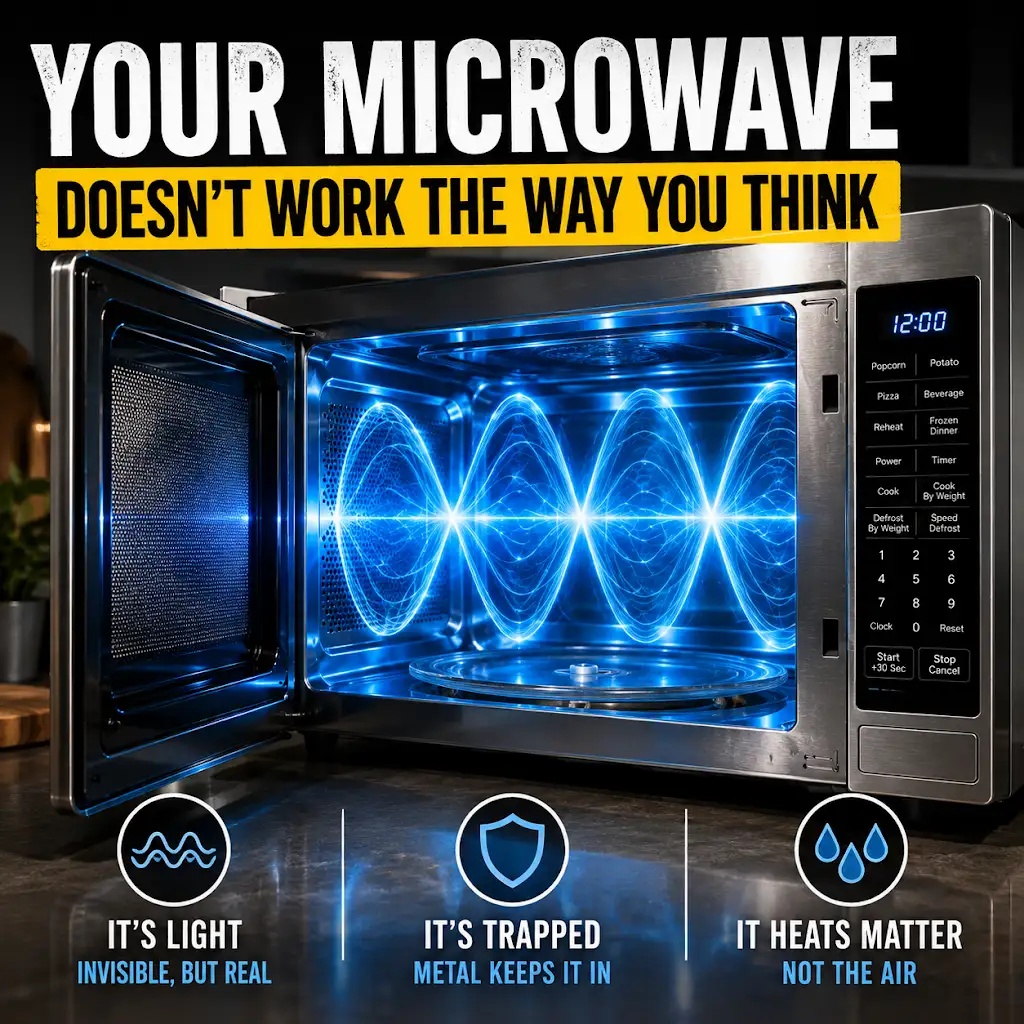
Your Microwave Doesn’t Work the Way You Think
FAQs
1. What is the basic principle behind how a microwave oven works?
Microwave ovens work by using microwave radiation to heat food. The microwaves cause water molecules in the food to vibrate, generating heat and cooking the food from the inside out.
2. How does the microwave radiation heat the food in the oven?
The microwave radiation emitted by the oven’s magnetron interacts with the water molecules in the food, causing them to rotate and generate heat through friction. This process heats the food quickly and efficiently.
3. What components are involved in the functioning of a microwave oven?
Key components of a microwave oven include the magnetron, which generates the microwave radiation, the waveguide, which directs the radiation into the cooking chamber, and the turntable, which rotates the food to ensure even heating.
4. Are there any safety concerns associated with using a microwave oven?
While microwave ovens are generally safe to use, it is important to follow the manufacturer’s instructions and avoid putting metal objects or containers in the oven. Additionally, it is recommended to use microwave-safe cookware to prevent potential hazards.
5. How does the microwave oven differ from a conventional oven in terms of cooking food?
Unlike conventional ovens, which use convection to heat the air and then transfer the heat to the food, microwave ovens cook food directly by agitating the water molecules within the food. This results in faster cooking times and often more even heating.