You’re standing in your kitchen, a fresh salmon fillet ready for searing, a pot of pasta water to boil. You flip the switch on your sleek, modern induction cooktop, and almost instantly, the water begins to bubble, the pan glows with a controlled heat. It’s a stark contrast to the slow, frustrating dance of gas flames or the lingering warmth of radiant electric elements. You’ve probably heard the term “induction,” and you might even own induction cookware, but do you truly understand the science behind this rapid, efficient heating? It’s more than just a fancy kitchen gadget; it’s a fascinating application of electromagnetism that fundamentally changes how you interact with heat in your culinary space.
The Magnetic Foundation: Understanding Ferromagnetism
At the heart of induction cooking lies a seemingly simple yet profound principle: magnetism. But not just any magnetism. To harness the power of induction, your cookware must possess a specific magnetic property.
What Makes a Pan “Induction Ready”?
You might have noticed those little symbols on the bottom of your pans, or perhaps you’ve passed over a pan in the store because it just “felt” right. That “feeling” often comes down to its material composition. Induction works by creating eddy currents within the cookware itself, and to do that effectively, the material needs to be ferromagnetous.
Ferromagnetism: The Key Ingredient
Ferromagnetism is a characteristic of certain materials, most notably iron and nickel, that allows them to be strongly attracted to magnets. These materials possess unpaired electrons whose magnetic moments can align. When exposed to an external magnetic field, these microscopic magnetic domains within the material readily align, making the material itself magnetic. Think of it like a group of tiny compass needles all pointing in the same direction when a larger magnet is brought near.
Common Ferromagnetic Cookware Materials
- Cast Iron: The undisputed champion of induction-ready cookware. Its dense iron content makes it highly ferromagnetic, ensuring excellent heat transfer.
- Enameled Cast Iron: While the enamel coating is not ferromagnetic, the underlying cast iron base ensures its compatibility with induction.
- Stainless Steel (Magnetic Grades): Not all stainless steel is created equal when it comes to induction. Stainless steels with higher nickel and chromium content, particularly those in the 400 series (like 18/8 or 18/10 with a magnetic bottom), are ferromagnetic and thus induction-compatible. You can easily test this by seeing if a regular refrigerator magnet sticks to the bottom of the pan.
- Carbon Steel: Similar to cast iron, carbon steel’s iron content makes it a great choice for induction.
Non-Ferromagnetic Cookware: The Inducted Outsiders
It’s equally important to know what won’t work. Materials like aluminum, copper, glass, and ceramic are not ferromagnetic. While they are excellent conductors of heat themselves, they cannot generate the necessary eddy currents when placed on an induction cooktop. Your induction cooktop will likely register this as an error or simply not heat up.
Induction cookware operates on the principle of electrical resistance, which generates heat through the interaction between the cookware and the induction cooktop. When an alternating current passes through the induction coil, it creates a magnetic field that induces an electric current in the cookware. This resistance to the induced current generates heat, allowing for efficient cooking. For a deeper understanding of the science behind this process, you can read more in the related article on Freaky Science at Freaky Science.
The Electromagnetic Dance: How Induction Works
Now that you understand the magnetic properties of your cookware, let’s delve into the fascinating process of how the cooktop actually creates heat. It’s a ballet of electricity and magnetism, orchestrated to deliver precise thermal energy directly to your pan.
The Induction Coil: The Heart of the Matter
Beneath the smooth, ceramic glass surface of your induction cooktop lies the unsung hero: the induction coil. This is typically a flat coil of copper wire. When you turn on the cooktop and place a ferromagnetic pan on it, electricity begins to flow through this coil.
Generating a Changing Magnetic Field
The magic happens when an alternating current (AC) is passed through the copper coil. This AC current doesn’t just flow; it constantly changes direction and magnitude at a very high frequency (typically 20-50 kHz). As the current oscillates, it generates a rapidly changing magnetic field that extends upwards, through the glass, and into the bottom of your cookware.
The Interplay Between Coil and Pan
Imagine the induction coil as a powerful electromagnet that’s constantly flipping its north and south poles. This oscillating magnetic field interacts with the ferromagnetic material of your pan.
Eddy Currents: The Direct Heat Generators
The interaction between the changing magnetic field and your ferromagnetic pan is where the real heating action begins. This is where you’ll encounter the concept of eddy currents, the direct source of your cooking heat.
Faraday’s Law in Action
The principle at play here is Faraday’s Law of Electromagnetic Induction. This law states that a changing magnetic field will induce an electromotive force (EMF) – essentially a voltage – in a nearby conductor. In your induction cooktop, the conductor is the bottom of your ferromagnetic pan.
Creating Electrical Currents Within the Pan
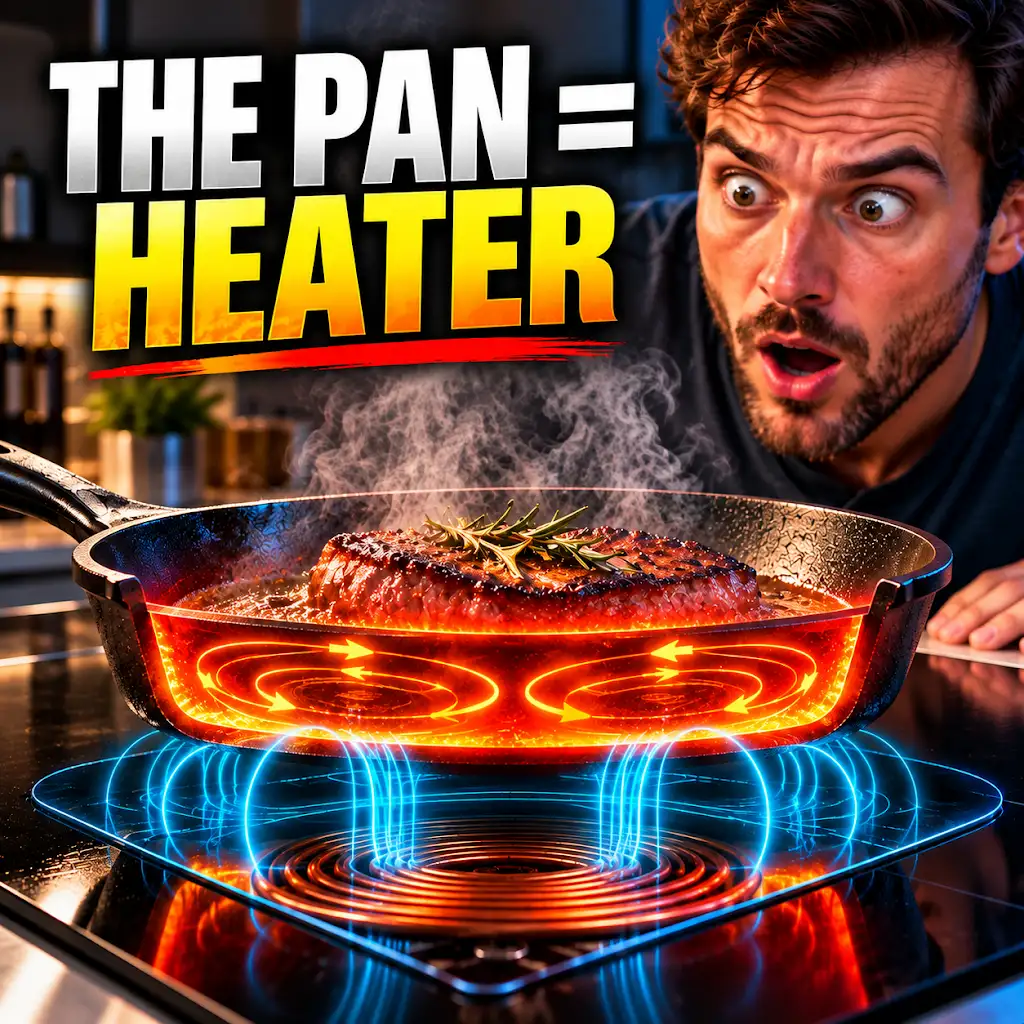
As the magnetic field from the coil oscillates, it induces circulating electrical currents within the metal of the pan. These currents flow in closed loops, much like ripples on the surface of water, and are known as “eddy currents.” The faster the magnetic field changes, the stronger the eddy currents that are induced.
The Role of Electrical Resistance
These eddy currents, however, don’t flow unimpeded. The metal of your pan has its own inherent electrical resistance. As these powerful eddy currents surge through the resistive material of the pan, they encounter opposition. This opposition converts the electrical energy of the eddy currents directly into heat. Think of it like friction – the more resistance, the more heat is generated. This phenomenon is known as Joule heating or ohmic heating.
Resistive Heating: The Secondary Heat Source
While eddy currents are the primary driver of heat, there’s another, albeit less significant, heating mechanism at play in induction cooking. This is called resistive heating, and it works in conjunction with eddy currents to ensure your pan gets thoroughly hot.
Hysteresis Losses: The Magnetization Cycle
Ferromagnetic materials have another property called hysteresis. When a ferromagnetic material is exposed to a changing magnetic field, its magnetic domains are repeatedly magnetized and demagnetized. This process of aligning and re-aligning these magnetic domains requires energy.
Energy Conversion to Heat
As the magnetic field from the induction coil rapidly cycles, the magnetic domains within your pan are forced to reorient themselves back and forth. This constant reorientation generates friction at a microscopic level, converting a small amount of the electrical energy into heat. This is known as hysteresis loss, and it contributes to the overall heating of the pan. While eddy currents are typically the dominant source of heat, hysteresis losses play a supporting role, particularly in materials with high magnetic permeability.
Induction cookware operates on the principle of electrical resistance, which generates heat through electromagnetic induction. This process allows for efficient cooking as the heat is produced directly in the cookware itself, rather than being transferred from a burner. For a deeper understanding of how this technology works and its benefits, you can explore a related article that delves into the science behind induction cooking. To learn more about this fascinating topic, visit this article.
The Advantages of Induction: Why It’s Superior
The science behind induction cooking isn’t just an interesting academic exercise; it translates into tangible benefits for you in the kitchen. The direct heating of the cookware, coupled with precise control, leads to a cooking experience that’s faster, more efficient, and safer.
Unparalleled Speed and Responsiveness
- Instantaneous Heat-Up: Because the heat is generated directly within the pan, there’s no need to preheat the cooktop surface itself. Water boils significantly faster, and pans reach searing temperatures in moments. You can react to cooking needs almost instantly.
- Precise Temperature Control: The power output of an induction cooktop can be adjusted in very small increments. This allows for incredibly precise temperature management, from a gentle simmer that won’t scorch delicate sauces to a rapid boil. You have granular control over the heat applied.
- Energy Efficiency: A significant portion of the energy generated by an induction cooktop is transferred directly to the cookware. In contrast, gas stoves lose a considerable amount of heat to the surrounding air, and traditional electric coil stoves also suffer from heat loss during the preheating phase of the element. This means less wasted energy and potentially lower utility bills.
Enhanced Safety Features
- Cooler Cooktop Surface: Since the heat is generated within the cookware itself, the ceramic glass surface of the induction cooktop remains relatively cool. This drastically reduces the risk of accidental burns if you touch the cooktop accidentally. It also means spills are less likely to burn onto the surface, making cleanup easier.
- Automatic Shut-off: Most induction cooktops are designed to automatically shut off the magnetic field when no cookware is detected, or when cookware is removed. This prevents accidental overheating and fire hazards.
- No Open Flames: Unlike gas stoves, induction cooktops do not involve open flames, eliminating the risk of ignition of nearby flammable materials.
Superior Cleanliness and Aesthetics
- Easy to Clean: The smooth, flat ceramic glass surface is incredibly easy to wipe clean. With no grates or elements to contend with, spills and splatters can be dealt with effortlessly.
- Sleek Design: Induction cooktops often boast a modern and minimalist aesthetic, contributing to a clean and sophisticated kitchen look.
The Future of Induction: Innovations and Evolution
The science of induction cooking is not static. Researchers and engineers are continually innovating, pushing the boundaries of what’s possible and further enhancing the user experience.
Smarter Cooktops and Enhanced Connectivity
- Integrated Sensors: Future induction cooktops may incorporate more sophisticated sensors to monitor the temperature of the food directly, not just the pan. This could lead to even more precise cooking and prevent overcooking.
- Smart Home Integration: Expect to see more induction cooktops seamlessly integrating with smart home ecosystems, allowing you to control them via voice commands, smartphone apps, and even pre-programmed cooking recipes.
- Multi-Zone Flexibility: Advancements are leading to cooktops with larger, more flexible cooking zones that can adapt to different pan sizes and shapes, offering greater cooking versatility.
Material Science Advancements
- New Ferromagnetic Alloys: Ongoing research into new ferromagnetic alloys could lead to cookware materials that are even more efficient at transferring heat, lighter in weight, or offer unique cooking properties.
- Hybrid Cookware: While less common now, there’s potential for hybrid cookware designs that combine ferromagnetic bases with other materials for specific cooking applications, while still maintaining induction compatibility.
In conclusion, the next time you’re searing a steak or simmering a delicate sauce on your induction cooktop, take a moment to appreciate the invisible forces at play. It’s a testament to human ingenuity, a clever application of physics that transforms raw electrical energy into precise culinary heat, all through the magic of magnetism and the power of electromagnetism. You’re not just cooking; you’re engaging with a sophisticated piece of science that makes your kitchen experience safer, faster, and more enjoyable.
The Pan Is the Heater: How Induction Cooking Really Works
FAQs
What is electrical resistance heating in induction cookware?
Electrical resistance heating in induction cookware refers to the process where an electric current passes through the cookware, causing resistance in the material and generating heat.
How does electrical resistance heating work in induction cookware?
In induction cookware, electrical resistance heating works by utilizing the resistance of the material to the electric current passing through it, which in turn generates heat due to the Joule heating effect.
What materials are commonly used in induction cookware for electrical resistance heating?
Common materials used in induction cookware for electrical resistance heating include stainless steel, cast iron, and copper due to their ability to conduct electricity and generate heat efficiently.
Is electrical resistance heating in induction cookware energy efficient?
Yes, electrical resistance heating in induction cookware is considered energy efficient as it directly heats the cookware itself, resulting in faster cooking times and less energy wasted compared to traditional stovetops.
Are there any safety concerns with electrical resistance heating in induction cookware?
While electrical resistance heating in induction cookware is generally safe to use, it is important to follow manufacturer instructions, avoid overheating the cookware, and use caution when handling hot surfaces to prevent burns or accidents.