You’ve probably seen them. The sleek, metallic boxes that hum to life, transforming cold leftovers into steaming meals in minutes. Microwave ovens. And you’ve likely also heard the warnings: “Don’t put metal in the microwave!” It’s a piece of advice etched into our collective culinary consciousness. But have you ever stopped to wonder why? What’s the science behind this seemingly contradictory phenomenon – a device that uses electromagnetic waves to cook food, yet is often encased in metal?
The truth is, the metal walls of your microwave aren’t the enemy; they’re the essential architects of the cooking process. Without them, the very magic of microwave cooking wouldn’t be possible. It’s a fascinating interplay of physics, engineering, and a healthy dose of caution that makes these kitchen workhorses so effective, and sometimes, so dangerous if misused.
Your microwave oven, at its core, is a sophisticated application of electromagnetic radiation. But what exactly are microwaves, and how do they generate heat? This is where the fundamental science begins.
The Electromagnetic Spectrum: Your Microwave’s Place in the Universe
You’re familiar with light, with radio waves, and perhaps even X-rays. All of these are forms of electromagnetic radiation, traveling at the speed of light in the form of oscillating electric and magnetic fields. The electromagnetic spectrum is a vast continuum, ranging from very low-energy radio waves to extremely high-energy gamma rays.
Your microwave oven operates within a very specific band of this spectrum, typically between 2.45 gigahertz (GHz). This frequency is chosen for a crucial reason: it’s highly effective at interacting with water molecules, the primary component of most foods.
The Magnetron: The Heart of the Operation
The source of these powerful microwaves is a device called a magnetron. Think of it as the engine of your microwave oven. The magnetron is a vacuum tube that, when subjected to a strong magnetic field and a high voltage, generates microwaves. This process involves electrons being accelerated and forced into circular paths, emitting microwave radiation as they do so.
The microwaves produced by the magnetron are then directed into the cooking chamber. But how do they get there, and how are they controlled? This is where the metallic structure of your oven truly shines.
Waveguides: Directing the Energy
The microwaves, once generated, are not simply broadcast randomly. They are guided from the magnetron to the cooking cavity via a carefully designed component called a waveguide. A waveguide is essentially a hollow metal tube, usually rectangular in cross-section. Its dimensions are critical; they are precisely engineered to propagate microwaves at the specific frequency the magnetron is producing, preventing them from escaping and ensuring they are directed into the oven cavity.
The metal of the waveguide acts as a conductor, reflecting the microwaves internally and channeling them forward. Without these metallic pathways, the microwave energy would dissipate uselessly.
Microwave ovens are designed with metal walls to ensure that the microwaves generated inside are contained, allowing for efficient cooking and preventing any interference with other electronic devices. For a deeper understanding of the science behind this design choice, you can read a related article that explores the principles of microwave technology and its applications. Check it out here: Freaky Science.
The Faraday Cage Effect: Containing the Energy
Now, let’s address the elephant in the room – the metal walls of your microwave oven. Why are they there, and how do they contribute to the cooking process rather than hindering it? The answer lies in a principle known as the Faraday cage.
What is a Faraday Cage?
A Faraday cage is an enclosure made of a conductive material, such as metal, that blocks electromagnetic fields. Named after scientist Michael Faraday, who discovered the principle in 1836, it works by redistributing electric charges on its surface. When an external electric field is applied, the charges within the conductive material rearrange themselves in such a way as to cancel out the external field inside the enclosure.
The Microwave Oven as a Faraday Cage
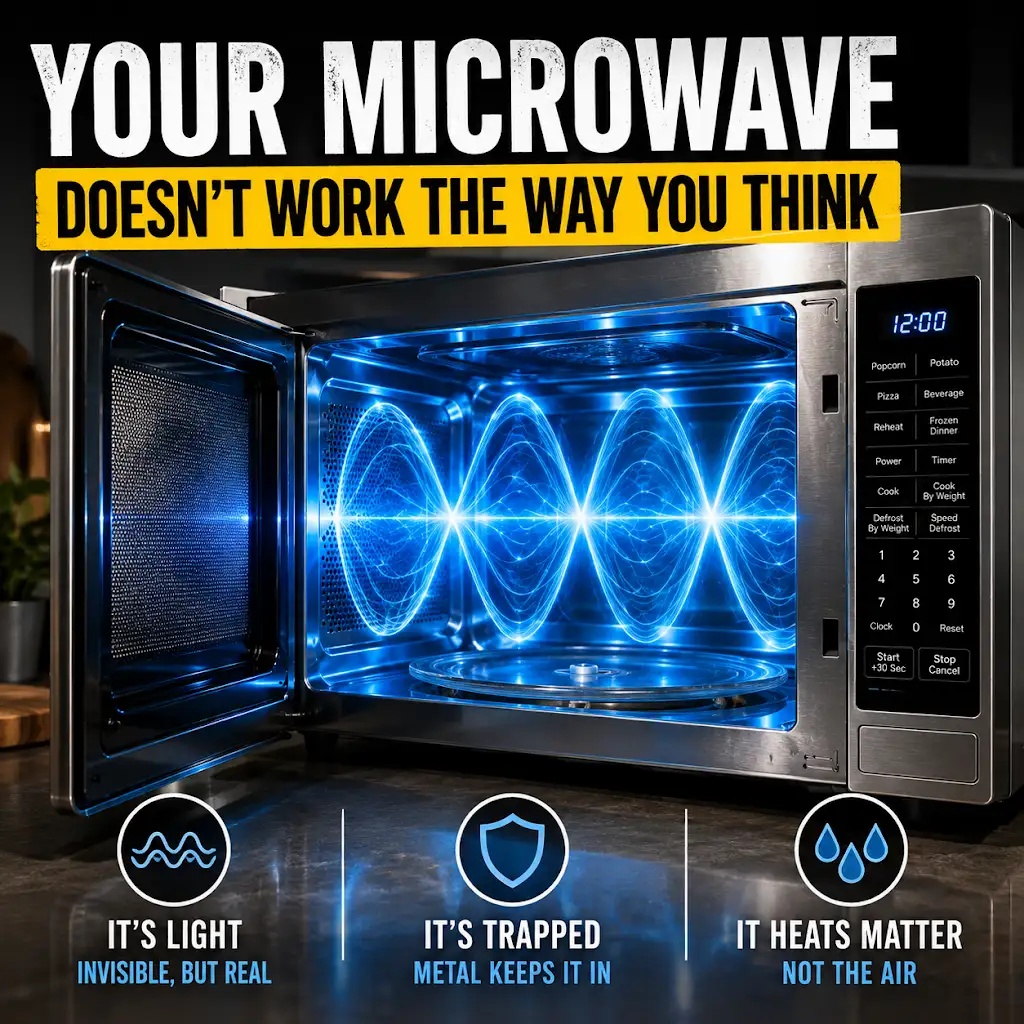
Your microwave oven is essentially a meticulously designed Faraday cage. The metal walls, the metal mesh on the door window, and the metallic seal all work together to contain the microwave radiation within the cooking cavity. This is absolutely crucial for two primary reasons:
- Safety: Microwave radiation, at the intensities used for cooking, can be harmful to living tissues. By containing the microwaves, the Faraday cage prevents them from escaping the oven and exposing you or others to potentially damaging radiation. The tiny perforations in the metal mesh of the door window are too small for the microwaves to pass through, while still allowing you to see your food.
- Efficiency: The metal walls reflect the microwaves back into the cooking cavity. This bouncing action ensures that the microwave energy is trapped inside and has multiple opportunities to interact with the food, leading to more efficient and even cooking. Without these reflections, a significant portion of the microwave energy would simply escape, rendering the cooking process very slow and ineffective.
The reflective nature of the metal is key. Imagine shining a flashlight into a mirrored room. The light bounces off the walls, illuminating the space from all angles. The metal walls of your microwave oven do something similar with microwaves, creating a complex pattern of standing waves that effectively bombard the food from all directions.
How Microwaves Cook Food: The Dielectric Heating Mechanism

So, the metal walls keep the microwaves in, and the magnetron generates them. But how do these invisible waves actually cook your food? This is where the interaction with food molecules comes into play.
The Role of Water Molecules
As mentioned earlier, the chosen frequency of 2.45 GHz is particularly effective at interacting with polar molecules. The most prevalent polar molecule in most foods is water. Water molecules have a positive charge on one side and a negative charge on the other, making them dipoles.
The Rapid Rotation: Generating Heat
When microwaves enter the cooking cavity and encounter food containing water, the oscillating electric field of the microwaves exerts a force on these polar water molecules. The microwaves rapidly flip back and forth billions of times per second. This rapid oscillation causes the water molecules to try and align themselves with the changing electric field.
Imagine millions of tiny compass needles being frantically spun around by an alternating magnetic force. This constant, rapid rotation of water molecules creates friction. It’s this friction between molecules, particularly water molecules, that generates heat. This process is called dielectric heating.
Penetration Depth and Even Cooking
Microwaves penetrate food to a certain depth, typically a few centimeters. This means that the outer layers of the food are heated directly by the microwaves. The heat then conducts inwards through the food. This is why, sometimes, the center of thicker foods might be cooler than the edges.
The bouncing of microwaves off the metal walls creates a pattern of high and low energy zones within the oven cavity. This is known as a standing wave pattern. While this can lead to uneven heating in some older or poorly designed ovens, modern microwave ovens often incorporate a turntable to rotate the food, and sometimes a stirrer fan, to help distribute the microwave energy more evenly and reduce these “hot spots” and “cold spots.”
Other Polar Molecules
While water is the primary driver of dielectric heating, other polar molecules in food, such as fats and sugars, also contribute to the heating process. Their molecular structures also allow them to vibrate and generate heat when exposed to microwaves, though generally to a lesser extent than water.
The Science of Metal in the Microwave: When Things Go Wrong

Now we arrive at the crucial part of the advice: why can’t you just put any old piece of metal in the microwave? The science behind the metal walls being essential for containing microwaves explains why certain metallic objects can be problematic.
Reflection vs. Absorption: The Key Difference
The metal walls of your microwave are designed to reflect microwaves. This reflection is controlled and predictable. However, when you introduce a different metallic object into the cooking cavity, the behavior of the microwaves can become unpredictable and potentially dangerous.
Arcing: The Spark of Disaster
One of the most common and dangerous phenomena that occurs when metal is placed in a microwave is arcing, or sparking. This happens for a few reasons:
- Sharp Edges and Points: Metallic objects with sharp edges or points, like the tines of a fork or crumpled aluminum foil, can concentrate the electric field of the microwaves. This concentration can become so intense that it ionizes the air molecules around the sharp point, creating a conductive path for electricity. This results in a visible spark or arc, which is essentially a mini lightning bolt.
- Reflection Interference: Metal objects can reflect microwaves in ways that interfere with the overall standing wave pattern within the oven. This can lead to extremely high energy concentrations in localized areas.
- Electron Accumulation: In some cases, electrons can accumulate on the surface of a metallic object. When the electric field of the microwaves oscillates, it can cause these accumulated electrons to be violently repelled, leading to a discharge – a spark.
Why is Arcing Dangerous?
Arcing is not just a visual spectacle; it can have several negative consequences:
- Damage to the Magnetron: The uncontrolled electrical discharges can send surges of energy back into the magnetron, potentially damaging this vital component and rendering your microwave inoperable.
- Fire Hazard: The sparks generated can ignite nearby food particles or packaging, posing a serious fire risk.
- Uneven Cooking: While the sparks are the most dramatic effect, the interference with the microwave field can also lead to very uneven heating of the food.
Aluminum Foil: A Case Study
Aluminum foil is a common culprit. Its thinness and tendency to be crumpled mean it often has sharp edges and points. While small, carefully placed pieces of foil can sometimes be used to shield parts of food from overcooking (like the tips of chicken wings), it’s a risky practice for the untrained, and improper use can easily lead to arcing. The reflective nature of foil can also interfere with the intended microwave distribution.
Metal Utensils and Containers
Metal forks, spoons, knives, and metal-rimmed dishes are obvious no-nos. Their solid metallic structure will reflect microwaves, potentially causing damage and arcing. The same applies to any container or dish that has metallic elements or decorations.
Microwave ovens are designed with metal walls to ensure that the microwaves remain contained within the cooking chamber, allowing for efficient heating of food. This design not only enhances safety but also improves cooking performance by preventing energy loss. For a deeper understanding of the science behind microwave technology and its various components, you can explore a related article on this topic at Freaky Science, which delves into the fascinating principles that govern how these appliances work.
Understanding Safe Metal Use: Nuances and Exceptions
| Reasons for Metal Walls in Microwave Ovens |
|---|
| 1. Reflecting Microwaves |
| 2. Preventing Leakage |
| 3. Durability and Safety |
| 4. Easy to Clean |
While the general rule is “no metal,” there are nuances and specific cases where metal is incorporated into microwave-safe designs, or where its presence is carefully managed.
The Door and the Cavity: Engineered for Reflection
As we’ve discussed, the metal walls and door of the microwave oven itself are intentionally designed to be highly reflective. This is controlled reflection. The thickness, shape, and composition of these metallic components are precisely engineered to ensure efficient and safe containment of microwaves. The perforated metal mesh in the door window is a prime example of this controlled design, allowing visibility while blocking microwaves.
Microwave-Safe Cookware: A Special Category
You might see cookware labeled as “microwave-safe” that incorporates certain metallic elements. These are typically designed with very specific considerations:
- Thin Metallic Trims: Some ceramic or glass dishes have very thin, continuous metallic trims. In these cases, the metallic element is often designed to be continuous and smooth, reducing the likelihood of concentrated electric fields and arcing. The goal is often for these trims to reflect microwaves to prevent the edges of the food from overcooking. However, even with these, it’s wise to exercise caution and refer to the manufacturer’s instructions.
- Microwave-Specific Metal Components: Some specialized microwave cooking accessories might have small metallic components. These are usually designed to be in specific positions and to interact with the microwaves in a controlled manner, often for browning or crisping. For example, some browning dishes have a metallic surface that heats up significantly when exposed to microwaves, mimicking the effect of a hot pan. These are engineered with safety in mind and are intended for specific uses.
The Importance of Manufacturer Instructions
The safest approach is always to adhere to the manufacturer’s instructions for your specific microwave oven and any cookware you use. If a dish is not explicitly labeled as microwave-safe, it’s best to err on the side of caution and avoid using it.
When in Doubt, Leave it Out
The adage “when in doubt, leave it out” is particularly pertinent when it comes to metal in the microwave. The potential for damage to your appliance or, more importantly, the risk of fire or injury, far outweighs any perceived benefit of using a questionable metallic item.
Conclusion: The Clever Design of Your Culinary Companion
Your microwave oven, with its seemingly contradictory use of metal, is a testament to clever engineering and a deep understanding of physics. The metal walls are not a hindrance but an indispensable part of the system, forming a Faraday cage that safely contains the cooking power of microwaves. This enclosure ensures that the electromagnetic waves are reflected back into the cooking cavity, leading to efficient dielectric heating of food.
The science behind this is elegant: the magnetron generates microwaves, waveguides direct them, and the metallic shell traps them, allowing them to interact with polar molecules like water, causing them to vibrate and generate heat.
However, this very same principle of controlled reflection highlights why uncontrolled introduction of metal can be so problematic. Sharp edges and points on metallic objects can concentrate microwave energy, leading to dangerous arcing and potential damage.
So, the next time you pop your popcorn or reheat your dinner, take a moment to appreciate the intricate science at play. You’re not just using a kitchen appliance; you’re harnessing the power of controlled electromagnetic waves, thanks to the brilliant, metallic enclosure that makes it all possible, and the careful understanding of what happens when that controlled environment is disrupted. It’s a powerful reminder that even the most common technologies have fascinating scientific principles at their heart.
Your Microwave Doesn’t Work the Way You Think
FAQs
1. Why do microwave ovens have metal walls?
Microwave ovens have metal walls to reflect the microwaves produced by the magnetron back into the oven cavity, ensuring that the food is evenly cooked.
2. How does the metal in microwave ovens work?
The metal walls in a microwave oven act as a barrier to contain the microwaves within the oven cavity, preventing them from escaping and potentially causing harm to the user.
3. Are there any safety concerns with metal walls in microwave ovens?
The metal walls in microwave ovens are designed to be safe for use, as they are specifically engineered to contain the microwaves within the oven cavity and prevent any leakage.
4. Can the metal walls in a microwave oven affect the cooking process?
The metal walls in a microwave oven are designed to reflect the microwaves back into the oven cavity, ensuring that the food is evenly cooked and reducing the risk of hot spots.
5. Are there any alternatives to metal walls in microwave ovens?
While metal walls are the most common design for microwave ovens, some models may use other materials such as ceramic or special coatings to achieve similar reflective properties.