
You’re standing in your kitchen, a cold dinner ready for a quick revival. You slide it into the microwave, push a few buttons, and with a hum, the magic begins. But have you ever stopped to wonder about the metal box that contains this culinary wizardry? What’s the deal with those shiny metal walls? It’s not just for aesthetics; there’s some fascinating science at play, and it all boils down to electromagnetism and how microwaves interact with the world around them.
Microwave ovens harness a specific type of electromagnetic radiation known as microwaves. These are part of the electromagnetic spectrum, falling between radio waves and infrared radiation. Think of them as tiny, energetic packets of light, but with a much longer wavelength than visible light and a frequency that makes them particularly adept at interacting with water molecules.
What Exactly Are Microwaves?
To truly appreciate the role of the metal walls, you first need to grasp what microwaves are. They are a form of electromagnetic energy. Just like visible light, radio waves, and X-rays, they consist of oscillating electric and magnetic fields that travel at the speed of light. The key difference lies in their frequency and wavelength. Microwaves used in ovens typically operate at a frequency of around 2.45 gigahertz (GHz), which translates to a wavelength of about 12.2 centimeters.
The Electromagnetic Spectrum: A Broader Perspective
It’s helpful to place microwaves within the larger context of the electromagnetic spectrum. At one end, you have high-energy gamma rays and X-rays with very short wavelengths and high frequencies. As you move along, you encounter ultraviolet light, visible light, infrared radiation (which we feel as heat), and then, you arrive at microwaves. Beyond microwaves are radio waves, which have even longer wavelengths and lower frequencies. Each part of this spectrum has unique properties and interactions with matter.
How Microwaves Heat Your Food
The magic of microwave cooking lies in the specific way microwaves interact with certain molecules, most notably water. Water molecules are polar, meaning they have a slightly positive charge on one end and a slightly negative charge on the other, like a tiny magnet. When microwaves pass through food, their oscillating electric field causes these polar water molecules to rapidly rotate and align themselves with the field. As the field rapidly switches direction (billions of times per second at 2.45 GHz), the water molecules jiggle back and forth, creating friction. This friction generates heat, which cooks the food from the inside out.
The Role of Dielectric Heating
This process is called dielectric heating. It’s not just water; other polar molecules like fats and sugars can also be heated by microwaves, but water is the most efficient absorber. This is why foods with higher water content cook faster in a microwave. The microwaves penetrate a few centimeters into the food, exciting the water molecules within that depth, and then the heat conducts through the rest of the food.
Microwave ovens are designed with metal walls primarily to contain the microwaves within the cooking chamber, ensuring efficient cooking and preventing radiation leakage. This design feature is crucial for safety and functionality, as it allows the microwaves to bounce around and evenly cook food. For a deeper understanding of the science behind microwave ovens and their construction, you can read more in this related article on Freaky Science: Freaky Science.
The Faraday Cage Phenomenon: Containing the Energy
Now, let’s talk about the metal walls. These aren’t just decorative panels; they are crucial components that create a protective barrier, preventing the microwaves from escaping the oven cavity. This is a prime example of a Faraday cage in action.
What is a Faraday Cage?
A Faraday cage, named after the English scientist Michael Faraday, is an enclosure made of conductive material, like metal mesh or solid metal, that blocks external electromagnetic fields. When an electric field is applied to a conductor, the charges within the conductor rearrange themselves in such a way that they cancel out the external field inside the enclosure. In the case of a microwave oven, the metal walls prevent the microwaves from escaping into your kitchen.
How Conductive Materials Work
The effectiveness of a Faraday cage relies on the properties of conductive materials. Metals are excellent conductors because they have free electrons that can move easily throughout the material. When microwaves, which are electromagnetic fields, encounter these conductive walls, the oscillating electric field causes the free electrons in the metal to move. This movement of electrons creates opposing electric fields that effectively cancel out the incoming microwave radiation inside the oven.
The Wavelength Matters: Why the Holes in the Door
You might have noticed that the door of your microwave oven isn’t solid metal. Instead, it has a metal mesh with small holes. This design is a clever application of physics related to the wavelength of the microwaves. The holes in the mesh are specifically designed to be smaller than the wavelength of the microwaves being used.
Diffraction and Wave Propagation
When a wave encounters an opening, it can diffract, meaning it bends and spreads out. However, diffraction is most pronounced when the size of the opening is comparable to or larger than the wavelength of the wave. Because the holes in the microwave door are significantly smaller than the 12.2 cm wavelength of the microwaves, they act as obstacles that prevent the microwaves from passing through effectively. The microwaves are essentially reflected back into the oven cavity.
The Trade-off: Visibility and Safety
This mesh design is a crucial safety feature. It allows you to see your food while it’s cooking without compromising the containment of the microwaves. If the holes were larger, microwaves could leak out. Conversely, if the mesh were too fine, it would impede the passage of visible light, making it difficult to monitor your food. The size of the holes represents a careful balance between electromagnetic containment and visual access.
The Role of the Metal Interior: Reflection and Even Heating

Beyond simply containing the microwaves, the metal interior of the oven plays an active role in how your food is heated. The reflective properties of the metal walls ensure that the microwaves are bounced around the cavity, distributing the energy more evenly throughout the food.
Reflection of Microwaves
Metals are highly reflective to microwaves. When microwaves are generated by the magnetron (the heart of the microwave oven), they are directed into the oven cavity. The metal walls then act like mirrors for these waves, bouncing them off in all directions. This continuous bouncing and reflection ensure that the microwaves don’t just hit the food from one angle.
Specular vs. Diffuse Reflection
In a perfectly smooth metal surface, you would get specular reflection, where the angle of incidence equals the angle of reflection, like a mirror. However, the interior of a microwave oven is not perfectly smooth. There are slight imperfections, and the cavity itself creates complex wave patterns. This results in a more diffuse reflection, where the microwaves scatter in many directions, leading to a more thorough bombardment of the food.
The Turntable: Combating Cold Spots
Despite the reflective interior, microwaves can still create areas of higher and lower intensity within the oven cavity, known as “hot spots” and “cold spots.” This is due to the wave nature of microwaves and how they interfere with each other. To counteract this, most microwave ovens include a turntable.
Standing Waves and Interference Patterns
When microwaves bounce around the cavity, they can interfere with each other. Constructive interference occurs when two wave crests or troughs align, resulting in a stronger wave. Destructive interference occurs when a wave crest aligns with a wave trough, canceling each other out. These interference patterns can lead to areas where the microwave intensity is much higher or much lower. The turntable rotates the food, ensuring that all parts of the food are exposed to varying intensities of microwaves over the cooking time, thus promoting more even cooking.
The Waveguide: Directing the Energy
The microwaves aren’t just randomly pumped into the oven cavity. They are guided there by a component called the waveguide. This is typically a rectangular metal tube that channels the microwaves from the magnetron to the oven cavity. The dimensions of the waveguide are carefully chosen to efficiently transmit microwaves at the operating frequency.
Impedance Matching
The waveguide is designed to have a specific impedance, which is a measure of how much it resists the flow of electromagnetic energy. This impedance is matched to the impedance of the magnetron and the oven cavity. This impedance matching ensures that the maximum amount of microwave energy is transferred from the source to the cooking chamber, with minimal energy being reflected back to the magnetron, which could damage it.
The Danger of Metal Objects: Why They Don’t Belong
So, the metal walls are good for containing microwaves, but what happens when you put other metal objects inside? This is where things get interesting, and potentially dangerous. Putting metal in a microwave is a big no-no, and the science behind it is directly related to how microwaves interact with conductive materials.
Arcing and Sparks: The Electrical Discharge
When you place a thin, smooth piece of metal inside a microwave, especially one with sharp edges or points, the microwaves can induce strong electric currents in the metal. If the electric field becomes strong enough, it can overcome the insulating properties of the air around the metal object, leading to a sudden discharge of electricity – a spark or an arc. This is known as arcing.
Charge Buildup on Sharp Edges
Sharp edges and points on metal objects concentrate the induced electric charges. Imagine the electric field lines bunching up around a sharp corner. This concentration can lead to a much higher electric potential difference over a small distance, making it easier for a spark to jump.
The Metal Container Problem: Reflection and Overheating
Larger, smooth metal containers like bowls or foil can also cause problems. Instead of allowing the microwaves to penetrate and heat the food, the metal reflects the microwaves. This can lead to uneven heating of the food, with some parts being overcooked while others remain cold. More importantly, the reflected microwaves can bounce back to the magnetron, potentially damaging it. Furthermore, the food inside the metal container might not heat up at all.
The Magnetron’s Vulnerability
The magnetron is designed to operate within the controlled environment of the oven cavity. Excessive reflected microwave energy can cause it to overheat and fail. This is why microwave manufacturers strongly advise against using metal cookware.
The “Microwave-Safe” Label: A Guide to What’s Okay
You’ll often see “microwave-safe” labels on dishes. These materials are typically glass, ceramic, or certain plastics that do not readily absorb microwaves or react with them in a way that causes heating or damage. They allow microwaves to pass through them and reach the food.
Testing for Microwave Safety
To test if a dish is microwave-safe, you can place it in the microwave with a cup of water. Microwave on high for one minute. If the dish remains cool, it’s likely microwave-safe. If it becomes hot, it’s absorbing microwave energy and should not be used.
Microwave ovens are designed with metal walls primarily to contain the microwaves and prevent them from escaping, ensuring efficient cooking and safety. For a deeper understanding of the science behind this design choice, you can explore a related article that delves into the principles of microwave technology and its applications. This insightful piece can be found here, where you will discover more about how these appliances work and the importance of their construction.
The Science of Insulation and Safety: Keeping You Protected
“`html
| Reasons for Metal Walls in Microwave Ovens |
|---|
| 1. Reflecting Microwaves |
| 2. Preventing Leakage |
| 3. Durability and Safety |
| 4. Easy to Clean |
“`
The metal walls of your microwave oven are more than just a reflective surface; they are part of a sophisticated system designed to keep you safe from the invisible forces within. The construction and design meticulously ensure that the microwave energy stays where it belongs.
Multiple Layers of Protection
Modern microwave ovens often have multiple layers of metal shielding. The main oven cavity is enclosed by metal walls, and the door also contains a metal mesh and often an additional metal frame. This layered approach provides robust containment of the microwaves.
The Door Seal: A Critical Barrier
The door seal is another crucial safety component. It’s designed to be airtight, preventing any microwave leakage around the edges of the door when it’s closed. Over time, these seals can degrade, which is why it’s important to inspect your microwave and replace it if the door seal is damaged or worn.
Interlock Switches: Preventing Operation When Open
To further enhance safety, microwave ovens are equipped with interlock switches. These are safety mechanisms that prevent the magnetron from operating when the oven door is open. As soon as you open the door, these switches disengage, cutting off the power to the magnetron.
Redundancy in Safety Design
Many microwave ovens have multiple interlock switches. This redundancy ensures that even if one switch fails, another will prevent the oven from operating with the door ajar. This is a critical safety feature, as microwaves leaking from an open oven could pose a health risk.
Ventilation and Heat Dissipation
While the primary function of the metal is to contain microwaves, the metal also plays a role in heat dissipation. The magnetron and other electronic components inside the oven generate heat during operation. The metal casing helps to conduct this heat away, allowing it to be released through ventilation openings.
The Importance of Unobstructed Vents
It’s essential to ensure that the ventilation openings of your microwave are not blocked. This allows for proper airflow and prevents the internal components from overheating, which could lead to malfunction or premature failure.
Beyond the Kitchen: Other Applications of Microwave Containment
The principles behind the metal walls of your microwave oven extend far beyond just heating your leftovers. The concept of containing electromagnetic radiation is vital in numerous scientific and technological fields.
Radio Frequency Shielding (RFI Shielding)
In electronics, preventing electromagnetic interference (EMI) and radio frequency interference (RFI) is crucial for the proper functioning of devices. Metal enclosures, similar in principle to a Faraday cage, are used to shield sensitive electronic components from external electromagnetic fields and to prevent them from emitting unwanted radiation.
Protecting Sensitive Equipment
This is particularly important in medical equipment, scientific instruments, and high-performance computing systems where even minor electromagnetic interference can lead to erroneous data or system failure.
Anechoic Chambers: The Silent Rooms of Science
Anechoic chambers are specially designed rooms used for testing antennas, electronic devices, and electromagnetic compatibility. They are lined with microwave-absorbing materials, but their underlying structure is often a form of Faraday cage to prevent external signals from interfering with the tests.
Controlling the Electromagnetic Environment
These chambers are essential for accurately measuring the electromagnetic properties of devices without the influence of the outside world.
Medical Applications: MRI and Radiation Therapy
While not directly using metal walls for containment in the same way as a microwave oven, the principles of electromagnetism and shielding are fundamental in other medical technologies. Magnetic Resonance Imaging (MRI) machines use powerful magnetic fields and radio waves. The room housing the MRI scanner is often shielded to prevent external radio frequency interference. Similarly, radiation therapy machines use controlled forms of radiation, and the design of the equipment and surrounding facilities incorporates shielding to protect personnel.
The Invisible Shield
From the humble kitchen appliance to sophisticated scientific instruments, the concept of using conductive materials to control and contain electromagnetic energy is a cornerstone of modern technology, ensuring both functionality and safety. The shiny metal walls of your microwave oven are a simple yet elegant demonstration of these profound scientific principles.
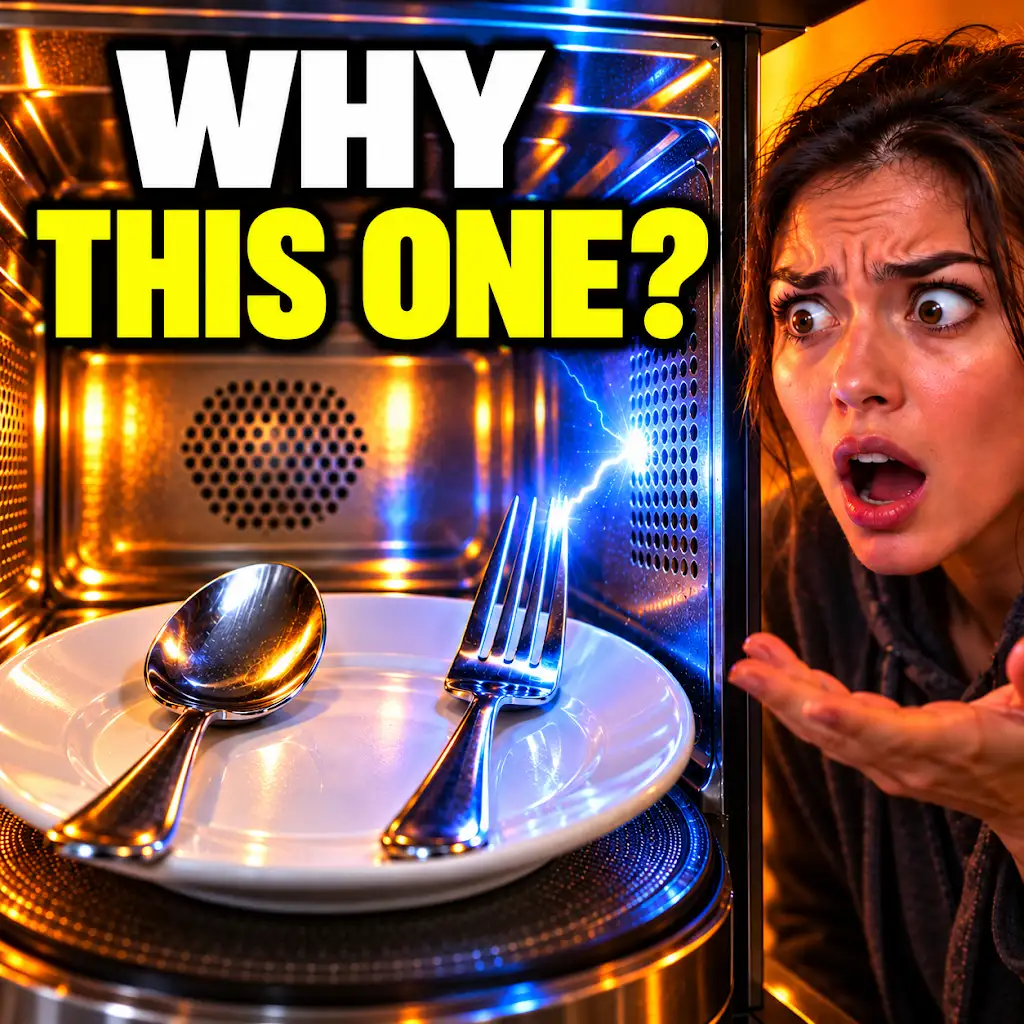
A Fork and a Spoon React Differently in a Microwave. Why?
FAQs
1. Why do microwave ovens have metal walls?
Microwave ovens have metal walls to reflect the microwaves produced by the magnetron back into the oven cavity, ensuring that the food is evenly cooked.
2. How does the metal in microwave ovens work?
The metal walls in a microwave oven act as a barrier to contain the microwaves within the oven cavity, preventing them from escaping and potentially causing harm to the user.
3. Are there any safety concerns with metal walls in microwave ovens?
The metal walls in microwave ovens are designed to be safe for use, as they are specifically engineered to contain the microwaves within the oven cavity and prevent any leakage.
4. Can the metal walls in a microwave oven affect the cooking process?
The metal walls in a microwave oven are designed to reflect the microwaves back into the oven cavity, ensuring that the food is evenly cooked and reducing the risk of hot spots.
5. Are there any alternatives to metal walls in microwave ovens?
While metal walls are the most common design for microwave ovens, some models may use other materials such as ceramic or special coatings to achieve similar reflective properties.