You might have experienced it firsthand, or perhaps you’ve seen it in a cartoon: a flash of light, a crackling sound, and a shower of sparks erupting from your microwave when you accidentally put in a fork or a metallic-lined plate. It’s a dramatic and slightly alarming spectacle, but what exactly is happening behind those dazzling displays of electrical fireworks? You’re about to find out. This isn’t just random magic; it’s a fascinating interplay of physics, electricity, and the very nature of microwaves. Prepare to demystify the science behind those metallic sparks.
Before we delve into the sparks, it’s crucial to understand how your microwave oven works in the first place. Think of your microwave as a sophisticated chamber designed to excite water molecules.
The Magnetron: The Heart of the Operation
At the core of every microwave oven is a device called a magnetron. This is where the magic of generating microwaves truly begins. You can picture it as a vacuum tube that, with the help of powerful magnets, converts electrical energy into high-frequency radio waves, specifically in the microwave range. These waves typically hover around 2.45 gigahertz (GHz), a frequency perfectly chosen for its ability to interact with water molecules.
How the Magnetron Generates Microwaves
The process involves a stream of electrons being accelerated through a magnetic field. As these electrons move, they create oscillations in resonant cavities within the magnetron. These oscillations are then amplified and guided out as electromagnetic waves. It’s a complex piece of engineering, but its primary function is to produce the invisible energy that cooks your food.
The Waveguide: Directing the Energy
Once generated, these microwaves need to be channeled into the cooking chamber. This is the job of the waveguide. It’s essentially a hollow metal tube that acts like a conduit, efficiently directing the microwave energy from the magnetron to the food cavity. The shape and dimensions of the waveguide are precisely calculated to minimize energy loss.
The Importance of Waveguide Design
The waveguide’s design ensures that the microwaves travel in a controlled manner, preventing them from dissipating before they reach their target. Without it, the energy would scatter and become ineffective.
The Cooking Cavity: A Reflective Chamber
The inside of your microwave oven is a metal box. This isn’t just for aesthetics; it’s a critical component of the heating process. The metal walls of the cavity are highly reflective to microwaves. This means that the microwaves bounce around inside the chamber, crisscrossing and bombarding your food from all angles. This constant reflection ensures that the food is exposed to a uniform field of microwave energy.
The Rotating Turntable: Even Heating
To further enhance even heating, most microwaves have a rotating turntable. As the food spins, different parts of it are exposed to the microwave field at different times, helping to cook it more evenly and prevent hot spots and cold spots.
The Interaction with Food: The Power of Water
Now, let’s talk about how this energy actually cooks your food. The key ingredient is water. Most foods contain a significant amount of water. Microwaves interact with the polar molecules of water. A water molecule has a slightly positive charge on one end and a slightly negative charge on the other, making it a dipole.
Dielectric Heating: The Core Mechanism
When microwaves enter the food, they cause these water molecules to rapidly vibrate and rotate as they try to align themselves with the oscillating electromagnetic field. This rapid movement creates friction between the water molecules, and this friction generates heat. This process is called dielectric heating. It’s an extremely efficient way to heat food from the inside out.
Other Polar Molecules
While water is the primary target, other polar molecules present in food, such as fats and sugars, also contribute to dielectric heating, though to a lesser extent.
If you’ve ever wondered about the real reason metal sparks in microwaves, you might find it interesting to explore a related article that delves deeper into the science behind this phenomenon. The article explains how the interaction between microwaves and metal can lead to sparks and even fires, shedding light on the underlying physics. For more information, you can read the full article here: Freaky Science.
The Electrical Phenomenon: Introducing Arcing
So, we’ve established how microwaves work. Now, let’s bring metal into the picture and see why it causes such a dramatic reaction. The sparks you see are a phenomenon known as arcing, or more formally, electrical discharge. It’s essentially a spark of electricity jumping across a gap.
The Role of Electric Fields
Microwaves are a form of electromagnetic radiation, and their interaction with conductors, like metal, is governed by the principles of electromagnetism. The oscillating electromagnetic field within the microwave cavity can induce currents in metallic objects.
Induced Currents and Charge Buildup
When a metal object is placed in the microwave, the rapidly changing electric field causes electrons within the metal to move back and forth. This movement of electrons creates alternating currents. Depending on the shape and placement of the metal, these currents can lead to a significant buildup of electrical charge at specific points or edges.
The Breakdown of Air: The Spark Formation
The air surrounding the metal object is an electrical insulator. However, when the electric field strength becomes sufficiently high, it can overcome the insulating properties of the air. This is known as dielectric breakdown.
Ionization and the Plasma Channel
At a certain point, the electric field is so strong that it rips electrons away from the air molecules, creating a plasma. This plasma is a highly conductive medium, and it forms a channel through which electricity can flow. This sudden flow of electricity creates the visible spark and the characteristic crackling sound.
Metal’s Magnetic Personality: Why Some Metals React More
Not all metals behave the same way in a microwave. Some will cause a spectacular light show, while others might seem to have little effect. This difference is due to a combination of factors related to the metal’s electrical conductivity, shape, and the specific way it interacts with the microwave field.
Conductivity: The Path of Least Resistance
Metals are excellent conductors of electricity. This means that electrons can move through them with relative ease. When microwaves hit a metal surface, they induce eddy currents within the metal. The higher the conductivity of the metal, the more readily these currents can flow, leading to a greater potential for charge buildup.
Good Conductors vs. Poor Conductors
Metals like aluminum, copper, and silver are highly conductive and will readily interact with microwaves, potentially leading to arcing. Less conductive metals, or those with surface treatments that impede electron flow, might show less dramatic effects.
Shape Matters: Sharp Edges and Points
The shape of a metallic object is perhaps the most crucial factor in determining whether it will arc. Sharp edges, points, and thin protrusions act as “charge concentrators.”
Electric Field Intensification
Imagine the electric field lines flowing around a smooth, rounded object versus a sharp point. At the sharp point, these field lines become incredibly dense and concentrated. This means that the electric field strength is significantly higher at these sharp points. When this concentrated field reaches the dielectric breakdown strength of the air, arcing is much more likely to occur.
The Analogy of Lightning Rods
This is why lightning rods are designed with sharp points; they are intended to attract electrical discharge in a controlled manner. In a microwave, however, these sharp points can lead to uncontrolled and potentially damaging arcing.
Thinness and Surface Area: A Double-Edged Sword
The thickness and surface area of a metal object also play a role. Thin pieces of metal, like the foil that lines some food packaging, have a large surface area relative to their mass. This can facilitate rapid charge buildup and subsequent discharge.
Foil’s Finicky Nature
Aluminum foil is a common culprit for arcing. Its thinness and the tendency for its edges to create sharp points when crumpled make it particularly prone to generating intense electric fields. However, it’s worth noting that sometimes, specifically designed foil packaging can be used in microwaves safely because of its controlled placement and shape.
The Dangerous Dance: Why You Shouldn’t Microwave Metal
While the sparks might seem like a fun science experiment, microwaving metal is a risky endeavor. The consequences can range from minor inconvenience to serious damage to your microwave and even a fire hazard.
Damaging Your Magnetron: The Ultimate Price
The most significant risk is damage to the magnetron. The intense electrical discharges generated by arcing can send powerful surges of electricity back into the magnetron. This can overload and ultimately burn out this vital component, rendering your microwave useless.
The Cost of Repair or Replacement
Replacing a magnetron can be expensive, and in many cases, it might be more cost-effective to buy a new microwave altogether.
Fire Hazard: A Smoking Gun
The sparks themselves are a source of intense heat. If these sparks ignite food particles or other flammable materials inside the microwave, they can start a fire. This is especially true if the metal object is in close proximity to greasy residues or packaging.
Unattended Cooking: A Recipe for Disaster
Never leave your microwave unattended, especially if you suspect metal has been placed inside. The rapid development of a fire can be alarming.
Uneven and Incomplete Cooking: A Futile Effort
Even if no sparks occur, metal objects can interfere with the proper distribution of microwaves. This can lead to uneven heating of your food, leaving some parts cold while others are overcooked.
The Microwave’s Shielding Effect
Metal surfaces reflect microwaves. If a large metal object is present, it can effectively create a “shadow” where microwaves cannot penetrate, preventing the food in that area from cooking.
Have you ever wondered about the real reason metal sparks in microwaves? This phenomenon can be quite alarming, but understanding the science behind it can help alleviate your concerns. For a deeper dive into this topic, you might find it interesting to read a related article that explores the interactions between microwaves and various materials. Check out this informative piece on the subject at Freaky Science, where you can learn more about the fascinating world of microwave technology and safety tips for using your appliance.
Safety First: Navigating the Microwave with Caution
| Metal Type | Reason for Sparking |
|---|---|
| Aluminum foil | Reflects microwaves and can cause arcing |
| Stainless steel | Can act as an antenna and cause sparking |
| Other metals | Can cause arcing due to reflection and antenna effect |
Understanding the science behind metal sparks empowers you to use your microwave safely and effectively. The key is to be aware of the principles at play and to exercise common sense.
Reading Labels: Your First Line of Defense
Many microwaveable food containers and packaging will have specific instructions regarding their use in a microwave. Always read these labels carefully. If it says “microwave safe,” it generally means the materials have been tested and deemed suitable.
Identifying Microwave-Safe Symbols
Look for symbols that indicate microwave compatibility. These are usually depicted as wavy lines or a microwave oven icon.
What to Avoid: The Usual Suspects
You’ve likely heard this before, but it bears repeating: never put solid metal objects into your microwave. This includes:
- Forks, knives, and spoons
- Aluminum foil (unless specifically indicated as safe for the particular product)
- Metal-lined containers
- Dishes with metallic trim or paint
- Twist ties with metal cores
The Exception to the Rule: The Designer’s Intent
There are rare instances where specially designed metal components are incorporated into microwave cookware. These are typically designed to absorb microwaves in a specific way or to be used for browning. Always follow the manufacturer’s instructions meticulously in these cases.
The Oops Moment: What to Do If Metal Goes In
If you accidentally put metal in the microwave, stop it immediately. Don’t wait for sparks to appear. Open the door and carefully remove the metal object with oven mitts, as it might be hot.
Inspect Your Microwave
After removing the metal, visually inspect the inside of your microwave for any signs of damage or burning. If you notice any, it’s best to err on the side of caution and have it checked by a professional.
The Art of the Faraday Cage: Understanding Microwave Containment
Your microwave oven itself is essentially a Faraday cage. A Faraday cage is an enclosure made of conductive material that blocks external electromagnetic fields. The metal walls of your microwave prevent the microwaves from escaping into your kitchen, protecting you from radiation.
How the Door Seal Works
The mesh screen embedded in the microwave door’s glass is also crucial. The holes in the mesh are smaller than the wavelength of the microwaves, effectively preventing them from passing through while allowing you to see inside.
By understanding the scientific principles at play, you can transform a potentially alarming kitchen mishap into a learning experience. The next time you see a flash of light from your microwave, you’ll know it’s not just a random occurrence, but a fascinating demonstration of physics in action. Remember, safety and knowledge go hand in hand when it comes to your kitchen appliances.
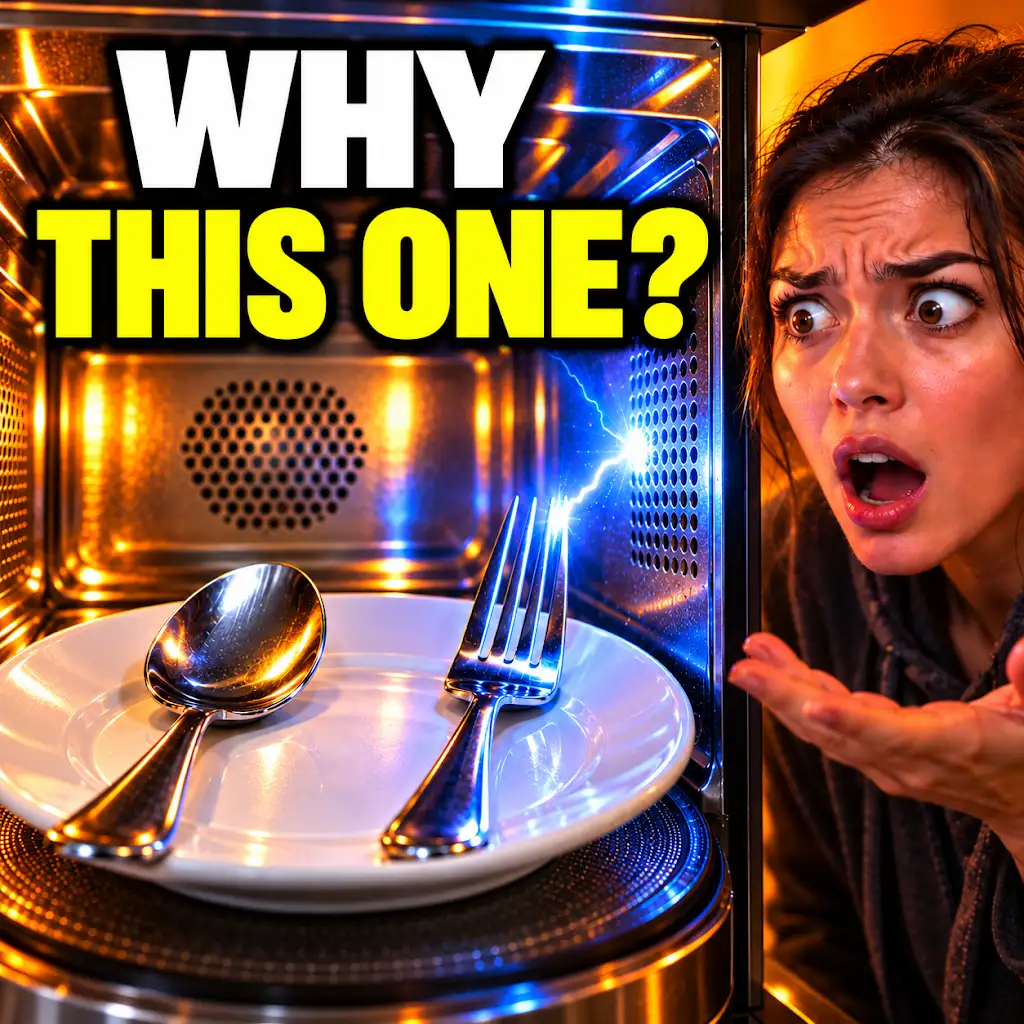
A Fork and a Spoon React Differently in a Microwave. Why?
FAQs
What causes metal to spark in microwaves?
Metal sparks in microwaves because the microwaves cause electric currents to flow through the metal, which can lead to sparking and potential damage to the microwave.
Is it safe to put metal in the microwave?
It is not safe to put metal in the microwave as it can cause sparking, potential damage to the microwave, and even pose a fire hazard.
What types of metal should not be put in the microwave?
Any type of metal, including aluminum foil, metal utensils, and metal containers, should not be put in the microwave as they can cause sparking and potential damage to the microwave.
Can metal objects be used in the microwave if they are microwave-safe?
Even if a metal object is labeled as microwave-safe, it is still not recommended to put it in the microwave as it can still cause sparking and potential damage to the microwave.
What should be used instead of metal in the microwave?
Instead of using metal in the microwave, it is recommended to use microwave-safe glass, ceramic, or plastic containers and covers. These materials are safe to use in the microwave and will not cause sparking or damage.