You stand on a train platform, a gentle breeze rustling your hair. The train, a silver serpent, is approaching. You glance at your watch – 10:00 AM precisely. You see the signal, a bright red disc, change to green. At the very same moment, a passenger on the train, leaning out of a window, sees a lamp post on the platform illuminate. You both might think, “That happened at the exact same time.” But what if I told you that the very concept of “at the exact same time” is not as absolute as you believe? Welcome to the mind-bending world of the relativity of simultaneity, a cornerstone of Albert Einstein’s revolutionary theory of special relativity. Prepare to have your perception of reality stretched and perhaps even slightly warped.
Imagine you’re not just on a train platform, but in a universe where time flows identically for everyone, everywhere. This is the classical, intuitive view of time that we all carry with us. We assume there’s a grand, cosmic clock ticking away, and every event, whether it’s the sun rising, a star exploding, or you choosing to read this article, happens at a specific, universal tick. This is the idea of absolute simultaneity. For centuries, physicists operated under this assumption. Newton, in his monumental work, described space and time as a fixed, absolute backdrop against which physical events unfolded. In this Newtonian universe, if two events happen at the same time for one observer, they happen at the same time for all observers, no matter how they are moving.
What “Simultaneous” Really Means (Classically)
Classically, “simultaneous” means occurring at precisely the same instant. If you have two events, Event A and Event B, and they both happen at 10:00:00.000 AM according to your watch, then they are simultaneous. The crucial point is that this judgment is independent of your motion. Another observer, whizzing by in a rocket at near the speed of light, would also measure Event A and Event B occurring at precisely the same instant. There’s no room for disagreement. This is the common-sense understanding we are accustomed to. We’ve built our lives, our societies, our very understanding of cause and effect, on this bedrock of absolute time.
Why This Classical View is Problematic
However, as our understanding of the universe deepened, particularly with the advent of electromagnetism, cracks began to appear in this seemingly solid foundation. The speed of light, for instance, was found to be a constant, regardless of the motion of the source or the observer. This was a deeply unsettling discovery. If the speed of light is constant, and speed is distance divided by time, then something about our perception of distance or time, or both, must be flexible. This is where Einstein stepped in, not to fix a broken clock, but to fundamentally redefine how we perceive the very fabric of space and time. He proposed that the laws of physics are the same for all non-accelerating observers, and that the speed of light in a vacuum is the same for all such observers. From these two simple postulates, a cascade of mind-bending consequences unfolds, the most profound of which is the relativity of simultaneity.
The concept of the relativity of simultaneity, which suggests that events perceived as simultaneous by one observer may not be seen the same way by another in relative motion, is a fascinating aspect of Einstein’s theory of relativity. To delve deeper into this topic, you can explore a related article that discusses the implications of this phenomenon on our understanding of time and space. For more insights, visit Freaky Science.
Einstein’s Leap: The Constant Speed of Light
Einstein’s genius lay in his willingness to question the most deeply ingrained assumptions about reality. He didn’t try to make the speed of light fit into the existing Newtonian framework; instead, he let the constant speed of light dictate the new framework. His theory of special relativity is built on two fundamental postulates. The first is the principle of relativity: the laws of physics are the same for all observers in uniform motion (i.e., not accelerating). The second, and perhaps the most counter-intuitive, is the constancy of the speed of light: the speed of light in a vacuum is the same for all inertial observers, regardless of the motion of the light source or the observer.
The Thought Experiment: Lightning Strikes on a Train
To truly grasp the relativity of simultaneity, you need to engage with Einstein’s famous thought experiments. Imagine you are standing on the ground next to a long, fast-moving train. A lightning bolt strikes the front of the train, and another strikes the rear of the train, precisely at the same moment according to an observer standing midway between the two strike points on the ground. Let’s call the observer on the ground Alice, and the observer in the middle of the train Bob.
Alice, standing stationary on the ground, sees both lightning strikes happen simultaneously. She is equidistant from both strike points. The light from both strikes travels to her at the same speed, and therefore arrives at her eyes at the same time. She can confidently declare these two events as simultaneous.
Now, consider Bob, who is in the exact middle of the train, moving towards the front strike and away from the rear strike. Because Bob is moving towards the light from the front strike, he will encounter that light sooner than he would if he were stationary. Conversely, because he is moving away from the light from the rear strike, that light will take longer to reach him.
What Bob Observes: A Different Timeline
From Bob’s perspective on the moving train, the lightning strike at the front of the train will appear to happen before the lightning strike at the rear. Why? Because Bob is moving towards the front strike, and therefore “catches up” to the light from that strike sooner. He is moving away from the rear strike, so the light from that strike has to travel further to reach him. Even though Alice on the ground sees them as simultaneous, Bob, moving relative to her, does not. The events that are simultaneous for Alice are not simultaneous for Bob.
This is the essence of the relativity of simultaneity. There is no single, universal “now” that applies to everyone. Your perception of whether two events happen at the same time depends on your motion relative to those events. This isn’t a matter of faulty equipment or flawed observation; it’s a fundamental consequence of the universe’s structure as dictated by the constant speed of light.
The Mathematics Behind the Mind-Bend
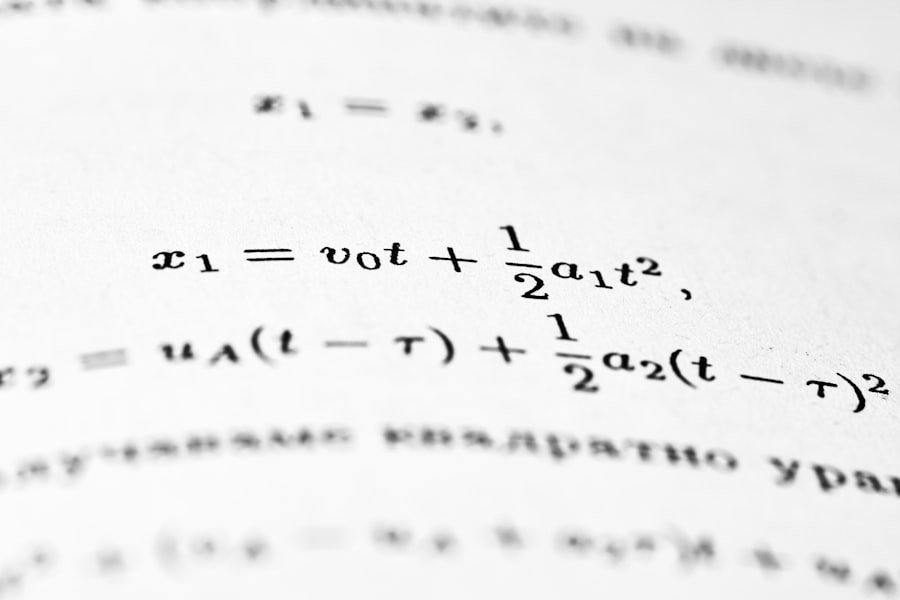
While thought experiments are powerful tools for conceptual understanding, the underlying mathematics of special relativity provides the rigorous proof. The Lorentz transformations are the mathematical equations that relate the space and time coordinates of an event as measured by two observers in different inertial frames of reference. These transformations are what reveal the interconnectedness of space and time and the relativity of simultaneity.
Lorentz Transformations: Connecting Different Perspectives
Let’s say you have an event that occurs at a certain position ($x$) and time ($t$) in your reference frame. Another observer, moving with a velocity ($v$) relative to you, will measure the same event at a different position ($x’$) and time ($t’$). The Lorentz transformations tell us how to convert coordinates from one frame to another. They are:
$t’ = \gamma (t – \frac{vx}{c^2})$
$x’ = \gamma (x – vt)$
where $\gamma$ (gamma) is the Lorentz factor, given by $\gamma = \frac{1}{\sqrt{1 – \frac{v^2}{c^2}}}$. Here, $c$ is the speed of light.
How the Equations Show Simultaneity is Relative
Consider two events, Event 1 and Event 2. In your reference frame (let’s call it S), they occur at times $t_1$ and $t_2$ and positions $x_1$ and $x_2$. For the events to be simultaneous in your frame, you would have $t_1 = t_2$.
Now, let’s see how an observer in a different reference frame (S’), moving with velocity $v$ relative to you, perceives these events. Using the Lorentz transformation for time:
$t’_1 = \gamma (t_1 – \frac{vx_1}{c^2})$
$t’_2 = \gamma (t_2 – \frac{vx_2}{c^2})$
If $t_1 = t_2$ (simultaneous in your frame), then the difference in observed times in the other frame is:
$t’_2 – t’_1 = \gamma ((t_2 – t_1) – \frac{v(x_2 – x_1)}{c^2})$
Since $t_1 = t_2$, the first term $(t_2 – t_1)$ is zero. This leaves:
$t’_2 – t’_1 = -\gamma \frac{v(x_2 – x_1)}{c^2}$
This equation clearly shows that if $x_1 \neq x_2$ (the two events happen at different locations), then $t’_2 – t’_1$ will not be zero, even if $t_1 = t_2$. In other words, if two events are simultaneous in one reference frame, they will generally not be simultaneous in another reference frame that is moving relative to the first, unless the events occur at the same spatial location. This is the mathematical confirmation of the relativity of simultaneity.
Implications: The Fabric of Spacetime
The relativity of simultaneity is not just a curious mathematical oddity; it has profound implications for our understanding of the universe. It forces us to abandon the notion of a universal, absolute “now” and embrace a more dynamic, interconnected view of reality where space and time are not independent entities but are woven together into a single fabric: spacetime.
Time Dilation and Length Contraction
The relativity of simultaneity is intimately linked to other counter-intuitive phenomena predicted by special relativity, such as time dilation and length contraction. Time dilation is the phenomenon where a moving clock appears to tick slower than a stationary clock. Length contraction is the phenomenon where a moving object appears shorter in the direction of its motion than it does when it is at rest. These effects are not arbitrary but arise from the same underlying principles that lead to the relativity of simultaneity. If your perception of simultaneity changes, it logically follows that your perception of time intervals and spatial distances will also change depending on your relative motion.
The Block Universe vs. The Flowing Present
The relativity of simultaneity also fuels philosophical debates about the nature of time. One interpretation is the “block universe” model. In this view, all of spacetime, past, present, and future, exists simultaneously as a static, four-dimensional block. Our perception of a flowing “present” is merely our consciousness moving through this block. The relativity of simultaneity supports this view because it implies that what is “now” for one observer might be in the past or future for another. There isn’t a universally agreed-upon slice of reality that constitutes the present moment for everyone.
Causality: The Unbreakable Link
While simultaneity is relative, causality is not. This is a crucial distinction. The principle of causality states that an effect cannot precede its cause. Even though observers in different reference frames may disagree on the simultaneity of two events, they will always agree on the order of causally connected events. If Event A causes Event B, then every observer, regardless of their motion, will agree that Event A happened before Event B. This is because the speed of light acts as a cosmic speed limit for information and influence. If Event A were to cause Event B, the signal or influence must travel from A to B at a speed no greater than the speed of light. This ensures that the temporal order of causally linked events is preserved across all inertial reference frames.
The concept of the relativity of simultaneity is a fascinating aspect of Einstein’s theory of relativity, which challenges our intuitive understanding of time and events occurring simultaneously. For those interested in exploring this topic further, a related article can provide additional insights into how different observers perceive time based on their relative motion. You can read more about these intriguing ideas in the article found here. Understanding these principles not only deepens our grasp of physics but also invites us to reconsider our everyday experiences of time.
Everyday Life and the Relativity of Simultaneity
| Concept | Definition |
|---|---|
| Relativity of Simultaneity | The concept that simultaneity is not absolute and can vary between different observers depending on their relative motion and position in space. |
| Time Dilation | The phenomenon where time appears to pass more slowly for an observer in motion relative to a stationary observer, as predicted by the theory of relativity. |
| Length Contraction | The contraction of an object’s length in the direction of its motion as measured by an observer in relative motion, as predicted by the theory of relativity. |
You might be thinking, “This is all very fascinating, but how does it affect my daily life?” The answer is: in ways you might not even realize, but also in ways that are often imperceptible due to our relatively low speeds. The effects of special relativity become significant only at speeds approaching the speed of light. However, the underlying principles are at play in much of modern technology.
GPS Systems: A Real-World Application
One of the most compelling everyday applications of relativity, including the relativity of simultaneity, is in the functioning of Global Positioning System (GPS) satellites. These satellites orbit the Earth at high speeds and in a weaker gravitational field than we experience on the surface.
- Special Relativity: The satellites are moving at high speeds relative to us on the ground. This motion causes their clocks to tick slightly slower due to time dilation.
- General Relativity (though not the focus here, it’s related): The satellites are in a weaker gravitational field, which causes their clocks to tick slightly faster.
The engineers who designed GPS had to account for both of these relativistic effects. If they didn’t, the tiny discrepancies in time measurement would accumulate rapidly, leading to significant errors in your location. Your GPS device needs to know the precise time to calculate your position based on the signals it receives from multiple satellites. The relativity of simultaneity plays a role in ensuring that the time measurements from these satellites are correctly interpreted by your receiver, allowing for the accurate pinpointing of your location.
Particle Accelerators and High-Energy Physics
In the realm of high-energy physics, where particles are accelerated to speeds very close to the speed of light, relativistic effects are not just noticeable; they are essential for understanding experimental results. The behavior of these particles, their lifetimes, and their interactions are all governed by the principles of special relativity, including the relativity of simultaneity. Experiments conducted in particle accelerators would yield nonsensical results if the relativistic framework were not applied.
The Limits of Our Intuition
Ultimately, the relativity of simultaneity challenges our deeply ingrained, intuitive understanding of time. It reveals that our everyday experiences, which occur at speeds far below the speed of light, provide a misleading picture of how the universe truly operates at its fundamental level. The universe is not a stage with a fixed backdrop; it is a dynamic, interconnected entity where space and time are inextricably linked.
Embracing the Mind-Bending Nature
The relativity of simultaneity is one of the most profound and mind-bending concepts in physics. It forces you to question your most basic assumptions about reality, about the nature of time itself. It suggests that your “now” is not everyone’s “now.” This idea, while initially disorienting, is also incredibly liberating. It opens up new ways of thinking about the universe and our place within it.
Don’t Worry, You Won’t Experience It Directly (Usually)
The good news is that in your everyday life, traveling at speeds much slower than light, you are unlikely to experience the dramatic effects of the relativity of simultaneity directly. The differences in perceived simultaneity between you and someone moving at, say, 60 miles per hour would be so minuscule as to be utterly undetectable by your senses or even by most common measuring devices. The effects are there, but they are incredibly subtle at everyday speeds.
A Foundation for Further Exploration
Understanding the relativity of simultaneity is a crucial step in appreciating the broader implications of special relativity, and indeed, of modern physics. It’s a gateway to understanding concepts like time dilation, length contraction, and the famous equation $E=mc^2$. It demonstrates that the universe is far stranger and more wonderful than our everyday intuition might suggest.
The Beauty of a Deeper Understanding
So, the next time you see a train approaching, or watch a clock tick, remember that the simple act of observing an event and assigning it a time is a complex interplay of your own motion and the fundamental structure of spacetime. The relativity of simultaneity is not just a scientific theory; it’s an invitation to marvel at the intricate and mind-bending nature of the cosmos, a cosmos that, upon closer inspection, is far more extraordinary than we could have ever imagined. It’s a testament to the power of human curiosity and the beauty of a universe that defies our everyday expectations.

Einstein Says There Is No Universal “Now” in the Universe
FAQs
What is the relativity of simultaneity?
The relativity of simultaneity is a concept in physics that states that the perception of simultaneous events can differ between observers in relative motion.
Who first proposed the concept of relativity of simultaneity?
The concept of relativity of simultaneity was first proposed by Albert Einstein in his theory of special relativity in 1905.
How does the relativity of simultaneity affect our perception of time and space?
The relativity of simultaneity implies that time and space are not absolute, but are instead relative to the observer’s frame of reference. This means that events that are simultaneous for one observer may not be simultaneous for another observer in relative motion.
What thought experiment is often used to illustrate the relativity of simultaneity?
The thought experiment known as the “train and platform” experiment is often used to illustrate the relativity of simultaneity. In this experiment, observers on a moving train and on a stationary platform perceive the timing of events differently due to their relative motion.
What are some real-world applications of the relativity of simultaneity?
The relativity of simultaneity has practical implications in fields such as GPS technology, where the accurate synchronization of time between satellites and receivers must account for the effects of special relativity, including the relativity of simultaneity.