
The vast expanse of the universe, stretching beyond human comprehension, holds secrets that continue to baffle scientists. Among these cosmic enigmas, the Cold Spot in the Cosmic Microwave Background (CMB) radiation stands out as a particularly intriguing anomaly. This region of space, significantly colder than its surroundings, has defied conventional explanations, prompting a spectrum of theories ranging from mundane statistical fluctuations to exotic cosmological phenomena.
Unveiling the Cosmic Microwave Background
The Cosmic Microwave Background (CMB) is a faint afterglow of the Big Bang, a snapshot of the universe when it was only about 380,000 years old. At this nascent stage, the universe had cooled enough for protons and electrons to combine, forming neutral atoms. This event, known as recombination, made the universe transparent to light for the first time, allowing photons to travel freely. These photons, stretched by the expansion of the universe over billions of years, have redshifted into the microwave portion of the electromagnetic spectrum, bathing the entire cosmos.
The CMB is remarkably uniform, with temperatures fluctuating only by tiny amounts across the sky. These minuscule variations, on the order of a few parts in 100,000, are crucial. They represent the seeds of large-scale structure in the universe – the slight density differences that eventually grew under gravity to form galaxies, clusters, and superclusters. The precise pattern of these temperature fluctuations, as mapped by missions like the Wilkinson Microwave Anisotropy Probe (WMAP) and the Planck satellite, provides cosmologists with a wealth of information about the age, composition, and evolution of the universe. The standard cosmological model, known as Lambda-CDM, successfully explains most of these patterns. However, the Cold Spot presents a significant challenge to this otherwise robust framework.
The Discovery and Characteristics of the Cold Spot
The CMB Cold Spot was first identified in data from the WMAP satellite and later confirmed and studied in greater detail by the Planck satellite. It is a vast region of the sky, approximately 1.5 billion light-years across, where the CMB temperature is about 2.73 Kelvin, which is about 100 microkelvins cooler than the average temperature of the CMB. This might seem like a small difference, but in the context of the incredibly uniform CMB, it is a statistically significant deviation.
The Cold Spot is not a uniform area of coldness but rather a region with a discernible temperature gradient. Its center is the coldest point, and the temperature gradually increases as one moves outwards. Its location is in the direction of the constellation Eridanus. The sheer size and unexpected coolness of this region prompted immediate scientific scrutiny, as it appeared to be at odds with the predictions of the standard cosmological model, which expects such anomalies to be rare and small in scale.
Significance of CMB Anomalies
Anomalies in the CMB are important because they can challenge our understanding of fundamental physics and cosmology. While most of the CMB follows predictable patterns, deviations from these expectations can point towards new physics or limitations in current theories. The existence of the Cold Spot, being a large-scale and statistically improbable feature, has been a particular focus of attention. If it cannot be explained by known physics, it could hint at the presence of undiscovered particles, forces, or even a departure from the assumption of a homogeneous and isotropic universe on the largest scales.
The Cosmic Microwave Background (CMB) Cold Spot has intrigued scientists for years, leading to various theories about its origin and implications for our understanding of the universe. A related article that delves deeper into this phenomenon can be found on Freaky Science, which explores potential explanations ranging from large-scale cosmic structures to the possibility of multiverse interactions. For more insights, you can read the article here: Freaky Science.
Potential Explanations for the CMB Cold Spot

The search for an explanation for the CMB Cold Spot has led to a diverse array of hypotheses, reflecting the creative and often speculative nature of scientific inquiry when faced with a genuine mystery. These explanations can be broadly categorized into those that seek to explain the anomaly within the existing cosmological framework and those that propose more radical departures from current understanding.
Statistical Fluctuation: The Conventional Approach
The simplest explanation, and one that is always considered for any statistical anomaly, is that the Cold Spot is simply a rare, but not impossible, random fluctuation in the CMB. The universe is vast, and while the probability of such a large and cold spot occurring by chance is low according to standard models, it is not zero. Cosmologists often compare such anomalies to rolling dice; you might not expect to roll a six six times in a row, but it’s not impossible.
The Lambda-CDM model predicts the likelihood of such large-scale temperature deviations. While the Cold Spot’s statistical significance is debated, with some analyses suggesting it is within the bounds of what the model allows, others find it to be unusually cold and large, requiring a lower probability of occurrence. If it is a true statistical anomaly, it means that our current understanding of the universe’s initial conditions or its subsequent evolution might be slightly incomplete, but the fundamental framework remains intact.
Super-Supervoids: Gravitational Shadows
One of the more compelling explanations within the standard cosmological model involves the concept of a “super-supervoid.” A void is a region of space with a much lower density of galaxies than average. As photons from the CMB travel through these vast, underdense regions, they lose energy due to the gravitational pull of matter. This phenomenon is known as the Integrated Sachs-Wolfe (ISW) effect.
The hypothesis suggests that the CMB Cold Spot might be the result of photons passing through an exceptionally large and deep void in the distribution of matter. This void would need to be significantly larger and less dense than any observed structure in the universe. As the photons traverse this immense expanse, they would climb out of the gravitational potential wells, losing energy and thus appearing cooler to us. The challenge with this explanation is finding such a colossal void in observational data that aligns precisely with the location and size of the Cold Spot. While surveys have identified large voids, none have been found to be of the magnitude required to definitively explain the anomaly.
Cosmic Strings and Other Exotic Topological Defects
Beyond conventional structures like voids, more exotic explanations venture into the realm of hypothetical topological defects, remnants from early universe phase transitions. Cosmic strings, for instance, are one-dimensional topological defects predicted by some Grand Unified Theories (GUTs). These incredibly dense, thin strands of energy could warp spacetime as the CMB photons pass near them.
If a large collection of cosmic strings, or a particularly massive individual string, were situated along the line of sight to the Cold Spot, it could gravitationally interact with the photons, causing them to lose energy and thus appear colder. This theory has the advantage of potentially explaining the scale and temperature of the Cold Spot without requiring an exceptionally large void. However, the existence of cosmic strings themselves is hypothetical, and their detection remains elusive, making this explanation highly speculative. Other topological defects, such as domain walls, have also been considered, but cosmic strings are often the primary focus in this category.
Brane Cosmology and the Multiverse
Perhaps the most far-reaching and speculative explanation for the CMB Cold Spot involves the concept of a multiverse, specifically in the context of brane cosmology. This theoretical framework suggests that our universe might be a “brane” – a three-dimensional surface – embedded within a higher-dimensional space, often referred to as the “bulk.”
In this scenario, the CMB Cold Spot could be the result of an interaction with another universe or brane. If another universe, with different physical properties or a lower density of matter, had a gravitational influence on our brane in the region corresponding to the Cold Spot, it could have imprinted a cooler temperature. Another variation suggests that a collision with another universe in the very early stages of cosmic evolution might have somehow created this cold region. While tantalizing, these theories are extremely difficult to test and remain firmly in the realm of theoretical physics. The concept of a multiverse itself is not directly observable.
The “Conformal Cyclic Cosmology” Hypothesis
A more unconventional cosmological model that has been proposed to explain the Cold Spot is the Conformal Cyclic Cosmology (CCC) proposed by Roger Penrose. This theory posits that the universe undergoes an endless cycle of expansion and contraction, with each cycle ending in a “Big Crunch” that transitions into a new “Big Bang.”
In the CCC model, the distant future of one aeon (cycle) becomes conformally related to the beginning of the next aeon. Penrose and his collaborators suggested that the Cold Spot might be a remnant or imprint from a previous aeon, specifically a supermassive black hole from a prior universe that somehow left its mark on our current CMB. This imprint, they argue, could manifest as a region of lower temperature. This theory is highly controversial within the cosmological community and faces significant theoretical hurdles in explaining how such an imprint could be preserved and observed.
Observational Evidence and Challenges

The study of the CMB Cold Spot is inherently tied to the observational capabilities of our most sensitive telescopes and the sophisticated analysis techniques employed by cosmologists. While the existence of the anomaly is well-established, precisely characterizing its properties and definitively distinguishing between competing explanations presents significant observational challenges.
The Role of Planck and WMAP
The Wilkinson Microwave Anisotropy Probe (WMAP) and, more significantly, the Planck satellite have been instrumental in mapping the CMB with unprecedented detail and accuracy. Planck, in particular, with its higher resolution and sensitivity, provided the most detailed maps of the CMB to date, allowing for a more precise characterization of the Cold Spot.
These missions have allowed scientists to measure the temperature, size, and shape of the Cold Spot with great precision. They have also enabled detailed statistical analyses of the CMB, comparing the observed anomaly with the predictions of the standard Lambda-CDM model. The data from these missions have been crucial in both confirming the existence of the Cold Spot and in raising questions about its origin, as its statistical significance appears to be higher than expected by the standard model.
Statistical Significance and the “Occam’s Razor” Principle
A key aspect of the debate surrounding the Cold Spot is its statistical significance. Cosmologists employ statistical methods to determine the probability that a particular feature observed in the CMB could arise purely by chance within the framework of a given cosmological model. The Cold Spot, being a large and cold region, has been found by some analyses to have a low probability of occurring in the standard Lambda-CDM model.
This raises the question of whether the model itself needs revision or if the anomaly is simply a rare, but possible, outcome. The principle of Occam’s Razor suggests that, when faced with multiple explanations, the simplest one that fits the evidence is usually the best. In this context, a simple statistical fluctuation is preferred over more complex theories involving cosmic strings or multiverses, provided it remains statistically plausible. However, as the statistical improbability of the Cold Spot in the standard model increases, the attractiveness of alternative explanations grows.
Future Observational Efforts
The quest to understand the CMB Cold Spot is ongoing and will likely be further advanced by future observational efforts. Next-generation CMB experiments, such as the Simons Observatory and CMB-S4, are being designed with even greater sensitivity and resolution. These instruments will provide more detailed maps of the CMB, allowing for a more refined analysis of the Cold Spot and its surrounding regions.
Furthermore, these advanced telescopes will also be able to map the polarization of the CMB. Polarization patterns can provide crucial information about the early universe, including the presence of gravitational waves from inflation and the distribution of matter. Analyzing the polarization in and around the Cold Spot could offer vital clues to distinguish between different theoretical explanations, particularly those involving gravitational effects or exotic physics. Continued surveys of large-scale structures, such as galaxy distribution and the cosmic web, will also be crucial to search for evidence of the hypothetical super-supervoids.
The Cold Spot in the Cosmic Web
The location of the CMB Cold Spot within the large-scale structure of the universe, often referred to as the cosmic web, provides a crucial piece of the puzzle. Understanding the distribution of matter around the Cold Spot is vital for evaluating explanations that involve gravitational effects.
Correlation with Large-Scale Structures
The initial hypothesis of a super-supervoid gained traction because it offered a way to explain the Cold Spot using known physics (the ISW effect). Scientists have extensively searched for such a void in the direction of the Cold Spot. While large voids have been identified in the cosmic web, finding one that is sufficiently large and empty to account for the observed temperature deficit remains a challenge.
Studies have looked for correlations between the CMB Cold Spot and regions of low galaxy density. Some analyses have found tentative correlations, suggesting that there might indeed be an underdensity of matter in that direction. However, the correlation is not strong enough to definitively confirm the super-supervoid hypothesis. The precise nature and extent of this underdensity are still under investigation.
Implications for the Cosmological Principle
The Cosmological Principle is a fundamental assumption in modern cosmology, stating that the universe is homogeneous and isotropic on large scales. Homogeneity means that the universe looks the same everywhere, and isotropy means that it looks the same in all directions. The existence of a statistically significant anomaly like the CMB Cold Spot, especially if it can be linked to a specific, unusually large structure or phenomenon, could potentially challenge this principle.
If the Cold Spot is indeed caused by an extremely large and persistent inhomogeneity, such as a super-supervoid or an interaction with another brane, it might suggest that our universe is not as perfectly homogeneous as assumed. This would have profound implications for cosmological models and our understanding of the universe’s evolution. However, it’s important to note that a single anomaly, even a significant one, does not necessarily invalidate the Cosmological Principle; it might simply represent a rare exception to an otherwise general rule.
The “Panglossian” Universe Debate
The debate surrounding the Cold Spot also touches upon the philosophical concept of a “Panglossian” universe, named after Dr. Pangloss from Voltaire’s Candide, who believed that this is “the best of all possible worlds.” In cosmology, a Panglossian view might suggest that the universe is fine-tuned for life, and anomalies are either statistical flukes or have deeper, benevolent explanations.
Conversely, scientists are driven by a desire for a predictive and consistent model. If the Cold Spot truly defies explanation within the standard model, it points to a gap in our knowledge that needs to be filled, rather than a feature that should be glossed over. The scientific approach prioritizes finding explanations that are testable and falsifiable, even if they lead to challenging conclusions about the nature of reality. The Cold Spot serves as a reminder that our current understanding of the cosmos is likely incomplete.
The Cosmic Microwave Background (CMB) cold spot has intrigued scientists for years, leading to various theories about its origin and significance in the universe. One compelling explanation suggests that this anomaly may be the result of a large supervoid, a vast region of space with significantly fewer galaxies than average. This phenomenon could be linked to the overall structure of the universe and its expansion. For more insights into this fascinating topic, you can read a related article that delves deeper into the mysteries surrounding the CMB cold spot by visiting this page.
The Ongoing Scientific Quest
| Metric | Description | Value/Observation |
|---|---|---|
| Temperature Deviation | Difference in temperature compared to average CMB temperature | Approximately -70 µK (microkelvin) |
| Angular Size | Apparent size of the cold spot on the sky | About 5° to 10° in diameter |
| Location Coordinates | Galactic coordinates of the cold spot center | l ≈ 209°, b ≈ -57° |
| Statistical Significance | Likelihood that the cold spot is a random fluctuation | Less than 2% probability of being a random fluctuation |
| Possible Cause: Supervoid | Large-scale underdense region that could cause the cold spot via the Integrated Sachs-Wolfe effect | Detected supervoid approximately 1.8 billion light-years across |
| Alternative Hypothesis: Primordial Fluctuation | Cold spot as a remnant of early universe quantum fluctuations | Consistent with some inflationary models |
| Alternative Hypothesis: Exotic Physics | Possibility of cosmic textures or multiverse collisions causing the cold spot | Currently speculative, no conclusive evidence |
The mystery of the CMB Cold Spot is a testament to the dynamic and evolving nature of scientific discovery. It is a frontier where theoretical speculation meets observational rigor, pushing the boundaries of our knowledge about the universe. While a definitive answer remains elusive, the ongoing investigation into this cosmic anomaly is a vibrant and productive area of research.
Synthesis of Theories and Evidence
The scientific community continues to synthesize new observational data with existing and developing theoretical frameworks. Each new analysis of Planck data, or the results from ongoing surveys of large-scale structure, are scrutinized in light of the various hypotheses. The process involves a constant interplay between observation and theory, with each informing the other.
For instance, if new observations reveal the precise shape and density profile of a potential super-supervoid in the direction of the Cold Spot, it would lend significant weight to the ISW explanation. Conversely, if searches for cosmic strings yield any positive results, it could revive interest in that exotic explanation. The lack of definitive evidence for any single hypothesis means that multiple avenues of research remain open and active.
The Importance of Anomaly Studies
The study of anomalies like the CMB Cold Spot is not just about solving a single puzzle; it is a crucial part of the scientific method. Anomalies highlight the limitations of current models and serve as powerful drivers for theoretical innovation and experimental advancement. They force scientists to question their assumptions, to look for overlooked phenomena, and to develop new tools and techniques to probe the universe.
Without the persistent pursuit of anomalies, scientific progress would stagnate. The CMB Cold Spot, in its enigmatic coolness, is a beacon, urging cosmologists to explore the unknown and to refine our understanding of the fundamental laws that govern our universe. It is a reminder that even in the seemingly uniform backdrop of the early universe, there are whispers of profound cosmic narratives waiting to be deciphered.
The Future of Cosmology and the Cold Spot
The resolution of the CMB Cold Spot mystery will undoubtedly have a significant impact on the future of cosmology. Depending on the explanation, it could either reinforce the validity of the standard Lambda-CDM model, albeit with a more nuanced understanding of its statistical predictions, or it could necessitate a paradigm shift, opening up new avenues of theoretical exploration.
Whether it is a rare statistical fluke, the shadow of an unimaginable void, an imprint from a past cosmic epoch, or a hint of multiversal interactions, the Cold Spot is a powerful reminder of the vastness of our ignorance and the boundless potential for discovery that lies within the cosmos. The quest to understand this anomaly continues, a compelling chapter in humanity’s ongoing endeavor to comprehend its place in the grand tapestry of existence.
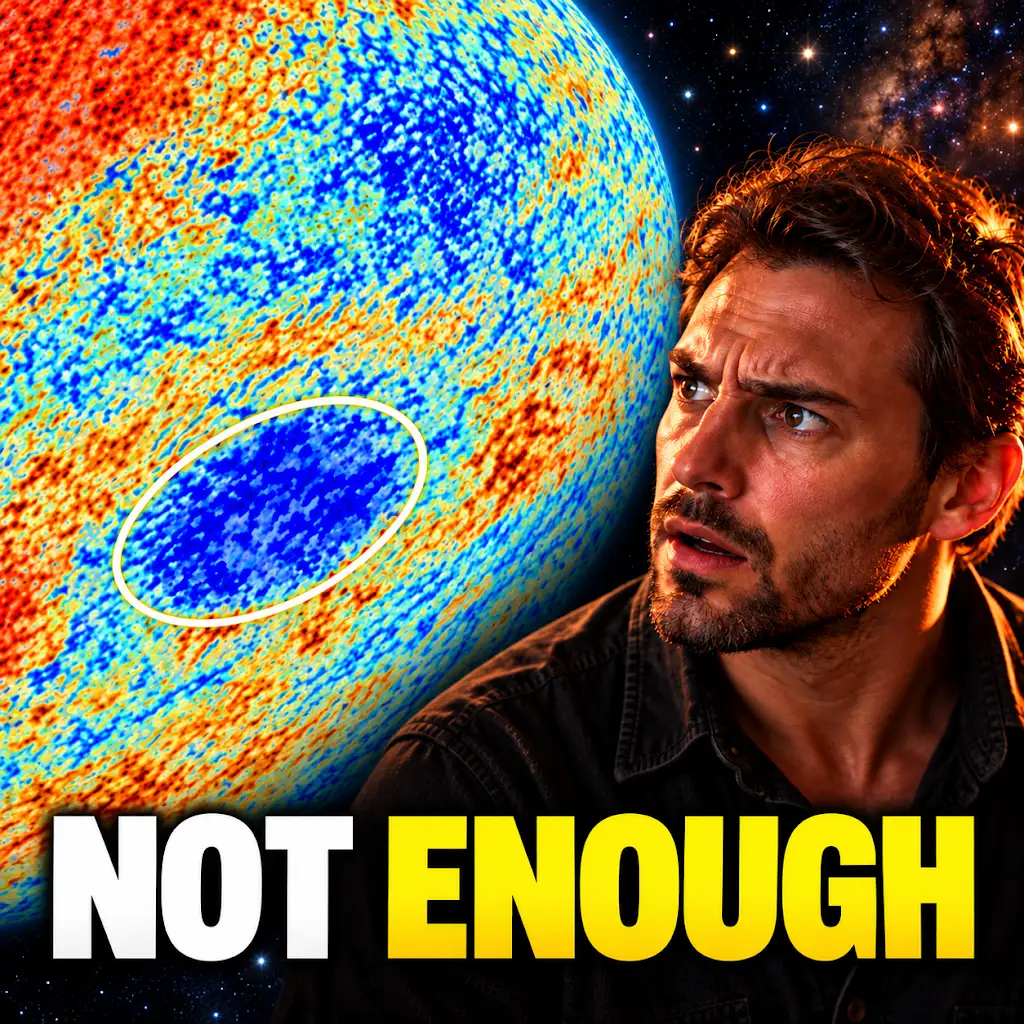
The Universe’s Cold Spot Has an Explanation. It’s Not Enough.
FAQs
1. What is the CMB cold spot?
The CMB cold spot refers to a region in the cosmic microwave background radiation that appears to be colder than its surroundings.
2. Why is the CMB cold spot significant?
The CMB cold spot is significant because it challenges the current understanding of the universe’s structure and may provide insights into the early universe and cosmic evolution.
3. How was the CMB cold spot discovered?
The CMB cold spot was discovered through observations made by the Wilkinson Microwave Anisotropy Probe (WMAP) satellite, which mapped the cosmic microwave background radiation in detail.
4. What are some proposed explanations for the CMB cold spot?
Some proposed explanations for the CMB cold spot include the presence of a supervoid (a vast region with fewer galaxies) or the effects of gravitational lensing by dark matter.
5. How does the existence of the CMB cold spot impact our understanding of the universe?
The existence of the CMB cold spot challenges current cosmological models and may lead to new discoveries about the large-scale structure of the universe, the nature of dark matter, and the origins of cosmic microwave background radiation.