The Curious Case of Hot Water Freezing Faster
It is a phenomenon that has baffled scientists and delighted curious minds for decades: the Mpemba effect. The seemingly counterintuitive observation that, under certain conditions, hot water can freeze faster than cold water. This paradox challenges our everyday understanding of thermodynamics, where we intuitively expect that an object at a lower temperature would require less time to reach its freezing point. While the effect is not universally observed and depends heavily on specific experimental parameters, its existence has been confirmed in numerous laboratory settings, sparking a continuous quest for a definitive explanation. This article delves into the fascinating world of the Mpemba effect, exploring its history, the proposed mechanisms, and the ongoing scientific debate surrounding this peculiar behavior of water.
In exploring the fascinating phenomenon of hot water freezing faster than cold water, often referred to as the Mpemba effect, you can find a wealth of information in related articles. One such resource is available at Freaky Science, which delves into various scientific experiments and theories that challenge our understanding of temperature and phase changes. This article provides insights into the conditions under which the Mpemba effect occurs and discusses the implications of this counterintuitive observation.
Unraveling the Origins of the Mpemba Effect
The Mpemba effect is named after Erasto Mpemba, a Tanzanian student who, in the 1960s, brought the phenomenon to the attention of physicists. While making ice cream, Mpemba noticed that his hot ice cream mixture froze faster than his classmates’ cold ones. He presented his observations to Dr. Denis Osborne, a physics teacher at Mkwawa Secondary School. Osborne, initially skeptical, decided to investigate further. His experiments, conducted with Mpemba, confirmed the observation under specific circumstances, and their findings were eventually published in the journal Nature in 1969.
Early Observations and Historical Context
Though Mpemba is credited with the modern popularization of the effect, the idea that hot water might freeze faster than cold has older roots. References can be found in the writings of Aristotle, who, in his Meteorologica, noted that “water that has been warmed freezes faster than that which has been warmed.” This suggests that the observation, while perhaps not scientifically scrutinized, was made by ancient philosophers as well. René Descartes also pondered this anomaly, and his notes contain similar observations. However, without the controlled experimental rigor of modern science, these early observations remained largely anecdotal. The persistence of this observation across different eras and cultures hints at a genuine physical phenomenon at play, awaiting a clear scientific understanding.
The Role of Erasto Mpemba and Dr. Osborne
The collaboration between Erasto Mpemba and Dr. Denis Osborne marked a pivotal moment in the scientific investigation of the Mpemba effect. Mpemba’s keen observational skills and persistence in bringing his observation to the attention of a physicist were crucial. Dr. Osborne’s willingness to explore what seemed like a contradiction to established scientific principles allowed for systematic investigation. Their joint efforts led to controlled experiments that provided quantitative data, moving the phenomenon from anecdotal observation to a subject of scientific inquiry. The initial publication in Nature brought the Mpemba effect to the forefront of scientific discussion, prompting further research and debate within the physics community.
Proposed Mechanisms Behind the Mpemba Effect
The lack of a single, universally accepted explanation for the Mpemba effect is what makes it such an enduring scientific puzzle. Over the years, numerous hypotheses have been proposed, each attempting to account for the accelerated freezing of hot water. These explanations often involve a combination of factors, and their relative importance can vary depending on the specific experimental setup and the properties of the water itself.
Evaporative Cooling: A Significant Contributor
One of the most widely discussed and plausible explanations for the Mpemba effect is evaporative cooling. When water is heated, its vapor pressure increases, leading to a higher rate of evaporation. Evaporation is an endothermic process, meaning it requires energy. This energy is drawn from the remaining liquid water, thus cooling it down. If the hot water container is open to the atmosphere, more rapid evaporation from the hotter water can lead to a faster overall decrease in its temperature compared to cold water, which evaporates at a slower rate. This pre-cooling through evaporation can give the hot water a head start in reaching the freezing point. The effect of evaporation is more pronounced when the surface area of the water is large and the surrounding air is dry.
Convection Currents and Heat Transfer
Another significant factor often cited is the role of convection currents. When water is heated, convection currents are established as warmer, less dense water rises and cooler, denser water sinks. In a container of cold water, these currents may be less vigorous or absent, leading to slower heat distribution and potentially stratification. In hot water, vigorous convection currents can efficiently transfer heat from the bulk of the liquid to the surface, where it can be lost to the surroundings through evaporation and convection. This enhanced heat transfer due to convection can accelerate the cooling process. Some researchers propose that the initial thermal gradients in hot water can drive stronger convective flows, leading to more efficient cooling.
In exploring the fascinating phenomenon of hot water freezing faster than cold water, often referred to as the Mpemba effect, you might find it interesting to read a related article that delves deeper into this intriguing subject. This article provides insights into the scientific principles behind the experiment and discusses various factors that can influence the results. For more information, you can check out the article here.
Dissolved Gases: The Impact of Air Content
The presence of dissolved gases in water can also influence its freezing behavior. When water is heated, dissolved gases, such as air, tend to become less soluble and are expelled from the liquid. Cold water typically holds more dissolved gases than hot water. The presence of dissolved gases can affect the freezing point of water and the way ice crystals form. Some theories suggest that water with fewer dissolved gases, like hot water that has undergone degassing, might freeze more readily. Dissolved gases can act as nucleation sites for ice crystal formation, and their absence in de-gassed hot water might alter the freezing kinetics.
Supercooling: A Complex Factor
Supercooling is the phenomenon where water remains in a liquid state below its freezing point (0°C or 32°F) without solidifying. The extent of supercooling can vary depending on impurities in the water and the cooling rate. It has been suggested that hot water might supercool less than cold water, meaning it reaches its actual freezing point and begins to form ice sooner. This could be due to differences in nucleation sites or the physical state of impurities at different temperatures. If hot water freezes at a temperature closer to 0°C while cold water supercools significantly below 0°C before freezing, then the hot water could appear to freeze faster.
Hydrogen Bonding and Water Structure
More complex explanations involve the intricate structure of water molecules and hydrogen bonding. Water molecules are constantly in motion, forming and breaking hydrogen bonds. Heating water can alter the arrangement and energy of these hydrogen bonds. Some theories propose that hot water, upon cooling, might reconfigure its hydrogen bond network in a way that facilitates faster ice nucleation and crystal growth
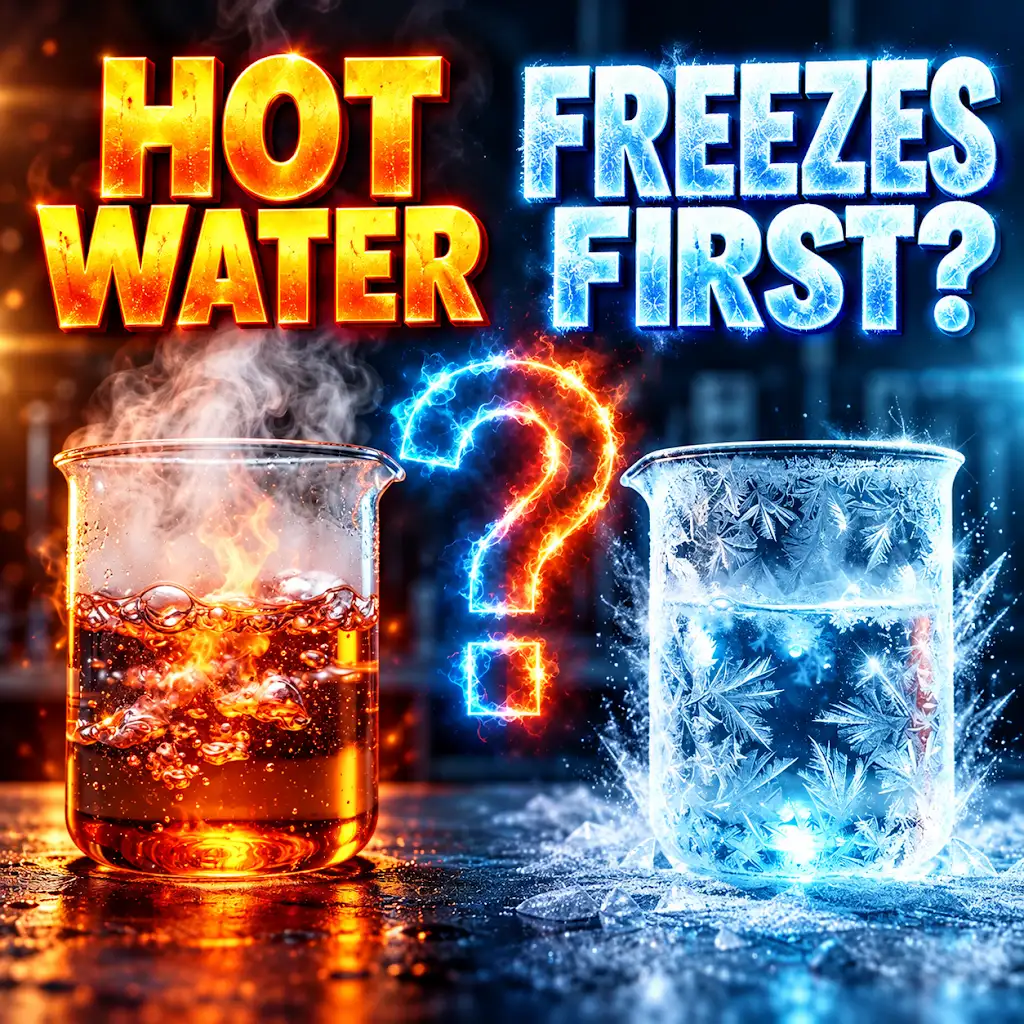
Why Hot Water Freezes Faster Than Cold (The Mpemba Effect)
FAQs
What materials are needed for a hot water freezing experiment?
For a hot water freezing experiment, you will need a pot to heat the water, water, a thermometer to measure the temperature, a container to pour the hot water into, and a cold environment such as a freezer or outside in cold weather.
Why does hot water freeze faster than cold water in some cases?
This phenomenon, known as the Mpemba effect, is still not fully understood by scientists. Some possible explanations include faster evaporation of hot water, differences in dissolved gases, and convection currents in the water.
What safety precautions should be taken when conducting a hot water freezing experiment?
When conducting a hot water freezing experiment, it is important to handle hot water with care to avoid burns. Use appropriate containers and tools to prevent accidents, and make sure to conduct the experiment in a safe environment away from flammable materials.
Can the hot water freezing experiment be replicated at home?
Yes, the hot water freezing experiment can be easily replicated at home using basic materials. However, it is important to follow safety guidelines and take necessary precautions when working with hot water and cold environments.
What are some variations of the hot water freezing experiment that can be tried?
Some variations of the hot water freezing experiment include adding different substances to the water, using different temperatures of hot water, or changing the environment in which the water is frozen. These variations can help explore different aspects of the freezing process.