
You probably have a microwave oven in your kitchen. It’s a convenient appliance, zapping your leftovers and popping your popcorn with impressive speed. But have you ever stopped to wonder how it actually works? It’s not magic, though it can certainly feel that way sometimes. Beneath the humming and the spinning plate lies a fascinating world of physics, a dance of electromagnetic waves that cook your food from the inside out. You might think you know all about it, but there are layers to microwave cooking that go deeper than simply pressing a button. This article will pull back the curtain, revealing the hidden physics that makes your microwave so effective. You’ll discover not just the ‘what’ but the ‘why’ behind this everyday marvel.
When you think of microwaves, you likely picture the appliance itself, its metallic interior, and the comforting beep it emits. But the real hero of the story is the electromagnetic wave, specifically microwaves. These aren’t sound waves, or heat waves in the traditional sense. They are part of the electromagnetic spectrum, a vast range of energy that includes visible light, radio waves, X-rays, and gamma rays. What makes microwaves special is their specific frequency and wavelength, which are perfectly tuned to interact with the molecules in your food.
What Are Electromagnetic Waves?
Imagine ripples on a pond, but instead of water, it’s an electric and magnetic field oscillating through space. That’s a simplified way to think about electromagnetic waves. They are produced by oscillating electric charges and propagate at the speed of light, carrying energy with them. The electromagnetic spectrum is organized by frequency – how many waves pass a point per second – and wavelength – the distance between two consecutive wave crests. Higher frequency means shorter wavelength and more energy. Visible light, for instance, has a specific range of frequencies that your eyes can detect. Radio waves have much lower frequencies and longer wavelengths, while X-rays and gamma rays have extremely high frequencies and very short wavelengths.
The Magic Frequency: 2.45 GHz
Your microwave oven operates at a specific frequency: 2.45 gigahertz (GHz). This translates to 2.45 billion cycles per second. Why this particular frequency? It’s not arbitrary. This frequency is highly effective at interacting with water molecules, which are abundant in most foods. Other frequencies might pass through food with little effect, or could be too energetic and cause undesirable side effects. The 2.45 GHz frequency strikes a delicate balance, allowing for efficient heating without causing radiation hazards.
How Microwaves Interact with Matter
The key to microwave cooking lies in how these waves interact with the molecules within your food. The primary target is water. Water molecules are polar, meaning they have a slightly positive charge on one end and a slightly negative charge on the other, like tiny magnets. When the oscillating electric field of the microwave encounters these polar molecules, it forces them to rotate, trying to align themselves with the changing field. This rapid rotation happens billions of times per second.
The Friction of Molecules: How Heat is Generated
Think about rubbing your hands together vigorously. You generate heat through friction. The same principle, on a molecular level, applies to microwave cooking. As the water molecules are forced to spin back and forth at an incredible rate, they collide with neighboring molecules. These collisions create friction, and this friction is what generates heat. This is why foods with high water content, like vegetables and cooked meats, heat up quickly in a microwave.
Beyond Water: Other Polar Molecules
While water is the primary player, other polar molecules in food, such as fats and sugars, also contribute to microwave heating. These molecules, though less abundant than water, also possess polarity and will rotate in response to the microwave’s electric field, generating additional heat through molecular friction. This is why fatty foods and sugary items can also heat up well, and sometimes even more intensely, in a microwave.
Microwaves are fascinating devices that utilize hidden physics principles to heat our food efficiently. For a deeper understanding of the science behind microwave technology, you can explore the article on Freaky Science, which delves into the electromagnetic waves and their interactions with molecules in food. This insightful piece provides a comprehensive overview of how microwaves work and the underlying physics that make them so effective. To read more, visit Freaky Science.
The Appliance Itself: The Anatomy of a Microwave Oven
Now that you understand the invisible force, let’s look at the appliance that harnesses it. Your microwave oven is a carefully engineered device designed to generate and direct these powerful microwaves safely and effectively. It’s not just a metal box; it’s a sophisticated piece of technology.
The Magnetron: The Heart of the Microwave
The most crucial component of any microwave oven is the magnetron. This is essentially a high-powered vacuum tube that generates the microwaves. Inside the magnetron, electrons are emitted and then made to travel in a circular path by strong magnets. This circular motion causes the electrons to oscillate at a specific frequency, which is then amplified and directed as microwaves. It’s a marvel of engineering that converts electrical energy into the precise electromagnetic radiation needed for cooking.
Waveguide: Directing the Energy
Once generated by the magnetron, the microwaves need to be channeled into the cooking cavity. This is the job of the waveguide. The waveguide is a hollow metal tube that acts like a pipe for the microwaves, guiding them from the magnetron to the turntable and the food. The dimensions of the waveguide are critical for efficient energy transfer. It’s designed to contain and direct the microwaves, preventing them from escaping and ensuring they reach the food.
The Cooking Cavity: A Faraday Cage
The interior of your microwave oven is essentially a Faraday cage. This is a metal enclosure designed to block external electromagnetic fields. The metal walls of the cavity reflect the microwaves, bouncing them around inside. This reflection ensures that the microwaves are distributed throughout the cavity, interacting with the food from multiple angles and preventing them from leaking out into your kitchen, which would be a safety hazard.
The Turntable: Ensuring Even Cooking
You’ve likely noticed the rotating turntable in your microwave. This isn’t just for show. Microwaves, like light, can create uneven heating patterns. There are areas within the cavity where the microwave energy is more intense (hot spots) and areas where it is less intense (cold spots). By rotating the food, the turntable ensures that all parts of it are exposed to both hot and cold spots, leading to more even cooking. Without it, you’d likely end up with food that’s overcooked in some places and barely warm in others.
The Door and Safety Interlocks: Protecting You
The door of your microwave is more than just an entrance to the cooking chamber. It’s equipped with a metal mesh screen that allows you to see inside but effectively blocks the microwaves from escaping. This mesh has holes that are much smaller than the wavelength of the microwaves, preventing them from passing through. Additionally, safety interlocks are built into the door mechanism. These switches ensure that the magnetron automatically shuts off the moment you open the door, preventing any accidental exposure to microwave radiation.
The Cooking Process: Heat Distribution and Penetration

The way microwaves heat food is fundamentally different from conventional cooking methods like baking or frying. This difference in heat generation and distribution is what gives the microwave its unique cooking characteristics.
Penetration Depth: Cooking from Within
Unlike conventional ovens that heat food from the outside in, microwaves penetrate the food and generate heat internally. The penetration depth varies depending on the food’s composition and the microwave frequency, but generally, microwaves can penetrate a few centimeters into most foods. This means that the outer layers and the inner parts of the food start heating up simultaneously, which is why cooking times are so significantly reduced.
Dielectric Heating: The Core Mechanism
The process of heating polar molecules through their interaction with an oscillating electric field is known as dielectric heating. This is the fundamental principle behind microwave cooking. As we discussed, the microwaves cause water, fat, and sugar molecules to rotate rapidly, generating heat through molecular friction. This internal generation of heat is what distinguishes microwave cooking.
Standing Waves and Hot Spots
While the turntable helps, it doesn’t completely eliminate the issue of uneven heating. Microwaves can interfere with each other inside the cavity, creating what are called “standing waves.” These are patterns of constructive and destructive interference that result in areas of high and low microwave intensity. These high-intensity areas are the “hot spots” where food cooks faster, and the low-intensity areas are the “cold spots.” Understanding this helps explain why stirring or rotating food midway through cooking is often recommended.
The Role of Water Content
As highlighted earlier, the amount of water in food is a crucial factor in how well it microwaves. Foods with high water content will absorb microwave energy much more efficiently and therefore cook faster. This is why a bowl of water will heat up much quicker than a dense, dry piece of bread. Conversely, foods with very low water content, like certain crackers or dry spices, will not heat up effectively in a microwave and might even become brittle.
Browning and Crisping: Limitations of Microwaves
One of the notable differences between microwave cooking and conventional cooking is the lack of browning and crisping. This is because the primary heating mechanism – dielectric heating – doesn’t reach the high temperatures required for the Maillard reaction (responsible for browning) or the dehydration needed for crisping. While some combination microwave ovens have added features like grills or convection elements to overcome this, a standard microwave will primarily cook and steam food, not create a crispy crust.
Beyond the Basics: Advanced Microwave Physics

While the core principles are straightforward, there are more nuanced aspects of microwave physics that contribute to the efficiency and effectiveness of your oven. Understanding these can help you use your microwave more wisely.
Permittivity and Permeability: Material Properties Matter
The way microwaves interact with food is also influenced by the food’s dielectric properties, specifically its permittivity and permeability. Permittivity describes how well a material can store electrical energy when exposed to an electric field, and permeability describes how well it can support the formation of a magnetic field. Different food components have different permittivities. For example, water has a high permittivity, which is why it heats so efficiently. Fats and sugars have lower permittivities. These properties dictate how much microwave energy is absorbed and how deeply it penetrates.
Attenuation: Energy Loss as it Travels
As microwaves travel through food, their energy is gradually absorbed and dissipated. This phenomenon is known as attenuation. The rate of attenuation depends on the material’s properties, particularly its dielectric loss tangent (a measure of how much energy is lost as heat). Materials with high dielectric loss tangent, like water, attenuate microwaves more strongly, meaning the microwaves don’t penetrate as deeply.
Microwave Susceptibility: Different Foods, Different Results
Not all foods are created equal when it comes to microwave cooking. You can think of this as “microwave susceptibility.” Foods that are highly susceptible, like vegetables and fruits (due to their high water content), will cook quickly. Foods that are less susceptible, like dense, dry baked goods, will take longer and may not heat evenly. Understanding this helps you adjust cooking times and methods for optimal results.
Resonance and Interference Patterns: A Deeper Look
The reflection of microwaves within the cavity can create complex interference patterns. At certain frequencies and cavity dimensions, you can get constructive interference, leading to intense heating in specific areas. Conversely, destructive interference can create cooler zones. While the turntable mitigates this, understanding these resonance phenomena is key to designing more efficient microwave ovens and cooking strategies. Some researchers are exploring ways to actively control these interference patterns to achieve more uniform heating.
The Effect of Frequency on Penetration
While 2.45 GHz is standard, it’s worth noting that different microwave frequencies have different penetration depths. Lower frequencies generally penetrate deeper into food. However, generating and containing lower frequency microwaves efficiently is more challenging and potentially less safe. The 2.45 GHz frequency represents a practical compromise between penetration, efficiency, and safety for consumer microwave ovens.
Understanding the hidden physics inside your microwave can enhance your appreciation for this common kitchen appliance. For a deeper exploration of the science behind microwaves and how they work, you might find this article on Freaky Science particularly enlightening. It delves into the principles of electromagnetic radiation and how they are harnessed to heat food efficiently, shedding light on the fascinating interactions that occur within your microwave.
Safety and You: Understanding the Physics of Protection
| Microwave Physics | Explanation |
|---|---|
| Microwave radiation | Generated by the magnetron and absorbed by water, fats, and sugars in food, causing them to vibrate and produce heat. |
| Microwave frequency | Typically operates at 2.45 gigahertz, which is the frequency at which water molecules absorb energy most efficiently. |
| Microwave cavity | Reflects and contains the microwave radiation, ensuring it is directed towards the food and not escaping into the environment. |
| Turntable | Rotates the food to ensure even exposure to the microwave radiation, preventing hot spots and cold spots in the food. |
You might have heard concerns about microwave radiation. The physics of microwave ovens, however, is designed with your safety as a paramount concern. The appliance is engineered to contain the radiation and shut it off when necessary.
The Faraday Cage Principle: Keeping Waves Inside
As mentioned earlier, the metal cavity of your microwave acts as a Faraday cage. This cage is highly effective at reflecting microwaves, preventing them from escaping. The metal reflects the electromagnetic waves, bouncing them back into the cooking chamber and keeping them contained within the appliance. This is a fundamental principle of electromagnetic shielding.
Door Seals and Mesh: The First Line of Defense
The door is a critical point for potential microwave leakage. The tight seals around the door are designed to prevent any gaps where microwaves could escape. The metal mesh embedded in the door’s window has holes that are significantly smaller than the wavelength of the microwaves. This means the microwaves are effectively blocked by the mesh, allowing you to see inside without letting the radiation out.
Safety Interlocks: Automatic Shutdowns
The multiple safety interlocks on the door are another crucial aspect of microwave safety. These are mechanical or electronic switches that detect whether the door is properly closed. If the door is opened, even slightly, these interlocks immediately cut power to the magnetron, stopping the production of microwaves. This prevents accidental exposure while the oven is operating.
Radiation Standards and Testing
Microwave ovens sold commercially must meet strict safety standards set by regulatory bodies. These standards specify the maximum allowable leakage of microwave radiation. Regular testing is conducted to ensure that ovens comply with these regulations. The industry has a strong track record of safety due to these rigorous standards and testing procedures.
Understanding Leakage Levels
While the goal is zero leakage, in reality, there can be extremely low levels of leakage from a microwave oven, especially if it’s damaged. However, these levels are so minuscule that they pose no significant health risk. The energy from these very low levels of microwaves is insufficient to cause the molecular heating that occurs within the oven, and the human body can easily dissipate such minimal energy. It’s important to maintain your microwave oven in good condition and replace it if the door or seals are damaged.
Conclusion: The Science Behind Your Speedy Meals
You’ve now journeyed through the hidden physics of your microwave oven, from the invisible dance of electromagnetic waves to the intricate engineering that makes it all possible. You’ve learned that it’s not magic but a clever application of physics principles, primarily dielectric heating, to efficiently cook your food. You understand the role of the magnetron, the waveguide, and the Faraday cage. You appreciate why the turntable is essential and how water content influences cooking speed.
The next time you reach for that popcorn bag or reheat your dinner, you’ll have a deeper appreciation for the scientific marvel humming away in your kitchen. You’ll know that the speed and convenience are a direct result of understanding and harnessing the power of microwaves, a testament to human ingenuity and the fascinating world of physics that surrounds us, even in the most mundane appliances. The hidden physics of microwave cooking is a story of molecular motion, electromagnetic forces, and clever engineering, all working together to bring warmth and nourishment to your table.
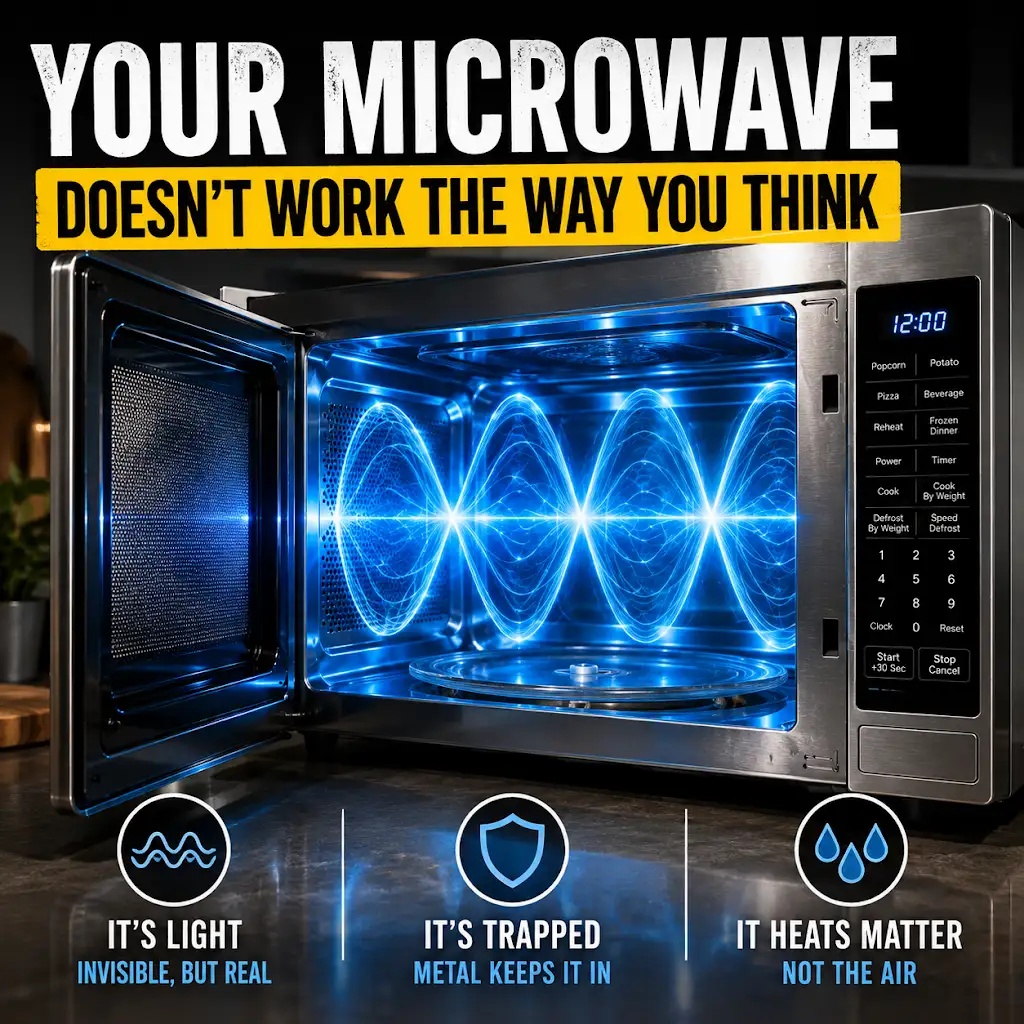
Your Microwave Doesn’t Work the Way You Think
FAQs
What is the hidden physics inside a microwave?
Microwaves use electromagnetic radiation to heat and cook food. The microwaves cause water molecules in the food to vibrate, creating friction and generating heat.
How does a microwave oven work?
Microwave ovens use a magnetron to generate microwaves, which are then directed into the cooking chamber. The microwaves bounce around inside the oven and are absorbed by the food, causing the molecules to vibrate and generate heat.
Is it safe to use a microwave oven?
When used according to the manufacturer’s instructions, microwave ovens are safe to use. The design of the oven and the regulations in place ensure that the microwaves are contained within the cooking chamber and do not pose a risk to the user.
What types of materials can be used in a microwave oven?
Microwaves can pass through glass, paper, plastic, and ceramic materials. However, metal and aluminum foil should not be used in a microwave oven, as they can cause sparks and potentially damage the oven.
How does a microwave oven differ from a conventional oven?
A conventional oven uses convection and conduction to cook food, while a microwave oven uses radiation. This fundamental difference in heating methods results in different cooking times and outcomes for various types of food.