
The enigmatic realm of quantum computing hinges on a fundamental unit known as the qubit. Unlike the classical bit, which can represent either a 0 or a 1, the qubit possesses the extraordinary ability to exist in a superposition of both states simultaneously. This peculiar characteristic, often described as being “both yes and no at the same time,” forms the bedrock upon which quantum computation’s potential power is built. Understanding this concept is crucial to grasping how quantum computers aim to tackle problems beyond the reach of even the most powerful supercomputers.
To appreciate the quantum leap, it is beneficial to first examine the familiar territory of classical computing.
Binary Representation
Classical computers operate on binary logic. Every piece of information, whether it is a letter, a number, or an instruction, is ultimately represented by a sequence of bits. Each bit is a physical entity that can exist in one of two distinct states: 0 or 1. Think of a light switch: it is either on or off.
Information Processing
The processing of information in classical computers involves manipulating these bits through logical operations. Gates like AND, OR, and NOT act upon these binary values to perform calculations and execute programs. The determinist nature of these operations means that given a specific input, the output is always predictable.
Limitations of Classical Computing
While classical computers have revolutionized our world, they encounter significant limitations when faced with problems of immense complexity. These often involve a combinatorial explosion, where the number of possible solutions grows exponentially with the size of the problem. Simulating complex molecular interactions, factoring very large numbers, or optimizing highly intricate systems can quickly overwhelm classical computational capabilities.
Quantum computing is a fascinating field that explores the potential of qubits, which can exist in multiple states simultaneously, leading to unprecedented computational power. A related article that delves into the complexities and implications of qubits is available at Freaky Science. This resource provides insights into the dual nature of qubits, illustrating how they can represent both yes and no at the same time, a concept that challenges traditional binary computing and opens up new possibilities for technology and problem-solving.
Introducing the Qubit: The Quantum Anomaly
The qubit introduces a radical departure from the binary simplicity of classical bits, unlocking new possibilities for computation.
Superposition: The Simultaneous State
The defining feature of a qubit is its capacity for superposition. Instead of being strictly 0 or 1, a qubit can exist in a combination of both states. Imagine a spinning coin before it lands: it is neither heads nor tails, but rather a blend of both possibilities. Mathematically, a qubit’s state can be represented as a linear combination of the |0⟩ and |1⟩ states, denoted as α|0⟩ + β|1⟩, where α and β are complex numbers representing the probability amplitudes of the qubit being in the |0⟩ or |1⟩ state, respectively. The square of these amplitudes (|α|² and |β|²) sum to 1, indicating the total probability of finding the qubit in either state upon measurement.
Analogy of the Spinning Coin
The spinning coin analogy, while helpful for conceptualizing superposition, has its limitations. Unlike a classical coin, which has a definite state even if unknown to us, a qubit in superposition truly exists in a probabilistic blend of states until measured. This probabilistic nature is not a lack of knowledge but an intrinsic property of the quantum system.
Contrast with Classical Bits
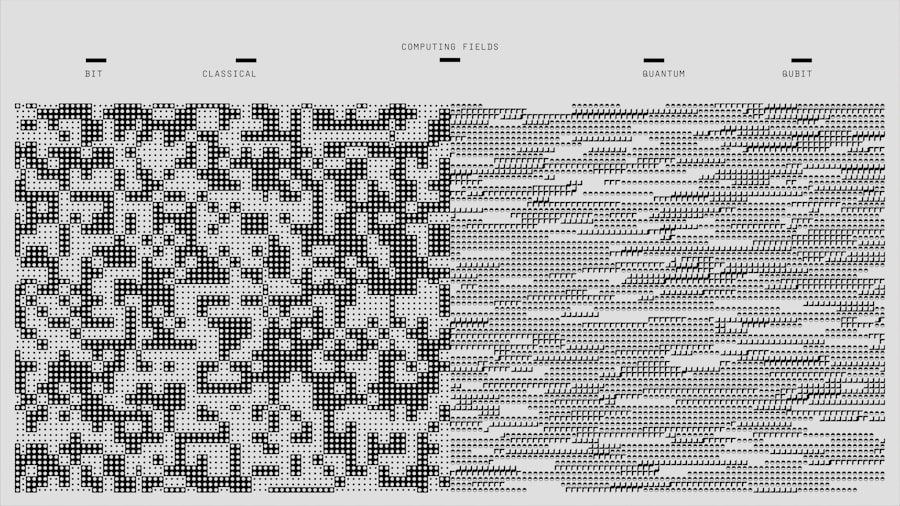
The contrast with classical bits is stark. A classical bit representing “yes” or “no” is unambiguously one or the other. A qubit representing “yes” AND “no” simultaneously offers a fundamentally different approach to information. This ability to hold multiple possibilities at once allows for a vastly increased information density and computational parallelism.
Measurement: Collapsing the Quantum State
The act of measuring a qubit fundamentally changes its state, collapsing the superposition into a definitive classical outcome.
The Measurement Problem
When a qubit in superposition is measured, it is forced to “choose” one of its constituent states, either |0⟩ or |1⟩. The probability of collapsing into each state is determined by the amplitudes α and β. This process is irreversible and leads to the loss of the superimposed information. The very act of observation alters the observed reality in the quantum world.
Probabilistic Outcomes
The outcome of a measurement on a qubit in superposition is inherently probabilistic. It is not possible to predict with certainty which state the qubit will collapse into. However, over many measurements of identical qubit states, the distribution of outcomes will consistently reflect the probability amplitudes. This predictability of statistical averages is key to harnessing quantum computation.
Implications for Computation
The collapse of superposition upon measurement presents a significant challenge for designing quantum algorithms. Algorithms must be carefully constructed to perform computations while the qubits remain in superposition, only collapsing them at the very end to extract the desired result. This interplay between maintaining superposition and controlled collapse is a central theme in quantum algorithm design.
Entanglement: The Spooky Connection
Entanglement is another profoundly counterintuitive quantum phenomenon that, alongside superposition, underpins the power of quantum computation.
Intertwined Fates
Entanglement describes a correlation between two or more qubits where their fates are intertwined, regardless of the physical distance separating them. If two qubits are entangled, measuring the state of one instantaneously influences the state of the other, even if they are light-years apart. This phenomenon famously troubled Albert Einstein, who described it as “spooky action at a distance.”
Bell Pairs and Beyond
A common example of entanglement is known as a Bell pair, where two qubits are created in a state such that if one is measured as |0⟩, the other is instantaneously found to be |0⟩, and if one is |1⟩, the other is |1⟩. This correlation is stronger than any classical correlation could achieve. More complex entangled states can involve multiple qubits, creating intricate webs of interconnected quantum information.
Resource for Quantum Algorithms
Entanglement is not merely a curiosity; it serves as a vital computational resource. It allows for the creation of complex correlations that are essential for powerful quantum algorithms like Shor’s algorithm for factoring and Grover’s algorithm for searching. The ability to manipulate and leverage these entangled states is a hallmark of quantum computation.
Quantum computers rely on qubits, which can exist in multiple states simultaneously, leading to the intriguing concept of being both yes and no at the same time. This unique property allows quantum computers to perform complex calculations much faster than classical computers. For a deeper understanding of how qubits function and their implications for the future of computing, you can read more in this insightful article on the topic. Check it out here.
Harnessing Qubit Properties for Computation
| Qubit State | Probability |
|---|---|
| Yes | 50% |
| No | 50% |
The unique properties of qubits enable quantum computers to perform computations in ways unimaginable for classical machines.
Quantum Parallelism
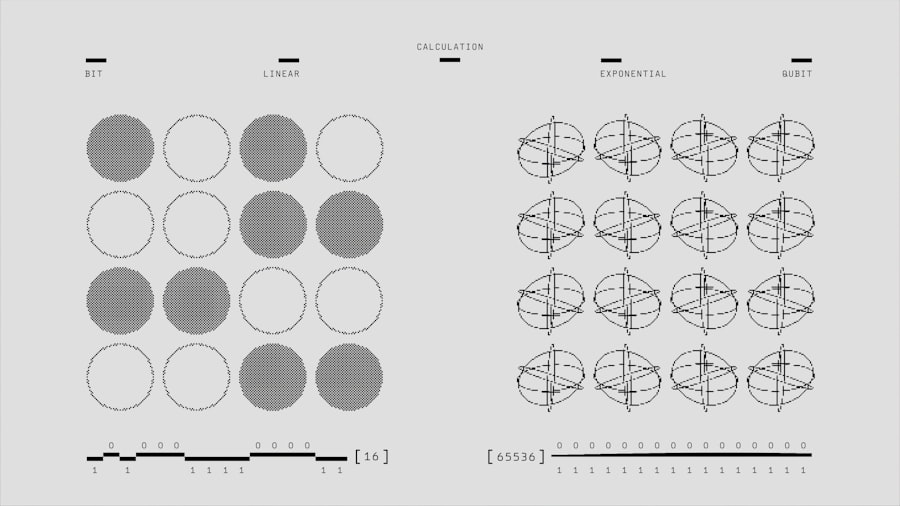
Superposition allows a quantum computer to explore a vast number of possibilities simultaneously. A quantum register of n qubits can represent 2^n states at once. This exponential increase in representational capacity means that a quantum algorithm can, in principle, test all these 2^n possibilities concurrently, offering a form of “quantum parallelism.”
Quantum Algorithms
Specialized quantum algorithms have been developed to exploit superposition and entanglement for problem-solving. Algorithms like Shor’s algorithm can factor large numbers exponentially faster than the best-known classical algorithms, posing a threat to current encryption methods. Grover’s algorithm can speed up unstructured database searches quadratically.
Challenges in Quantum Computing
Despite the immense potential, building and controlling quantum computers remains a significant engineering and scientific challenge. Maintaining the fragile quantum states of qubits requires extremely low temperatures and isolation from environmental noise. Errors are also a common issue, necessitating the development of robust quantum error correction techniques.
Qubit Architectures
Currently, several different physical implementations of qubits are being explored, including superconducting circuits, trapped ions, photonic systems, and topological qubits. Each architecture has its own advantages and disadvantages in terms of scalability, stability, and gate fidelity. The ongoing research and development in these areas are crucial for the future of quantum computing.
The journey from classical bits to qubits represents a paradigm shift in computation. The ability of qubits to exist in simultaneous states of both “yes” and “no” through superposition, coupled with the profound interconnectedness of entanglement, unlocks a realm of computational possibilities that could revolutionize fields ranging from medicine and materials science to artificial intelligence and cryptography. While significant hurdles remain in perfecting these quantum machines, the fundamental principles of qubits offer a tantalizing glimpse into a future where previously intractable problems can be addressed with unprecedented speed and efficiency.
FAQs
What is a qubit in quantum computing?
A qubit is the basic unit of quantum information in quantum computing. It is the quantum equivalent of a classical bit, and can exist in multiple states simultaneously due to the principles of superposition and entanglement.
How can a qubit be both yes and no at the same time?
In quantum computing, a qubit can exist in a state of superposition, meaning it can be in multiple states at once. This allows it to represent both 0 and 1 simultaneously, enabling quantum computers to perform certain calculations much faster than classical computers.
What is the significance of qubits being in a state of superposition?
The ability of qubits to exist in a state of superposition allows quantum computers to process and analyze large amounts of data in parallel, leading to the potential for significant advancements in fields such as cryptography, drug discovery, and optimization problems.
Are qubits the only components of a quantum computer?
No, in addition to qubits, quantum computers also require other components such as quantum gates, quantum circuits, and quantum algorithms to perform computations and solve problems using the principles of quantum mechanics.
What are the current challenges in developing practical quantum computers using qubits?
Some of the challenges in developing practical quantum computers using qubits include maintaining qubits in a stable state, minimizing errors caused by decoherence, and scaling up the number of qubits while maintaining their coherence and connectivity.