
The vast expanse of space, a canvas of cosmic wonders, is also a realm of subtle yet potent dangers. For the sophisticated instruments that serve as humanity’s eyes and ears beyond Earth’s protective atmosphere – our satellites – these dangers manifest not as meteoroid impacts, though those are a concern, but as invisible streams of energetic particles. These particles, emanating from solar flares, coronal mass ejections, and the deeper reaches of the galaxy, can wreak havoc on the delicate electronics that form the very heart of these orbiting sentinels. This article explores the critical role of radiation-hardened electronics in safeguarding these invaluable space assets, ensuring their longevity and operational integrity.
Satellites, by their very nature, operate beyond the shielding of Earth’s magnetosphere and atmosphere. This leaves them exposed to a constant barrage of ionizing radiation. Understanding the sources and characteristics of this radiation is paramount to developing effective protection strategies.
Solar Particle Events (SPEs)
The Sun, a magnificent fusion reactor, is also a capricious source of energetic particles. Solar flares, sudden bursts of electromagnetic radiation, are often accompanied by the ejection of large numbers of high-energy protons. Coronal Mass Ejections (CMEs), on the other hand, are massive expulsions of plasma and magnetic field from the Sun’s corona, carrying with them a significant flux of energetic particles that can travel across interplanetary space. These events, while spectacular from afar, represent significant threats to spacecraft electronics. Imagine a constant, invisible hailstorm, but instead of ice, it’s charged particles traveling at near-light speeds.
Galactic Cosmic Rays (GCRs)
Beyond our solar system, the universe is permeated by a flux of GCRs. These are extremely high-energy particles, primarily atomic nuclei, originating from supernova remnants and other energetic astrophysical phenomena. GCRs are more energetic and penetrate deeper than solar particles, posing a pervasive and constant threat to satellite components. They are the persistent, low-level background radiation that all space-faring electronics must contend with.
The Van Allen Radiation Belts
Orbiting Earth are two donut-shaped regions of energetic charged particles trapped by the planet’s magnetic field. These are the Van Allen belts. The inner belt is populated primarily by high-energy electrons and protons, while the outer belt contains a higher concentration of electrons. Satellites passing through or operating within these belts are subjected to intense radiation fields that can degrade electronic components over time. Think of these belts as invisible, charged asteroid fields that spacecraft must navigate.
Radiation-hardened electronics are essential for the reliable operation of satellites in the harsh environment of space, where they are exposed to high levels of radiation. These specialized components are designed to withstand the damaging effects of radiation, ensuring that satellites can perform their functions without failure. For more information on this topic, you can read a related article that discusses the advancements in radiation-hardened technologies and their applications in satellite systems. Check it out here: Freaky Science Article.
The Impact of Radiation on Electronics: A Silent Degradation
The seemingly innocuous streams of particles in space can have profound and debilitating effects on standard electronic components. These effects are not typically immediate failures, but rather a gradual degradation that can lead to malfunctions and eventual operational cessation.
Single Event Effects (SEEs)
When a single energetic particle strikes a sensitive region of an electronic device, it can deposit enough charge to cause a transient or permanent malfunction. These are known as Single Event Effects (SEEs). SEEs are broadly categorized into destructive and non-destructive events.
Non-Destructive SEEs
- Single Event Upset (SEU): This is perhaps the most common SEE. An SEU occurs when a particle causes a temporary change in the state of a memory bit, flipping a ‘0’ to a ‘1’ or vice versa. While not damaging, it can lead to data corruption or incorrect operation, requiring a reset or re-initialization of the affected component. An analogy would be a light switch flickering momentarily, causing a brief interruption in the steady glow.
- Single Event Transient (SET): Similar to an SEU, an SET is a temporary voltage or current fluctuation in a circuit. These transients can propagate through the logic of a device and cause errors in calculations or signal processing. It’s like a brief hiccup in a spoken sentence, momentarily distorting the message.
Destructive SEEs
- Single Event Latch-up (SEL): This is a more serious phenomenon where a particle strike can trigger a parasitic bipolar transistor within a CMOS integrated circuit, creating a low-impedance path between the power supply and ground. This can lead to excessive current draw, potentially causing permanent damage to the device if not quickly detected and mitigated by power cycling. An SEL is akin to a short circuit occurring inside the component, leading to an uncontrolled surge of power.
- Single Event Burnout (SEB) and Single Event Gate Rupture (SEGR): These are destructive events that primarily affect power transistors. SEB involves the thermal destruction of the device due to localized high current density, while SEGR is a breakdown of the insulator layer in a transistor. These are akin to a fuse blowing, but on a microscopic and often irreparable scale.
Total Ionizing Dose (TID) Effects
Over extended periods of exposure to radiation, the cumulative ionization within semiconductor materials can lead to significant performance degradation. This is known as Total Ionizing Dose (TID).
Threshold Voltage Shifts
Ionization in the gate oxide of transistors can create trapped charges. These trapped charges alter the electric field across the oxide, leading to a shift in the transistor’s threshold voltage – the voltage required to turn it on. This can make transistors harder to switch, slower, or even inoperable. Imagine a door that gradually becomes stiffer and harder to open with repeated use and exposure to the elements.
Increased Leakage Currents
TID effects can also lead to an increase in leakage currents between different parts of a transistor. These leakage currents can consume power, generate heat, and interfere with the intended operation of the circuit, further degrading performance. It’s like a faucet that develops a slow, steady drip even when fully closed, wasting resources.
Radiation Hardened Electronics: Fortifying the Digital Fortress
To counter the pervasive threat of space radiation, specialized electronic components and design methodologies are employed. These “radiation-hardened” or “rad-hard” electronics are designed to withstand the harsh space environment and maintain their functionality for the intended lifespan of a satellite.
Material Science and Fabrication Techniques
The very construction of radiation-hardened components is a key to their resilience.
Silicon-on-Insulator (SOI) Technology
SOI technology is a cornerstone of modern rad-hard electronics. Instead of using bulk silicon, SOI devices utilize a thin layer of silicon bonded to an insulating material, typically silicon dioxide. This insulating layer acts as a barrier, significantly reducing the volume of silicon that can act as a charge collection site for incoming particles.
Reduced Parasitic Capacitance
The insulating substrate in SOI devices leads to lower parasitic capacitances. This can result in faster switching speeds and reduced power consumption, both desirable attributes for space applications.
Improved Charge Isolation
The insulating layer effectively isolates individual transistors from each other. This dramatically reduces the likelihood of charge diffusion from one device to another, thereby mitigating the impact of SEEs like SELs. It’s like having individual strongholds on an island, where an attack on one doesn’t easily spread to its neighbors.
Dielectric Isolation
Similar to SOI, dielectric isolation involves surrounding individual transistors with insulating materials. This further enhances charge isolation and reduces parasitic effects.
Trench Isolation
Trench isolation involves etching trenches into the silicon substrate and filling them with an insulating material like silicon dioxide. This technique helps to prevent latch-up and reduces leakage currents between adjacent transistors.
Circuit Design and Architecture
Beyond the materials, the way electronic circuits are designed plays a crucial role in their radiation resilience.
Redundancy
A fundamental principle in aerospace engineering, redundancy involves duplicating critical components or systems.
Triple Modular Redundancy (TMR)
In TMR, three identical modules perform the same function. Their outputs are then compared by a “majority vote” circuit. If one module produces an erroneous output due to a radiation event, the other two will outvote it, ensuring the system continues to function correctly. This is akin to having three identical navigators on a ship, where if one gives a wrong heading, the majority will correct the course.
Active/Standby Redundancy
Here, a primary component operates normally, while a backup component remains in standby. If the primary component fails, the backup is activated. This approach is simpler than TMR but requires a mechanism to detect the failure and switch over.
Error Detection and Correction (EDAC) Codes
EDAC codes are implemented in memory and data transmission systems to detect and correct errors introduced by radiation.
Hamming Codes
Hamming codes are a class of linear error-correcting codes that can detect up to two-bit errors and correct single-bit errors. By adding redundant bits to data, they provide a robust mechanism for data integrity.
Reed-Solomon Codes
More powerful than Hamming codes, Reed-Solomon codes can correct multiple-bit errors and are often used in applications where data corruption is a significant concern.
Robust Circuit Topologies
Certain circuit designs are inherently more resistant to radiation. For instance, using less sensitive transistor types and designing circuits with wider noise margins can improve their resilience. Analog circuits can incorporate techniques like input clamping and filtering to suppress transient effects.
Testing and Qualification: Ensuring Space-Readiness
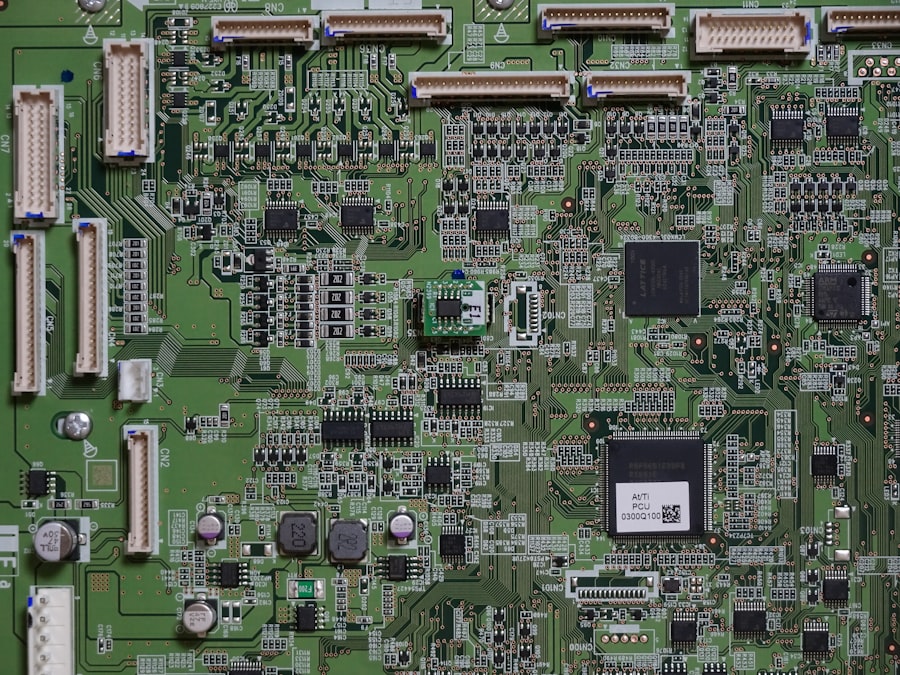
Before any electronic component can be launched into space, it must undergo rigorous testing to verify its radiation tolerance. This process is known as qualification.
Radiation Testing Facilities
Specialized facilities are equipped with particle accelerators and radiation sources to expose electronic components to controlled doses of ionizing radiation.
Proton and Ion Beam Irradiation
Components are subjected to beams of protons and heavy ions that simulate the energies and types of particles found in space. The dose rate and total dose are carefully controlled to mimic expected exposure levels.
Gamma Ray Irradiation
While simulating protons and ions, gamma ray irradiation is also used to assess TID effects due to its high penetration capabilities.
Environmental Testing
In addition to radiation testing, components undergo a suite of environmental tests that replicate the stresses of launch and operation in space.
Thermal Vacuum Testing
This simulates the extreme temperature fluctuations and vacuum conditions of space.
Vibration and Shock Testing
These tests ensure components can withstand the intense vibrations and shocks experienced during launch.
Electromagnetic Compatibility (EMC) Testing
This verifies that components do not interfere with other electronic systems on the satellite.
Radiation hardened electronics are crucial for the functionality and longevity of satellites operating in harsh space environments. These specialized components are designed to withstand the damaging effects of cosmic radiation, ensuring that satellites can continue to perform their missions without failure. For those interested in exploring this topic further, a related article can be found at Freaky Science, which delves into the advancements in technology that enhance the resilience of satellite systems against radiation. Understanding these innovations is essential for anyone involved in aerospace engineering or satellite design.
The Future of Radiation Hardened Electronics: Smaller, Faster, Smarter
| Metric | Description | Typical Value / Range | Unit |
|---|---|---|---|
| Total Ionizing Dose (TID) Tolerance | Maximum cumulative radiation dose the electronics can withstand | 10 – 100 krad(Si) | krad(Si) |
| Single Event Upset (SEU) Rate | Frequency of bit flips caused by single energetic particles | 10^-6 to 10^-9 errors/bit/day | errors/bit/day |
| Latchup Immunity | Resistance to destructive latchup events caused by radiation | Up to 100 MeV·cm²/mg | MeV·cm²/mg |
| Operating Temperature Range | Temperature range for reliable operation in space | -55 to +125 | °C |
| Neutron Fluence Tolerance | Maximum neutron exposure without performance degradation | 10^12 – 10^14 | n/cm² |
| Power Consumption | Typical power usage of radiation-hardened components | 10 – 500 | mW |
| Mean Time Between Failures (MTBF) | Expected operational lifetime without failure | 10^5 – 10^7 | hours |
The ongoing miniaturization of electronic components, driven by advancements in semiconductor technology, presents a double-edged sword for space applications. While smaller devices offer advantages in terms of size, weight, and power (SWaP), they also become inherently more susceptible to radiation. The pursuit of radiation hardening must therefore keep pace with these miniaturization trends.
Advanced Lithography and Materials
Researchers are exploring new materials and fabrication techniques to create even more radiation-tolerant devices at advanced technology nodes. This includes investigating novel semiconductor materials and developing refined isolation techniques.
On-Chip Radiation Detection and Mitigation
Future rad-hard electronics may incorporate on-chip sensors that can detect incoming radiation particles and trigger localized mitigation strategies in real-time. This could involve dynamically adjusting operating parameters or activating localized shielding.
Software-Defined Mitigation
As software capabilities increase, it is likely that more sophisticated radiation mitigation strategies will be implemented in software. This could involve advanced error detection and correction algorithms that are more adaptive to the specific radiation environment.
Conclusion
The journey of a satellite from conception to orbit is a testament to human ingenuity. Yet, this journey is fraught with peril from an unseen adversary: space radiation. Radiation-hardened electronics act as the armor for our digital probes, enabling them to withstand this gauntlet and continue their vital missions. From the fundamental physics of particle interactions to the intricate design of resilient circuits and the rigorous demands of qualification, the field of radiation-hardened electronics is a critical, often unsung, hero in our exploration and utilization of space. As we push the boundaries of space exploration further, the development of ever more robust and intelligent radiation-hardened electronics will remain an indispensable element of our cosmic endeavors.
SHOCKING: The Deep-Core “Blobs” Are Hacking Reality
FAQs
What are radiation hardened electronics used in satellites?
Radiation hardened electronics are specially designed components that can withstand the harsh radiation environment of space. They are used in satellites to ensure reliable operation despite exposure to cosmic rays, solar flares, and other forms of ionizing radiation.
Why is radiation hardening important for satellite electronics?
Radiation hardening is crucial because space radiation can cause malfunctions, data corruption, or permanent damage to electronic circuits. Hardening helps maintain satellite functionality, prolongs mission life, and prevents costly failures.
How are electronics radiation hardened for satellite applications?
Electronics are radiation hardened through various methods including using radiation-tolerant materials, shielding, specialized circuit design techniques, error correction codes, and manufacturing processes that reduce susceptibility to radiation-induced effects.
What types of radiation affect satellite electronics?
Satellite electronics are primarily affected by high-energy particles such as protons, electrons, and heavy ions from solar wind, cosmic rays, and trapped radiation belts around Earth. These particles can cause single-event upsets, latch-ups, and cumulative damage.
Are radiation hardened electronics more expensive than standard electronics?
Yes, radiation hardened electronics typically cost more due to specialized design, testing, and manufacturing processes. However, the increased reliability and mission assurance they provide justify the higher expense for space applications.