
The universe, a vast cosmic laboratory, constantly bombards Earth with an invisible tempest: high-energy cosmic rays. These particles, originating from beyond our solar system, possess energies far exceeding anything achievable in terrestrial accelerators. Studying these celestial visitors offers a unique window into fundamental physics, extreme astrophysical processes, and the very fabric of the cosmos. Rather than requiring colossal human-made machines, nature performs its most energetic experiments on a grand scale, and we, as observers, are the fortunate recipients of its profound insights.
What Exactly Are Cosmic Rays?
Cosmic rays are not rays in the conventional sense, like beams of light or radio waves. Instead, they are charged subatomic particles – primarily protons and atomic nuclei – that have been accelerated to incredibly high energies. Imagine a single grain of sand, but imbued with the kinetic energy of a speeding bullet, or even that of a thrown baseball whizzing past at near the speed of light. That’s the scale of energy we’re talking about. These particles travel through the vacuum of space, often traversing unfathomable distances before reaching Earth’s atmosphere. Their journey can span millions of light-years, making them messengers from the most distant and violent corners of the universe.
Origins: A Cosmic Forge
Determining the precise origin of these energetic particles is one of the ongoing challenges in astrophysics. While lower-energy cosmic rays are generally understood to be produced by phenomena like supernovae – the explosive deaths of massive stars – the sources of the ultra-high-energy cosmic rays (UHECRs) remain more enigmatic. These extreme energies suggest the involvement of even more powerful cosmic accelerators. Possibilities include:
Supernovae and Their Remnants
The shock waves generated by supernovae are like cosmic particle accelerators, capable of boosting charged particles to energies up to $10^{15}$ electronvolts (eV). The expanding shells of debris from these explosions, known as supernova remnants, can contain strong magnetic fields that further accelerate particles through complex acceleration mechanisms. These remnants act as cosmic battlegrounds where particles are repeatedly slammed and accelerated.
Active Galactic Nuclei (AGN)
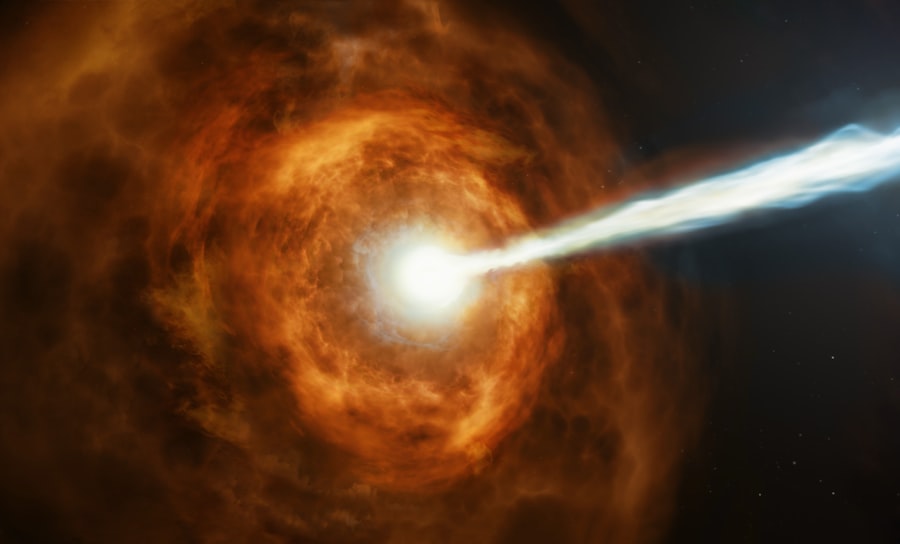
These are the luminous, energetic centers of some galaxies, powered by supermassive black holes actively accreting matter. As matter spirals into the black hole, it forms an accretion disk and can launch powerful jets of plasma that shoot outwards at relativistic speeds. These jets are thought to be potent sites for particle acceleration, potentially reaching energies of $10^{18}$ eV and beyond. The churning accretion disks and the powerful magnetic fields within these jets are like cosmic centrifuges, capable of spinning particles to extreme velocities.
Pulsars and Magnetars
Neutron stars, the incredibly dense remnants of collapsed stars, can possess immensely strong magnetic fields. Pulsars are rapidly rotating neutron stars that emit beams of radiation, while magnetars are an even more extreme class with magnetic fields a quadrillion times stronger than Earth’s. These magnetic behemoths are suspected to be capable of generating UHECRs through processes involving magnetic reconnection events, where magnetic field lines snap and release enormous amounts of energy.
The Mysterious Ultra-High-Energy Cosmic Ray Sources
For the most energetic cosmic rays, exceeding $10^{18}$ eV, the typical astrophysical accelerators like supernovae become less likely candidates. The “GZK cutoff” (named after the physicists Kenneth Greisen, Bruno Rossi, and Luis Alvarez, and independently formulated by Georgi Zatsepin and Vadim Kuzmin) predicts that protons traveling cosmological distances will interact with the cosmic microwave background radiation, losing energy and thus limiting the observable energy of primary cosmic rays from very distant sources to around $5 \times 10^{10}$ eV. Therefore, observing cosmic rays with energies above this limit strongly suggests that their sources must be relatively nearby, within a few hundred million light-years, or that they are not protons but heavier nuclei, which are less susceptible to energy loss via GZK interactions. This GZK cutoff acts as a cosmic speed limit, and particles that manage to break through it are particularly noteworthy.
Recent advancements in our understanding of high-energy cosmic rays have been highlighted in a related article that explores the implications of these experiments for astrophysics and particle physics. The article delves into the origins of cosmic rays and their potential to unlock secrets about the universe’s most energetic phenomena. For more insights on this fascinating topic, you can read the full article here: Freaky Science.
Earth’s Cosmic Ray Detectors: The Atmosphere and Beyond
The Atmospheric Cascade
Upon entering Earth’s atmosphere, these high-energy cosmic rays engage in a dramatic series of collisions. Imagine a single falling domino triggering a chain reaction that knocks over millions more. The primary cosmic ray particle slams into an atom in the upper atmosphere – typically nitrogen or oxygen – with immense force. This collision is not just a simple hit; it’s an energetic fragmentation.
The Birth of an Air Shower
The impact generates a shower of secondary particles: pions, kaons, muons, electrons, positrons, and photons. These secondary particles, in turn, collide with other atmospheric constituents, creating an ever-expanding cascade known as an extensive air shower (EAS). This shower spreads out laterally as it descends, resembling a ripple emanating from a stone dropped in a pond. The vast majority of these secondary particles are short-lived, decaying rapidly into even more particles.
Muons: The Persistent Travelers
Among the particles produced, muons are particularly interesting. Due to their relatively long lifespan (at relativistic speeds), they can penetrate deep into the atmosphere, even reaching the Earth’s surface. They are like the seasoned travelers of the atmospheric cascade, making it through the initial chaos. Studying these muons provides crucial information about the primary cosmic ray’s energy and composition.
The Ground Level Observatory
To study these fleeting atmospheric phenomena, scientists have constructed elaborate ground-based observatories. These facilities are designed to detect the products of the air showers reaching the Earth’s surface.
Scintillation Detectors
These detectors utilize materials that emit light when struck by charged particles. When a muon or electron from an air shower passes through the scintillator, it produces flashes of light that are then detected by photomultiplier tubes, recording the passage of the particle. These detectors act like miniature lightning rods, capturing the energy of passing charged particles.
Cherenkov Detectors
When a charged particle travels through a medium (like air or water) at a speed faster than the speed of light in that medium, it emits a characteristic blue glow known as Cherenkov radiation. Cherenkov detectors exploit this phenomenon to identify and track particles in air showers. This is akin to hearing the sonic boom of a supersonic jet; it’s a signature of exceeding a certain speed limit.
Water Cherenkov Detectors
Large volumes of highly purified water are used in these detectors. When a charged particle from an air shower passes through the water, it emits Cherenkov light, which is then detected by arrays of photomultiplier tubes lining the tanks. The timing and intensity of the light provide information about the particle’s energy and trajectory. These massive water tanks are essentially giant cosmic ray traps, waiting to capture their light signatures.
The Role of Fluorescence Detectors
While ground-based detectors capture particles that reach the surface, another crucial method involves looking at the light emitted by the air shower itself as it develops in the upper atmosphere.
Observing the Invisible Bloom
As the charged particles within an air shower traverse the atmosphere, they excite the nitrogen molecules. This excitation causes the nitrogen to emit ultraviolet (UV) fluorescence light. Fluorescence detectors, like the Pierre Auger Observatory’s fluorescence telescopes, are designed to capture this faint UV glow. This allows scientists to reconstruct the trajectory and energy of the primary cosmic ray with remarkable precision, even before it reaches the ground. Imagine watching a phantom flower bloom in the night sky, each petal a shower of light from an invisible particle.
Unveiling the Secrets of the Cosmos
Probing Extreme Astrophysics
The study of high-energy cosmic rays provides a unique, direct probe of the most energetic and extreme astrophysical environments in the universe. Unlike light, which can be absorbed or scattered, these particles travel vast distances, carrying information from their sources relatively unimpeded.
Understanding Cosmic Particle Accelerators
By analyzing the energy spectrum, composition, and arrival directions of cosmic rays, scientists can test and refine models of astrophysical particle acceleration. Are the UHECRs primarily protons, or are they heavier nuclei? Do they come from a specific type of object, or are they more broadly distributed? These questions are fundamental to understanding how the universe creates its most energetic phenomena. The data from cosmic ray observatories act as a cosmic fingerprint, helping to identify the perpetrators of these high-energy events.
Investigating Supernova Remnants and AGN Jets
The detection of cosmic rays with energies that align with predictions for supernova remnants or AGN jets provides strong evidence that these phenomena are indeed playing a role in accelerating these particles. Conversely, discrepancies can point to the need for new theoretical models or the involvement of previously unconsidered sources.
Testing Fundamental Physics
The extreme energies of cosmic rays push the boundaries of our current understanding of physics. Their study can reveal new particles or interactions that are not observable in terrestrial laboratories.
The Standard Model Under Pressure
The Standard Model of particle physics, while highly successful, is known to be incomplete. Cosmic ray interactions can provide opportunities to search for evidence of physics beyond the Standard Model, such as the existence of extra spatial dimensions or new fundamental forces. Researchers look for anomalies in cosmic ray behavior that cannot be explained by current theories, acting as cosmic detectives searching for clues to a grander physical reality.
Probing Neutrino Physics
While cosmic rays are predominantly charged particles, their interactions can also produce neutrinos – elusive, nearly massless particles that interact very weakly with matter. Studying cosmic ray-induced neutrinos is becoming an important avenue for understanding neutrino properties and sources. They are like the silent shadows of the cosmic ray world, offering their own unique insights.
Exploring Lorentz Invariance
Lorentz invariance is a fundamental principle of special relativity, stating that the laws of physics are the same for all observers in uniform motion. At extremely high energies, subtle violations of Lorentz invariance could, in principle, manifest themselves. Cosmic ray observations, particularly the arrival times of photons and protons from distant sources, can be used to place stringent limits on such potential violations, ensuring the integrity of our fundamental physical laws.
Implications for Astrobiology and the Search for Life
While not a primary focus, cosmic rays also have indirect implications for understanding the conditions necessary for life.
Impact on Planetary Atmospheres
High fluxes of cosmic rays can significantly influence the chemistry of planetary atmospheres, potentially affecting processes relevant to the formation or destruction of organic molecules. Understanding these effects is crucial for astrobiology, as we consider the habitability of exoplanets. They are like the cosmic weather systems that can impact planetary environments.
Radiation Hazards for Space Exploration
For future human exploration of space, the constant bombardment of cosmic rays represents a significant radiation hazard. Understanding the nature and intensity of these cosmic rays is essential for developing effective shielding and ensuring the safety of astronauts.
Pioneering Observatories: Humanity’s Eyes on the Cosmic Expanse
The scientific community has invested heavily in building and operating sophisticated observatories dedicated to unraveling the mysteries of cosmic rays. These instruments are the culmination of decades of technological advancement and theoretical insight.
The Pierre Auger Observatory: A Global Giant
Located in Mendoza, Argentina, the Pierre Auger Observatory is the largest cosmic ray observatory in the world. It employs a hybrid approach, combining a vast array of surface detectors with fluorescence telescopes to observe extensive air showers.
The Surface Detector Array
This array consists of over 1,600 water Cherenkov detectors spread over 3,000 square kilometers. This immense footprint allows it to sample a large number of air showers and gather statistics on their properties. The sheer scale of this array makes it a powerful net, designed to catch as many cosmic particles as possible.
The Fluorescence Detector System
Complementing the surface array, four fluorescence detector stations overlook the array. These telescopes measure the UV fluorescence light emitted by air showers as they develop in the atmosphere, providing complementary information about the primary cosmic ray’s energy and trajectory.
The Telescope Array: A Complementary Perspective
The Telescope Array is another major cosmic ray observatory, located in Utah, USA. It also uses a hybrid system, combining a fluorescence detector with a surface array of scintillators.
Synergy in Observation
By employing similar but distinct methodologies, the Pierre Auger Observatory and the Telescope Array provide a crucial cross-validation of results. Discrepancies between the two can highlight areas needing further investigation, while agreement strengthens confidence in scientific conclusions. They act as two independent witnesses to a cosmic event, each providing a slightly different but equally valuable testimony.
Future Generations of Detectors
The quest to understand cosmic rays is ongoing, with plans for even more advanced observatories under development. These future instruments aim to achieve higher sensitivity, better energy resolution, and broader energy coverage, pushing the frontiers of cosmic ray astrophysics even further.
Expanding the Reach
New observatories will likely incorporate advancements in detector technology, such as more efficient scintillators, improved Cherenkov detection capabilities, and sophisticated data analysis techniques. They are designed to be more sensitive, like upgrading from binoculars to a telescope, allowing us to see fainter and more distant cosmic phenomena.
Recent advancements in high energy cosmic ray experiments have opened new avenues for understanding the universe’s most energetic phenomena. Researchers are constantly seeking to unravel the mysteries surrounding these cosmic rays, which can provide insights into fundamental physics and the origins of the universe. For those interested in exploring this topic further, a related article can be found at Freaky Science, where the latest findings and implications of cosmic ray studies are discussed in detail. These investigations not only enhance our knowledge of cosmic events but also challenge existing theories in astrophysics.
The Ongoing Cosmic Dialogue
| Experiment Name | Location | Energy Range (eV) | Primary Objective | Detection Method | Operational Since |
|---|---|---|---|---|---|
| Pierre Auger Observatory | Argentina | 10^18 – 10^20 | Study ultra-high-energy cosmic rays | Surface detectors and fluorescence telescopes | 2004 |
| Telescope Array Project | Utah, USA | 10^18 – 10^20 | Measure energy spectrum and composition of cosmic rays | Surface detectors and fluorescence detectors | 2008 |
| IceCube Neutrino Observatory | South Pole | 10^12 – 10^18 (indirect cosmic ray studies) | Detect neutrinos from cosmic ray interactions | Ice Cherenkov detectors | 2010 |
| HiRes (High Resolution Fly’s Eye) | Utah, USA | 10^17 – 10^20 | Measure cosmic ray energy spectrum | Fluorescence detectors | 1997 – 2006 |
| AGASA (Akeno Giant Air Shower Array) | Japan | 10^18 – 10^20 | Study extensive air showers from cosmic rays | Surface scintillation detectors | 1990 – 2004 |
The study of high-energy cosmic rays is a vibrant and dynamic field of research. Each new observation, each refined analysis, adds another piece to the grand puzzle of the universe. These celestial messengers, born in the flames of cosmic explosions and accelerated by forces beyond our everyday comprehension, continue to speak to us.
Answering the Big Questions
By listening to the whispers of these energetic particles, scientists are striving to answer some of the most fundamental questions about our universe: What are its most powerful accelerators? What are the fundamental laws of physics at the highest energies? And what is our place within this vast and energetic cosmos? The ongoing collection and analysis of cosmic ray data represent a continuous dialogue with the universe, a dialogue that promises to reveal ever more profound truths about the nature of reality. We are not just passive observers; we are participants in a grand cosmic experiment, deciphering nature’s most profound secrets, one particle at a time.
FAQs
What are cosmic rays?
Cosmic rays are high-energy particles, primarily protons and atomic nuclei, that travel through space at nearly the speed of light. They originate from various sources such as the sun, distant stars, supernovae, and other cosmic phenomena.
How do nature’s high energy cosmic ray experiments work?
Nature’s high energy cosmic ray experiments involve detecting and studying cosmic rays as they interact with Earth’s atmosphere. When cosmic rays collide with atmospheric particles, they create extensive air showers of secondary particles, which can be observed using ground-based detectors, balloons, or satellites.
Why are cosmic ray experiments important?
Cosmic ray experiments help scientists understand fundamental physics, the composition and origin of cosmic rays, and the processes occurring in extreme astrophysical environments. They also provide insights into particle interactions at energies higher than those achievable in human-made accelerators.
What types of detectors are used in cosmic ray experiments?
Detectors used in cosmic ray experiments include scintillation counters, Cherenkov detectors, water tanks, and radio antenna arrays. These instruments measure the energy, direction, and composition of cosmic rays and their secondary particles.
Where are cosmic ray experiments typically conducted?
Cosmic ray experiments are conducted in various locations worldwide, including high-altitude observatories, underground laboratories, and space-based platforms. Examples include the Pierre Auger Observatory in Argentina, the IceCube Neutrino Observatory in Antarctica, and satellite missions like the Alpha Magnetic Spectrometer on the International Space Station.