You’ve probably seen it in the movies, or perhaps you’ve been brave (or foolish) enough to witness it firsthand: the dazzling, crackling show of metal sparks dancing within your microwave oven. It’s a phenomenon that can be both mesmerizing and terrifying, prompting the question: what exactly is going on in there? This article will delve into the fascinating science behind why metal and microwaves don’t mix, transforming your kitchen appliance into an unexpected light show.
Before we can understand why metal sparks, we need to understand what a microwave oven is and how it works. Your microwave is a marvel of applied physics, designed to heat food efficiently and quickly.
The Heart of the Machine: The Magnetron
At the core of every microwave oven lies a crucial component called the magnetron. Think of the magnetron as the engine that generates the magic. This vacuum tube is responsible for creating electromagnetic waves, specifically in the microwave frequency range, typically around 2.45 gigahertz (GHz). This frequency is chosen for a very specific reason: it’s highly effective at interacting with water molecules, which are abundant in most foods.
How the Magnetron Generates Waves
The magnetron works by using a combination of magnetic fields and electric fields to accelerate electrons. These high-speed electrons then interact with cavities within the magnetron, causing them to oscillate and emit microwave radiation. This process is complex and involves principles of quantum mechanics and electromagnetism, but the end result is a stream of powerful electromagnetic waves.
The Wavelength of Heat: Microwaves and Water
The 2.45 GHz frequency of microwaves is significant because it corresponds to the resonant frequency of water molecules. Water molecules are polar, meaning they have a positive end and a negative end, much like tiny magnets. When these molecules are exposed to the oscillating electromagnetic field of the microwaves, they rapidly rotate, trying to align themselves with the constantly changing electric field.
Molecular Dance and Heat Generation
This rapid rotation is the key to cooking. As the water molecules twist and turn, they collide with neighboring molecules, transferring kinetic energy. This increased molecular motion translates directly into heat. The faster the molecules move, the hotter the food becomes. This is why foods with high water content, like vegetables, heat up more effectively in a microwave.
Directing the Energy: The Waveguide and Cavity
Once generated by the magnetron, the microwaves are channeled through a hollow metal tube called a waveguide. This waveguide directs the waves into the cooking cavity of the microwave oven. The interior of the cavity is also lined with metal, which acts as a reflective surface.
The Reflective Nature of Metal
The metal walls of the microwave cavity are designed to bounce the microwaves around. This ensures that the food placed inside is exposed to the electromagnetic radiation from multiple angles, promoting even heating. Without this reflection, the microwaves would largely travel in a straight line, leading to uneven cooking and potentially cold spots in your meal. The reflections create a complex pattern of electromagnetic waves within the cavity, a phenomenon known as standing waves.
Microwaving sharp metal objects can lead to dangerous sparks and potential fires, a phenomenon that has puzzled many users. For a deeper understanding of this issue, you can explore the article on Freaky Science that delves into the science behind why sharp metal sparks in a microwave. This informative piece explains the principles of electromagnetic waves and how they interact with metal surfaces, providing valuable insights into safe microwave practices. To read more, visit Freaky Science.
The Unwanted Guest: Metal’s Role in the Spark Show
Now that you have a basic understanding of how microwaves are generated and used to heat food, let’s turn our attention to the star of our show: metal. Metal, in its various forms, reacts quite differently to microwaves than the water molecules in your food. This difference in behavior is the root cause of those startling sparks.
Electrical Conductivity: The Key Difference
The fundamental reason metal sparks in a microwave is its high electrical conductivity. Unlike the relatively poor conductivity of food materials, metals are excellent conductors of electricity. This means that free electrons within the metal can move easily when exposed to an electric field.
Free Electrons in Metals
Metals have a unique atomic structure where their outermost electrons are not tightly bound to individual atoms. Instead, they form a “sea” of electrons that are free to roam throughout the metal’s structure. This freedom of movement is what makes metals so good at conducting electricity.
Interaction with Electromagnetic Fields
When microwaves, which are electromagnetic waves, enter the cooking cavity, they create oscillating electric and magnetic fields. These fields exert forces on charged particles. In non-metallic materials like food, the dominant charged particles are the polar molecules (like water) which are influenced by the electric field, causing them to rotate and generate heat.
Inducing Currents in Metal
However, in metals, the abundant free electrons are much more readily influenced by the oscillating electric field. The rapidly changing electric field of the microwaves causes these free electrons to accelerate and move back and forth within the metal. This movement of charge constitutes an electric current, specifically an induced current.
Resonance and Amplification: The Buildup of Energy
The problem isn’t just the induced currents; it’s what happens when these currents interact with the shape and properties of the metal object. This is where resonance comes into play, a concept you might recognize from physics experiments with pendulums or musical instruments.
Resonant Frequencies of Metal Objects
Just like a pendulum has a natural frequency at which it swings, metal objects can have resonant frequencies depending on their size, shape, and thickness. When the frequency of the microwaves aligns with a resonant frequency of the metal object, the induced currents can become significantly amplified. The electrons are essentially being “pushed” by the microwave field in sync with their natural oscillation, leading to a much larger buildup of electrical energy.
Edge Effects and Charge Accumulation
Another crucial factor contributing to sparking is the presence of sharp edges, points, or thin sections on metal objects. These features concentrate the electric field. Imagine squeezing water through a narrow nozzle – the pressure increases. Similarly, the electric field becomes much more intense at these geometric irregularities.
The Electric Field Concentration
When the electric field is concentrated at a sharp edge, it can exert a stronger force on the free electrons in that area. This leads to a greater accumulation of electric charge at these points. As more and more charge builds up, the electric potential difference between these points and the surrounding air (or other parts of the metal) can become extremely high.
The Spark: A Miniature Lightning Strike

The culmination of these electrical phenomena – induced currents, resonance, charge accumulation, and field concentration – is the visible spark. It’s a dramatic discharge of electrical energy, akin to a tiny lightning bolt within your microwave.
Electrical Breakdown of Air
The air around the metal object, especially at those concentrated high-field points, is normally an electrical insulator. However, when the electric potential difference becomes sufficiently high, it can exceed the dielectric strength of the air. This means the electric field becomes strong enough to rip electrons away from the air molecules, ionizing the air.
Ionization and Plasma Formation
The newly created free electrons and ions in the air then become mobile and contribute to the flow of current. This process of ionization rapidly propagates, creating a conductive channel through the air. This ionized air, now carrying a significant electrical current, is what we perceive as a spark or a flash of light. The extreme heat generated by the current causes the air in the channel to glow.
Arcing: The Path of Least Resistance
The spark you see is essentially an electrical arc. An arc is a type of electrical discharge that occurs when the electric field is strong enough to break down the insulating properties of a medium, such as air. The electricity will always seek the path of least resistance.
The Role of Geometry in Arcing
The shape of the metal object plays a crucial role in determining where the arc will occur. Sharp points and edges are particularly prone to arcing because they concentrate the electric field, making it easier to reach the breakdown voltage of the air. Thin, foil-like materials can also be problematic as they can be easily torn apart by the forces of the induced currents.
The Sound and Fury: Why it Crackles
The crackling, popping sound associated with metal sparks is the result of the rapid expansion of the air heated by the electrical arc. The intense heat causes the air to expand explosively, creating pressure waves that we perceive as sound.
Rapid Heating and Expansion
The electrical discharge is incredibly brief but generates a tremendous amount of heat in a very small area. This instantaneous heating causes the surrounding air to expand rapidly, much like a small explosion. The high-frequency vibrations generated by this rapid expansion are what you hear as crackling and popping.
Different Types of Metal Mayhem
Not all metals behave identically in a microwave. Their properties, such as thickness, shape, and the presence of alloys, can influence the intensity and nature of the sparking.
Thin Foils and Wrappers: The Flammable Fliers
Thin metallic foils, like aluminum foil, are particularly notorious for sparking. Their extreme thinness means they have very little mass and can heat up rapidly. The sharp edges and the ability of the foil to be easily crinkled or torn create numerous points of concentrated electric field.
The Danger of Thin Metal
When exposed to microwaves, the induced currents in thin foil can become incredibly strong, especially at any creases or tears. This can lead to rapid, localized heating and frequent, intense arcing. In some cases, the superheated foil can even ignite nearby flammable materials, posing a fire hazard.
Utensils with Sharp Edges: The Fork in the Road
Metallic utensils, especially those with sharp points like forks or whisks, are also prime candidates for sparking. The prongs of a fork, for example, create multiple points of high electric field concentration.
The Prongs of Trouble
When a fork is placed in a microwave, the microwaves induce currents in its metal prongs. The sharp points of the prongs amplify the electric field, leading to charge accumulation and eventual electrical breakdown of the air, resulting in sparks. The movement of the fork within the microwave can also exacerbate the problem by bringing these high-field points closer to the microwave walls or other metal objects.
Small, Round Objects: The Energetic Orbs
Even seemingly innocuous metal objects like the gold trim on a ceramic plate or a small metal charm can cause issues. These often have rounded edges, which are less prone to extreme field concentration than sharp points. However, their small size and isolated nature can still lead to sparking.
The Metallic Trims and Decorations
The metallic compounds used in decorative glazes or trims on dishes can also be conductive. When these dishes are microwaved, the microwaves interact with these metallic components, inducing currents. If the metallic particles are small and distributed, they can act as miniature antennas, picking up and radiating microwave energy, leading to localized heating and potential sparking.
When using a microwave, it’s important to be cautious about the materials you place inside, as sharp metal objects can create dangerous sparks. This phenomenon occurs due to the interaction between microwaves and the metal, which can lead to arcing and potentially cause a fire. For a deeper understanding of this topic, you can read more about the science behind it in this informative article on Freaky Science. Understanding these interactions can help you avoid accidents and ensure safe microwave usage.
Why Your Microwave is Designed for This (and How to Avoid It)
| Reason | Explanation |
|---|---|
| Metal Composition | Sharp metal objects in a microwave can cause sparks due to the composition of the metal, which can reflect and concentrate the microwave energy. |
| Arcing | Sharp edges on metal objects can cause arcing, where the microwave energy jumps between the metal and the walls of the microwave, creating sparks. |
| Damage to Microwave | Sparks from sharp metal objects can damage the interior of the microwave, leading to potential safety hazards. |
Microwave ovens are designed with safety in mind, but the inherent properties of metal create a potential hazard. Understanding this interaction is key to preventing a kitchen disaster.
The Metal Cavity: A Necessary Evil
As we discussed earlier, the metal cavity of your microwave is essential for reflecting microwaves and ensuring efficient heating. However, this very feature means that any metal introduced inside will be interacting with a highly reflective electromagnetic environment.
The Physics of the Cavity
The metal walls of the cavity create a complex electromagnetic field pattern. When an external metal object is introduced, it becomes part of this system. The induced currents in the external metal object are influenced by the existing field within the cavity, leading to a feedback loop that can amplify the problem.
Manufacturer Warnings: The Fine Print
Nearly every microwave oven manual will contain explicit warnings against placing metal in the appliance. These warnings are not merely suggestions; they are crucial safety instructions based on the fundamental physics of microwave operation.
Reading the Manual Matters
Manufacturers go to great lengths to inform consumers about the dangers of microwaving metal. These warnings are often placed in prominent positions within the user manual and sometimes even on stickers inside the microwave itself. Heeding these warnings is the simplest and most effective way to prevent metal sparks.
Safe Practices: Keeping the Sparks at Bay
The good news is that avoiding metal sparks is straightforward. It requires a little awareness and a commitment to safe microwave usage.
Empty and Clean Containers
Always ensure that the microwave cavity is free of any metal objects before operation. This includes stray cutlery, aluminum foil scraps, or even decorative metal elements on containers.
Choosing Microwave-Safe Materials
When in doubt, err on the side of caution. Opt for containers that are specifically labeled as “microwave-safe.” These are typically made of glass, ceramic, or certain types of plastic that do not contain metallic components or coatings.
Avoiding Decorative Metal
Be particularly mindful of dishes with metallic trims, gold or silver accents, or any other decorative elements that might contain metal. These can lead to unexpected sparking.
The Exception to the Rule? (With Caution!)
There are some nuanced situations where certain types of metal might be used in specific microwave applications. For instance, some industrial or specialized microwave systems might be designed to handle metal in controlled ways. However, for the typical household microwave oven, the general rule of “no metal” is the safest and most important principle to follow. Even metal racks designed for some ovens should be used with caution and only according to the manufacturer’s instructions, as they are engineered to manage microwave energy differently.
In conclusion, the dazzling display of metal sparks in your microwave is a captivating demonstration of basic physics principles. It’s a visual reminder of the powerful forces at play within this common kitchen appliance and the crucial importance of understanding how different materials interact with electromagnetic radiation. By respecting the science and adhering to safety guidelines, you can ensure your microwave remains a tool for convenient cooking, rather than an unintentional stage for a fiery spectacle.
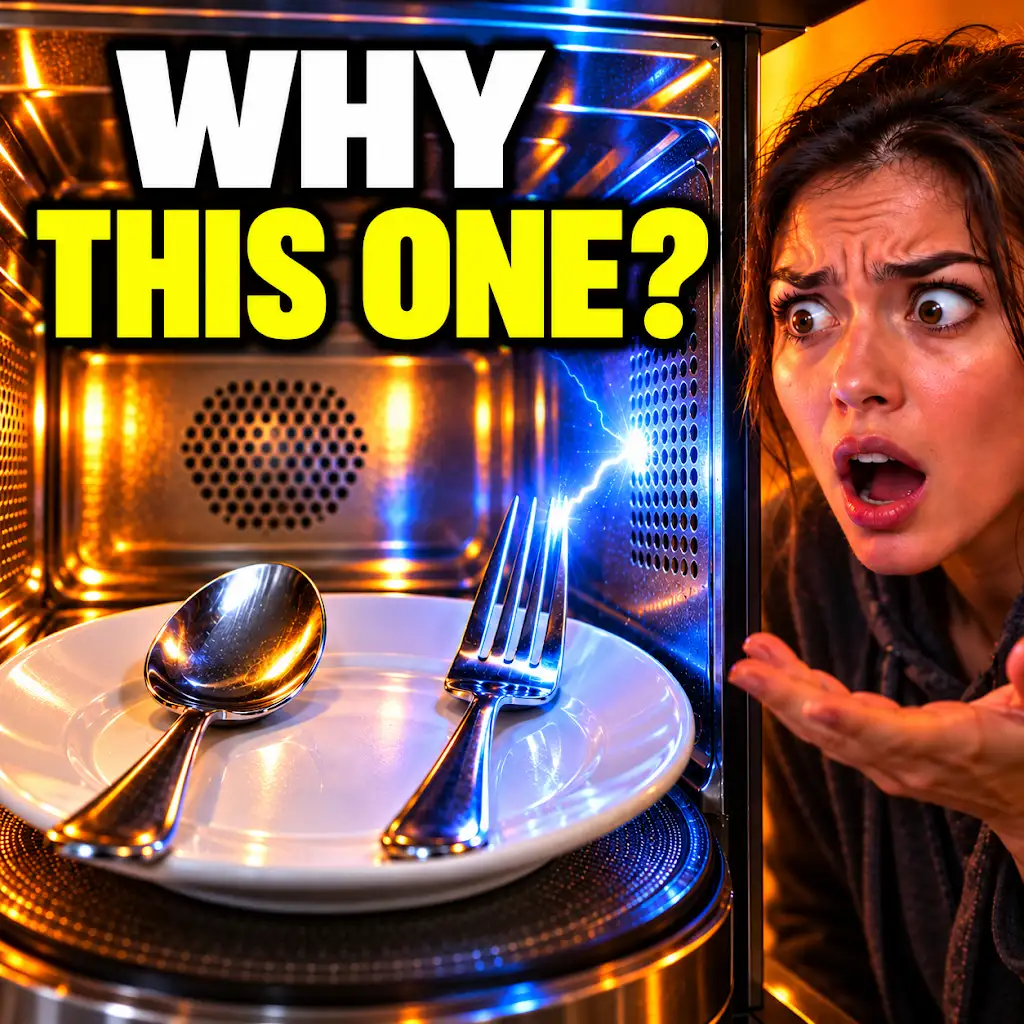
A Fork and a Spoon React Differently in a Microwave. Why?
FAQs
What causes sharp metal sparks in a microwave?
Metal sparks in a microwave are caused by the reflection of microwaves off of metal surfaces, which can create a buildup of electrical energy and result in sparks.
Is it safe to put metal in a microwave?
It is not safe to put metal in a microwave, as it can cause sparks, damage the microwave, and potentially create a fire hazard.
What types of metal can cause sparks in a microwave?
Any type of metal, including aluminum foil, metal utensils, and metal-trimmed dishes, can cause sparks in a microwave due to their ability to reflect microwaves.
How can I safely heat food with metal in a microwave?
To safely heat food with metal in a microwave, it is recommended to use microwave-safe cookware and utensils that are specifically designed for use in microwaves.
What should I do if I see sparks from metal in my microwave?
If you see sparks from metal in your microwave, immediately turn off the microwave, unplug it, and do not attempt to use it until it has been inspected and repaired by a professional.