You’ve probably heard the warnings: “Don’t put metal in the microwave!” It’s a common piece of advice, etched into the collective consciousness of anyone who’s ever used the kitchen appliance. But have you ever stopped to wonder why it’s so dangerous? What exactly happens when a fork, foil, or even a fancy metal-rimmed plate ventures into that humming box? This isn’t just about avoiding a spark or a minor inconvenience; understanding the science behind it can help you use your microwave safely and effectively. You’ll learn about the fundamental principles of microwave operation, the specific dangers associated with metal, and how to navigate the nuances of this seemingly simple rule.
Before you can understand why metal is a problem, you need to grasp how your microwave oven cooks your food in the first place. It’s a fascinating process, and knowing the fundamentals will demystify the potential hazards.
The Magic of Magnetrons and Microwaves
At its core, a microwave oven is a specialized radio transmitter. The crucial component responsible for generating the waves is called a magnetron. This is a vacuum tube that uses a magnetic field to accelerate electrons, which then interact with a resonant cavity to produce high-frequency electromagnetic waves, specifically in the microwave frequency range (typically around 2.45 gigahertz). These waves are then channeled into the cooking cavity.
How Microwaves Heat Food
The magic of microwave cooking lies in how these electromagnetic waves interact with food. Not all components of food are equally affected, but water, fats, and sugars are particularly good absorbers of microwave energy. When these molecules encounter the microwaves, they begin to vibrate rapidly. This rapid vibration generates heat through friction, effectively cooking the food from the inside out. Think of it like rubbing your hands together vigorously – the friction generates heat. The microwaves are essentially doing that to the molecules within your food.
The Dielectric Heating Principle
This process is known as dielectric heating. The microwaves cause the polar molecules within the food (molecules with a positive and negative end, like water) to align themselves with the oscillating electric field of the microwaves. As the field rapidly reverses direction, these molecules try to keep up, leading to constant rotation and thus heat generation. The efficiency of this heating depends on the dielectric properties of the foodstuff.
Penetration Depth
Microwaves penetrate food to a certain depth, typically a few centimeters. This is why food cooked in a microwave often heats more uniformly than if it were cooked solely by conduction (like in an oven or on a stovetop). However, thicker or denser foods may still require stirring or rotating to ensure even cooking, as the outer layers absorb most of the energy.
The Role of the Waveguide and Stirrer/Turntable
Once generated by the magnetron, the microwaves are directed into the cooking cavity through a waveguide. This is a hollow metal channel that efficiently transmits the waves. Inside the oven, a waveguide stirrer (a rotating fan-like metal component) or a turntable (a rotating glass plate) is often used to ensure that the microwaves are distributed as evenly as possible throughout the cavity. Without these, you’d likely experience hot spots and cold spots in your food.
Safety Features: The Faraday Cage
Your microwave oven is designed with safety in mind. The metal casing of the oven acts as a Faraday cage. This is a conductor that completely encloses a volume, effectively blocking electromagnetic radiation from escaping. The door has a metal mesh or a conductive coating with small holes that are too small for the microwaves to pass through, while still allowing you to see inside. This containment is crucial for preventing exposure to potentially harmful microwave radiation.
If you’re curious about the safety of placing metal inside a microwave, you might find the article on Freaky Science particularly enlightening. It discusses the science behind microwaves and metal, explaining why certain types of metal can cause sparks or fires while others may not pose a risk. For more detailed information, you can read the article here: Freaky Science Article.
The Science of Sparks: Why Metal Reacts in the Microwave
Now that you understand the basic principles of microwave operation, let’s dive into the core of the issue: what happens when you introduce metal into this controlled electromagnetic environment. The interaction is far from benign and can lead to some dramatic, and dangerous, results.
Reflection and Concentration of Microwaves
Metals, unlike food, do not absorb microwave energy in the same way. Instead, they reflect it. Think of metal as a mirror for microwaves. When microwaves hit a metallic surface, they bounce off. This reflection isn’t just harmlessly redirecting the waves; it can cause them to concentrate in unexpected ways, leading to the creation of intense electric fields.
Electric Current Induction and Charge Buildup
The oscillating electric field of the microwaves induces electric currents within the metal object. These currents flow back and forth along the surface of the metal. In smooth, continuous pieces of metal, these currents might dissipate without much issue. However, when the metal has sharp edges, points, or thin sections, these induced currents can accumulate charge at these specific locations. This charge buildup creates a high electrical potential difference.
Arc Formation: The Plasma Discharge
When the electrical potential difference between two points on the metal, or between the metal and another conductive surface (like the oven walls), becomes sufficiently high, the air between them can no longer act as an insulator. The air molecules become ionized, forming a plasma. This plasma discharge is what you see as a spark or an arc. It’s essentially a mini lightning strike happening inside your microwave.
The Role of Shape and Size
The shape and size of the metal object play a significant role in the likelihood and intensity of arcing. Thin, pointed objects like forks or crumpled aluminum foil are particularly prone to arcing. The points on these objects concentrate the induced electric field, making it easier to reach the breakdown voltage of the air. Larger, smooth pieces of metal might reflect microwaves without significant arcing, but they can still interfere with the cooking process.
Multiple Reflections and Hot Spots
The reflected microwaves can bounce around inside the oven cavity, creating hot spots and cold spots in the food. This can lead to uneven cooking and can even damage the magnetron itself over time as it’s forced to work harder against the reflected energy.
Specific Metal Hazards and Their Consequences
It’s not just about preventing sparks; putting metal in the microwave can lead to more serious consequences that extend beyond a visual spectacle. Understanding these specific hazards will reinforce the importance of this safety guideline.
Fire Risk
The most immediate and dangerous consequence of arcing is the risk of fire. The intense heat generated by the electrical discharge can ignite any flammable materials present in the microwave, including food residue, paper towels, or even the packaging the food might be in. A small spark can quickly escalate into a full-blown fire, posing a significant threat to your kitchen and home.
Igniting Food Residue
Even if the metal object itself doesn’t directly catch fire, the intense sparks can ignite lingering food particles or grease that may have accumulated on the oven walls or the metal object. This is especially true if you haven’t cleaned your microwave thoroughly.
Damage to the Microwave Oven
Beyond the fire risk, repeated or severe arcing can damage the microwave oven itself. The intense electrical discharges can scorch the interior walls, damage the magnetron, or even compromise the electronic components. This can render your microwave inoperable or, worse, create a safety hazard for future use. The magnetron is particularly vulnerable, as it’s designed to operate under specific conditions, and excessive reflected energy can cause it to overheat and fail.
Interference with Cooking
Even if no visible sparks occur, metal objects can interfere with the microwave’s ability to cook food. The reflected microwaves can create areas of insufficient cooking, leaving your food cold or undercooked in certain spots, while other areas might become overcooked or dry. This not only leads to an unsatisfying meal but can also pose a food safety risk if certain parts of the food are not heated to a safe temperature.
Uneven Heating and Undercooking
As mentioned, the reflection of microwaves can lead to uneven heating. This means that while one part of your meal might be piping hot, another might remain unpleasantly cool. This is particularly problematic for foods that require thorough cooking to eliminate bacteria.
Dehydration and Texture Changes
The intense, concentrated microwave energy can also lead to localized dehydration and undesirable changes in texture. You might find your food becoming dry and tough in certain areas while being watery in others, a direct result of the inefficient and uneven energy distribution caused by the metal.
The Myth of “Small Amounts” and “Smooth Surfaces”
While it’s true that the risk of arcing is higher with sharp edges and thin metals, it’s a dangerous misconception to believe that small, smooth, or specially designed metal items are always safe. The underlying principle of reflection and potential charge buildup still applies. Even a seemingly innocuous metal spoon placed at a specific angle could potentially cause issues. It’s best to err on the side of caution.
Spoons and Forks: A Common Misconception
Many people believe that simply putting a spoon or fork in the microwave for a short period is harmless. While it might not always result in dramatic sparks, the potential for arcing is still present, especially if the utensil touches the oven walls or is positioned in a way that concentrates the electric field.
“Microwave-Safe” Metal Utensils?
You might occasionally see products marketed as “microwave-safe metal.” These are typically designed with specific shapes and arrangements to minimize the risk of arcing. However, it’s crucial to follow the manufacturer’s instructions precisely, as even these items can be misused. When in doubt, it’s always safer to avoid metal altogether.
Navigating the Nuances: When Metal Might Be Okay (and When to Be Extra Cautious)
While the general rule is a firm “no” to metal, there are a few specific situations and material types where the danger is significantly reduced or managed. However, these are exceptions, and vigilance is always key.
“Microwave-Safe” Dinnerware with Metallic Accents
You might have dinnerware with a thin metallic trim or metallic decoration. Many of these are designed to be “microwave-safe.” The key here is that the metallic component is often a very thin layer of metallic paint or glaze that is specifically engineered to either reflect microwaves away or to be sufficiently dispersed that it doesn’t create the concentrated charge buildup needed for arcing.
The Importance of Manufacturer Labels
Always check the bottom of your dinnerware for a “microwave-safe” label. If there’s any doubt, or if the metallic element appears thick or continuous, it’s best to avoid microwaving it. Manufacturers who test their products for microwave safety will usually indicate it.
Testing the “Is it Safe?” Method (with extreme caution!)
If you’re unsure and the item has a very thin metallic accent, some suggest a test: place the dish in the microwave with a cup of water. Microwave on high for one minute. If the dish gets excessively hot, or if you see any signs of sparking or unusual behavior, remove it immediately and do not use it in the microwave again. This method is not foolproof and should be undertaken with extreme caution.
Certain Types of Foil and Wrappers
While crumpled foil is a recipe for disaster, some specially designed foil containers or wrappers might be considered usable in certain microwaves, provided they have specific instructions for use. These are often found in pre-packaged microwave meals.
The “Smooth and Flat” Rule for Foil
If you absolutely must use foil (which is generally discouraged), ensure it is smooth, flat, and not touching the oven walls. Any wrinkles or folds create points where charge can build up. It’s generally used for covering food to prevent splattering or to create a barrier, rather than for cooking. However, even this carries a risk.
Pre-Packaged Meal Packaging
Many pre-packaged microwave meals come with foil components. These are designed by the food manufacturer and the microwave oven manufacturer to be safe for their intended use. They are often designed to sit in a specific way within the oven, or the foil is integrated into a cardboard sleeve that controls its interaction with the microwaves. Again, always follow the instructions on the packaging.
Microwave Ovens with Specific “Metal” Settings
Some modern microwave ovens are equipped with specific settings or pre-programmed cooking cycles that allow for the use of certain metal containers or accessories. These ovens are designed with advanced technology that manages the microwave energy distribution and intensity to safely accommodate these items.
Understanding the Technology
These ovens often use sophisticated wave patterns and power modulation to prevent arcing. They might use lower power levels or different frequencies for these specific settings. It’s crucial to understand how these settings work and to use them only with the recommended types of metal containers.
Always Refer to Your Oven’s Manual
Never assume your microwave can handle metal unless it explicitly states so in its user manual and provides specific instructions for its use. Relying on guesswork here can be very dangerous.
When it comes to using a microwave, many people wonder about the safety of placing metal objects inside. A related article discusses the potential hazards and guidelines for using metal in microwaves, providing valuable insights into what can and cannot be safely heated. For more detailed information, you can check out this informative piece on the topic at Freaky Science. Understanding these safety measures can help prevent accidents and ensure that your cooking experience remains enjoyable.
Best Practices and Alternatives: Keeping Your Microwave Safe
| Material | Microwave Safety |
|---|---|
| Aluminum foil | Avoid using it as it can cause sparks and potential fire hazards |
| Stainless steel | Generally safe for limited use, but can cause arcing if it has sharp edges or points |
| Other metals | Avoid using them as they can cause sparks and damage to the microwave |
To avoid any potential hazards, it’s best to stick to tried-and-true methods and materials. Knowing what to use instead of metal will ensure safe and efficient cooking.
Prioritize Glass, Ceramic, and Microwave-Safe Plastic
The safest materials to use in your microwave are glass, ceramic, and plastics explicitly labeled as microwave-safe. These materials are designed to allow microwaves to pass through them and heat the food, without reflecting or interfering with the microwave energy.
Glassware: A Versatile Choice
Glass containers, like Pyrex or Anchor Hocking, are excellent for reheating leftovers, cooking, and steaming. They are durable, easy to clean, and don’t react with food. Ensure they don’t have metallic trim.
Ceramic Dishes: For Serving and Reheating
Ceramic dishes are also a good option, especially for serving food directly from the microwave. Again, check for metallic accents. Unglazed ceramics might absorb more moisture, so keep that in mind.
Microwave-Safe Plastics: Convenience and Caution
Many plastic containers are labeled microwave-safe. Look for the microwave symbol (often a wavy line or a microwave with waves coming out). These are convenient for meal prep and reheating. However, some plastics can warp or leach chemicals when overheated, so it’s still wise to use them according to instructions and to opt for higher-quality, BPA-free options when possible.
Covering Food: The Right Way to Do It
Covering food in the microwave helps to retain moisture and prevent splattering. The best materials for this purpose are plastic wrap (loosely tented), paper towels, or microwave-safe lids.
Venting is Crucial
When using plastic wrap or a lid, it’s essential to vent it by leaving a small opening or poking a few holes. This allows steam to escape, preventing pressure buildup and potential explosions. Never seal a container completely tightly with plastic wrap or a lid.
Paper Towels: Simple and Effective
For covering smaller items or preventing splatters, a simple paper towel works wonders. It allows steam to escape freely and is disposable.
Cleaning Your Microwave Regularly
A clean microwave is a safer microwave. Food residue and grease can accumulate on the interior walls and can become a fire hazard when exposed to sparks from improper metal use.
Regular Wipe-Downs
Make it a habit to wipe down the interior of your microwave after each use, especially if there have been any spills. This prevents food particles from baking on.
Deep Cleaning
Periodically, you’ll want to give your microwave a more thorough cleaning. You can use a mixture of water and vinegar or lemon juice, heated in the microwave for a few minutes, to loosen grime. Then, wipe it down with a damp cloth.
When in Doubt, Leave it Out!
This is the golden rule of microwave safety. If you are ever unsure whether a particular item is safe to put in your microwave, the best course of action is simply not to put it in. The risk is not worth the potential danger. It’s always better to be overly cautious and find an alternative method of heating or cooking your food.
By understanding the principles behind microwave operation and the dangers associated with metal, you can ensure you are using your appliance safely and effectively. Remember, a few extra seconds of thought can prevent a potentially hazardous situation.
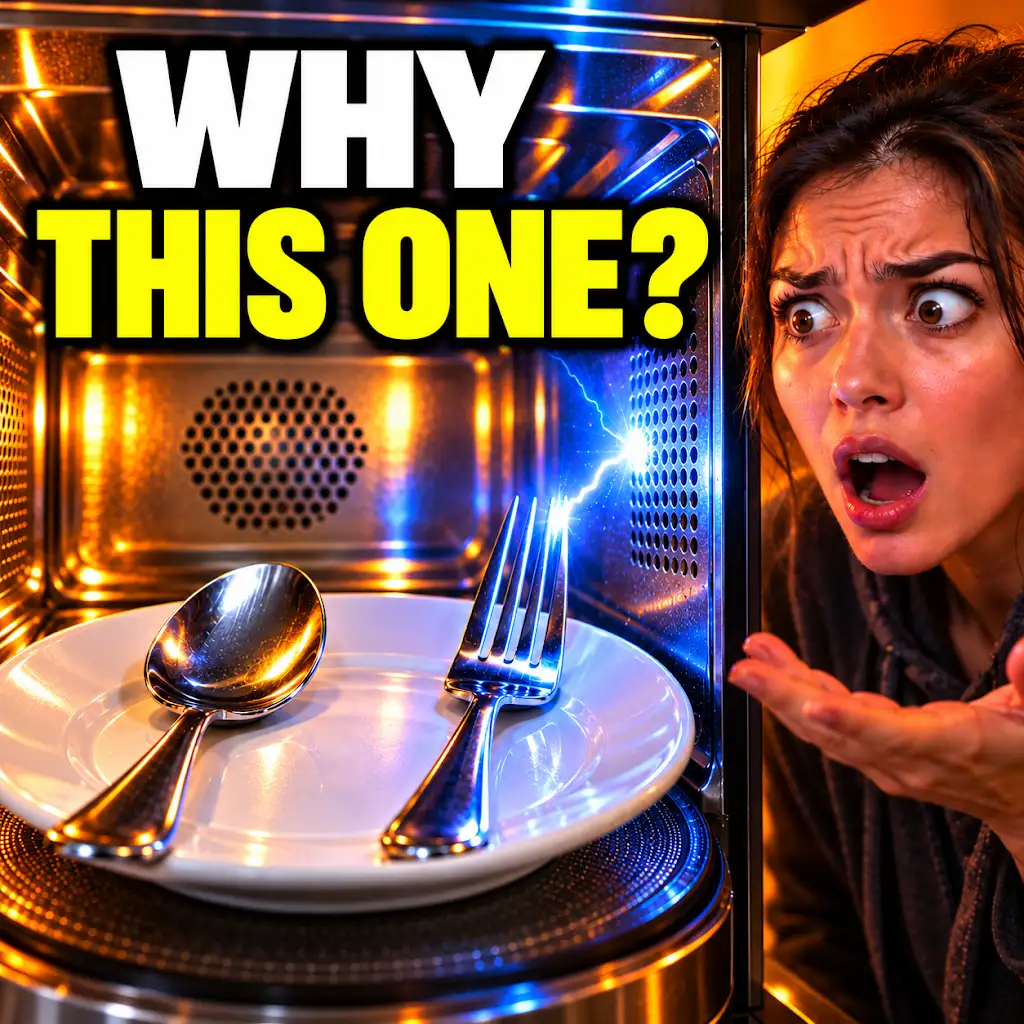
A Fork and a Spoon React Differently in a Microwave. Why?
FAQs
Can metal be safely used in a microwave?
No, metal should not be used in a microwave as it can cause sparks, fires, and damage to the microwave.
What happens if metal is put in a microwave?
When metal is put in a microwave, it can cause the electrons in the metal to move back and forth rapidly, creating sparks and potentially causing a fire.
Why is it dangerous to put metal in a microwave?
Metal reflects the microwaves in a microwave oven, which can cause the electrical currents to build up and potentially lead to a fire or damage to the microwave.
What types of metal should not be used in a microwave?
Any type of metal, including aluminum foil, metal utensils, and metal containers, should not be used in a microwave.
Are there any exceptions to using metal in a microwave?
No, there are no safe exceptions to using metal in a microwave. It is always best to avoid using metal in a microwave to prevent accidents and damage.