
The vast expanse of the universe, as revealed by the cosmic microwave background (CMB) radiation, is a tapestry of subtle variations. This ancient light, a relic from the early universe, carries information about its state shortly after the Big Bang. Among these variations, one anomaly has long captured the attention of cosmologists: the CMB Cold Spot. Its unusually low temperature has defied conventional explanations, sparking debate and intrigue. Is this enigmatic region a genuine cosmic mystery, a window into something beyond our current understanding, or merely a statistical fluke within the expected fluctuations of the early universe?
The Genesis of the Cosmic Microwave Background
To understand the significance of the CMB Cold Spot, one must first appreciate the CMB itself. The CMB is the afterglow of the Big Bang, the faint radiation that permeates all of space. Approximately 380,000 years after the Big Bang, the universe had cooled enough for electrons and protons to combine and form neutral atoms. This event, known as recombination, allowed photons to travel freely through space for the first time. These photons, stretched and cooled by the expansion of the universe over billions of years, are what we detect today as the CMB.
The Predictable Nature of the CMB
The CMB is remarkably uniform, with an average temperature of about 2.725 Kelvin. However, the universe is not perfectly smooth. Tiny temperature fluctuations, on the order of microKelvin, are imprinted on the CMB. These fluctuations are incredibly important, as they represent the seeds from which all cosmic structures, from galaxies to galaxy clusters, eventually grew. The standard model of cosmology, the Lambda-CDM model, predicts the statistical properties of these fluctuations with remarkable accuracy. These predictions are based on the physics of inflation, a period of rapid expansion in the very early universe, and the subsequent evolution of matter and energy. The power spectrum of the CMB, which describes the distribution of these fluctuations at different angular scales, is a key observational test of the Lambda-CDM model.
The Cosmic Microwave Background (CMB) Cold Spot has been a topic of significant debate among cosmologists, raising questions about its origin and implications for our understanding of the universe. For those interested in exploring this phenomenon further, a related article can be found at Freaky Science, which delves into various theories surrounding the CMB Cold Spot and its potential connection to large-scale cosmic structures. This resource provides a comprehensive overview of the ongoing research and discussions in the field, making it a valuable read for anyone curious about the mysteries of the cosmos.
Unveiling the Cold Spot: An Unexpected Anomaly

The CMB Cold Spot first gained prominence with data from the Wilkinson Microwave Anisotropy Probe (WMAP) and later with even greater precision from the Planck satellite. It is a region of the sky where the CMB temperature is significantly lower than the surrounding areas, and indeed, lower than expected by the Lambda-CDM model. This region spans a substantial portion of the sky, roughly 1.5 degrees across, and its temperature is about 0.2 millikelvin colder than the average.
Statistical Significance and the “Greatest Anomaly”
The statistical significance of the Cold Spot has been a subject of intense scrutiny. While random fluctuations are expected, the magnitude and size of the Cold Spot appear to be rather unlikely within the framework of the standard cosmological model. Some analyses have suggested that the probability of such a feature arising by chance is very low, leading some scientists to dub it the “Greatest Anomaly” in the CMB. However, the interpretation of this statistical significance is complex and depends on the specific assumptions made about the underlying statistical properties of the CMB. It is important to distinguish between the intrinsic statistical fluctuations predicted by the model and the possibility of observational biases or limitations.
Exploring Potential Explanations for the Cold Spot

The unusual nature of the CMB Cold Spot has spurred numerous theoretical investigations, attempting to reconcile this anomaly with our understanding of the universe. These explanations range from conventional astrophysical phenomena to more speculative, exotic scenarios.
The Void Hypothesis: A Conventional Astrophysical Explanation
One of the most straightforward explanations for the CMB Cold Spot is the presence of a large, underdense region of matter in the foreground, known as a supervoid. According to the Integrated Sachs-Wolfe (ISW) effect, photons passing through a gravitational potential well (a region of higher density) gain energy, while photons passing through a gravitational potential hole (a region of lower density) lose energy. If the Cold Spot is located in the direction of a vast supervoid, the CMB photons would have traversed this region of lower density, causing them to lose energy and appear colder to us.
The Challenge of the Supervoid
While the supervoid hypothesis is a plausible explanation, it faces certain challenges. For the ISW effect to account for the observed temperature difference, the supervoid would need to be exceptionally large and deep, extending over a significant fraction of the observable universe. Detecting such a massive void and confirming its alignment with the Cold Spot has proven difficult. While some large voids have been identified in the direction of the Cold Spot, their properties do not perfectly match the requirements of the standard ISW explanation. Furthermore, the Cold Spot appears to be remarkably “cold” across a wide range of angular scales, which a single large void might not fully explain.
Exotic Scenarios: Beyond the Standard Model
When conventional explanations falter, scientists often turn to more speculative theories. The CMB Cold Spot has inspired a number of exotic hypotheses that challenge fundamental aspects of the Lambda-CDM model.
Cosmic Strings: Relics of Early Universe Phase Transitions
One such hypothesis involves cosmic strings. These are hypothetical one-dimensional topological defects that could have formed during phase transitions in the very early universe. If a large number of cosmic strings were present in the line of sight to the Cold Spot, their gravitational influence could, under certain configurations, lead to a region of slightly lower temperature in the CMB. However, observational evidence for cosmic strings is scarce, and the precise mechanism by which they would produce the observed Cold Spot remains an active area of research.
Collisions with Other Universes: The Multiverse Hypothesis
Perhaps the most intriguing, and speculative, explanation for the CMB Cold Spot comes from the realm of the multiverse. The idea is that our universe might not be the only one; there could be other universes with different physical properties. If our universe had a rare “collision” or interaction with another universe in its early stages, this could have left an imprint on the CMB, such as the Cold Spot. This is a highly theoretical concept, and currently, there is no direct observational evidence to support it. However, it highlights the imaginative thinking that the Cold Spot has stimulated.
Other Exotic Possibilities: From Black Holes to Inflationary Scars
Other more exotic explanations have been proposed, including the possibility that the Cold Spot is a result of extremely rare quantum fluctuations during inflation, or even the imprint of a supermassive black hole from the early universe. These theories, while imaginative, often require very specific and unlikely conditions to manifest as the observed Cold Spot.
Refining Measurements and Statistical Tests
The ongoing debate surrounding the reality and significance of the CMB Cold Spot hinges on precise measurements and rigorous statistical analysis. As observational techniques improve and more data becomes available, scientists are able to refine their understanding of the CMB and its anomalies.
The Role of Planck and Future Observatories
The Planck satellite has provided the most detailed maps of the CMB to date, offering unprecedented resolution and sensitivity. Its data has been crucial in characterizing the Cold Spot and in testing various theoretical models. Future observatories, with even greater capabilities, will undoubtedly play a vital role in further investigating this anomaly. These future missions will aim to reduce observational uncertainties, improve foreground subtraction, and potentially map the CMB with even higher precision.
The Importance of Null Tests
A crucial aspect of assessing the reality of any anomaly is to perform “null tests.” These are tests designed to determine if the anomaly is genuinely peculiar or if it’s simply a consequence of the specific way the data was analyzed. For the Cold Spot, null tests might involve looking for similar-sized cold spots elsewhere in the sky, or analyzing the distribution of temperature fluctuations in different regions of the CMB. If similar anomalies are found elsewhere, it might suggest that the standard model’s predictions for fluctuations are more robust than initially thought. Conversely, if the Cold Spot remains unique and statistically improbable, it strengthens the case for it being a significant deviation.
The Cosmic Microwave Background (CMB) cold spot has sparked significant debate among scientists regarding its authenticity and implications for our understanding of the universe. A related article discusses various theories that attempt to explain this intriguing phenomenon, including the possibility of it being a statistical fluke or a sign of new physics. For those interested in delving deeper into this topic, you can read more about it in this fascinating article that explores the ongoing research and differing viewpoints surrounding the CMB cold spot.
The Ongoing Quest: A Catalyst for Cosmological Advancement
| Metric | Value | Description | Source/Study |
|---|---|---|---|
| Temperature Deviation | ~-70 µK | Measured temperature difference of the Cold Spot compared to average CMB temperature | Planck Collaboration (2015) |
| Angular Size | 5° to 10° | Approximate angular diameter of the Cold Spot on the sky | WMAP and Planck data analyses |
| Statistical Significance | 2-3 sigma | Level of deviation from Gaussian random field expectations | Planck 2015 and WMAP studies |
| Possible Explanation | Supervoid | Large-scale underdensity in galaxy distribution possibly causing the Cold Spot via the Integrated Sachs-Wolfe effect | Szapudi et al. (2015) |
| Alternative Explanation | Statistical Fluke | Random fluctuation in the CMB consistent with standard cosmology | Planck Collaboration (2015) |
| Follow-up Observations | Galaxy Surveys | Surveys like DES and WISE used to search for corresponding large-scale structures | Szapudi et al. (2015), Mackenzie et al. (2017) |
| Current Consensus | Inconclusive | Debate continues whether the Cold Spot is a real anomaly or a statistical artifact | Recent cosmology reviews (2023) |
The CMB Cold Spot, whether it ultimately proves to be a genuine cosmic enigma or a statistical curiosity, has served as a powerful catalyst for cosmological research. It has pushed the boundaries of our theoretical understanding and spurred the development of new observational techniques.
Challenging and Testing the Standard Model
The very existence of anomalies like the Cold Spot is a valuable part of the scientific process. They act as critical tests for our current cosmological models. If a model cannot adequately explain observed phenomena, it forces scientists to re-evaluate its assumptions and potentially develop new, more comprehensive theories. The Cold Spot has, in this sense, been a valuable tool for stress-testing the Lambda-CDM model.
The Future of Cosmic Exploration
The quest to understand the CMB Cold Spot is far from over. It represents a compelling invitation to continue exploring the universe’s deepest mysteries. Whether the answer lies in a vast, unseen void, exotic relics of the early universe, or even the tantalizing prospect of other universes, the pursuit of understanding this cold anomaly will undoubtedly lead to new discoveries and a deeper appreciation of our place in the cosmos. The journey of unraveling the CMB Cold Spot is a testament to humanity’s insatiable curiosity and our enduring drive to comprehend the universe around us.
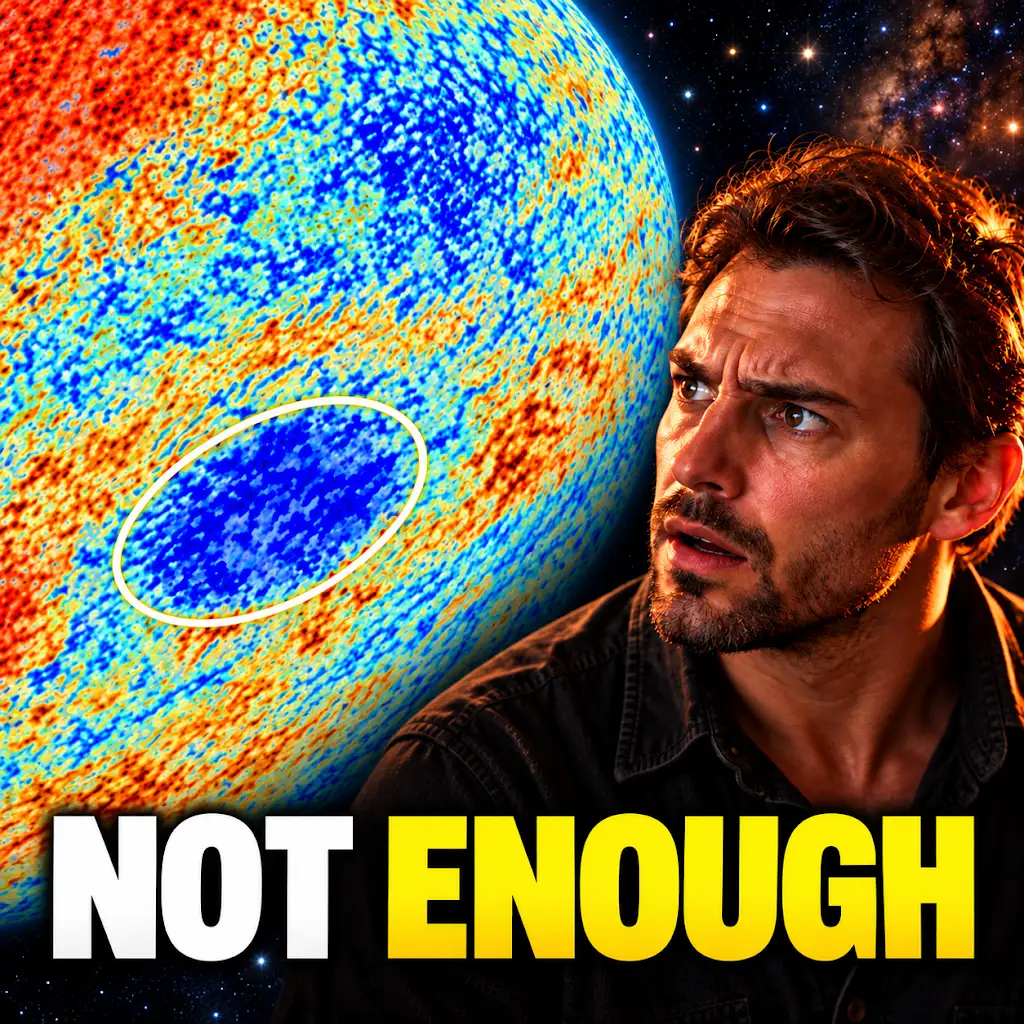
The Universe’s Cold Spot Has an Explanation. It’s Not Enough.
FAQs
What is the CMB cold spot?
The CMB cold spot refers to a region of the cosmic microwave background (CMB) radiation that appears to be colder than its surroundings. It is a large, anomalous area of the sky where the temperature of the CMB is lower than expected.
Is the CMB cold spot real?
Yes, the CMB cold spot is a real phenomenon that has been observed in the CMB radiation. It has been studied by astronomers and is considered to be a genuine feature of the universe.
What causes the CMB cold spot?
The exact cause of the CMB cold spot is still a topic of research and debate among scientists. Some theories suggest that it could be the result of a void or a large mass concentration in that region of space, while others propose more exotic explanations involving the nature of the early universe.
How was the CMB cold spot discovered?
The CMB cold spot was first detected in 2004 by the Wilkinson Microwave Anisotropy Probe (WMAP) satellite. Since then, it has been confirmed by other experiments, including the Planck satellite, which mapped the CMB in even greater detail.
What are the implications of the CMB cold spot?
Studying the CMB cold spot can provide valuable insights into the large-scale structure of the universe and the conditions of the early universe. By understanding the origins of the cold spot, scientists hope to gain a better understanding of the fundamental properties of the cosmos.