You’ve likely experienced induction without even realizing it. That sleek, modern-looking stovetop that heats up pots and pans with an almost magical speed? That’s induction at work. It’s a fascinating and efficient way to convert electrical energy directly into heat, bypassing the traditional methods of direct resistance heating. This technology, once confined to industrial settings, has moved into our kitchens, offering a cleaner, faster, and often more energy-efficient cooking experience. But how does it actually work? Let’s delve into the captivating world of induction and uncover the science behind this elegant conversion of electricity into heat.
At its core, induction is all about harnessing the power of electromagnetism. You might recall from basic physics that moving electric charges create magnetic fields, and conversely, changing magnetic fields can induce electric currents in nearby conductors. This fundamental principle is the bedrock upon which induction heating is built. It’s not about simply passing electricity through a resistive element and letting the heat dissipate. Instead, induction utilizes a precisely controlled alternating magnetic field to generate heat within the material you want to heat. This distinction is crucial and leads to many of the advantages induction offers.
The Role of Alternating Current
The key to creating a changing magnetic field lies in the use of alternating current (AC). Unlike direct current (DC), which flows in a single direction, AC periodically reverses its direction. This constant switching is what allows us to generate a dynamic magnetic field. Imagine a sine wave oscillating back and forth; that’s essentially what the current in an induction coil is doing. This oscillation is what continuously changes the strength and direction of the magnetic field it produces. Without this alternating nature, there would be no induction. The frequency of this alternating current is also an important factor, though we’ll explore that in more detail later.
Magnetic Fields and Their Properties
A magnetic field is a region around a magnetic material or a moving electric charge within which the force of magnetism acts. In the case of induction, the electric current flowing through a specially designed coil generates this magnetic field. This field extends outwards from the coil and has a specific pattern and strength. When this field is rapidly changing, it has the ability to interact with other conductive materials placed within its influence. The strength of the magnetic field is directly proportional to the current flowing through the coil, and its direction is determined by the direction of the current flow, following the principles of Ampere’s Law.
Faraday’s Law of Induction: The Crucial Link
The fundamental principle governing how a changing magnetic field generates an electric current is described by Faraday’s Law of Electromagnetic Induction. In simple terms, this law states that a changing magnetic flux through a circuit induces an electromotive force (EMF), which is essentially a voltage. If the circuit is closed, this induced EMF will drive an electric current. In the context of induction heating, the “circuit” is the conductive cookware itself. The alternating magnetic field generated by the induction coil penetrates the cookware, and as the field fluctuates, it induces eddy currents within the metal.
Eddy Currents: The Direct Cause of Heat
These induced electric currents circulating within the cookware are known as eddy currents. They are essentially tiny, swirling currents that are generated throughout the conductive material. Because the cookware itself has electrical resistance (even good conductors have some), these eddy currents encounter opposition as they flow. This resistance is what causes energy to be dissipated in the form of heat. The more eddy currents that are generated, and the higher their magnitude, the more heat will be produced. It’s this generation of eddy currents directly within the cooking vessel that makes induction so efficient.
Induction heating is a fascinating process that efficiently converts electricity into heat through electromagnetic induction. This method is widely used in various applications, from cooking to industrial processes. For a deeper understanding of how induction works and its practical uses, you can explore a related article on the topic at Freaky Science. This resource provides insights into the principles of induction heating and its advantages over traditional heating methods.
The Induction Heating Process: A Step-by-Step Breakdown
Now that you have a foundational understanding of the underlying physics, let’s walk through the actual process of how induction heating transforms electricity into usable heat. It’s a carefully orchestrated sequence of events that leverages electromagnetism to deliver rapid and precise heating.
The Induction Coil: The Heart of the System
The induction coil is the indispensable component responsible for generating the alternating magnetic field. Typically, this coil is made of copper, chosen for its excellent electrical conductivity. It’s usually shaped into a flat spiral or a series of concentric loops, strategically placed beneath the cooking surface. The design and dimensions of the coil are critical for its efficiency and for coupling effectively with the cookware. When AC electricity flows through this coil, it generates a powerful, oscillating magnetic field that extends upwards.
Generating the Alternating Magnetic Field
As mentioned, the alternating current flowing through the induction coil causes the magnetic field it produces to continuously change in strength and direction. Imagine the magnetic field lines emanating from the coil, expanding and contracting, and even reversing their polarity in sync with the AC frequency. This dynamic field is the essential ingredient for inducing currents in the cookware. The frequency of the AC is typically in the range of 20 to 100 kHz, which is significantly higher than the 50 or 60 Hz mains frequency found in your home. This higher frequency allows for more rapid changes in the magnetic field, leading to more efficient eddy current generation.
Interaction with Ferromagnetic Cookware
Induction cooking is most efficient with cookware made of ferromagnetic materials, such as cast iron or certain types of stainless steel. These materials are readily magnetized, meaning their internal magnetic domains can be easily aligned by an external magnetic field. When the alternating magnetic field from the induction coil interacts with ferromagnetic cookware, two primary heating mechanisms are at play:
Eddy Current Heating (Joule Heating)
This is the primary mechanism for most induction heating applications. As the alternating magnetic field penetrates the conductive base of the cookware, it induces eddy currents within the metal. The resistance of the cookware material opposes the flow of these eddy currents, converting their kinetic energy into heat through the Joule effect (also known as resistive heating). The higher the resistance of the cookware and the stronger the induced eddy currents, the more heat is generated.
Hysteresis Heating
In ferromagnetic materials, there’s an additional heating mechanism called hysteresis heating. When the external magnetic field from the induction coil changes direction, it causes the magnetic domains within the cookware material to reorient themselves. This constant reorientation involves friction at the atomic level, which generates heat. While eddy current heating is generally the dominant factor, hysteresis heating can contribute to the overall heat generation, especially in materials with high magnetic permeability.
Heating Through Conduction and Convection
It’s important to understand that the induction coil itself does not get hot enough to directly heat the cookware through radiant heat. The heat is generated within the base of the cookware due to the induced eddy currents and hysteresis. Once this heat is generated, it then transfers to the contents of the pot or pan through the normal processes of conduction (heat moving through the material of the cookware) and convection (heat moving within the food or liquid). This is why it’s crucial to use cookware with a good conductive base for efficient induction cooking.
Factors Influencing Induction Heating Efficiency

The effectiveness and efficiency of induction heating are not solely determined by the induction coil and the cookware. Several other factors play a significant role in optimizing the heat transfer and ensuring a satisfactory cooking experience.
Cookware Material Properties
As discussed, ferromagnetic materials are ideal for induction. Their magnetic properties allow for strong eddy current generation and contribute to hysteresis heating. However, even within ferromagnetic materials, variations exist. For instance, cast iron, with its higher resistance and magnetic permeability, tends to heat very effectively. Certain grades of stainless steel are also designed to be induction-compatible, often by incorporating a layer of ferromagnetic material in their base. Non-ferromagnetic materials like aluminum or copper, while excellent conductors, do not generate significant hysteresis heat and rely solely on eddy currents, making them less efficient for direct induction heating. However, many modern “induction-compatible” cookware pieces have a sandwich construction with a ferromagnetic layer to enable induction.
Cookware Thickness and Design
The thickness of the cookware’s base also influences heating efficiency. A thicker base generally allows for a more robust generation of eddy currents and can distribute heat more evenly. However, excessively thick bases can sometimes lead to slower heat-up times. The design of the base is also important. A flat, even surface ensures good contact with the induction coil, maximizing the magnetic coupling and preventing heat loss. Warped or uneven bases will result in less efficient and uneven heating.
Frequency of the Alternating Current
The frequency of the AC supplied to the induction coil has a direct impact on the depth to which the magnetic field penetrates the cookware and the magnitude of the induced eddy currents. Higher frequencies lead to a shallower penetration depth (known as the “skin effect”), which can be beneficial for certain applications to concentrate heating at the surface. For typical induction cooking, frequencies in the tens of kilohertz are used to strike a balance between efficient eddy current generation throughout the cookware base and manageable coil design. The frequency is carefully selected by the manufacturer to optimize performance for common cookware types.
Power Output and Control
The power output of the induction hob, which is essentially the electrical power supplied to the induction coil, directly dictates the intensity of the magnetic field and thus the rate of heat generation. Induction hobs offer precise power control, allowing users to select specific heat levels. This is achieved by adjusting the amplitude of the AC current or by rapidly switching the power on and off in a pulsed manner (pulse-width modulation). This fine-grained control is a significant advantage over traditional stovetops, enabling delicate simmering and rapid boiling with equal ease.
Advantages of Induction Heating Over Traditional Methods
Induction heating offers a compelling set of advantages that have contributed to its growing popularity in both residential and industrial settings. These benefits stem directly from the fundamental principles of how it generates heat.
Superior Energy Efficiency
One of the most significant advantages of induction heating is its exceptional energy efficiency. Because the heat is generated directly within the cookware, there is minimal heat loss to the surrounding air, unlike gas or radiant electric stovetops. Traditional methods lose a substantial amount of energy through convection and radiation from the heating element. Induction, by contrast, converts a much higher percentage of electrical energy directly into useful heat within the pot or pan. This translates to lower energy consumption and potentially lower utility bills.
Rapid Heating and Precise Control
Induction hobs are renowned for their speed. They can bring water to a boil significantly faster than conventional stovetops. This is because the heat is generated instantaneously and directly within the cookware. Furthermore, induction offers unparalleled temperature control. The user can make minute adjustments to the heat setting, and the hob responds almost immediately, providing a level of precision that is difficult to achieve with other cooking methods. This allows for more consistent and predictable cooking results.
Enhanced Safety Features
Induction technology inherently incorporates several safety features. Since the cooking surface itself does not directly generate heat (it only gets warm from residual heat transfer from the cookware), the risk of accidental burns is significantly reduced. The hob will only activate and generate heat when a ferromagnetic pan is placed on it, and it will automatically shut off if the pan is removed. This prevents accidental activation and reduces the risk of leaving a burner on unintentionally.
Cleaner and Easier to Maintain
The smooth, flat surface of induction cooktops makes them incredibly easy to clean. Spills and splatters are less likely to bake onto a hot surface because the surface itself doesn’t get extremely hot. Any food that does spill can be wiped away easily with a damp cloth once the surface has cooled. This contrasts with the grates and open burners of gas stoves or the elements of radiant electric stoves, which can be more challenging to keep clean.
Induction cooking is an innovative method that efficiently converts electricity into heat, providing a fast and precise way to cook food. This technology utilizes electromagnetic fields to directly heat pots and pans, making it a popular choice for modern kitchens. For a deeper understanding of the science behind this process, you can explore a related article that discusses the principles of induction heating and its various applications in everyday life. To read more about it, visit this informative page.
Beyond the Kitchen: Industrial Applications of Induction Heating
| Metric | Description | Typical Value | Unit |
|---|---|---|---|
| Frequency of AC Current | Alternating current frequency used to generate magnetic field | 20,000 – 50,000 | Hz |
| Magnetic Field Strength | Intensity of magnetic field inducing eddy currents in the cookware | 10 – 100 | mT (millitesla) |
| Eddy Current Density | Current density induced in the conductive material of the cookware | 10^4 – 10^6 | A/m² |
| Heat Generation Efficiency | Percentage of electrical energy converted into heat in the cookware | 80 – 90 | % |
| Power Input | Electrical power supplied to the induction coil | 1000 – 3000 | W |
| Heat Output | Thermal power generated in the cookware | 800 – 2700 | W |
| Cookware Material | Type of metal used affecting induction heating efficiency | Cast Iron, Stainless Steel | N/A |
| Skin Depth | Depth at which the induced current density falls to 1/e of its surface value | 0.1 – 1 | mm |
While induction cooking has captured the public’s imagination, the technology has a long and established history in various industrial applications where its efficiency and precision are highly valued.
Metal Melting and Refining
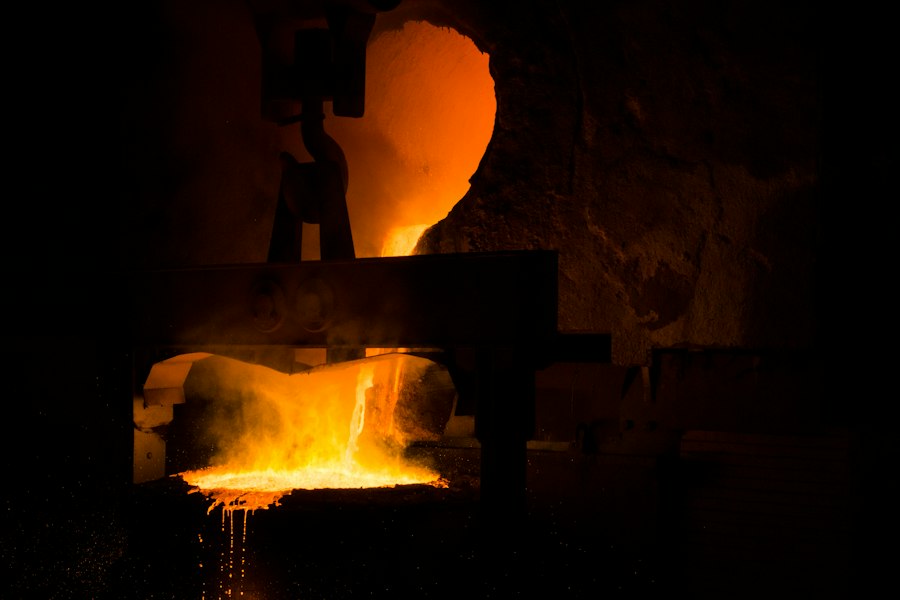
One of the most critical industrial uses of induction heating is in the melting and refining of metals. Large induction furnaces can melt significant quantities of steel, aluminum, copper, and other metals with remarkable speed and efficiency. The intense heat generated directly within the metal charge allows for rapid melting and precise control over the molten metal’s temperature, which is crucial for alloying and achieving desired material properties.
Heat Treatment of Metals
Induction heating is widely used for various heat treatment processes, such as hardening, tempering, and annealing of metal parts. By precisely controlling the temperature and duration of the induction heating process, manufacturers can alter the microstructure of metals to achieve specific mechanical properties like increased strength, hardness, or ductility. The localized heating capabilities of induction also allow for selective hardening of specific areas of a component, without affecting the rest of the part.
Brazing and Soldering
Induction heating provides a clean and efficient method for brazing and soldering metal components. The rapid and localized heating allows for precise melting of filler metals at specific joints, creating strong and reliable bonds. This method is often preferred over torch brazing as it minimizes the risk of overheating adjacent materials or causing distortion.
Surface Hardening
For applications requiring wear resistance, induction heating is employed for surface hardening of metal components. This process heats only the surface layer of the metal to a high temperature, followed by rapid quenching, creating a hard, wear-resistant case while leaving the core of the material tough and ductile. This technique is commonly used for gears, shafts, and other critical components that experience significant friction and wear.
Other Specialized Applications
The versatility of induction heating extends to numerous other specialized applications. This includes the drying of coatings and inks, the curing of polymers, the shrink-fitting of components (where heating causes expansion for assembly), and even in certain medical applications for therapeutic heating. The ability to generate controlled heat precisely where and when it’s needed makes induction a powerful tool across a wide spectrum of industries.
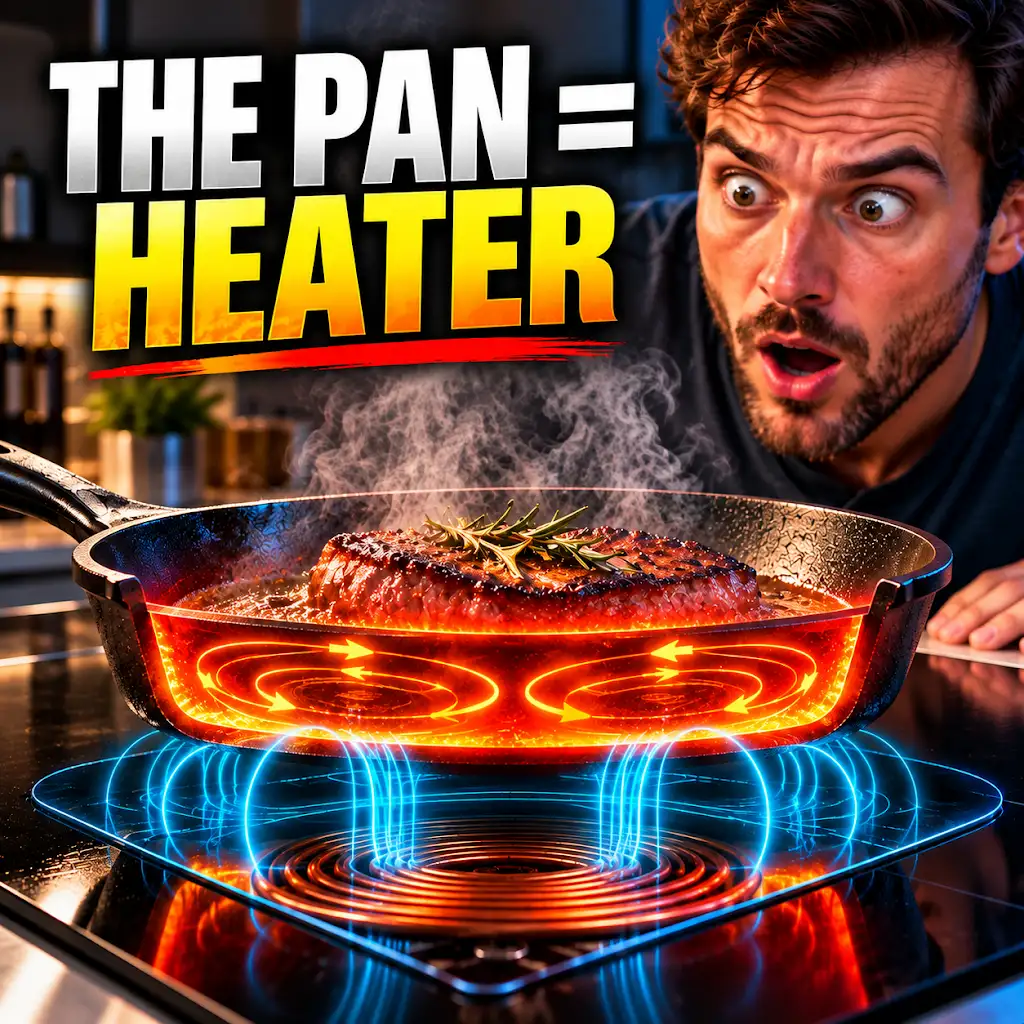
The Pan Is the Heater: How Induction Cooking Really Works
FAQs
What is induction?
Induction is the process of generating heat in a conductive material by creating a magnetic field that causes electric currents to flow within the material.
How does induction convert electricity into heat?
In induction heating, an alternating current is passed through a coil, creating a rapidly changing magnetic field. When a conductive material is placed within this magnetic field, eddy currents are induced in the material, generating heat due to resistance.
What are the advantages of using induction for heating?
Induction heating is efficient, fast, and precise. It allows for targeted heating of specific areas, reduces energy consumption, and minimizes heat loss to the surroundings.
What types of materials can be heated using induction?
Induction heating can be used on a wide range of conductive materials, including metals like steel, copper, and aluminum. Non-metallic materials with conductive properties can also be heated using induction.
What are some common applications of induction heating?
Induction heating is commonly used in industrial processes such as metal forging, heat treating, brazing, and soldering. It is also used in applications like induction cooktops, induction sealing, and induction melting.