You stand before your microwave, a sleek appliance promising hot meals in minutes. You press a button, hear the hum, and watch the turntable spin, food transforming from chilled to steaming. But have you ever wondered, truly wondered, how this culinary wizardry works? It all comes down to a fascinating dance of electromagnetic waves, specifically, microwaves. You’re about to delve into the heart of your microwave oven, understanding the science behind the speed.
The journey of a microwave begins not with a magic wand, but with the electricity that powers your home. This readily available energy is the spark that ignites the entire process. Your microwave oven is, at its core, a carefully engineered system designed to convert electrical energy into a specific form of electromagnetic radiation: microwaves.
The Humble Power Cord: Your Gateway to the Grid
You plug it in, and that’s where the story starts. The electrical current flowing from your wall outlet is the raw material. This alternating current (AC) oscillates, meaning the direction of electron flow reverses thousands of times per second. This constant change is crucial for what happens next.
Inside the Power Supply Unit: Stepping Up the Voltage
The initial AC voltage from your outlet isn’t high enough to generate microwaves. So, the first step inside your microwave is a power supply unit. This unit, often involving a transformer, steps up the voltage significantly. Think of it like a hydraulic pump increasing the pressure of water before it’s released. This higher voltage is essential for the next, more critical component.
The Transformer’s Role: Building the Momentum
The transformer is a device with coils of wire. When AC electricity flows through one coil (the primary coil), it creates a fluctuating magnetic field. This magnetic field, in turn, induces a voltage in a second coil (the secondary coil) that is wound around it. By carefully choosing the number of turns in each coil, the transformer can either increase or decrease the voltage. In a microwave, it’s designed to increase it, preparing the electrical energy for its ultimate purpose.
Microwave ovens are fascinating appliances that use microwave radiation to heat food efficiently. The process involves generating electromagnetic waves that excite water molecules in the food, causing them to vibrate and produce heat. For a deeper understanding of how microwave ovens work and the science behind microwave radiation, you can read a related article at Freaky Science. This resource provides insights into the technology and safety aspects of microwave cooking.
The Heart of the Matter: The Magnetron – Microwave Maestro
The magnetron is the undisputed star of the microwave oven. This ingenious vacuum tube is responsible for generating the very microwaves that cook your food. It’s a marvel of engineering that harnesses the principles of electron physics and magnetic fields to create high-frequency radio waves.
Inside the Magnetron: A Symphony of Electrons and Magnets
Imagine a cylindrical cavity made of metal. At its center, you have a cathode, typically made of a material that emits electrons when heated. Surrounding this cathode are several resonant cavities, like small, precisely shaped chambers within the metal structure. Powerful permanent magnets are placed on the outside of this cylinder.
The Electron Cloud’s Dance: From Cathode to Cavities
When you turn on the microwave, electricity heats the cathode, causing it to release a cloud of electrons. These electrons are then accelerated towards the anode (which is part of the cylindrical structure). However, the strong magnetic field applied by the permanent magnets acts upon these moving electrons, forcing them into a spiraling, circular path.
The Resonant Cavities: Amplifying the Oscillations
As the electrons spiral, they pass by the openings of the resonant cavities. This interaction causes the electrons to bunch up and oscillate. Each cavity is designed to resonate at a specific microwave frequency (typically around 2.45 gigahertz, which is 2.45 billion cycles per second). When the electrons’ oscillations align with the natural resonant frequency of these cavities, they amplify the electromagnetic waves, much like a perfectly tuned instrument produces a strong note.
The Output Waveguide: Channeling the Energy
The amplified microwave energy is then channeled out of the magnetron through a metal tube called a waveguide. This waveguide acts like a directional antenna, guiding the microwaves towards the cooking cavity of your oven. The precisely engineered dimensions of the waveguide ensure that the microwaves are efficiently transferred without significant loss.
Directing the Waves: The Waveguide and Stirrer/Turntable System

Once the microwaves are generated by the magnetron, they need to be directed into the cooking chamber in a way that ensures even heating. This is where the waveguide and either a stirrer fan or a turntable come into play.
The Waveguide: The Microwave Highway
The waveguide is a hollow metal conduit that acts as a tunnel for the microwaves. Its cross-section is carefully designed to allow the microwaves to propagate efficiently. Think of it as a specialized pipe that only allows certain types of energy to travel through it. The material of the waveguide is crucial – it must be conductive to reflect the microwaves, preventing them from escaping prematurely.
The Stirrer Fan: Chaotic Scattering of Waves
In some older or simpler microwave designs, you might find a metal stirrer fan located at the top of the cooking cavity. This fan rotates, its blades designed to reflect and scatter the microwaves in different directions. By constantly changing the angle at which the microwaves hit the food, the stirrer fan helps to distribute the energy more evenly, reducing the chance of hot spots and cold spots.
The Turntable: Rotating the Food for Uniform Exposure
The more common method for achieving even heating is the turntable. As the food sits on a rotating glass plate, it is constantly being moved through the microwave field. This ensures that all sides of the food are exposed to the microwaves for roughly the same amount of time, leading to more uniform cooking. The rotation is synchronized with the microwave generation to prevent the food from settling into a pattern that would lead to uneven heating.
The Importance of Reflection: The Metal Cavity Walls
The interior walls of your microwave oven are made of metal. This is not just for aesthetics; it’s a functional necessity. Metal is an excellent reflector of microwaves. As the waves bounce off the walls, they are reflected back into the cooking cavity, continuing to interact with the food. This reflection process creates a complex pattern of wave interference within the oven, which is why the stirrer or turntable is essential to break up any potentially damaging static patterns.
How Microwaves Cook: The Science of Molecular Excitation
Now that you understand how microwaves are generated and directed, the crucial question remains: how do they actually cook your food? The answer lies in their interaction with the molecules within the food itself, primarily water.
The Dielectric Heating Principle: Agitating Water Molecules
Microwaves are a form of electromagnetic radiation, and like all electromagnetic waves, they have both an electric and a magnetic field component. When these waves encounter polar molecules – molecules with a positive and negative charge at opposite ends, like water – they exert a force on these molecules. Water molecules are highly polar.
The Rapid Rotation: Creating Friction and Heat
As the electric field of the microwave oscillates, it causes the polar water molecules in your food to rapidly rotate, trying to align themselves with the changing field. This rapid rotation happens billions of times per second. This constant jostling and friction between the water molecules generates heat. Think of it like rubbing your hands together vigorously; the friction creates warmth.
Penetration Depth: Cooking from the Inside Out (Sort Of)
Microwaves penetrate food to a certain depth, typically a few centimeters. This means that the heat is generated not just on the surface, but also within the food itself. This is why microwave cooking can be so fast. However, it’s important to note that it’s not truly “cooking from the inside out.” The outer layers will absorb more energy initially. The heat then conducts inwards, but the microwave energy itself is primarily absorbed by water molecules within that penetration depth.
Other Polar Molecules: Fats and Sugars Also Contribute
While water is the primary target, other polar molecules found in food, such as fats and sugars, also absorb microwave energy to some extent. This contributes to the overall heating process, though typically to a lesser degree than water. Non-polar molecules, like plastics or glass, are largely unaffected by microwaves and therefore do not heat up significantly in the oven.
The Role of Frequency: Why 2.45 GHz is Key
The specific frequency of microwaves used in ovens (around 2.45 GHz) is chosen because it is highly effective at agitating water molecules. At this frequency, the water molecules can respond efficiently to the oscillating electric field, leading to rapid heating. Lower frequencies wouldn’t be as effective at exciting water molecules, and higher frequencies might be absorbed too quickly by the outer layers, leading to inefficient cooking.
Microwave ovens are fascinating appliances that utilize microwave radiation to heat food quickly and efficiently. The technology behind these ovens involves the generation of electromagnetic waves that excite water molecules in the food, causing them to heat up. For a deeper understanding of how microwave radiation works and its applications, you can explore a related article on this topic. Check out this informative piece at Freaky Science to learn more about the science behind microwave ovens and their impact on cooking.
Safety and Containment: Keeping the Waves Where They Belong
| Aspect | Description |
|---|---|
| Source of radiation | Microwave ovens generate microwave radiation using a device called a magnetron, which converts electrical energy into microwave radiation. |
| Frequency | The typical frequency of microwave radiation generated by microwave ovens is around 2.45 gigahertz. |
| Waveform | The microwave radiation generated has a specific waveform that allows it to interact with water molecules in food, causing them to vibrate and generate heat. |
| Shielding | Microwave ovens are designed with metal shielding to contain the radiation within the oven and prevent it from leaking out into the surrounding environment. |
You might have heard concerns about microwave radiation. While microwaves are a form of radiation, your oven is designed with multiple safety features to ensure that the radiation stays contained within the cooking chamber.
The Faraday Cage Principle: Metal Walls as a Shield
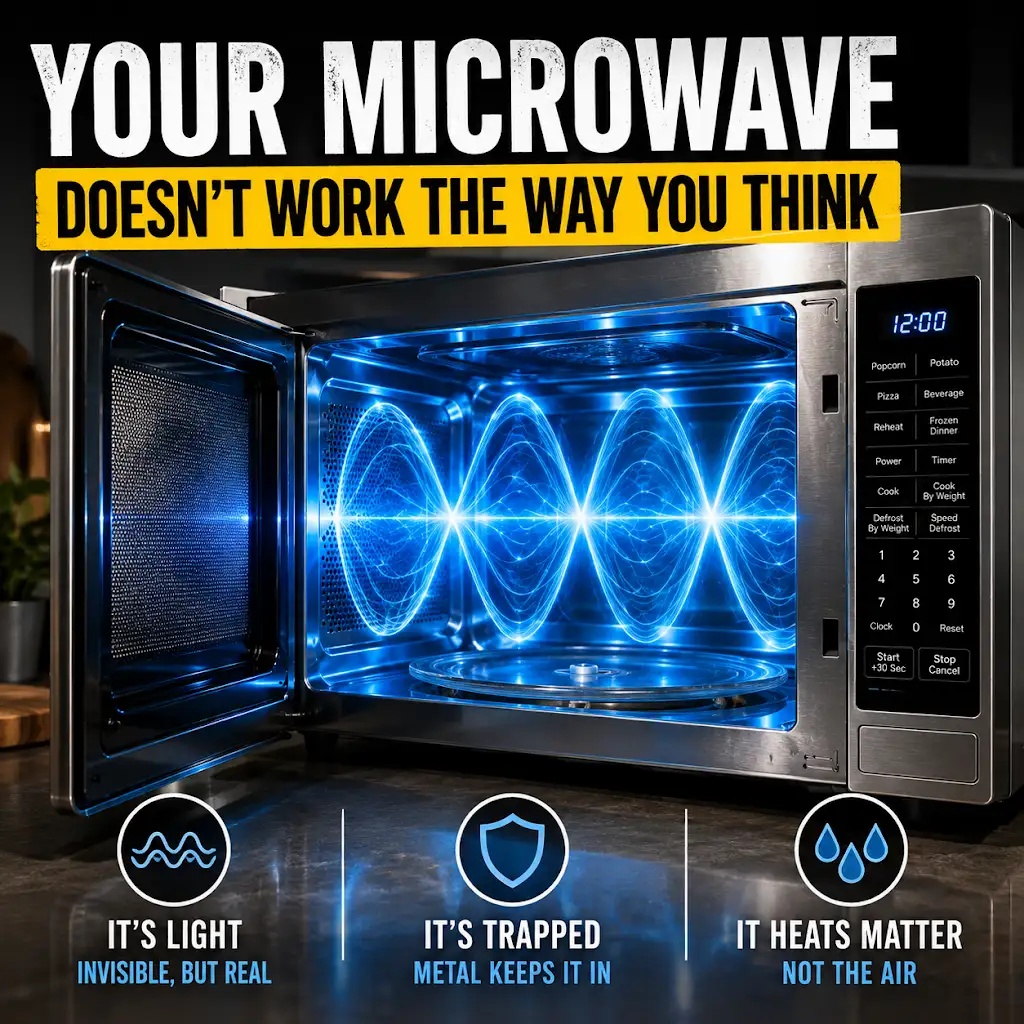
The metal construction of the microwave oven’s interior and exterior acts as a Faraday cage. A Faraday cage is an enclosure made of conductive material that blocks external electromagnetic fields and prevents internal ones from escaping. The metal walls reflect microwaves, keeping them bouncing around inside the cooking cavity.
The Door Seal: A Critical Barrier
The microwave door is equipped with a specialized seal, often made of a rubber or composite material. This seal is designed to be an airtight and electromagnetically impermeable barrier when the door is closed. It ensures that no microwaves escape during operation.
The Interlock Switches: Preventing Operation When Open
Perhaps the most crucial safety feature is the series of interlock switches. These are mechanical or electronic switches that are activated when the oven door is closed. If the door is not properly latched, or if one of the interlock switches is faulty, the microwave will not operate. These switches are designed in a way that makes it virtually impossible for the magnetron to generate microwaves unless the door is securely closed.
The Mesh Screen: A Visible Barrier
You’ll notice a mesh screen integrated into the glass of your microwave door. This mesh consists of small holes that are significantly smaller than the wavelength of the microwaves. While it allows you to see inside, the holes are too small for the microwaves to pass through, effectively acting as an additional barrier.
Regulatory Standards: Ensuring Safe Emission Levels
Microwave ovens are subject to strict regulatory standards set by government agencies. These standards dictate the maximum permissible leakage of microwave radiation from an oven. Manufacturers must design and test their ovens to ensure they meet these stringent safety requirements. When your oven is functioning correctly and intact, the amount of radiation that might escape is negligible and well within safe limits.
Your Microwave Doesn’t Work the Way You Think
FAQs
What is microwave radiation?
Microwave radiation is a type of electromagnetic radiation with wavelengths ranging from one meter to one millimeter, and frequencies between 300 MHz (1 m) and 300 GHz (1 mm).
How do microwave ovens generate microwave radiation?
Microwave ovens generate microwave radiation through a component called a magnetron. The magnetron takes electricity and converts it into high-powered microwave radiation.
Is microwave radiation harmful to humans?
Microwave radiation can be harmful to humans if exposure is at high levels. However, microwave ovens are designed with safety features to prevent leakage of microwave radiation during operation.
What safety measures are in place to prevent exposure to microwave radiation from ovens?
Microwave ovens are designed with a metal mesh in the door and safety interlock switches to prevent the oven from operating if the door is open. This prevents exposure to microwave radiation during operation.
What are the potential risks of exposure to high levels of microwave radiation?
Exposure to high levels of microwave radiation can cause tissue heating and burns. It is important to follow safety guidelines and use microwave ovens properly to minimize the risk of exposure.