You’re standing in your kitchen, admiring your new induction cooktop. It looks sleek, modern, and undeniably cool. But you’re also a little mystified. How does this thing, which doesn’t even look like it’s getting hot, manage to boil water so quickly and cook your food so evenly? You’ve probably heard the term “induction” thrown around, but the actual science behind it might feel a bit like magic. Well, prepare to demystify that magic, because you’re about to understand exactly how your induction stove heats metal so efficiently. It’s not sorcery; it’s brilliant physics, and once you grasp it, you’ll appreciate your cooktop even more.
At the heart of your induction stove lies a fascinating interaction between electricity and magnetism. You see, induction cooking doesn’t heat the stovetop itself in the way a traditional electric coil or gas burner does. Instead, it directly heats the cookware. This is achieved through the clever manipulation of electromagnetic fields.
How Electricity Creates Magnetism
You might recall from science class that whenever an electric current flows through a wire, it generates a magnetic field around that wire. This is a fundamental principle of electromagnetism. The strength and direction of this magnetic field are directly related to the amount and direction of the electrical current. Think of it like a tiny, invisible force field emanating from the wire.
The Role of Copper Coils
Beneath the smooth, ceramic surface of your induction cooktop, you’ll find a precisely engineered coil of copper wire. When you turn on your induction burner and place a compatible pot or pan on it, an alternating electric current is sent through this copper coil. This current, rapidly changing direction hundreds of times per second, generates a powerful, oscillating magnetic field. This magnetic field is the engine that drives the entire induction heating process.
The Induction Cooktop as an Electromagnet
Essentially, the copper coil in your induction stove acts as a large, powerful electromagnet. However, unlike a permanent magnet that has a fixed field, this electromagnet’s field is dynamic and constantly changing. This dynamism is crucial for the next step in the heating process. The strength of this oscillating magnetic field extends upwards, reaching into the base of your cookware.
Induction stoves utilize electromagnetic fields to directly heat metal cookware, making them an efficient and modern cooking option. For a deeper understanding of the science behind this technology, you can explore a related article that delves into the principles of induction heating and its advantages over traditional cooking methods. To read more, visit this article.
Introducing Eddy Currents: The Unseen Heaters
Now, here’s where the magic truly begins to reveal itself. For induction heating to occur, you need more than just a magnetic field; you need a material that can interact with that field in a specific way. This is where your specially designed cookware comes into play, and the key concept is the generation of eddy currents.
The Interaction Between Magnetic Field and Conductive Material
When the oscillating magnetic field from the copper coil penetrates the base of your cookware, it encounters a material that is electrically conductive. Most induction-compatible cookware, like cast iron and stainless steel with a magnetic base, is made of such materials. As the magnetic field lines weave their way through the metal, they induce tiny electrical currents within the metal itself. These are the “eddy currents.”
Lenz’s Law and Induced Currents
This phenomenon is explained by a principle known as Lenz’s Law. In simple terms, Lenz’s Law states that any change in magnetic flux through a circuit induces an electromotive force (EMF) and hence a current. In the case of your induction stove, the changing magnetic field from the coil induces a current within the conductive base of your pan. Because the magnetic field is constantly oscillating, the induced current within the pan also oscillates. These currents flow in swirling, circular patterns, hence the name “eddy currents.”
The Role of Cookware Material
It’s essential to understand that not all cookware materials are suitable for induction. You can’t just grab any old aluminum pot and expect it to work. The cookware needs to be ferromagnetic, meaning it can be attracted to a magnet. This property ensures that the material has sufficient magnetic permeability to effectively interact with the oscillating magnetic field and generate strong eddy currents.
Why Ferromagnetic Materials are Key
Ferromagnetic materials, such as iron and certain types of stainless steel, possess a molecular structure that allows them to become strongly magnetized when exposed to an external magnetic field. This strong magnetization is what allows them to efficiently “catch” the fluctuating magnetic field from the induction coil and generate substantial eddy currents. Non-ferromagnetic materials, like copper and aluminum, won’t generate enough eddy currents to heat up effectively on an induction cooktop.
Resistance is Futile: Generating Heat Through Hysteresis

While eddy currents are a primary driver of heat, especially in more conductive metals, there’s another crucial mechanism at play that contributes significantly to the efficiency of induction cooking, particularly with ferromagnetic cookware: hysteresis.
What is Magnetic Hysteresis?
Magnetic hysteresis refers to the lagging of magnetization behind the magnetizing field in ferromagnetic materials. In simpler terms, as the external magnetic field from the induction coil rapidly changes direction, the magnetic domains within the cookware material struggle to keep up. They are constantly being aligned and then misaligned with the changing field.
The Molecular Dance Within the Metal
Imagine millions of tiny magnets (magnetic domains) within the metal of your pan. As the external magnetic field fluctuates, these tiny magnets are forced to twist and turn, trying to align themselves with the incoming field. This constant molecular shuffling and friction generates heat. It’s like rubbing your hands together very, very rapidly – the friction creates warmth.
Hysteresis Losses and Heat Generation
The energy required to constantly realign these magnetic domains is dissipated as heat. This “hysteresis loss” is a direct consequence of the material’s magnetic properties and the rapidly alternating magnetic field. For induction cooking, this is a very desirable effect, as it converts electrical energy directly into thermal energy within the cookware itself.
The More Resistive, the Hotter
The degree to which a material exhibits hysteresis is related to its magnetic properties. Materials with higher magnetic permeability and coercivity tend to exhibit more significant hysteresis losses. This is another reason why specific ferromagnetic materials are chosen for induction-compatible cookware, as they are optimized for this heat-generating process.
The Power of Direct Heating: Unrivaled Efficiency
The real brilliance of induction cooking lies in its ability to heat the cookware directly, bypassing many of the energy losses associated with traditional cooking methods. This direct approach is what makes induction so incredibly efficient.
Energy Transfer from Cooktop to Cookware
In traditional electric stoves, a heating element (like a coil) gets hot, and then it transfers that heat to the cookware through radiation and conduction. This process is inherently inefficient because a significant amount of heat is lost to the surrounding air and the stovetop itself. With induction, the energy doesn’t need to heat the cooktop surface first. The magnetic field directly induces currents and magnetic losses within the base of the pan.
Minimizing Heat Dissipation
Because the heat is generated inside the cookware, there’s very little heat lost to the ambient environment. The cooktop surface remains relatively cool, and you don’t feel the blast of heat you would from a gas burner or a hot electric coil. This targeted heating means more of the energy you’re paying for is actually going into cooking your food.
Speed and Responsiveness: A Direct Consequence of Efficiency
This direct and efficient energy transfer leads to two of the most celebrated features of induction cooking: speed and responsiveness. Water boils incredibly fast, and when you turn the heat up or down, the cookware reacts almost instantaneously. This is because the heat generation is directly tied to the applied electrical power and the interaction with the cookware.
Instantaneous Temperature Control
When you adjust the power setting on your induction stove, you are directly controlling the strength of the oscillating magnetic field. This, in turn, directly influences the intensity of the eddy currents and hysteresis losses within your cookware. The result is an almost immediate change in the pan’s temperature, giving you unparalleled control over your cooking. This is a stark contrast to other electric cooktops where there’s a delay as the heating element heats up or cools down.
Induction stoves utilize electromagnetic fields to heat metal cookware directly, providing a more efficient cooking method compared to traditional gas or electric stoves. This technology works by inducing an electric current in the metal, which generates heat almost instantly. For a deeper understanding of how this innovative cooking method operates, you can explore a related article on the science behind induction heating at Freaky Science. This resource delves into the principles of electromagnetism and how they apply to everyday cooking appliances.
The Safety and Cleanliness Advantage
| Metric | Description | Typical Value | Unit |
|---|---|---|---|
| Frequency | Operating frequency of induction coil generating alternating magnetic field | 20,000 – 100,000 | Hz (Hertz) |
| Power Output | Electrical power supplied to the induction coil | 1000 – 3500 | Watts |
| Induced Eddy Current | Electric currents generated in the metal causing resistive heating | Varies with metal type and thickness | Amperes (A) |
| Heating Efficiency | Percentage of electrical energy converted to heat in the metal | 80 – 90 | % |
| Skin Depth | Depth at which the induced current density falls to 1/e of its surface value | 0.1 – 1.0 | mm (millimeters) |
| Temperature Rise Rate | Speed at which the metal temperature increases under induction heating | 10 – 50 | °C per second |
| Metal Types | Common metals suitable for induction heating | Cast iron, stainless steel, carbon steel | N/A |
Beyond its heating efficiency, the inherent design of induction cooking also contributes to a safer and cleaner kitchen environment. These benefits are direct byproducts of how the heat is generated.
A Cooler Cooktop Surface
As mentioned, the induction cooktop surface itself does not get directly hot. It’s only heated indirectly by residual heat from the cookware. This significantly reduces the risk of accidental burns, making it a much safer option, especially in households with children or pets. You can accidentally touch the surface after cooking, and while it might be warm, it won’t be searing hot like a traditional electric coil.
Reduced Risk of Fires
The fact that the cooktop itself isn’t a direct heat source also reduces the risk of fires. You’re less likely to scorch food that spills onto the surface, and there are no open flames to worry about. The heat is contained within the cookware, making it a more controlled and predictable cooking experience.
Effortless Cleaning
The smooth, flat, and cool surface of an induction cooktop makes cleaning a breeze. Spills don’t get baked onto a scorching hot surface. Instead, they can often be wiped away easily with a damp cloth. This ease of cleaning is a welcome benefit for anyone who spends time in the kitchen.
Non-Stick Properties of Spills
Because the cooktop surface doesn’t get as hot as other cooktops, food spills are less likely to caramelize and become permanently bonded to the glass. This means less scrubbing and more time enjoying your culinary creations.
In conclusion, your induction stove’s ability to heat metal efficiently is a testament to the elegant application of physics. By harnessing the power of electromagnetism to create eddy currents and leverage magnetic hysteresis directly within your cookware, it delivers unparalleled speed, responsiveness, and energy efficiency. It’s a sophisticated system that transforms electrical energy into culinary results with minimal waste, all while offering enhanced safety and a cleaner cooking experience. So, the next time you marvel at how quickly your water boils or how perfectly your steak sears, you’ll know it’s not magic; it’s the brilliant science of induction at work.
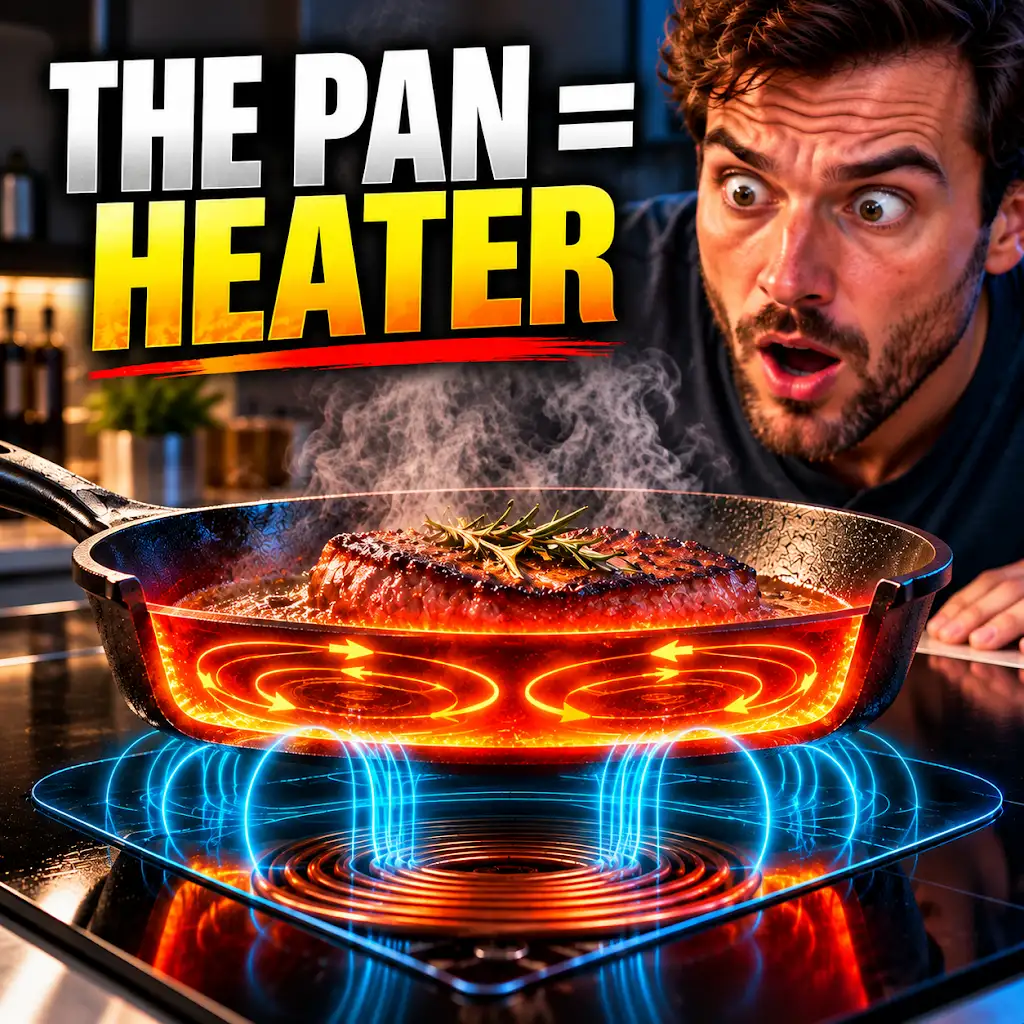
The Pan Is the Heater: How Induction Cooking Really Works
FAQs
What is an induction stove?
An induction stove is a type of cooktop that uses electromagnetic energy to heat pots and pans directly, rather than using a traditional heating element like gas or electric stoves.
How do induction stoves heat metal?
Induction stoves heat metal through electromagnetic induction. When a pot or pan made of a magnetic material is placed on the stove, an alternating current passes through a coil beneath the cooktop, creating a magnetic field. This magnetic field induces electrical currents in the metal cookware, generating heat.
What types of cookware can be used on induction stoves?
Cookware made of ferrous metals such as cast iron, stainless steel, or magnetic steel can be used on induction stoves. Non-magnetic materials like aluminum, copper, or glass will not work on these stoves unless they have a magnetic base.
Are induction stoves more energy-efficient than gas or electric stoves?
Yes, induction stoves are generally more energy-efficient than gas or electric stoves. They heat up faster, waste less heat, and provide precise temperature control, making them more efficient in cooking.
Are there any safety concerns with using induction stoves?
Induction stoves are generally safe to use, but there are a few safety concerns to be aware of. The cookware and the cooktop can get very hot during cooking, so it’s important to use caution and avoid touching them directly. Additionally, people with pacemakers or other medical devices that can be affected by electromagnetic fields should consult with their doctor before using induction stoves.