You’re standing in your kitchen, a glint of anticipation in your eye. You’ve just invested in an induction cooktop, and you’re ready to experience the future of cooking. But as you place your favorite heavy-bottomed pot onto the sleek, ceramic surface, you can’t help but wonder: how exactly does this magical thing heat your pan so quickly and efficiently? Forget those glowing red coils or dancing blue flames of the past. Induction is a different beast altogether, and understanding its inner workings will not only demystify the process but also deepen your appreciation for its technological marvel.
At its core, the efficiency of your induction cooktop hinges on a phenomenon known as electromagnetic induction. It’s a concept that sounds like it belongs in a science fiction novel, but it’s rooted in fundamental physics. Unlike traditional cooktops that heat the air around the pan or transfer heat through direct contact with a heating element, induction works by creating a magnetic field that directly interacts with the cookware itself. Think of it as a direct, invisible conduit of energy.
The Key Player: The Coil and the Electric Current
Beneath that smooth ceramic surface, you’ll find a coil of copper wire. This is the workhorse of your induction system. When you turn on your cooktop and place a compatible pan on it, an alternating electric current is sent through this copper coil. This alternating current is crucial because it generates a rapidly changing magnetic field around the coil. Imagine this magnetic field as an invisible, pulsating wave emanating from the cooktop. It’s this pulsating magnetic field that will ultimately do the heavy lifting of heating your food.
Generating the Field: The Power of AC
The “alternating” aspect of the current is what makes all the difference. A direct current (DC) flows in one direction, creating a static magnetic field. However, an alternating current (AC) constantly reverses its direction, oscillating back and forth thousands of times per second. This rapid oscillation is what causes the magnetic field to change its polarity and intensity at the same pace. This dynamic, fluctuating magnetic field is the essential ingredient for inducing the necessary electrical activity within your pan.
Induction cooktops are known for their efficient heating capabilities, which primarily stem from the principles of electromagnetic induction. When an induction cooktop is activated, it generates a magnetic field that directly heats the cookware, allowing for rapid and precise temperature control. For a deeper understanding of how this technology works and its advantages over traditional cooking methods, you can read a related article at Freaky Science. This resource provides insights into the science behind induction cooking and its impact on modern culinary practices.
The Magic Wand: Ferromagnetic Cookware and Eddy Currents
This is where the compatibility of your cookware becomes paramount. Not just any pot or pan will work on an induction cooktop. The magic only happens with cookware that contains ferrous (iron-containing) materials. This is why your favorite stainless steel pan with a magnetic base, cast iron skillet, or enameled cast iron pot are the perfect candidates. Aluminum, copper, or glass pans, while excellent on other cooktops, will likely remain stubbornly cool.
The Attraction: Why Magnets Matter
The reason for this is simple: ferrous metals are attracted to magnets. When the powerful, oscillating magnetic field generated by the induction coil encounters the ferrous material of your pan, it forces the free electrons within the metal to move. This movement of electrons is what we call an electric current. Think of the magnetic field as a shepherd, and the electrons in your pan as a flock of sheep, being herded back and forth in response to the shepherd’s movements.
The Inducers: Eddy Currents at Work
These induced currents within the pan are not just random electron jiggles. They flow in circular patterns, and because of their shape, they are known as “eddy currents.” These eddy currents are the direct source of heat in your induction cooking. As these currents flow through the resistance of the metal in your pan, they encounter friction. This friction, much like rubbing your hands together vigorously, generates heat. The faster and more intense the eddy currents, the more heat is produced.
The Resistance Factor: Turning Electricity into Heat
The efficiency of this heat generation isn’t just about the presence of eddy currents; it’s also about how much resistance those currents face. The material of your pan plays a crucial role here. Different metals have different electrical resistivities. Ferrous metals, while excellent conductors, also possess a certain degree of electrical resistance. It’s this resistance that converts the kinetic energy of the moving electrons (the eddy currents) into thermal energy – heat.
Material Matters: The Role of Resistivity
Metals like copper and aluminum are excellent electrical conductors with very low resistivity. This means that if you could induce currents in them, they would flow with minimal resistance, producing very little heat. However, iron and steel, the primary components of induction-compatible cookware, have significantly higher electrical resistivity. This higher resistance allows for a more substantial conversion of electrical energy into heat when the eddy currents flow. So, while the magnetic field induces the currents, the pan’s material determines how much heat those currents will generate.
The Power of Design: Pan Thickness and Base Construction
Beyond the raw material composition, the design of your pan’s base also contributes to heat efficiency. Thicker bases generally have more material for eddy currents to flow through, and their construction can be optimized to ensure even heat distribution. Manufacturers often incorporate layers of different metals, sometimes including aluminum or copper sandwiched between steel layers, to enhance both conductivity and heat distribution. This layered approach ensures that the heat generated by the eddy currents is spread uniformly across the base of the pan, preventing hot spots and ensuring consistent cooking.
The “Free” Energy Transfer: Minimizing Heat Loss
One of the most significant advantages of induction cooking is its remarkable efficiency in transferring heat directly to the pan, with minimal energy wasted. Unlike gas or electric coil cooktops, which rely on heating the surrounding air, induction essentially bypasses this intermediary step.
No Radiant Heat: The Silent Surface
With an induction cooktop, the ceramic surface itself doesn’t get intensely hot directly from the heating element. It only becomes warm due to the heat conducted back from the pan. This means that much less energy is lost to the environment through radiant heat. Imagine a traditional electric coil; a significant portion of its heat radiates outwards, warming your kitchen rather than solely focusing on your food. Induction, on the other hand, is like a laser pointer for heat, directing it precisely where you need it.
Direct Contact is Key: Eliminating Air Gaps
The efficiency is also amplified by the fact that the magnetic field and subsequent eddy currents are generated directly within the pan’s base. There’s no need for air to be heated and then transfer that heat to the pan. The energy is, in essence, transferred directly into the metal of your cookware. This direct energy transfer is far more efficient than indirect methods, leading to faster heating times and less energy consumption.
Induction cooktops are known for their efficiency in heating pans quickly and evenly, primarily due to the principle of electromagnetic induction. This technology allows the cooktop to generate heat directly in the cookware, rather than relying on an external heat source. For a deeper understanding of how this process works and its advantages over traditional cooking methods, you can read a related article on the topic at Freaky Science, which explores the science behind induction cooking and its impact on modern kitchens.
The Control and Precision: Why Induction Excels
| Metric | Description | Value/Explanation |
|---|---|---|
| Heating Method | Type of heat transfer used by induction cooktops | Electromagnetic induction |
| Frequency of Electromagnetic Field | Typical operating frequency range | 20 kHz to 50 kHz |
| Pan Material Requirement | Type of cookware compatible with induction heating | Ferromagnetic materials (e.g., cast iron, stainless steel) |
| Heat Generation Location | Where heat is generated in the cooking process | Directly in the pan’s metal base via eddy currents |
| Energy Efficiency | Percentage of energy transferred to the pan | Approximately 85-90% |
| Heat-Up Time | Time taken to heat the pan compared to traditional cooktops | Faster, typically within seconds to a few minutes |
| Safety Feature | Cooktop surface temperature during operation | Remains relatively cool since heat is generated in the pan |
The efficiency of induction isn’t just about raw power; it’s also about the exquisite control and precision it offers. This precision stems from the direct relationship between the electrical power supplied and the heat generated in the pan.
Instantaneous Response: Like a Gas Flame, but Better
When you adjust the power setting on your induction cooktop, you’re not indirectly telling a heating element to get hotter or cooler. You are directly altering the strength of the magnetic field and, consequently, the intensity of the eddy currents. This means the heat response is virtually instantaneous. Turn the dial up, and the pan heats up immediately. Turn it down, and it cools down just as quickly. This responsiveness is akin to cooking with a gas flame, but without the drawbacks of open flames or wasted heat.
Precise Temperature Management: No More Guesswork
This immediate feedback loop allows for incredibly precise temperature control. Whether you’re simmering a delicate sauce or searing a steak, you can fine-tune the heat with remarkable accuracy. The cooktop doesn’t “lag” behind your adjustments, meaning you’re not constantly overshooting or undershooting your desired temperature. This level of control leads to more consistent cooking results and a significant reduction in the risk of burning or undercooking your food.
The Magnetic Field’s Finesse: Beyond Simple Heat
The oscillating magnetic field isn’t just a brute force heater. Its rapid oscillations and the way it induces currents in the pan are surprisingly sophisticated. The frequency and strength of the magnetic field can be finely tuned by the cooktop’s internal electronics. This allows for different “power levels” that aren’t just arbitrary numbers but represent distinct patterns of eddy current generation, optimized for different cooking tasks. This is why you might have settings for “simmer,” “sear,” or “boil” that feel distinctly different and produce superior results compared to simply turning a dial up or down on a less sophisticated appliance.
In conclusion, your induction cooktop is a marvel of modern engineering. It harnesses the fundamental principles of electromagnetism to create a cooking experience that is faster, more efficient, and more precise than ever before. The invisible dance of the magnetic field, the dance of electrons within your ferrous cookware, and the inherent resistance of the metal all conspire to deliver heat directly to your food with minimal waste. So, the next time you’re enjoying a perfectly cooked meal from your induction cooktop, take a moment to appreciate the elegant science that made it all possible. You’re not just cooking; you’re participating in a subtle yet powerful display of physics.
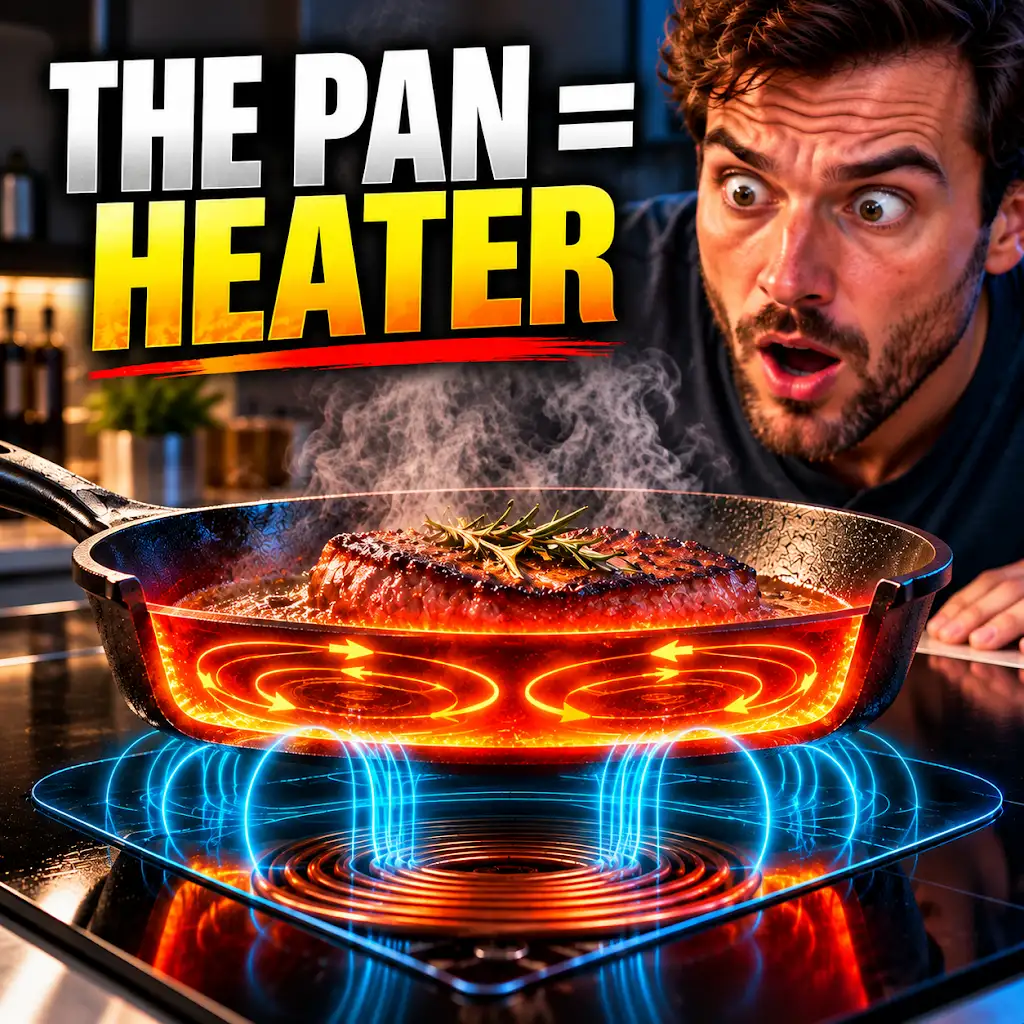
The Pan Is the Heater: How Induction Cooking Really Works
FAQs
1. How do induction cooktops heat the pan?
Induction cooktops use electromagnetic energy to directly heat the pan through magnetic induction. The cooktop creates a magnetic field that excites the iron molecules in the pan, causing it to heat up.
2. Are induction cooktops more efficient than traditional gas or electric stoves?
Yes, induction cooktops are more efficient because they heat the pan directly, rather than heating a burner that then heats the pan. This results in faster cooking times and less energy wasted.
3. Do induction cooktops require special cookware?
Yes, induction cooktops require cookware that is magnetic in order to work properly. Cookware made of materials like cast iron, stainless steel, or certain types of magnetic aluminum are compatible with induction cooktops.
4. Are induction cooktops safer to use compared to gas or electric stoves?
Induction cooktops are considered safer to use because they do not have open flames or exposed heating elements. The cooktop itself remains cool to the touch, reducing the risk of burns or fires.
5. Can induction cooktops be used with all types of recipes and cooking techniques?
Yes, induction cooktops can be used for a wide variety of recipes and cooking techniques. They offer precise temperature control and quick heat adjustments, making them versatile for tasks like simmering, boiling, sautéing, and more.