The subtle dance of water molecules, seemingly passive in its liquid state, holds a remarkable secret: the ability to conjure frost and ice through the very process of its departure. Evaporative cooling, a fundamental principle of thermodynamics, is not merely responsible for the refreshing sensation on one’s skin after a dip in a pool or the drying of clothes on a line. It is also a potent, albeit often overlooked, force in the formation of ice, particularly in natural environments where it can transform damp surfaces into delicate crystalline landscapes. Understanding this phenomenon requires delving into the molecular behavior of water and the energy exchanges that govern its phase transitions. It is a process that, while seemingly counterintuitive – how can something getting colder be caused by something leaving? – is a direct consequence of the kinetic energy distribution within a liquid.
The Molecular Ballet of Evaporation
At its heart, evaporative cooling is a story of molecular escape. Water, like any liquid, is a dynamic system composed of molecules in constant motion. These molecules possess varying amounts of kinetic energy, a measure of their speed and intensity of vibration. While the average kinetic energy of the molecules determines the temperature of the liquid, there is a distribution, with some molecules moving faster (possessing higher kinetic energy) and others slower. Evaporation occurs when these high-energy molecules, residing at the liquid’s surface, gain enough momentum to overcome the intermolecular forces holding them within the liquid. They break free and transition into the gaseous state, becoming water vapor.
The Energetic Cost of Freedom
The crucial aspect of this molecular exodus is the energy expenditure. When the most energetic molecules leave the liquid, they take their kinetic energy with them. This leaves behind the molecules with lower kinetic energy. Consequently, the average kinetic energy of the remaining liquid molecules decreases. Since temperature is a direct reflection of the average kinetic energy of the particles within a substance, this reduction in average kinetic energy leads to a drop in the liquid’s temperature. It is this lowering of temperature that constitutes evaporative cooling. The more rapid the evaporation, the more energy is removed, and the more pronounced the cooling effect.
Factors Influencing Evaporation Rate
Several environmental factors dictate how quickly evaporation occurs, and by extension, how effective evaporative cooling will be. The most significant of these is humidity. When the air is already saturated with water vapor, the rate of evaporation slows considerably because the air molecules are less able to accept additional water molecules. Conversely, dry air can readily absorb water vapor, accelerating evaporation. Wind also plays a critical role. A gentle breeze can whisk away the humid air that accumulates just above the water’s surface, replacing it with drier air, thus promoting continuous evaporation. Surface area is another key factor; a wider, shallower body of water will evaporate faster than a deep, narrow one because more molecules are exposed to the air.
Evaporative cooling is a fascinating process that can lead to the formation of ice under specific conditions, particularly in environments where humidity is low. For a deeper understanding of this phenomenon and its implications, you can explore the article on Freaky Science, which discusses various aspects of evaporative cooling and its effects on temperature regulation. To read more, visit this article.
From Coolness to Crystallization: The Path to Ice
Evaporative cooling, while capable of producing significant temperature drops, does not directly cause ice formation in most everyday scenarios. The ambient temperature typically needs to be at or below freezing for ice to form. However, evaporative cooling acts as a powerful facilitator, pushing temperatures lower than they might otherwise be, thereby creating conditions conducive to freezing, especially in specific environmental niches. Imagine a situation where the air temperature is just a few degrees above freezing, say 5°C (41°F). Without evaporative cooling, water at this temperature will remain liquid. However, if conditions are right for significant evaporation, the water can cool down considerably. If the evaporation is rapid enough, the water’s temperature can be drawn down to 0°C (32°F) and even below, entering the supercooled state.
The Supercooled State: A Precarious Balance
Supercooling is a fascinating phenomenon where a liquid is cooled below its freezing point without solidifying. This state is inherently unstable. The water molecules are still in motion, but their kinetic energy is low enough that the attractive forces between them can begin to assert themselves, forming nascent ice crystals. However, without a trigger, such as a disturbance or an impurity, these small clusters of molecules may not grow into a stable ice crystal. Evaporative cooling can, in a sense, “prepare” the water for freezing by lowering its temperature to this supercooled state. It’s like getting the ingredients ready, but not quite baking the cake yet.
Ice Nucleation: The Spark of Solidification
For ice to form from supercooled water, a process called nucleation must occur. Nucleation is the initial formation of a stable crystalline structure. In the context of freezing water, this typically involves the formation of a small ice crystal. This crystal can arise spontaneously from the random arrangement of water molecules, but this is a rare event. More commonly, nucleation is initiated by a “nucleation site.” These sites can be microscopic impurities present in the water (like dust particles or dissolved minerals), or even rough surfaces. When a supercooled water droplet encounters a suitable nucleation site, the water molecules can arrange themselves around it, forming a stable ice nucleus that can then grow into a larger ice crystal. Evaporative cooling, by bringing the water to the supercooled state, makes it much more susceptible to nucleation events.
Natural Niches Where Evaporative Cooling Drives Ice Formation
While the widespread freezing of lakes and rivers is primarily driven by ambient air temperatures falling below 0°C, there are specific natural environments where evaporative cooling plays a dominant role in ice formation, even when the overall air temperature is not significantly below freezing. These are often microclimates where evaporation is exceptionally efficient.
Frost Flowers: Delicate Sculptures of Frozen Dew
One of the most striking examples of ice formation driven by evaporative cooling is the phenomenon of “frost flowers.” These ethereal, ribbon-like ice structures form on plant stems, typically in the late autumn or early winter, when the air temperature is just at or slightly above freezing, but the ground is still unfrozen and moist. As the night progresses and the air cools, any remaining moisture on the plant stems begins to evaporate. The evaporation draws heat from the stem, cooling the surrounding water to below freezing. Since the plant tissue is still slightly warmer than the air and continues to release moisture, the cooled water on the surface begins to freeze. This process continues as more water is drawn up from the stem and evaporates, extruding thin, delicate ice filaments that are sculpted by the continued evaporation and freezing. The wind can play a role here, as it accelerates evaporation, helping to create the characteristic petal-like structures.
Ice Pillars on Moist Surfaces: Towers of Frozen Vapor
Similar to frost flowers, ice pillars can form on moist soil or other damp surfaces under specific conditions. If the air temperature is close to freezing and there is sufficient moisture in the soil, evaporation from the surface will occur. This evaporation cools the water at the surface, leading to ice formation. As more water is drawn up from below and evaporates, it freezes, gradually building up tall, slender ice pillars. These structures often appear like delicate, white needles or columns. The continuous supply of water from the soil and the constant evaporation are key to their formation, with evaporative cooling acting as the engine that drives the temperature down to the freezing point.
The Thermodynamics Behind the Frost
To fully appreciate how evaporative cooling can lead to ice, a grasp of basic thermodynamic principles is essential. The process is governed by the first and second laws of thermodynamics, specifically concerning energy conservation and entropy. When water evaporates, it undergoes a phase change from liquid to gas. This transition requires energy input to break the intermolecular bonds. This energy is drawn from the internal kinetic energy of the remaining liquid molecules.
Latent Heat of Vaporization and Freezing
The energy required to convert a substance from a liquid to a gas at a constant temperature is known as the latent heat of vaporization. For water, this is a substantial amount of energy. When water evaporates, it absorbs this latent heat from its surroundings, including the water itself. This absorption of heat is what causes the cooling effect. Conversely, when water freezes, it releases a similar amount of energy, known as the latent heat of fusion. However, in the context of evaporative cooling leading to ice, the primary energy transfer is the absorption of latent heat of vaporization, which lowers the temperature to the freezing point. Once freezing begins, the release of the latent heat of fusion can actually slow down the rate of further freezing, as this released heat must also be dissipated.
Energy Balance and Equilibrium
The formation of ice through evaporative cooling is a dynamic equilibrium of energy exchanges. For ice to form and persist, the rate at which heat is removed through evaporation must be sufficient to counteract the heat input from the surrounding environment and the latent heat released during freezing. In the case of frost flowers and ice pillars, the continuous supply of moisture from the ground or plant stems, coupled with a favorable wind and air temperature, ensures that evaporation remains high enough to drive the temperature down to the freezing point and sustain the ice formation process. The system is constantly trying to reach thermal equilibrium, but the continuous process of evaporation disrupts this, maintaining a localized state of cooling.
Evaporative cooling is a fascinating process that not only helps in regulating temperature but can also lead to the formation of ice under specific conditions. For a deeper understanding of this phenomenon, you can explore an insightful article on the topic at Freaky Science. This resource delves into the science behind how evaporative cooling can contribute to ice formation, shedding light on the intricate balance of temperature and humidity in our environment.
Practical Implications and Broader Significance
| Parameter | Value | Unit | Description |
|---|---|---|---|
| Initial Water Temperature | 20 | °C | Starting temperature of water before evaporative cooling |
| Ambient Air Temperature | 10 | °C | Temperature of surrounding air during cooling |
| Relative Humidity | 40 | % | Humidity level affecting evaporation rate |
| Evaporation Rate | 0.5 | g/min | Mass of water evaporated per minute |
| Cooling Rate | 0.3 | °C/min | Rate at which water temperature decreases |
| Time to Ice Formation | 45 | min | Duration until ice starts to form |
| Ice Thickness | 2 | cm | Thickness of ice layer formed by evaporative cooling |
| Latent Heat of Vaporization | 2260 | kJ/kg | Energy required to evaporate water |
The phenomenon of ice formation through evaporative cooling, while often producing small-scale and ephemeral ice structures, carries broader implications and practical applications, both in natural systems and in human endeavors. Understanding this process can inform strategies for frost prevention in agriculture and shed light on the intricate ways that natural forces shape landscapes.
Agricultural Applications and Frost Prevention
In agriculture, understanding evaporative cooling is crucial for protecting crops from frost damage. While some methods of frost protection involve directly adding water to increase the thermal mass of the soil or plants, the principles of evaporative cooling highlight the importance of managing moisture and air movement. For instance, in certain conditions, excessive evaporation can lead to chilling of plants. Conversely, in regions prone to early frosts, techniques that encourage controlled evaporation might be employed strategically. The creation of mist or fog, which involves suspending tiny water droplets in the air, can also leverage evaporative cooling principles. As these droplets evaporate, they cool the surrounding air, potentially keeping delicate crops above the critical freezing point.
Environmental Insights and Climate Dynamics
On a larger scale, the interplay between evaporation, cooling, and ice formation is a subtle yet significant component of climate dynamics. While direct ice formation through widespread evaporative cooling is rare, the principle contributes to the overall energy balance of terrestrial and aquatic systems. For example, the cooling effect of evaporation from oceans and land surfaces influences local air temperatures and contributes to atmospheric circulation patterns. Understanding these microclimates where ice forms through this mechanism can also provide insights into the sensitivity of certain ecosystems to changes in temperature and moisture availability, making them indicators of broader climatic shifts. The study of such phenomena can help refine climate models and improve our understanding of how water and energy interact within Earth’s complex systems.
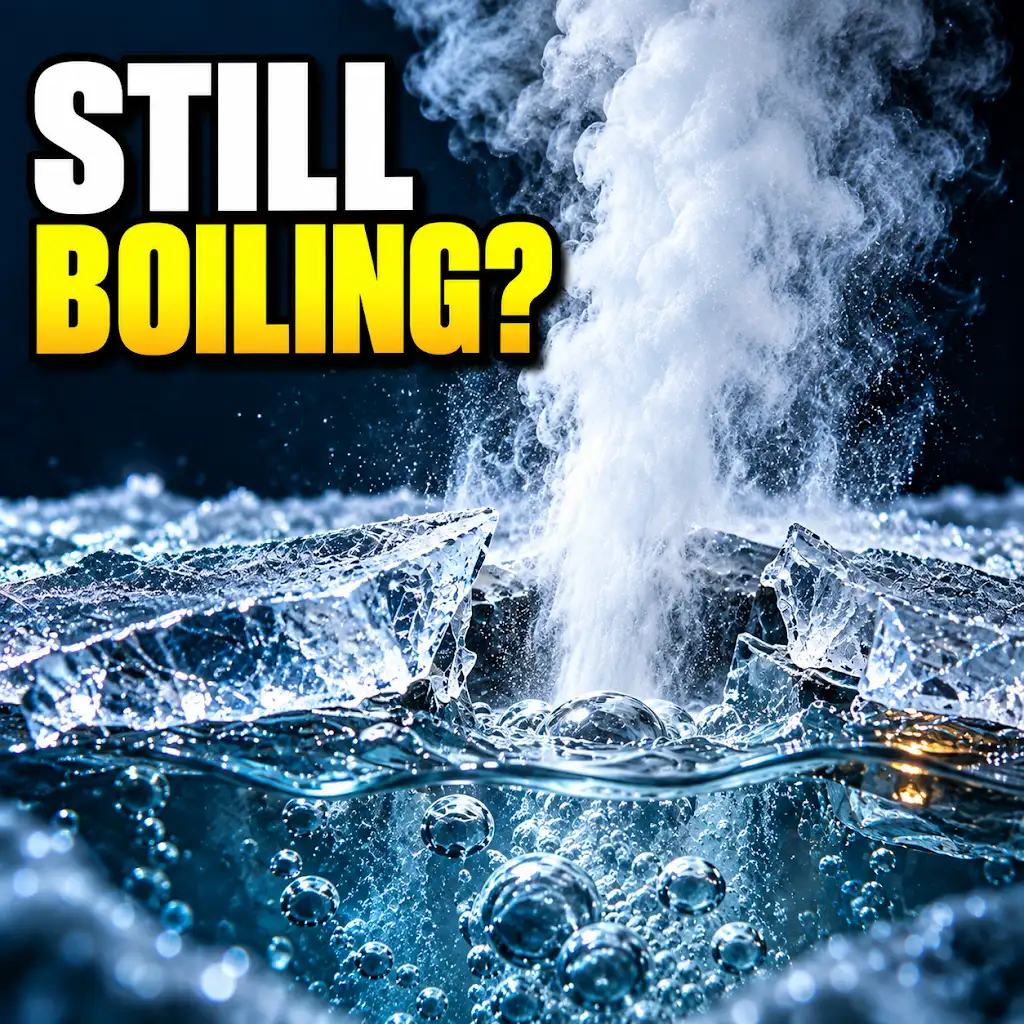
Water Boiled While Ice Formed. Could a Lander Sink Into It?
FAQs
What is evaporative cooling?
Evaporative cooling is a natural process where a liquid evaporates and absorbs heat from its surroundings, causing a cooling effect.
How is ice formed by evaporative cooling?
Ice can be formed by evaporative cooling when water evaporates from a surface, such as a metal plate, and the remaining water molecules lose energy, causing the temperature to drop below freezing and forming ice.
Can evaporative cooling be used to make ice in hot climates?
Yes, evaporative cooling can be utilized to make ice in hot climates by using devices like clay pots or cooling chambers that allow water to evaporate and create a cooling effect that can freeze water into ice.
What are some practical applications of ice formed by evaporative cooling?
Ice formed by evaporative cooling can be used for preserving food, providing relief from heat in hot climates, and even for creating ice sculptures or decorations.
Is ice formed by evaporative cooling different from ice formed in a freezer?
Yes, ice formed by evaporative cooling is typically less dense and may have a different crystal structure compared to ice formed in a freezer, which can affect its melting rate and other properties.