You’re standing in your kitchen, the aroma of perfectly heated leftovers wafting from the microwave. It’s a daily ritual, but have you ever stopped to wonder how those invisible waves are making your food hot so quickly and efficiently? You’re about to find out.
Before diving into the specifics of how your food gets heated, it’s crucial to grasp the fundamental concept of electromagnetic radiation. Think of it as a spectrum of energy that travels in waves, much like ripples on a pond. These waves are comprised of oscillating electric and magnetic fields, propagating through space at the speed of light. The key differentiator between different types of electromagnetic radiation – from radio waves to gamma rays – is their wavelength and frequency.
The Electromagnetic Spectrum: A Wide Range of Waves
You’ve likely encountered various forms of electromagnetic radiation in your daily life, even if you haven’t thought of them as such.
Radio Waves: The Longest Wavelengths
At the lower frequency, longer wavelength end of the spectrum are radio waves. These are the unsung heroes behind your radio broadcasts, Wi-Fi signals, and mobile phone communications. They possess enough energy to travel vast distances and carry information without significantly interacting with most matter.
Microwaves: The Sweet Spot for Cooking
Just above radio waves in frequency (and therefore shorter in wavelength) lie microwaves. This is where the magic happens for your kitchen appliances. Microwaves used in ovens typically fall within a specific frequency range, around 2.45 gigahertz (GHz). This particular frequency is chosen for a very good reason, which we’ll explore in detail later.
Infrared Radiation: Heat You Can Feel
Next up are infrared waves, which you experience directly as heat. Think about the warmth radiating from a campfire or a hot stove element. Infrared radiation is responsible for this sensation because its wavelengths are particularly adept at exciting the molecules within objects, causing them to vibrate and generate heat.
Visible Light: The Colors We See
This is the narrow band of the spectrum that our eyes can detect. Different wavelengths within visible light correspond to the different colors we perceive, from red (longer wavelengths) to violet (shorter wavelengths). While visible light can carry energy, it’s not the primary mechanism for heating food in a microwave.
Ultraviolet (UV) Radiation: Beyond Visible Light
As we move to shorter wavelengths and higher frequencies, we encounter ultraviolet radiation. While the sun emits UV rays, excessive exposure can be harmful, leading to sunburn. UV radiation carries more energy than visible light.
X-rays and Gamma Rays: High Energy and Penetration
At the very high frequency, short wavelength end of the spectrum are X-rays and gamma rays. These are extremely energetic forms of radiation, capable of penetrating deep into matter. While they have important medical and industrial applications, they are far too energetic and potentially damaging for everyday food heating.
Wave-Particle Duality: More Than Just Waves
It’s important to note that electromagnetic radiation also exhibits particle-like behavior, meaning it can be thought of as discrete packets of energy called photons. The energy of a photon is directly proportional to the frequency of the radiation. This wave-particle duality is a fundamental concept in quantum mechanics and helps explain how these waves interact with matter at a molecular level.
Electromagnetic radiation plays a crucial role in the heating process of food, particularly in microwave ovens, where it excites water molecules and generates heat. For a deeper understanding of how this phenomenon works and its implications in cooking, you can explore a related article on the topic at Freaky Science. This resource delves into the science behind electromagnetic waves and their interaction with various food substances, providing insights into the efficiency and effectiveness of microwave cooking.
The Molecular Dance: How Microwaves Interact with Food
Now that you have a foundational understanding of electromagnetic radiation, let’s focus on the star of the show: microwaves and their interaction with the molecules within your food. The efficiency of microwave heating hinges on the specific properties of certain molecules found in virtually all foods.
The Importance of Polar Molecules: Water, Fats, and Sugars
The key to microwave heating lies in the presence of polar molecules. A polar molecule has an uneven distribution of electron density, meaning it has a slightly positive end and a slightly negative end. Think of it like a tiny magnet.
Water: The Primary Target
Water is by far the most abundant polar molecule in most foods. A water molecule (H₂O) is bent, with the oxygen atom pulling more strongly on the shared electrons than the hydrogen atoms. This creates a permanent dipole moment, making water molecules highly responsive to electromagnetic fields.
Fats and Oils: Also Polar, but Less So
Fats and oils are also polar, though generally less so than water. Their interaction with microwaves contributes to the overall heating process, especially in foods with a higher fat content.
Sugars and Proteins: Contributing to the Mix
Sugars and proteins also contain polar groups and can absorb microwave energy, contributing to the heating of food. However, their dielectric properties (how well they absorb electrical energy) are generally lower than that of water.
The Electric Field’s Influence: Making Molecules Wiggle
When microwaves, which are electromagnetic waves containing oscillating electric fields, pass through food, they interact with these polar molecules. The electric field constantly changes direction.
Alignment and Reorientation: The Molecular Tug-of-War
Imagine your polar water molecules as tiny compass needles. When an electric field is applied, these needles try to align themselves with the field. As the electric field rapidly oscillates back and forth (billions of times per second at 2.45 GHz), the polar molecules are forced to constantly reorient themselves to follow the changing field.
Friction and Heat Generation: The Result of Constant Movement
This incessant, rapid reorientation causes the molecules to bump into each other and vibrate vigorously. This molecular friction is what generates heat. It’s akin to rubbing your hands together rapidly – the friction creates heat. In microwave heating, this happens at a microscopic level, throughout the food.
Dielectric Heating: The Scientific Term
The process of heating materials by the absorption of electromagnetic radiation, particularly in the microwave frequency range, is scientifically known as dielectric heating. It’s the interaction between the oscillating electric field of the microwaves and the dielectric properties of the material (its ability to store electrical energy in an electric field) that drives the heating process.
The Microwave Oven: A Controlled Environment for Heating

Your microwave oven isn’t just a box that bombards food with invisible waves. It’s a carefully engineered appliance designed to efficiently deliver and control this energy for optimal cooking.
The Magnetron: The Heart of the Microwave
The crucial component responsible for generating microwaves in your oven is the magnetron. This is a vacuum tube that utilizes a strong magnetic field and a high-voltage electric field to accelerate electrons.
Generating the Waves: From Electricity to Microwaves
As these energetic electrons move, they interact with resonant cavities within the magnetron, causing them to emit high-frequency electromagnetic radiation – microwaves. The magnetron essentially converts electrical energy into microwave energy.
The Waveguide: Directing the Power
Once generated, the microwaves need to be channeled to the cooking cavity. This is the job of the waveguide, a hollow metal tube that efficiently guides the microwave energy from the magnetron to the oven cavity.
The Cavity and Stirrer/Turntable: Ensuring Even Heating
The cooking cavity itself is designed to reflect microwaves. However, microwave energy can create “hot spots” and “cold spots” due to the wave nature of the radiation. To counteract this, microwave ovens employ strategies to ensure more uniform heating.
The Turntable: Rotating the Food
Many microwave ovens have a turntable that rotates the food. This simply moves the food through different positions within the standing wave pattern created by the microwaves, exposing different parts of the food to varying intensities of radiation over time.
The Stirrer: Reflecting and Scattering Waves
Some older or higher-end models might feature a stirrer, a fan-like metal blade that rotates within the oven cavity. The stirrer reflects and scatters the microwaves in different directions, helping to distribute the energy more evenly throughout the cavity.
Safety Features: Keeping the Waves Contained
Microwave ovens are designed with safety in mind, incorporating features to prevent microwave leakage.
The Metal Cavity: A Faraday Cage
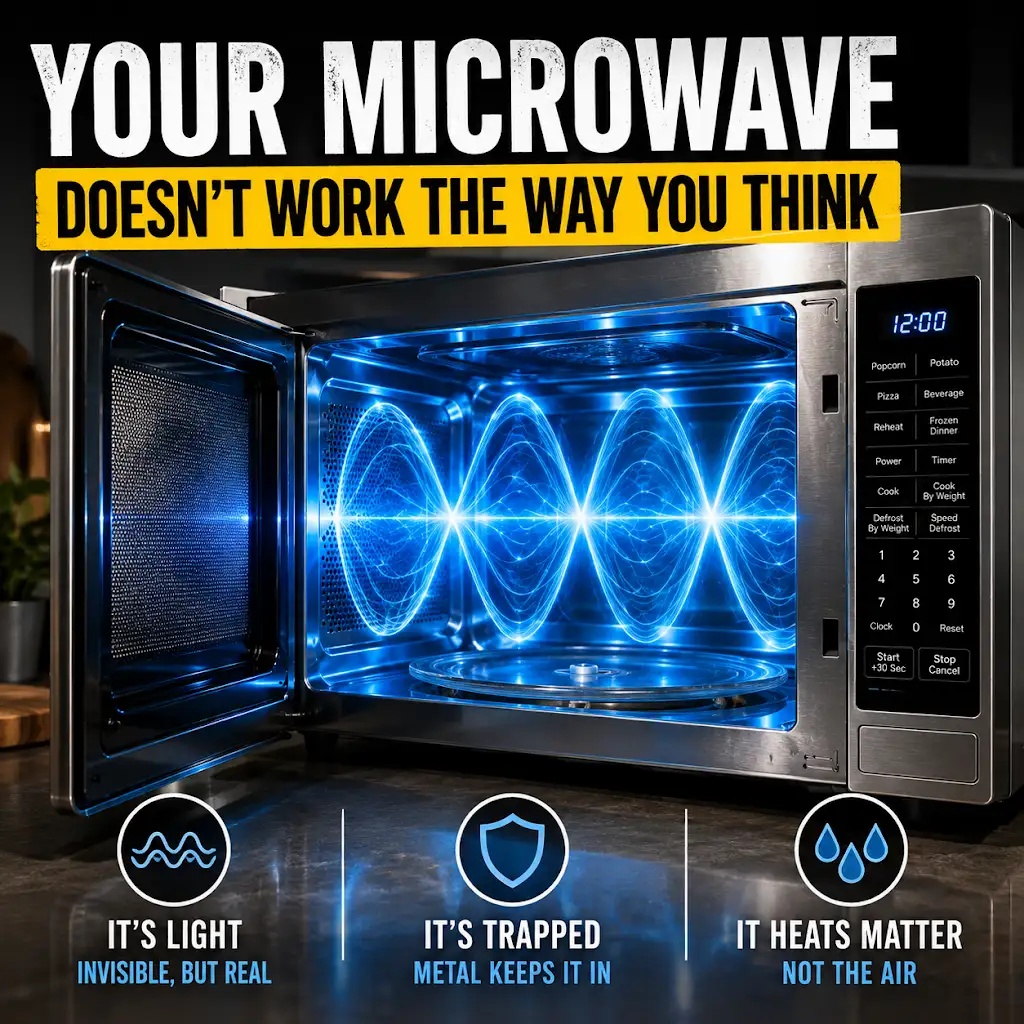
The metal construction of the oven cavity acts as a Faraday cage, effectively containing the microwaves within the oven. This prevents them from escaping into your kitchen.
The Door Seal and Interlock Switches: Preventing Escape
The door features a specialized mesh screen that allows you to see inside but is fine enough to block microwave radiation. Interlock switches ensure that the magnetron automatically shuts off as soon as the door is opened, preventing any accidental exposure.
The Efficiency of Microwave Heating: Why It’s So Fast

You’ve experienced it firsthand: food heats up in a microwave in minutes, not hours. This remarkable speed is a direct result of the way microwaves interact with food, and it’s a testament to the efficiency of dielectric heating.
Direct Energy Transfer: Heating from Within
Unlike conventional ovens that heat food from the outside in using conduction and convection, microwaves penetrate the food and excite polar molecules directly throughout a certain depth. This means the energy is being generated within the food itself, rather than being transferred slowly from the surface inwards.
Penetration Depth: How Far the Waves Go
Microwaves don’t penetrate infinitely deeply into food. The penetration depth depends on the food’s composition and the microwave frequency. For typical foods and at 2.45 GHz, microwaves can penetrate a few centimeters. This allows for relatively rapid heating of thicker items.
Rapid Molecular Excitation: The Speed of the Dance
As discussed earlier, the rapid oscillation of the electric field causes polar molecules to reorient at an incredibly high rate. This fast-paced molecular dance translates directly into rapid heat generation. The energy transfer is almost instantaneous at the molecular level.
Selective Heating: Targeting the Right Molecules
Microwaves are most efficiently absorbed by polar molecules, particularly water. This selective heating is one of the reasons for their speed. Foods with higher water content will heat faster. This also explains why some foods might cook unevenly – areas with less water may heat more slowly.
Reduced Heat Loss: Minimizing Energy Waste
Because the heat is generated internally, there is less heat loss to the surrounding environment compared to conventional cooking methods. In a conventional oven, a significant amount of energy is used to heat the air inside the oven and the oven walls themselves. In a microwave, the energy is primarily focused on the food.
Time and Energy Savings: A Practical Benefit
The efficiency of microwave heating translates into significant time and energy savings for you. You can prepare meals, reheat leftovers, or defrost frozen items much faster than with traditional methods, using less overall energy.
Electromagnetic radiation plays a crucial role in the way food is heated, particularly in microwave ovens, where the radiation excites water molecules, causing them to vibrate and generate heat. This fascinating process is explored in greater detail in a related article that delves into the science behind food heating methods. For those interested in understanding the intricate workings of this technology, you can read more about it in this informative piece on Freaky Science.
Considerations for Optimal Microwave Cooking: Beyond Just Pressing “Start”
| Frequency of Electromagnetic Radiation | Effect on Food |
|---|---|
| 2.45 GHz | Causes water molecules in food to vibrate and generate heat |
| Penetrates food up to 1 inch | Heats food from the inside out |
| High frequency waves | Quickly heats food without heating the surrounding air |
While microwaves offer incredible convenience and speed, achieving the best results requires a little understanding of how they work. Simply throwing food in and pressing a button might not always yield the perfect outcome.
Arranging Food for Evenness: The Art of Placement
The way you arrange food in a microwave can have a big impact on how evenly it heats.
The Doughnut Hole Principle: Creating Space
For larger, irregularly shaped items, it’s often beneficial to arrange them in a ring or “doughnut hole” shape, with the denser, thicker parts facing outwards. This allows microwaves to reach the center more effectively.
Thicker Parts Towards the Outside: Strategic Positioning
When heating multiple items or a single large item, place the thicker, denser parts closer to the outer edges of the turntable, where microwave energy is generally more intense.
Overlapping and Clumping: What to Avoid
Avoid overlapping food items as much as possible. This creates cold spots where one piece of food shields another from the microwaves. Similarly, avoid letting food clump together in dense masses.
Covering Your Food: Trapping Steam and Preventing Splatter
Covering food in the microwave is often a good idea, but it needs to be done correctly.
Venting is Key: Releasing Steam Safely
Always vent covers to allow steam to escape. You can do this by leaving a small gap in the lid, using microwave-safe plastic wrap and poking holes, or using a vented microwave cover. Trapped steam can build up pressure and cause explosions.
Benefits of Covering: Moisture Retention and Even Heating
Covering helps to trap moisture, preventing food from drying out, and can promote more even heating by distributing steam. It also helps to prevent splattering, keeping your microwave cleaner.
Stirring and Rotating: The Mid-Cook Check
For longer cooking times or thicker items, interrupting the cooking process to stir or rotate the food is crucial for achieving uniform results.
The Importance of Mid-Cook Intervention
Even with a turntable, some hot and cold spots can persist. Stirring or rotating the food partway through the cooking time helps to redistribute the heat and ensure all parts cook evenly.
Checking for Doneness: The Final Frontier
After the initial cooking time, it’s always a good idea to check for doneness. Use a fork or knife to test the tenderness, and if necessary, continue cooking in short bursts, checking frequently.
Understanding Microwave-Safe Cookware: The Material Matters
Not all cookware is created equal when it comes to microwave use. Using the wrong materials can be ineffective or even dangerous.
Plastics: Use with Caution
Many plastics are safe for microwave use, but always look for the “microwave-safe” label. Older or damaged plastic containers can leach chemicals into your food when heated. Avoid using thin, disposable plastic containers that aren’t explicitly microwave-safe.
Glass and Ceramic: Generally Safe
Most glass and ceramic dishes are microwave-safe, provided they don’t have metallic trim or decorations. These metallic elements can cause arcing (sparks) and damage your microwave.
Metal: A Big No-No
Metal containers, aluminum foil, and dishes with metallic accents are generally not microwave-safe. They reflect microwaves, preventing the food from heating, and can cause dangerous arcing that can damage the appliance.
Defrosting Techniques: Gentle Heat for Frozen Foods
Defrosting in the microwave can be tricky. While convenient, it can easily lead to partially cooked spots if not done carefully.
Using the Defrost Setting: Lower Power for Slower Thawing
Most microwaves have a “defrost” setting, which typically uses lower power levels and cycles the microwave on and off. This allows the food to thaw more gently without cooking the edges.
Separating and Stirring During Defrosting: Active Involvement
For optimal defrosting, it’s often helpful to separate frozen items (like hamburger patties) as they start to thaw and stir or break apart larger frozen blocks during the defrosting cycle.
The Trade-off: Speed vs. Perfection
While microwave defrosting is fast, it might not always produce the same texture as slow thawing in the refrigerator. For delicate items or when a perfect texture is paramount, refrigerator defrosting is usually preferred.
Conclusion: The Ingenious Science Behind Your Quick Meals
You’ve journeyed from the fundamental nature of electromagnetic radiation to the intricate workings of your microwave oven and the molecular dance that heats your food. The efficiency with which microwaves heat your meals is a fascinating interplay of physics and engineering.
A Symphony of Waves and Molecules
The carefully chosen frequency of microwaves, the design of the magnetron to generate them, the waveguide to direct them, and the oven cavity to contain them all work in concert. More importantly, it’s the inherent property of polar molecules, especially water, to vigorously align and reorient themselves in the oscillating electric field that unlocks the rapid heating process. This constant molecular friction generates heat directly within the food, a stark contrast to the slower, external heating of conventional ovens.
Convenience Rooted in Science
The convenience you experience every day is not a mere accident but a product of scientific understanding and technological innovation. The ability to reheat leftovers in minutes, defrost frozen ingredients swiftly, or even cook simple meals rapidly has transformed the way we approach food preparation. It’s a testament to how harnessing the power of invisible forces can have a tangible and beneficial impact on our daily lives.
Beyond the Button: Mastering Microwave Cooking
While the basic operation of a microwave is simple, understanding the underlying principles empowers you to achieve even better results. By considering factors like food arrangement, proper covering, strategic stirring, and the use of microwave-safe cookware, you can elevate your microwave cooking from functional to truly excellent.
The Future of Food Heating: Continued Innovation
The field of microwave heating continues to evolve. Researchers are exploring ways to further improve efficiency, achieve more precise temperature control, and even develop new applications for microwave technology in cooking. As our understanding deepens, we can anticipate even more innovative and efficient ways to prepare our food in the future, all built upon the fundamental principles you’ve just explored. So, the next time you press that start button, take a moment to appreciate the ingenious science that’s about to deliver your perfectly heated meal.
Your Microwave Doesn’t Work the Way You Think
FAQs
What is electromagnetic radiation?
Electromagnetic radiation is a form of energy that is all around us. It includes radio waves, microwaves, infrared radiation, visible light, ultraviolet radiation, X-rays, and gamma rays.
How does electromagnetic radiation heat food?
When food is placed in a microwave oven, the microwaves cause the water molecules in the food to vibrate, generating heat. This heat then cooks the food from the inside out.
Is electromagnetic radiation safe for heating food?
Microwave ovens are designed to contain the electromagnetic radiation and prevent it from escaping. When used according to the manufacturer’s instructions, microwave ovens are considered safe for heating food.
What are the potential health risks of electromagnetic radiation from microwaves?
Exposure to high levels of electromagnetic radiation, such as from a malfunctioning microwave oven, can cause burns and other injuries. However, when used properly, the levels of radiation emitted by microwave ovens are not known to cause long-term health risks.
Are there other methods of heating food using electromagnetic radiation?
In addition to microwave ovens, induction cooktops use electromagnetic radiation to heat pots and pans directly, rather than heating the surrounding air. This method is efficient and allows for precise control of the cooking temperature.