You stand in your kitchen, the hum of the microwave a familiar soundtrack to your life. You pop in last night’s leftovers, press a few buttons, and in mere minutes, you’re enjoying a hot meal. It’s a convenience so ingrained, you rarely stop to think about where this magical box of rapidly heated food actually came from. The answer, surprisingly, takes you back to the thunderous skies and tense skies of World War II, to the battlefield of radar.
You might not immediately connect the life-saving technology of radar with your humble microwave oven, but the link is undeniable. During World War II, the need for early warning systems was paramount. Enemy aircraft and ships, especially at night or in poor weather, presented a terrifying, unseen threat. The development of radar, short for RAdio Detection And Ranging, was a monumental technological leap driven by the desperate urgency of war.
The Principles of Radio Waves and Reflection
Imagine you’re in a completely dark room and you want to know if there’s a wall in front of you. You could shout and listen for the echo. Radar works on a similar, albeit far more sophisticated, principle. It emits radio waves, invisible electromagnetic energy, into the environment. When these waves encounter an object – be it an airplane, a ship, or even a storm cloud – they bounce back, or reflect. By precisely measuring the time it takes for these reflected waves to return, and by analyzing their characteristics, radar systems can determine the object’s distance, direction, and even its speed. It’s essentially a high-tech echo locator, but instead of sound, it uses radio waves.
Early Radar Systems and Their Impact
The earliest radar systems were bulky, power-hungry, and limited in their capabilities compared to today’s advanced versions. However, their impact on the war was profound. You can picture the chain of command, the anxious faces of radar operators, their eyes glued to screens displaying blips that represented potential enemy incursions. The Battle of Britain, for instance, was significantly influenced by the British radar network, which allowed them to scramble fighter planes to intercept incoming German bombers with unprecedented efficiency. This saved countless lives and proved the strategic importance of radar. The development wasn’t confined to one nation; scientists and engineers across the Allied forces were relentlessly pursuing advancements, each breakthrough a vital contribution to the war effort. You can imagine the collaborative spirit, the shared goal of survival driving innovation.
The Discovery of Microwave Radiation
While radar’s primary function was detection, a fascinating byproduct of its development emerged: the understanding of how radio waves, particularly those in the microwave frequency range, could interact with matter. This discovery was not a direct war objective, but an accidental observation during research. Scientists working on radar systems, especially those involved with magnetrons – a key component for generating high-power microwaves – noticed peculiar effects. They observed that these microwaves could heat up objects in their vicinity. This was not something they were actively seeking, but it was a phenomenon that couldn’t be ignored. The intense energy being emitted by these new radar components was having a tangible, thermal effect.
The development of radar technology during World War II not only played a crucial role in military strategy but also paved the way for innovations in everyday life, such as the microwave oven. As scientists experimented with radar waves to detect enemy aircraft, they discovered that these same waves could be harnessed to heat food quickly and efficiently. This fascinating transition from wartime technology to kitchen convenience is explored in more detail in the article found at Freaky Science, which delves into the unexpected connections between military advancements and modern appliances.
The Accidental Genius: Percy Spencer and the Birth of the Microwave Oven
The story of the microwave oven’s invention is a classic tale of accidental discovery, a testament to the power of curiosity and keen observation. It’s a narrative that makes you pause and appreciate how the most revolutionary inventions can sometimes spring from the most unexpected places.
The Chocolate Bar Incident
The legend, and it is a compelling one, centers around Percy Spencer, a self-taught engineer working for the Raytheon Manufacturing Company during WWII. Raytheon was a major producer of magnetrons for radar. One day, while working near an active radar set, Spencer felt a peculiar sensation. He had a chocolate bar in his pocket, and it had melted. This wasn’t a result of the ambient temperature; the radar set was emitting a significant amount of microwave energy. You can almost see him, a thoughtful man, putting two and two together. He realized that the microwaves he was working with were capable of heating things. This wasn’t the intended purpose of the radar technology, but Spencer, with his inquisitive mind, saw a new possibility.
The Pea Experiment and Beyond
Intrigued, Spencer decided to conduct a more controlled experiment. He decided to test the heating capabilities of microwaves on other foods. The next item he chose was popcorn. He placed a bag of unpopped popcorn kernels near the magnetron. Within minutes, the kernels popped, filling the room with the delightful aroma of freshly made popcorn. This was concrete proof that microwaves could cook food. His curiosity didn’t stop there. He then tried cooking an egg. The result, as you might imagine, was a rather messy explosion, as the steam inside the egg couldn’t escape fast enough. These early, somewhat chaotic experiments, were the embryonic stages of a culinary revolution. You can picture him, perhaps with a chuckle, wiping down the lab bench after the egg incident, but his mind already racing with the implications.
Patenting the Invention
Recognizing the immense potential of this discovery, Spencer and Raytheon began to develop the technology further. They understood that simply exposing food to raw microwave energy wasn’t practical or safe. They needed to contain the microwaves and control the heating process. This led to the development of the first microwave oven, initially called the “Radarange.” In 1945, Raytheon filed for a patent for the microwave cooking apparatus. This patent marked the formalization of a completely new way of preparing food, a stark contrast to the centuries-old methods that preceded it.
From Military Marvel to Kitchen Companion: The Evolution of Microwave Technology
The journey from a bulky military device to the sleek appliance you have in your kitchen was not an overnight one. It involved years of refinement, overcoming significant challenges, and adapting the technology for widespread domestic use. You might think of the early prototypes as clunky giants compared to today’s compact models.
Early Commercial Models: The Radarange
The first commercial microwave oven, the Radarange, was introduced in 1947. These were not for home use. They were massive, weighing over 700 pounds and standing nearly six feet tall, and incredibly expensive, costing around $5,000 (equivalent to tens of thousands of dollars today). You can imagine these behemoths being installed in restaurants, ships, and industrial kitchens where their rapid cooking capabilities were a significant advantage, despite their size and cost. They were a novelty, a glimpse into the future of cooking, but far from accessible to the average consumer.
Challenges in Adoption
Several factors contributed to the slow adoption of microwave ovens by households. The high cost was a major barrier. The technology was also perceived as potentially dangerous, with concerns about radiation leakage. Early public understanding of microwaves was limited, and safety regulations were still being developed. You can imagine the skepticism: a box that cooks food with invisible waves? It sounded almost like science fiction to many. Furthermore, the early designs were utilitarian, lacking the aesthetic appeal that would eventually make them desirable kitchen appliances.
Miniaturization and Cost Reduction
The real breakthrough for the microwave oven came with advancements in solid-state electronics and magnetron technology, which allowed for smaller, more efficient, and less expensive components. Engineers worked diligently to make the ovens safer and more user-friendly. You can thank the ongoing research and development in the latter half of the 20th century for making the technology more accessible. As manufacturing processes improved and the components became more common, the price of microwave ovens began to drop, making them a viable option for more households.
The Science Behind the Speed: How Microwaves Cook Food

You might wonder what makes your microwave so much faster than a conventional oven. The answer lies in the unique way microwaves interact with water molecules, the primary component of most foods. It’s a fundamental difference in the physics of cooking.
Dielectric Heating: The Core Principle
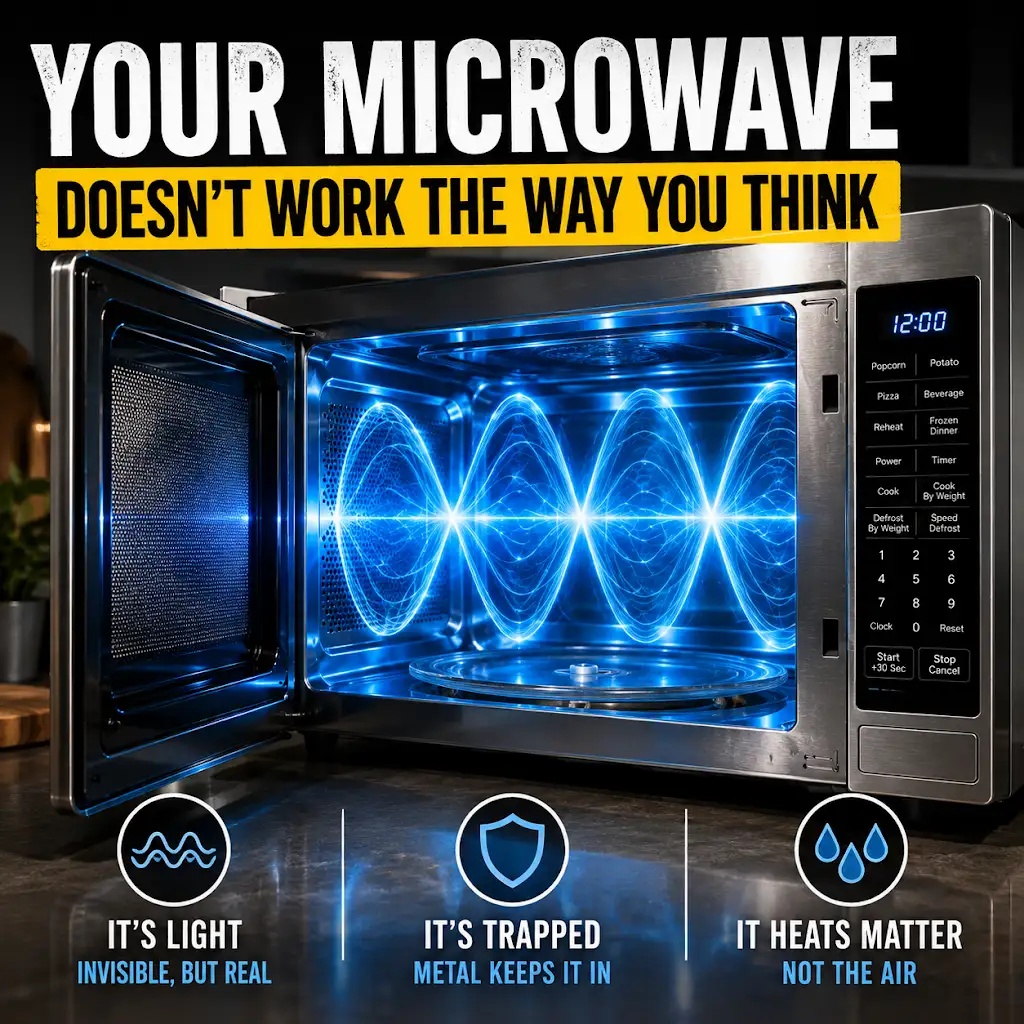
Microwave ovens utilize a process called dielectric heating. Inside the oven cavity, microwaves are generated by the magnetron and then bounced around by the metal walls, creating an electromagnetic field. When you place food in the oven, these microwaves penetrate it. Water molecules, being polar, have a positive and a negative end. In the presence of the oscillating electromagnetic field of the microwaves, these water molecules try to align themselves with the field. As the field rapidly changes direction (billions of times per second), the water molecules are forced to twist and turn back and forth at an incredibly high rate.
The Friction That Cooks
This rapid molecular movement creates friction between the water molecules. It’s this friction, this intense internal agitation, that generates heat throughout the food. Unlike conventional ovens that heat food from the outside in through conduction and convection, microwaves heat the food from within, wherever water molecules are present. You can visualize this: the microwaves are zipping through the food, making the water molecules dance, and that dance is what cooks the food. This is why some foods can cook unevenly if their water content is not consistent.
Penetration Depth and Even Cooking
The depth to which microwaves can penetrate food varies depending on the food’s composition and the microwave’s power. Generally, microwaves penetrate a few centimeters into most foods. This leads to rapid heating, but it also explains why sometimes the center of a dish might be cooler than the edges, or why certain foods require stirring or standing time to ensure even cooking. You might have experienced this yourself – a perfectly heated edge on your pizza, but a slightly cooler center. The standing time allows the heat generated in the outer layers to conduct inwards, equalizing the temperature. The rotating turntable, a common feature in modern microwaves, also plays a crucial role in promoting more even heating by ensuring that different parts of the food are exposed to the microwave field at different times.
The development of radar technology during World War II not only played a crucial role in military strategy but also laid the groundwork for innovations in everyday life, such as the microwave oven. As scientists explored the properties of microwaves for detecting enemy aircraft, they inadvertently discovered that these same waves could heat food efficiently. This fascinating transition from warfare to kitchen convenience is explored in more detail in a related article that delves into the unexpected connections between wartime inventions and modern appliances. For more insights, you can read the article here.
The Modern Microwave: A Multifaceted Kitchen Appliance
| World War II Radar | Microwave Ovens |
|---|---|
| Developed to detect enemy aircraft and ships | Utilizes microwave radiation to cook food |
| Used magnetron tubes to generate microwave signals | Also uses magnetron tubes to produce microwaves |
| Played a crucial role in the Allied victory | Revolutionized cooking and food preparation |
| Advanced technology that was kept secret during the war | Became a popular household appliance after the war |
Today, the microwave oven is far more than just a popcorn maker or a way to reheat leftovers. It has evolved into a versatile and indispensable tool in modern kitchens, offering a range of functionalities that cater to diverse cooking needs. You’ve likely seen them integrated into other appliances or boasting advanced features that would have seemed like magic just a few decades ago.
Beyond Reheating: Versatile Cooking Functions
Modern microwaves are no longer limited to simply heating. Many come equipped with grilling elements, convection fans, and even steam cooking capabilities. You can bake cakes, roast meats, and prepare steamed vegetables all within the same appliance. This versatility has made them increasingly attractive as primary or supplementary cooking devices. You can imagine the convenience: a single appliance that can perform tasks that once required multiple separate gadgets. Some models even offer pre-programmed settings for specific dishes, taking the guesswork out of cooking.
Smart Technology and User Experience
The integration of smart technology has further enhanced the microwave oven’s capabilities. You can find models that connect to Wi-Fi, allowing you to control them remotely via smartphone apps, download new recipes, and receive cooking status updates. Voice control is also becoming more prevalent, enabling you to operate the microwave hands-free. You might have a microwave that can scan a barcode on a food package and automatically set the correct cooking time and power level. This seamless integration with your digital life is a testament to how far this appliance has come.
Safety and Efficiency Improvements
Continuous advancements in design and technology have led to significant improvements in microwave oven safety and energy efficiency. Modern microwaves are designed with robust safety interlocks to prevent operation when the door is open, and the cavity shielding is highly effective at containing microwave radiation. Energy-efficient designs are also becoming standard, helping to reduce power consumption. You can feel reassured knowing that the technology has been refined to be both powerful and safe for everyday use. The evolution from a military detection system to a sophisticated kitchen appliance is a remarkable journey, showcasing the power of innovation to transform our daily lives, one perfectly heated meal at a time.
Your Microwave Doesn’t Work the Way You Think
FAQs
What is the connection between World War II radar and microwave ovens?
During World War II, radar technology was developed and used to detect enemy aircraft. After the war, the technology was adapted for commercial use, leading to the invention of the microwave oven.
How did World War II radar technology contribute to the invention of microwave ovens?
The radar technology used during World War II relied on the use of magnetrons, which are vacuum tubes that generate microwave radiation. This technology was later used in the development of the first microwave ovens.
Who is credited with inventing the first microwave oven?
The first microwave oven was invented by Percy Spencer, an American engineer, in 1946. He discovered that microwave radiation from a radar magnetron could cook food when he accidentally melted a candy bar in his pocket while working with the technology.
What are the key components of a microwave oven?
A microwave oven consists of a magnetron, which generates the microwave radiation, a waveguide to direct the radiation into the cooking chamber, and a control panel to set the cooking time and power level.
How do microwave ovens cook food?
Microwave ovens cook food by using microwave radiation to excite the water molecules in the food, causing them to vibrate and generate heat. This heats the food from the inside out, resulting in faster cooking times compared to conventional ovens.