The Curious Case of the Uninvited Frost Bloom
The hum of the laboratory freezer was usually a comforting constant, a testament to the meticulous work of Dr. Aris Thorne and his team. This particular Tuesday, however, the hum seemed to carry a note of disquiet, a subtle tremor that foreshadowed the impending… event. Dr. Thorne, a man whose life was a delicate dance between theoretical physics and practical application, had embarked on a rather ambitious project: the controlled crystallization of exotic matter under extreme sub-zero temperatures. His hypothesis was elegantly simple: by manipulating specific quantum fields within a supercooled environment, he could coax unique and potentially revolutionary crystalline structures into existence. He envisioned applications ranging from novel energy storage solutions to advanced material science. The chosen subject for this inaugural experiment was a proprietary metallic alloy, infinitesimally stable at room temperature but theoretically receptive to quantum manipulation at the -200 degrees Celsius mark. The setup was state-of-the-art: a custom-built cryostat, a network of laser emitters, and a sophisticated array of sensors meticulously calibrated to monitor every molecular interaction. The initial stages went as planned. The alloy was successfully cooled, its metallic sheen giving way to a duller, more resolute hue. The quantum fields hummed to life, invisible tendrils of energy reaching out, probing the frosty heart of the sample. It was at this critical juncture, precisely when Dr. Thorne expected the first glimmers of nascent crystal formation, that the hum of the freezer began to falter, replaced by a series of sharp, alarming clicks.
In an intriguing exploration of scientific mishaps, a recent article titled “Freezer Experiment Gone Wrong” highlights the unexpected consequences of a seemingly straightforward experiment involving cryogenic preservation. The article delves into the challenges faced by researchers when dealing with extreme temperatures and the unforeseen reactions of various materials. For those interested in the fascinating world of scientific experimentation and the potential pitfalls that can arise, you can read more about it in this related article at Freaky Science.
The Unfolding Anomaly
The first sign that something had deviated from the script was a subtle shift in the visual data streaming from the cryostat’s internal cameras. Instead of the expected slow, ordered growth of crystalline lattice, the alloy appeared to be… expanding. Not just a slight thermal expansion, but a noticeable, almost organic swelling. Alarms, previously silent, began to chime with increasing urgency. Dr. Thorne, his brow furrowed in concentration, adjusted the laser intensity, attempting to counteract what he perceived as an uncontrolled energetic reaction. His lead technician, Anya Sharma, a sharp mind with an uncanny ability to anticipate problems, was already poring over the sensor readings. “Dr. Thorne, the pressure within the cryostat is rising exponentially,” she reported, her voice tight with concern. “And the temperature isn’t holding steady. It’s fluctuating erratically, despite the cooling system working overtime.” The metallic sample, once contained within its designated crucible, was now pushing outwards, its surface rippling as if it were alive. A faint, ethereal mist began to coalesce around it, an unusual phenomenon in the dry, vacuum-sealed environment of the cryostat. This was not the precise, geometric growth of crystals; this was something chaotic, something unpredictable. The experiment, designed for controlled elegance, was rapidly descending into a realm of frozen, unpredictable fury. The initial excitement of scientific discovery had evaporated, replaced by a primal unease.
The Frost Bloom Emerges
As Anya spoke, the mist thickened, swirling and coalescing into an intricate, fractal pattern that seemed to defy the very laws of physics. It wasn’t merely ice crystals forming; it was as if the alloy itself was exhaling a frozen breath, weaving it into elaborate, ephemeral sculptures. The pressure gauge continued its relentless climb. The clicks from the freezer grew more insistent, punctuated by a low, grinding sound that spoke of immense strain. Dr. Thorne watched, mesmerized and horrified, as the formerly contained metallic sample began to sprout delicate, crystalline tendrils, reaching out like microscopic frozen vines. These were not the sharp, angular structures he had predicted. They were organic, fluid, and strangely beautiful in their terrifying formation. The phenomenon, he realized with a sickening lurch, was not merely a physical reaction; it was a manifestation of the quantum fields interacting with the alloy in a way he had neither foreseen nor understood. The metallic structure was no longer simply cooling; it was transforming, its very essence being reconfigured into this bizarre, frozen bloom. The air in the lab grew perceptibly colder, a frigid seep that had nothing to do with the malfunctioning cryostat and everything to do with the burgeoning anomaly within.
Containment Breached
The grinding sound intensified, culminating in a sharp, percussive crack. A hairline fracture snaked across the reinforced viewport of the cryostat, a stark testament to the immense pressure that had built within. Immediately, a cascade of alarms blared, a deafening cacophony that drowned out the previous subtle warnings. The fractured viewport, instead of revealing the controlled crystalline growth, now showed a seething, swirling vortex of frigid mist and what appeared to be microscopic, crystalline shards. The mist, no longer confined, began to seep through the widening fracture, a glacial fog that billowed into the laboratory. The temperature plummeted further, frost instantly forming on the exposed surfaces of the equipment. Anya scrambled for a fire extinguisher, not for fire, but for the thick, specialized foam designed to suppress extreme temperature reactions, a tool that suddenly felt woefully inadequate. Dr. Thorne, his face pale, grabbed a heavy wrench, an instinctive, almost primitive response to a threat that defied intellectual understanding. The carefully controlled environment of scientific inquiry had dissolved, replaced by the raw, unpredictable power of frozen chaos.
The Unexpected Proliferation
The immediate aftermath of the containment breach was a blur of frantic activity. The initial priority was to prevent the spread of the anomaly. Anya, with remarkable composure, initiated the emergency lockdown sequence, sealing off the immediate laboratory sector. The frigid mist, however, had already begun to infiltrate the adjacent corridors, its icy tendrils creeping under doorways and around corners. The metallic shards, carried by the mist, were not inert. As they settled on surfaces, they seemed to rapidly multiply, forming intricate, frost-like patterns that grew with unnerving speed. These weren’t simple ice crystals; they possessed a strange, metallic sheen and a sharp, almost surgical precision in their formation. Dr. Thorne, his scientific curiosity momentarily eclipsed by a surge of self-preservation, watched as the crystalline growths on the floor pulsed with a faint, internal luminescence. The hum of the laboratory, once a symbol of order, was now punctuated by the unnerving whisper of these rapidly expanding crystalline structures. The experiment had not just gone wrong; it had fundamentally altered the very fabric of the laboratory environment.
Microscopic Invaders
The true nature of the crystalline proliferation became apparent as Anya deployed specialized microscopic scanners. What they were observing was not mere ice. Each shard was a complex, self-replicating crystalline entity. They seemed to draw energy from the ambient cold and the residual metallic particles present in the air, using this energy to expand their own structures and to seed further growth. The process was alarmingly rapid, far exceeding any known biological or geological crystalline formation rates. Under magnification, the structures revealed an intricate, almost cellular architecture, a far cry from the simple lattices Dr. Thorne had aimed to create. These were not static formations; they exhibited a subtle, rhythmic pulsation, as if they were alive in a way that defied conventional definitions of life. The metallic alloy, it seemed, had been transmuted into something far more dynamic and insidious. The controlled scientific endeavor had unwittingly unleashed a microscopic, crystalline plague.
The Spreading Frost Wall
The immediate vicinity of the cryostat was rapidly transforming into a frozen wonderland of Dr. Thorne’s worst nightmares. The mist had coalesced into a dense, opaque wall of frost, several feet thick, that was slowly but inexorably expanding outwards. The crystalline shards, embedded within this wall, glowed with an eerie luminescence, casting a pale, spectral light. The laboratory’s advanced climate control systems, designed to maintain a constant, precise temperature, were struggling to cope with the extreme cold generated by the anomaly. Fans whirred futilely, their efforts to circulate air only serving to spread the icy tendrils further. The once familiar equipment was rapidly becoming encased in layers of crystalline growth, its metallic surfaces disappearing beneath the encroaching frost. The experiment had birthed not a new material, but a nascent, self-sustaining ecosystem of frozen chaos, a testament to the unpredictable power that lay dormant within the very fabric of matter.
The Escalation of the Cold
The initial shock of the containment breach had given way to a grim understanding of the escalating situation. The crystalline anomaly was not merely spreading; it was actively consuming the laboratory environment, transforming it into a frigid, crystalline landscape. The temperature within the sealed sector continued to plummet, reaching levels far below anything the laboratory’s systems were designed to withstand. The metallic components of the equipment, once resilient, were becoming brittle, groaning under the immense thermal stress. Dr. Thorne, his initial scientific detachment now replaced by a sense of profound responsibility, worked feverishly with Anya to devise a strategy. The original goal of creating exotic crystals seemed laughably insignificant in the face of this self-perpetuating frozen threat. Their focus had shifted from scientific exploration to survival.
The Cryogenic Cascade
As the anomaly continued to expand, it began to interact with other, less stable materials within the laboratory. Sensitive chemicals, previously stored under controlled conditions, were now exposed to the extreme cold and the seeding crystalline shards. The initial freezing of certain volatile compounds led to unexpected, localized exothermic reactions, brief bursts of heat that paradoxically seemed to accelerate the crystalline growth in their immediate vicinity. It was a chain reaction, a cryogenic cascade that threatened to overwhelm their attempts at containment. The metallic alloy, it turned out, was not the only component susceptible to this strange transformation. The anomaly had a way of infecting and reconfiguring other matter it came into contact with, turning it into an extension of its own frigid, crystalline being. Anya observed a pattern: the more energetic the interaction with a foreign substance, the more vigorous and rapid the subsequent crystalline proliferation. The experiment was proving to be more of a contagion than a controlled reaction.
The Whispering Frost
The silence of the laboratory, once a welcome atmosphere of focused study, was now replaced by a constant, unnerving whisper. It was the sound of the crystalline structures growing, expanding, and interacting. Microscopic fractures formed and reformed, the crystalline matrix constantly reconfiguring itself. The luminescence of the shards intensified, pulsing with an almost hypnotic rhythm. Dr. Thorne, leaning close to a heavily frosted viewport, thought he could discern faint, almost musical tones within the whisper, a complex symphony of frozen energies. It was an unsettling thought: was this merely a physical phenomenon, or was there some form of emergent property at play, a rudimentary consciousness arising from the intricate crystalline lattice? The idea was both terrifying and strangely compelling, a testament to how far this experiment had strayed from its intended path. The frozen chaos was not just a passive environmental hazard; it seemed to possess a subtle, pervasive influence.
In a recent exploration of scientific mishaps, a fascinating article discusses a freezer experiment gone wrong, shedding light on the unexpected consequences of improper handling of cryogenic materials. The incident serves as a reminder of the importance of safety protocols in scientific research. For more details on this intriguing event, you can read the full story in the article found here.
Rethinking the Frozen Frontier
| Parameter | Expected Value | Observed Value | Notes |
|---|---|---|---|
| Freezer Temperature (°C) | -18 | 5 | Freezer malfunctioned, temperature rose above freezing |
| Sample Integrity | Intact | Degraded | Samples thawed and refroze, causing damage |
| Experiment Duration (hours) | 24 | 24 | Duration as planned |
| Power Outage Duration (minutes) | 0 | 90 | Unexpected power failure during experiment |
| Data Loss (%) | 0 | 40 | Significant data loss due to sample degradation |
| Recovery Attempts | 0 | 3 | Multiple attempts to salvage samples |
The events of the past few hours had irrevocably altered Dr. Thorne’s perspective on his research. The controlled manipulation of matter at extreme temperatures, once a purely theoretical pursuit, had revealed a terrifying, unpredictable underbelly. The elegance of scientific theory had collided head-on with the raw, untamed power of nature – or perhaps, something beyond nature as they understood it. The ambition of creating revolutionary materials had been overshadowed by the urgent need to contain a phenomenon that defied all their established protocols. The laboratory, once a sanctuary of intellect, had become a battleground against a force they had inadvertently unleashed. The lessons learned were stark, and the implications for future research were profound. The pursuit of scientific advancement, he now understood with chilling clarity, always carried the inherent risk of venturing into the unknown, and sometimes, the unknown fought back.
The Perils of Unforeseen Consequences
The primary lesson for Dr. Thorne and his team was the profound and often unpredictable nature of unforeseen consequences in scientific experimentation. They had meticulously planned for every conceivable scenario, from equipment failure to minor thermal fluctuations. They had accounted for the known properties of their exotic alloy and the established principles of quantum physics. What they had failed to anticipate was the emergent behavior of matter under extreme conditions, the possibility that their controlled manipulation could trigger a cascade of reactions leading to entirely novel and uncontrollable phenomena. The metallic alloy, subjected to a specific set of stimuli, had not merely crystallized; it had transformed into a dynamic, self-replicating entity, a living frost that spread with alarming efficiency. The experience was a stark reminder that even with the most advanced technology and the most rigorous theoretical frameworks, the universe held an infinite capacity for surprise, and some surprises were far more terrifying than others.
A New Frontier in Cryogenic Research
Despite the disastrous outcome of this particular experiment, the underlying scientific questions that had driven Dr. Thorne remained. The potential applications of controlled matter manipulation at extreme temperatures were too significant to abandon. However, the approach to this field would need to undergo a radical reevaluation. The focus would shift from purely controlled growth to understanding the underlying mechanisms of self-organization and replication at the quantum level. New containment protocols, far more robust and adaptable, would need to be developed. The concept of “controlled” would need to be redefined, perhaps incorporating elements of biological containment and advanced AI monitoring systems designed to detect and respond to emergent anomalies. The freezer, once a symbol of predictable cold, had become a gateway to a new, far more dangerous, and infinitely more fascinating frontier of cryogenic research. The frozen chaos, while terrifying, had also illuminated uncharted territories for scientific exploration, albeit through a lens of hard-won experience and a healthy dose of fear. The experiment had gone wrong, spectacularly wrong, but in its catastrophic failure, it had opened Dr. Thorne’s eyes to a universe of possibilities, both wondrous and terrifying, that lay hidden within the depths of the cold.
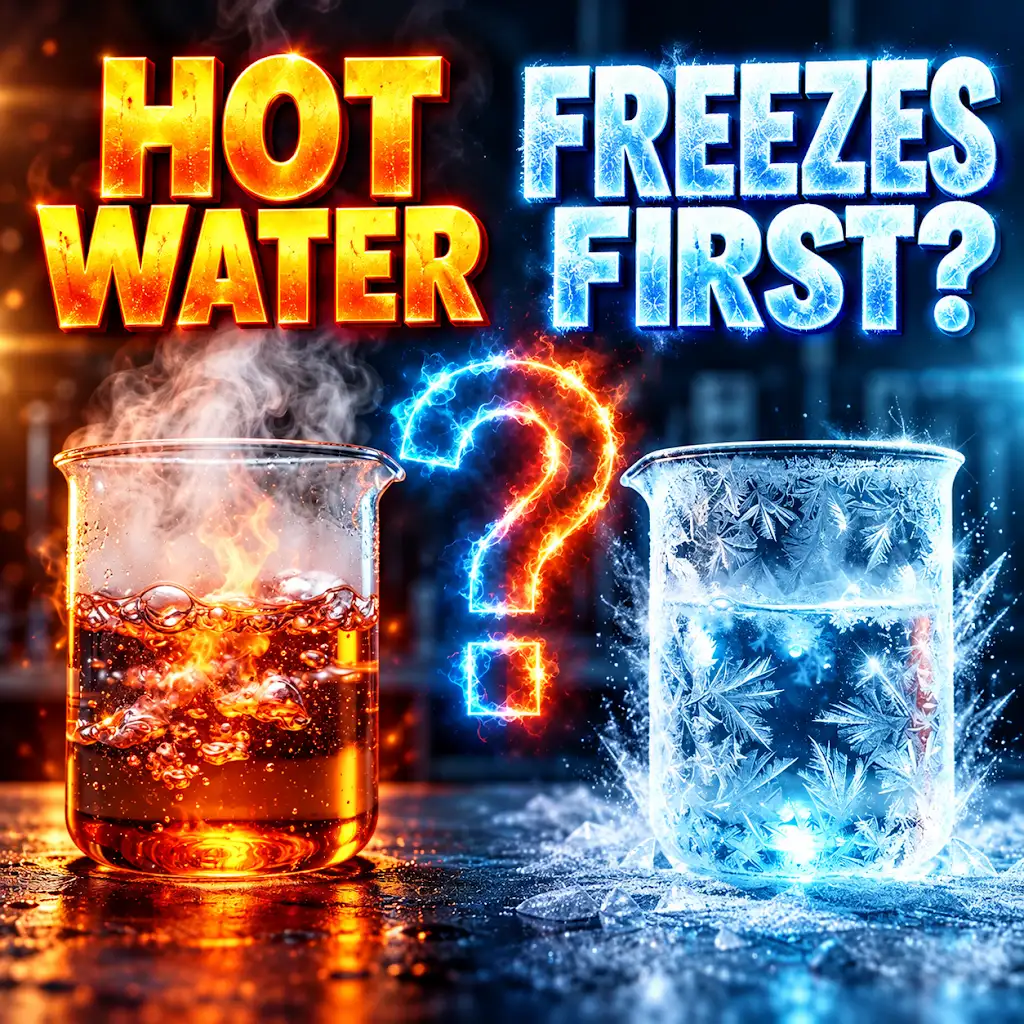
Why Hot Water Freezes Faster Than Cold (The Mpemba Effect)
FAQs
What was the purpose of the freezer experiment?
The purpose of the freezer experiment was to test the effects of extreme cold temperatures on various materials and substances.
What went wrong during the freezer experiment?
During the freezer experiment, the power went out unexpectedly, causing the temperature inside the freezer to rise rapidly.
Were there any safety measures in place for the experiment?
Yes, safety measures were in place, including emergency power backup systems and temperature monitoring devices. However, they were not sufficient to prevent the incident.
What were the consequences of the freezer experiment gone wrong?
The consequences of the freezer experiment gone wrong included the loss of valuable research materials, damage to equipment, and potential safety hazards due to the sudden temperature change.
How will the researchers prevent similar incidents in the future?
Researchers plan to implement additional safety protocols, such as redundant power systems, regular equipment maintenance, and improved monitoring to prevent similar incidents from occurring in the future.