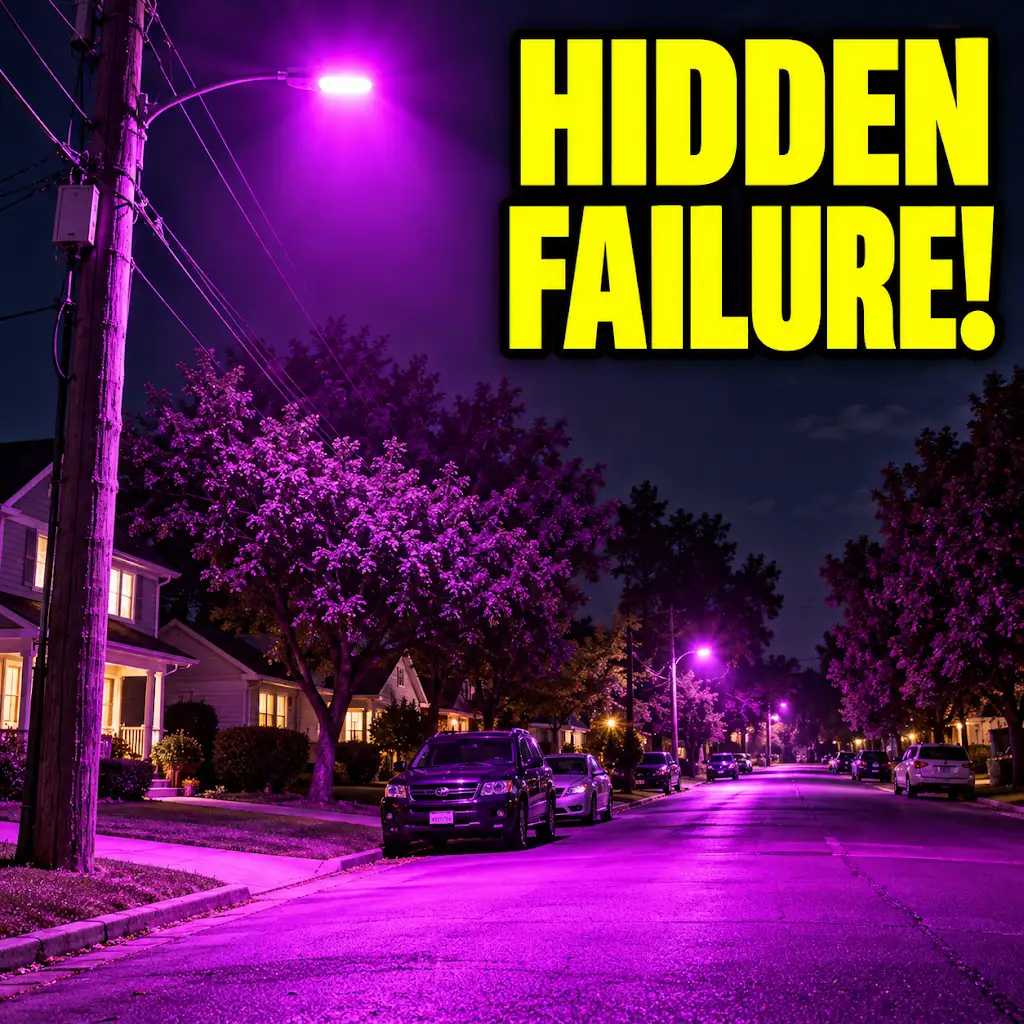
So, you’ve seen them – those purple streetlights. They pop up here and there, and you might be wondering what’s up with them. Are they for decoration? Some kind of special signal? Or is there more to it? The short answer is, those purple lights are often a byproduct of a specific type of LED technology, and while they look cool, their main effect is usually related to how insects react to that particular wavelength of light.
The Science Behind the Violet Glow
The color you see from a streetlight is determined by the wavelengths of light it emits. LEDs (Light Emitting Diodes) are pretty versatile, and by tweaking the materials and coatings, manufacturers can produce a wide range of colors. Purple, or more accurately, a deep violet or even a bluish-purple, usually comes from specific phosphor coatings on blue LEDs.
How LEDs Make Color
Think of an LED like a tiny light bulb that works differently. Instead of heating a filament, it uses semiconductors to produce light. When electricity passes through these semiconductors, electrons jump across a gap, releasing energy in the form of photons – light particles. The color of the light depends on the energy of these photons, which in turn is dictated by the material used in the semiconductor.
For white light LEDs, a common method involves a blue LED with a phosphor coating. This phosphor absorbs some of the blue light and re-emits it at different wavelengths, combining with the remaining blue light to create a spectrum that our eyes perceive as white. However, sometimes the phosphor doesn’t perfectly convert all the blue light, or it might have a stronger output in certain parts of the spectrum. This is where the purple or violet hue can emerge. It’s essentially an imbalance in the spectral output, leaning towards the shorter, bluer and violet ends.
Phosphor Coatings and Spectral Peaks
The specific chemical composition of the phosphor coating is crucial. These coatings are designed to absorb the high-energy blue light from the underlying LED chip and then fluoresce, emitting light at lower energy levels. The goal for “white” light is to produce a broad spectrum across red, green, and blue, mimicking sunlight. However, variations in the phosphor can lead to a “peak” in the violet or deep blue region of the spectrum that is more pronounced than usual.
When this particular spectral signature is emitted, our eyes pick it up. The human eye’s sensitivity varies across the spectrum. While we see a specific wavelength as pure violet, when mixed with other wavelengths in the LED’s output, it can result in a distinct purple or bluish-purple appearance. It’s not a deliberate choice to make a “purple streetlight” in most cases, but rather a consequence of the specific manufacturing process and materials used to achieve a certain light output, sometimes with a compromise on the “whiteness” or spectrum.
The phenomenon of purple streetlights has intrigued many due to their unique appearance and the science behind their visible spectrum. For those interested in exploring this topic further, a related article can be found at Freaky Science, which delves into the implications of different light wavelengths on urban environments and human health. This resource provides valuable insights into how the visible spectrum of light affects our daily lives and the potential benefits and drawbacks of using purple streetlights in cities.
The Visible Spectrum and Human Perception

Our eyes are complex tools, and how we perceive color isn’t just about the raw wavelengths of light hitting our retinas. It’s a combination of physics and biology. The “purple” we see from these streetlights is a fascinating intersection of these.
Wavelengths and Colors
Light is electromagnetic radiation, and what we call “color” is our interpretation of different wavelengths within the visible spectrum. This spectrum ranges roughly from 380 nanometers (violet) to 750 nanometers (red). Violet light has the shortest wavelengths, while red has the longest.
- Violet: Approximately 380–450 nm
- Blue: Approximately 450–495 nm
- Green: Approximately 495–570 nm
- Yellow: Approximately 570–590 nm
- Orange: Approximately 590–620 nm
- Red: Approximately 620–750 nm
When an LED emits a spectrum with a strong peak in the violet or deep blue range, and potentially a weaker output in the green and red regions, our eyes can perceive this as a purplish hue. It’s not a pure spectral violet, which is quite rare in everyday lighting, but a mixture that creates that distinct color.
Why We See Purple
The perceived color of an object is determined by the wavelengths of light it reflects or transmits. For a streetlight, we’re seeing the light emitted directly. The specific phosphor chemistry in these LEDs leads to an emission spectrum that has a significant “hump” or peak in the violet/blue region. While there might be other wavelengths present, this dominant peak influences our perception.
Furthermore, the human visual system is more sensitive to certain colors than others. Our eyes have three types of cone cells, sensitive to red, green, and blue light. The way these cones are stimulated by different wavelengths determines the color we see. A light source with a disproportionately strong violet component can stimulate the blue cones strongly and, to a lesser extent, other cones, leading to the perception of purple.
Impact on Wildlife, Particularly Insects

This is where the color of the streetlight starts to become more than just an aesthetic curiosity. Many insects, especially moths and other nocturnal flyers, are highly attracted to light. The wavelengths of light they are most sensitive to play a significant role in this attraction, and purple light can have a particular effect.
Insect Vision and Light Attraction
Insects have different visual systems than humans. Many are particularly sensitive to ultraviolet (UV) and blue light. This sensitivity is often linked to their foraging behavior (e.g., finding nectar-rich flowers that reflect UV light) and their navigation. Artificial lights that emit strongly in these sensitive ranges can act as powerful attractants, drawing insects away from their natural habitats and behaviors.
The “Moth Effect”
Streetlights that emit a significant amount of violet or deep blue light can be exceptionally attractive to certain nocturnal insects, particularly moths. This is often referred to as the “moth effect.” While white LEDs are generally considered less disruptive to insect populations than older sodium vapor lamps, some of the newer LED technologies, especially those with a pronounced blue/violet output, can still exert a strong pull.
This attraction can lead to insects congregating around the light source, where they are vulnerable to predation, desiccation, or exhaustion. It can disrupt their mating cycles, their ability to find food, and their overall life functions. So, while a purple streetlight might be visually interesting to us, it can have unintended and significant consequences for local insect populations.
Practical Considerations and Alternatives
The emergence of purple streetlights has sparked discussions about light pollution, its ecological impact, and the technologies available to mitigate these issues. There’s a growing awareness that the color of artificial light matters.
Lighting Standards and Best Practices
Regulatory bodies and lighting organizations often set standards for outdoor lighting, aiming to balance visibility, safety, and environmental concerns. These standards increasingly address the spectral output of lighting. For instance, there’s a move towards “dark-sky friendly” lighting, which emphasizes reducing the amount of light that shines upwards and outwards, and also considering the spectral composition to minimize ecological disruption.
Shifting Towards Warmer Tones
As the understanding of light’s impact on wildlife has grown, there’s a trend towards using warmer color temperatures for outdoor lighting. This typically means LEDs that emit light with a stronger presence in the yellow and red parts of the spectrum, and less in the blue and violet. This is often achieved by using different phosphor combinations or different LED technologies altogether.
Many municipalities and urban planners are actively evaluating and replacing older, bluer-leaning LED fixtures with newer ones that have a warmer color temperature, often described as “amber” or “warm white” (typically 2200K to 3000K). This shift aims to reduce insect attraction, minimize disruption to nocturnal ecosystems, and even lessen the overall perceived brightness and glare, which can also be a form of light pollution.
The recent exploration of purple streetlights has sparked interest due to their unique position in the visible spectrum, which some studies suggest may have benefits for urban environments. For a deeper understanding of this phenomenon, you can read more in a related article that discusses the implications of different light wavelengths on human health and safety. This insightful piece can be found here.
Why Are They Sometimes Purple?
| Parameter | Value | Unit | Description |
|---|---|---|---|
| Peak Wavelength | 400 – 420 | nm | Range of peak emission wavelengths for purple streetlights |
| Visible Spectrum Range | 380 – 450 | nm | Approximate visible spectrum range for purple light |
| Color Temperature | 2700 – 3500 | K | Typical correlated color temperature for purple streetlights |
| Luminous Efficacy | 50 – 70 | lm/W | Efficiency of converting electrical power to visible light |
| CRI (Color Rendering Index) | 70 – 80 | Index | Ability to render colors accurately under purple streetlight |
| Dominant Wavelength | 410 | nm | Dominant wavelength perceived by human eye |
| Bandwidth (FWHM) | 20 – 30 | nm | Full width at half maximum of emission spectrum |
Bringing it back to the initial question, why do we see these purple lights? It’s rarely an intentional design choice for aesthetic purposes. The purple hue is usually an incidental outcome of the LED manufacturing process.
Cost and Efficiency Trade-offs
Historically, manufacturers have focused on developing LEDs that are highly efficient and cost-effective. To produce “white” light, a common approach involves a blue LED chip coated with phosphors. The specific blend of phosphors is optimized to achieve a desired level of brightness and perceived whiteness.
Sometimes, the cheapest or most readily available phosphors, or the manufacturing processes optimized for mass production, can result in a spectral output that leans more towards the blue and violet end of the spectrum than other parts. This can be particularly true for older generations of LED technology or for fixtures that prioritize cost savings.
The Spectrum of “White” Light
It’s worth remembering that “white” light isn’t a single color but a mix of wavelengths. The color temperature of white light is measured in Kelvin (K). Lower Kelvin numbers (e.g., 2000K-3000K) indicate warmer, more yellowish light, while higher numbers (e.g., 4000K-6500K) indicate cooler, more bluish light. Many of the earlier “white” LEDs were in the higher Kelvin range, inherently containing more blue light. When the phosphor tuning wasn’t perfect, or if the blue LED chip itself had a strong output, the violet component could become noticeable.
Ongoing Technological Advancement
The LED industry is constantly evolving. Newer, more advanced phosphors and LED designs allow for greater control over the spectral output. This means that future streetlights are likely to have a more consistent and desirable spectral composition, with less chance of producing an unintended purple hue. The focus is increasingly on creating lighting that is not only efficient but also environmentally responsible and human-friendly, addressing the ecological impacts that have become apparent.
Why The Streetlights Are Turning Purple
FAQs
What is the visible spectrum of light?
The visible spectrum of light is the range of electromagnetic radiation that is visible to the human eye. It includes all the colors of the rainbow, from red to violet.
Why is a purple streetlight unique in terms of the visible spectrum?
A purple streetlight is unique because it emits light that falls outside the typical range of colors found in traditional streetlights, which are usually white, yellow, or orange. Purple light is not commonly used for street lighting due to its unconventional appearance.
How does a purple streetlight affect visibility at night?
A purple streetlight may affect visibility at night differently than traditional white or yellow streetlights. The human eye may perceive objects differently under purple light, potentially impacting depth perception and color recognition.
Is there a specific reason for using a purple streetlight in certain locations?
In some cases, a purple streetlight may be used for aesthetic purposes or to create a unique ambiance in a specific area. It could also be used for special events or artistic installations where a different lighting effect is desired.
Are there any potential drawbacks to using purple streetlights?
One potential drawback of using purple streetlights is that they may not provide the same level of visibility and safety as traditional white or yellow lights. Additionally, purple light may cause more light pollution and glare compared to other colors, impacting the surrounding environment and wildlife.