You’re standing in your workshop, a hefty piece of steel in your hand. Imagine wanting to shape it, to forge it into something new, but the furnace feels ancient, slow, and inefficient. You yearn for a faster, cleaner, more precise way to bring that metal to the perfect temperature. This is where the marvel of electromagnetic induction steps onto the stage, offering you a revolutionary approach to heating metal. Forget the roaring flames and the laborious process; induction heating is your key to unlocking unparalleled efficiency and control.
This isn’t just about making things hot; it’s about harnessing fundamental physical principles to precisely deliver energy exactly where and when you need it. You’ll discover that with electromagnetic induction, you’re not just applying heat; you’re orchestrating a symphony of magnetic fields and electrical currents to transform your materials. It’s a technology that has reshaped industries, from automotive manufacturing to jewelry making, and understanding its core tenets will empower you to optimize your own metalworking processes.
At its heart, electromagnetic induction is about the intricate interplay between electricity and magnetism. You’ve likely encountered magnets and electric currents in your life, but their ability to mutually influence each other is the bedrock of this heating method. When you understand this fundamental relationship, the concept of heating metal becomes remarkably intuitive.
Faraday’s Law: The Spark of Induction
The story begins with Michael Faraday, a brilliant scientist whose meticulous experiments laid the groundwork for much of our modern electrical technology. His groundbreaking discovery, known as Faraday’s Law of Induction, is the cornerstone of this heating technique. In essence, Faraday observed that a changing magnetic field can induce an electromotive force (EMF) – essentially, a voltage – in a conductor. For you, this means that if you can create a magnetic field that’s constantly changing, you can generate electrical currents within a conductive material like metal.
Lenz’s Law: The Direction of Resistance
Complementing Faraday’s Law is Lenz’s Law. This principle tells you the direction of the induced current. Lenz’s Law states that the induced current will flow in such a direction as to oppose the change in magnetic flux that produced it. Think of it as a natural pushback. As the magnetic field tries to change, the induced current generates its own magnetic field that acts to counteract that change. While this might sound like a hindrance, it’s precisely this opposition that leads to the heating effect you desire.
The Core Principle: From Magnetism to Heat
So, how does this lead to heating? Imagine you have a coil of wire, and you’re passing an alternating current (AC) through it. An AC current constantly changes direction and magnitude. As this current flows through the coil, it generates a magnetic field that also constantly changes. When you bring a conductive metal object, such as a steel rod or a copper plate, into the proximity of this fluctuating magnetic field, the magic happens.
The changing magnetic field permeates the metal, inducing circulating currents within it. These are not ordinary currents; they are known as eddy currents. Because the metal has electrical resistance, these eddy currents, as they flow through the material, encounter opposition. And just like any electrical current flowing through a resistive material, this opposition generates heat. The more intense the eddy currents and the higher the resistance of the metal, the more heat you produce. This is the fundamental mechanism of induction heating: converting electrical energy into magnetic energy, and then into heat energy directly within the metal itself.
Electromagnetic induction is a fascinating phenomenon that not only generates electric currents but also has practical applications in heating metals. This process involves the creation of magnetic fields that induce electric currents in conductive materials, leading to rapid heating. For a deeper understanding of this topic, you can explore a related article that delves into the principles and applications of electromagnetic induction in heating metals. Check it out here: Freaky Science.
The Machinery of Heat: How Induction Systems Work
Now that you grasp the underlying physics, let’s delve into the practical components that make induction heating a reality. These systems are designed to efficiently generate and control the necessary magnetic fields to achieve precise and rapid heating of your metalwork.
The Inductor Coil: The Heart of the Operation
The inductor coil is the most crucial element of any induction heating system. This is the specially designed coil of conductive material, typically copper, that surrounds or is placed near the metal you want to heat. The shape and size of the inductor coil are critical and are tailored to the specific geometry of the workpiece. For instance, a cylindrical workpiece might be heated by a cylindrical coil, while a flat plate might require a different coil configuration.
Power Supply: Driving the Dynamo
The inductor coil needs a powerful source of electricity to generate the changing magnetic field. This comes from the power supply. For induction heating, this is invariably an AC power supply, often operating at high frequencies. The frequency of the AC current directly influences the depth to which the eddy currents penetrate the metal (known as the depth of penetration or skin depth). Higher frequencies lead to shallower penetration, meaning the heat is concentrated closer to the surface of the metal. Lower frequencies allow the heat to penetrate deeper into the core of the workpiece. Selecting the right frequency is vital for achieving the desired heating profile. Modern induction heating systems often utilize solid-state power supplies, such as inverters, which provide precise control over frequency and power output.
Workpiece: The Target of Transformation
The workpiece is, of course, the metal object you intend to heat. Its electrical conductivity and magnetic properties play a significant role in how efficiently it can be heated. Ferromagnetic materials, like iron and steel, are particularly responsive to induction heating because they possess inherent magnetic properties that enhance the magnetic field, leading to more efficient energy transfer. Non-ferrous metals like aluminum and copper can also be heated effectively, but they often require higher power densities and frequencies due to their lower resistance and lack of ferromagnetic properties.
Control System: Orchestrating the Heat
A sophisticated control system is essential for precise induction heating. This system monitors and adjusts the power output and frequency of the supply to ensure the workpiece reaches the desired temperature without overheating or uneven heating. It can include features like temperature feedback mechanisms, timers, and programmable heating cycles. This allows you to replicate precise heating processes consistently, a significant advantage over traditional methods.
The Edges of Efficiency: Why Induction Excels
You might be wondering, what makes induction heating so much more efficient than, say, a forge or a furnace? The answer lies in its directness and precision. You’re not wasting energy heating the surrounding air or the furnace walls.
Direct Energy Transfer: No Wastage
Unlike conventional heating methods where heat is transferred from a source (like burning fuel or heating elements) to the workpiece through convection and radiation, induction heating delivers energy directly to the metal itself. The eddy currents generated within the workpiece are the source of the heat. This means that virtually all the electrical energy supplied to the inductor coil is converted into heat within the metal. You’re not losing significant amounts of energy to the surrounding environment, leading to dramatically higher energy efficiency. Think of it as pointing a laser beam directly at your target instead of trying to illuminate the entire room with a flashlight.
Rapid Heating: Time is Money
Induction heating is incredibly fast. The direct energy transfer and the generation of eddy currents allow for extremely rapid temperature increases. You can heat a metal object from room temperature to forging temperature in a matter of seconds or minutes, depending on the size and material. This drastically reduces production cycle times, allowing you to process more parts in the same amount of time. This speed translates directly into increased productivity and reduced labor costs.
Precise Temperature Control: No More Guesswork
The ability to precisely control the heating process is a major advantage. By adjusting the power output, frequency, and heating duration, you can achieve very specific temperatures and heating profiles. This is crucial for applications where material properties are highly sensitive to temperature, such as heat treatment processes like hardening, tempering, and annealing. You can achieve uniform heating throughout the workpiece or selective surface heating, depending on your needs. This level of control is often difficult or impossible to achieve with traditional heating methods.
Environmental Friendliness: A Cleaner Process
Induction heating is a cleaner process compared to combustion-based heating methods. It produces no direct emissions of greenhouse gases or pollutants, making it an environmentally friendlier choice. Furthermore, it typically operates with lower noise levels than furnaces, contributing to a more pleasant working environment. The absence of open flames also significantly reduces fire hazards.
Applications: Where Induction Shines Brightest

The versatility and efficiency of electromagnetic induction have led to its widespread adoption across a multitude of industries. You’ll find this technology at work in applications ranging from heavy industry to intricate craft.
Forging and Metal Forming: Shaping the Future
One of the most prominent applications of induction heating is in forging and metal forming. Imagine needing to soften a piece of metal so you can hammer it into a specific shape. Induction heating provides a fast and efficient way to bring your workpiece to the ideal forging temperature. This is used in the automotive industry for producing engine components, in aerospace for manufacturing critical parts, and in general manufacturing for countless metal components. The ability to heat only the portion of the metal that needs to be worked on can also be a significant advantage, minimizing energy consumption and reducing the risk of overheating other parts of the workpiece.
Heat Treatment: Enhancing Material Properties
Heat treatment is another area where induction heating truly excels. Processes like hardening (increasing hardness and strength), tempering (reducing brittleness after hardening), and annealing (softening and increasing ductility) rely on precise temperature control. Induction heating allows for rapid and uniform heating of specific areas of a component, enabling targeted heat treatments that can significantly enhance the performance and lifespan of manufactured parts. For example, you might harden the surface of a gear tooth while leaving the core tough and flexible.
Brazing and Soldering: Joining with Precision
When you need to join two metal pieces together using a filler metal, brazing and soldering are the go-to methods. Induction heating offers a highly controlled and efficient way to melt the filler metal and create strong, reliable joints. The localized heating of induction ensures that only the joint area is heated, minimizing the risk of damaging the surrounding materials. This is widely used in electronics, plumbing, and the manufacturing of various metal assemblies.
Melting and Casting: Fluid Metal, Precise Control
While not as common for very large-scale melting operations as some other methods, induction heating is exceptionally useful for melting and casting smaller batches of metal or specialized alloys. Induction furnaces can achieve very high temperatures quickly, allowing for the melting of materials with high melting points. The precise temperature control also enables better control over the casting process, leading to higher quality finished products with fewer defects. This is particularly important in industries like jewelry making and specialized component manufacturing.
Electromagnetic induction is a fascinating phenomenon that plays a crucial role in heating metals, allowing for efficient and precise temperature control in various industrial applications. For those interested in exploring this topic further, a related article discusses the principles and applications of electromagnetic induction in greater detail. You can read more about it in this insightful piece on Freaky Science, which delves into the science behind this innovative heating method and its implications for modern technology.
Advanced Concepts and Considerations: Fine-Tuning Your Heat
| Parameter | Description | Typical Values | Units |
|---|---|---|---|
| Frequency of AC Current | Alternating current frequency used to induce eddy currents | 20,000 – 400,000 | Hz |
| Magnetic Field Strength | Intensity of the magnetic field applied to the metal | 0.1 – 1.5 | Tesla (T) |
| Induced Eddy Current Density | Current density generated inside the metal due to induction | 10^4 – 10^6 | A/m² |
| Skin Depth | Depth at which the current density falls to 1/e of its surface value | 0.01 – 1 | mm |
| Power Density | Power dissipated as heat per unit volume of metal | 10^3 – 10^7 | W/m³ |
| Heating Rate | Rate at which temperature increases in the metal | 10 – 1000 | °C/s |
| Electrical Resistivity of Metal | Resistance to current flow, affects heat generation | 1.7 x 10^-8 – 1.0 x 10^-6 | Ω·m |
| Thermal Conductivity | Ability of metal to conduct heat away from heated zone | 10 – 400 | W/(m·K) |
While the basic principles of induction heating are straightforward, there are several advanced concepts and practical considerations that can further optimize your heating processes and ensure you get the most out of this technology.
Skin Effect and Depth of Penetration: Where the Heat Goes
You’ve heard about eddy currents. Now, let’s talk about how they behave within the metal. The skin effect is a phenomenon where AC currents tend to flow more on the surface of a conductor than in its interior. This is particularly pronounced at higher frequencies. The depth of penetration (δ) is the distance from the surface at which the current density drops to approximately 37% of its surface value.
- High Frequencies (e.g., hundreds of kHz to MHz): Lead to a shallow depth of penetration. This is ideal for surface hardening, where you want to heat only the outer layer of a component, leaving the core unaffected. This also means you can heat very thin materials effectively.
- Low Frequencies (e.g., 50/60 Hz to a few kHz): Result in a deeper depth of penetration. This is suitable for through-heating of larger or thicker components, where you need to raise the temperature of the entire mass of the metal.
Understanding and controlling the depth of penetration is crucial for achieving the desired heating profile and preventing unintended heating or material damage.
Magnetic Materials vs. Non-Magnetic Materials: Different Approaches
As mentioned earlier, ferromagnetic materials like iron and steel are inherently more responsive to induction heating. This is because they have high magnetic permeability, meaning they readily concentrate magnetic flux. This concentrates the magnetic field within the material, leading to stronger induced eddy currents and more efficient heating.
Non-magnetic materials like aluminum, copper, and brass can also be heated effectively, but they require different approaches. They have lower magnetic permeability and rely solely on the induced eddy currents to generate heat. This often necessitates using higher power densities and/or higher frequencies to achieve the same heating rate as ferromagnetic materials. You might also need to consider using flux concentrators or specially designed inductor coils to enhance magnetic field coupling.
Power Factor and Matching: Optimizing Energy Transfer
The power factor of an induction heating system is a measure of how effectively electrical power is being converted into useful work (in this case, heat). An ideal power factor is 1.0 (or unity), meaning all the apparent power drawn from the supply is being used to generate real power. Induction heating systems, particularly those operating at higher frequencies, can have a poor power factor due to the inductive nature of the coil.
Impedance matching is the process of ensuring that the impedance of the power supply is matched to the impedance of the inductor and workpiece combination. This ensures maximum power transfer from the supply to the load. Capacitors are often used in induction heating circuits to improve the power factor and achieve better impedance matching. This is like tuning a radio to get the clearest signal; it ensures you’re getting the most “bang for your buck” from your electrical input.
Coil Design and Cooling: The Physical Realities
The design of the inductor coil is not just about shape; it also involves material selection and cooling. Inductor coils are typically made of hollow copper tubing, which allows for water cooling. The intense electrical currents flowing through the coil generate significant heat, and without adequate cooling, the coil would quickly overheat and fail. The circulating water effectively dissipates this heat, allowing the coil to withstand the high power levels required for induction heating.
The construction of the coil also needs to be robust to withstand the physical stresses of the heating process. For some applications, insulating materials might be incorporated into the coil design to prevent short circuits or to direct the magnetic field more effectively.
Safety Considerations: Working with Power
As with any powerful electrical technology, safety is paramount when working with induction heating systems.
- Electrical Hazards: High voltages and currents are involved, so proper insulation, grounding, and adherence to safety protocols are essential. Never bypass safety interlocks or work on energized equipment.
- Thermal Hazards: The workpiece can become extremely hot very quickly, posing a burn risk. Appropriate personal protective equipment (PPE), such as heat-resistant gloves and eyewear, is crucial. Ensure adequate ventilation to dissipate heat and any potential fumes.
- Magnetic Field Hazards: While generally not considered a significant biological hazard at typical induction heating frequencies, strong magnetic fields can affect electronic devices like pacemakers. Be aware of the presence of such devices and take appropriate precautions.
Always consult the manufacturer’s safety guidelines and ensure you are adequately trained before operating any induction heating equipment.
Conclusion: Embracing the Future of Metal Heating
You’ve journeyed through the fascinating world of electromagnetic induction, uncovering the fundamental principles, the intricate machinery, and the myriad benefits it offers for heating metal. You’ve seen how a simple dance between magnetic fields and electrical currents can unlock unparalleled efficiency, speed, and precision in your metalworking endeavors.
From the foundational laws of Faraday and Lenz to the sophisticated control systems of modern induction units, you now possess a deeper understanding of how this technology transforms raw energy into perfectly heated metal. The direct energy transfer, the rapid heating capabilities, and the precise temperature control make induction heating a superior choice for a wide range of applications, from heavy industrial forging to intricate crafting.
As you move forward, consider the potential of electromagnetic induction to revolutionize your own processes. Whether you’re a seasoned blacksmith looking to modernize your forge, a manufacturer seeking to improve production efficiency, or an innovator exploring new material processing techniques, induction heating offers a compelling path to success. It’s a testament to human ingenuity, a powerful tool that continues to shape the materials around us, and a key to unlocking a more efficient, cleaner, and precise future for metalworking. Embrace the power of induction, and you’ll find yourself at the forefront of innovation, shaping the metal world with newfound capability and control.
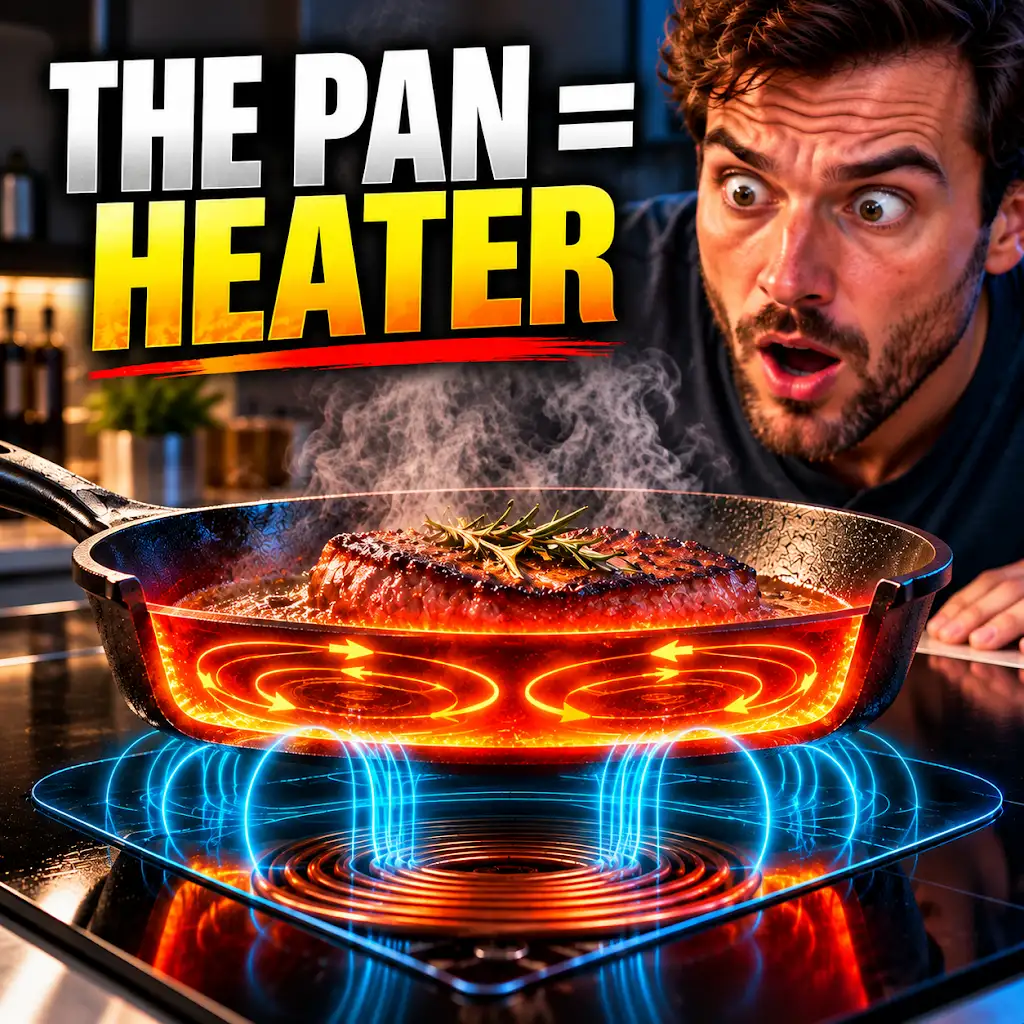
The Pan Is the Heater: How Induction Cooking Really Works
FAQs
What is electromagnetic induction?
Electromagnetic induction is the process where a changing magnetic field induces an electric current in a conductor.
How does electromagnetic induction heat metal?
When a metal object is placed in an alternating magnetic field, the changing magnetic field induces electric currents within the metal, causing it to heat up due to resistance.
What are the advantages of using electromagnetic induction to heat metal?
Some advantages of using electromagnetic induction to heat metal include faster heating times, precise temperature control, energy efficiency, and the ability to heat only the desired area of the metal object.
What types of metals can be heated using electromagnetic induction?
Most metals that are good conductors of electricity, such as iron, steel, copper, and aluminum, can be heated using electromagnetic induction.
What are some common applications of electromagnetic induction heating in metalworking?
Electromagnetic induction heating is commonly used in metalworking processes such as brazing, soldering, annealing, and hardening, as well as in industries like automotive, aerospace, and manufacturing.