You’re standing in your kitchen, ready to whip up a meal, and you’re eyeing your new induction cooktop with a mixture of curiosity and perhaps a touch of intimidation. You’ve heard the buzz about how much faster and more efficient it is, but the underlying science can feel a little like a magic trick. You’re about to discover that it’s not magic at all, but a brilliant application of physics, specifically the fascinating world of eddy currents. This isn’t just about cooking; it’s about understanding how you can harness electromagnetic forces to bring your culinary creations to life with unprecedented speed and control.
You might be wondering, what exactly is happening beneath that sleek, flat surface? The magic, as it were, begins with electromagnetism. Unlike traditional cooktops that heat a resistive element and then transfer that heat to your cookware, induction cooking creates heat directly within the pot or pan itself. This is achieved through a carefully orchestrated dance of electromagnetic fields.
The Role of the Coil
At the heart of your induction cooktop lies a coil of copper wire. When you turn on the cooktop, an alternating electric current is passed through this coil. This alternating current is crucial. As the current flows and changes direction rapidly, it generates a fluctuating magnetic field that extends upwards from the coil. Think of it like an invisible force field that permeates the space above the cooktop. This magnetic field isn’t static; it’s constantly expanding and collapsing, creating a dynamic push and pull.
Creating the Magnetic Field
The alternating current flowing through the copper coil is the engine driving this magnetic field. The frequency of this alternating current is typically quite high, often in the range of 20-50 kHz. This rapid oscillation is what allows the magnetic field to fluctuate so effectively. The strength of the magnetic field is also a key factor. The design of the coil, the amount of current, and the proximity of the cookware all contribute to the intensity of this invisible force. You can visualize this as waves of magnetic energy rippling outwards from the coil.
The Interaction with Cookware
This fluctuating magnetic field is the gateway to efficient cooking. However, it’s not just any cookware that will react. This is where the specific properties of induction-compatible pots and pans come into play. When you place a suitable pot or pan on the cooktop, the fluctuating magnetic field generated by the coil penetrates the base of the cookware. This is the critical interaction. The magnetic field lines pass through the metallic base, and this is where the real action begins.
Eddy currents play a crucial role in the efficiency of induction cooking, as they are responsible for generating heat directly in the cookware. For a deeper understanding of the principles behind this technology, you can explore a related article that delves into the science of eddy currents and their applications in various fields. To read more about it, visit this article.
The Birth of Eddy Currents: The Secret to Induction Heat
This is where the term “eddy currents” comes into play, and it’s the core mechanism behind induction cooking. You’re about to witness a powerful demonstration of a fundamental principle of electromagnetism. When a conductor, like the metallic base of your pot, is exposed to a changing magnetic field, an electric current is induced within that conductor.
Faraday’s Law in Action
The principle governing the creation of these currents is known as Faraday’s Law of Electromagnetic Induction. In simple terms, this law states that a changing magnetic field through a coil (or any closed circuit, including the base of your pan) will induce an electromotive force (EMF), which in turn drives an electric current. Because the base of your cookware is a good electrical conductor and it’s sitting within the oscillating magnetic field of the cooktop, these induced currents are generated.
The Swirling Motion
These induced currents don’t just flow in a straight line; they form closed loops within the metallic base of the cookware. Imagine tiny whirlpools of electricity swirling within the metal. These are the “eddy currents.” They are aptly named because their path resembles the swirling patterns of water in an eddy. The rapid oscillation of the magnetic field causes these eddy currents to form and dissipate countless times per second, creating a dynamic and continuous flow.
Resistance as a Heatsink
Now, here’s where the heat is generated. Every conductor has electrical resistance. Even highly conductive metals like iron or stainless steel have some inherent resistance to the flow of electricity. As these eddy currents surge through the metallic base of your cookware, they encounter this resistance. Just like friction generates heat when you rub your hands together, the electrical resistance causes the eddy currents to dissipate their energy as heat. The faster and more intense the eddy currents, the more heat is generated. This is the direct heating of your cookware, not the surrounding air or a heating element.
The Efficiency Advantage: Why Induction Cooks Faster

You’ve probably noticed how quickly your induction cooktop brings water to a boil or heats up a pan. This remarkable speed is directly attributable to the efficiency of eddy current generation. Unlike conventional stovetops, where heat has to be transferred through multiple layers (heating element to stovetop surface, then to cookware), induction cooking bypasses these intermediaries.
Direct Heat Transfer
The most significant factor in induction’s efficiency is the direct transfer of heat. The eddy currents are generated within the base of your pot or pan. This means that the heat is produced exactly where you need it – directly in contact with your food. There’s no wasted energy warming up the air around the pan, nor is there a loss of heat as it travels through a resistive element or a glass ceramic surface. It’s a remarkably direct and focused method of heating.
Minimal Heat Loss to the Environment
Think about an electric coil burner. A lot of the heat generated by the coil dissipates into the surrounding air. You can feel this radiant heat even when nothing is on the burner. With induction, this is significantly reduced. The magnetic field is designed to interact primarily with the ferrous metal of the cookware. While some minor heat loss can occur, it’s a fraction of what you’d experience with other cooking methods. This means more of the energy you’re supplying is going into actually heating your food.
Precise Energy Delivery
The power output on an induction cooktop is directly proportional to the strength of the magnetic field and the resulting eddy currents. This allows for incredibly precise control over the heat. You can turn the dial from a gentle simmer to a rapid boil with immediate effect. This responsiveness means you’re not waiting for a heating element to cool down or ramp up, further contributing to the overall efficiency of your cooking process. You’re using exactly the amount of energy needed, when you need it.
Understanding Your Induction-Ready Cookware

You’ve likely seen symbols on cookware packaging indicating “induction compatible” or “induction ready.” This isn’t just a marketing gimmick; it’s crucial for your induction cooktop to function correctly. The effectiveness of eddy current generation is dependent on the material properties of your cookware.
The Importance of Ferrous Metals
Induction cooking relies on the interaction of a magnetic field with a conductive material. However, for strong eddy currents to be induced, the material needs to have certain magnetic properties. Specifically, cookware made of ferrous metals – metals that contain iron – are ideal. This includes cast iron, enameled cast iron, and most types of stainless steel (specifically, those with a high nickel or chromium content that makes them magnetic).
Why Some Pots Won’t Work
If you try to use a pot made of aluminum, copper, or non-magnetic stainless steel on an induction cooktop, you’ll find that it simply won’t heat up, or it will heat very poorly. This is because these materials, while good electrical conductors, are not ferromagnetic. The fluctuating magnetic field will induce some eddy currents, but the magnetic interaction is weak, resulting in very little heat generation. It’s like trying to push a swing with a feather – you won’t get much of a reaction.
The Magnet Test
A simple way to check if your existing cookware is induction compatible is the “magnet test.” Place a magnet on the bottom of your pot or pan. If the magnet sticks firmly, it’s likely induction compatible. If it only weakly adheres or doesn’t stick at all, it’s probably not suitable for your induction cooktop. This simple test can save you from frustration and ensure you’re using the right tools for the job.
What to Look for When Buying New Cookware
When purchasing new cookware for your induction cooktop, always look for the “induction compatible” symbol or check the product description. Manufacturers will clearly indicate if a product is suitable for induction use. Don’t assume that all stainless steel or all heavy-bottomed pots will work; always verify.
Eddy currents play a crucial role in the efficiency of induction cooking, as they are responsible for generating heat directly in the cookware. For a deeper understanding of the principles behind this technology, you can explore a related article that delves into the science of these currents and their applications in various fields. This informative piece can be found at Freaky Science, where you will discover how eddy currents not only enhance cooking but also contribute to advancements in other technologies.
Optimizing Your Cooking Experience with Eddy Currents
| Parameter | Description | Typical Value / Range | Unit |
|---|---|---|---|
| Frequency of AC Current | Operating frequency of the induction coil generating eddy currents | 20,000 – 50,000 | Hz |
| Induced Eddy Current Density | Magnitude of eddy currents induced in the cookware | 104 – 106 | A/m2 |
| Skin Depth | Depth at which eddy current density falls to 1/e of surface value | 0.1 – 1.0 | mm |
| Power Transfer Efficiency | Efficiency of converting electrical energy to heat via eddy currents | 80 – 90 | % |
| Cookware Material Resistivity | Electrical resistivity affecting eddy current generation | 1.0 x 10⁻⁷ – 1.0 x 10⁻⁶ | Ω·m |
| Magnetic Permeability (μ) | Relative permeability of cookware material influencing eddy currents | 1 (non-ferrous) – 5000 (ferrous) | Dimensionless |
| Heating Rate | Rate at which cookware temperature increases due to eddy currents | 5 – 15 | °C/min |
Now that you understand the underlying science, you can leverage this knowledge to become an even more proficient and efficient induction cook. It’s about harnessing the power of eddy currents to your advantage.
The “Clap” Test for Cookware
Beyond the magnet test, you might have heard about the “clap” test. While not scientifically rigorous, placing a pot on the cooktop and turning it to a medium setting will often produce an audible “clap” or humming sound if the cookware is properly seated and induction compatible. This is the sound of the magnetic field interacting with the cookware. A lack of sound, or a very weak one, can indicate a poor connection or incompatible cookware.
Using the Right Size Burner
Induction cooktops are very responsive to the size of the cookware. For optimal efficiency, you want the base of your pot or pan to align with the diameter of the induction element. If your pan is much smaller than the element, you’re not fully utilizing the magnetic field, and heat distribution might be uneven. Conversely, if your pan is too large, it might not be fully heated. Many induction cooktops have elements of varying sizes to accommodate different pot sizes.
The Importance of a Flat Bottom
A flat, smooth bottom on your cookware is essential for efficient eddy current induction. Any warping or significant curvature will create air gaps between the pot and the cooktop surface. These air gaps disrupt the magnetic field and prevent consistent contact, leading to reduced heating and potential hot spots. This is another reason why cast iron, which can sometimes have a slightly uneven base, might require a bit more care or a heat diffuser if you’re seeking absolute perfection.
Understanding Power Levels and Responsiveness
Your induction cooktop’s power levels are directly related to the strength of the magnetic field and, consequently, the intensity of the eddy currents. You’ll quickly learn to associate specific power settings with desired cooking outcomes. The near-instantaneous response of induction means you can make fine adjustments on the fly, preventing overcooking or undercooking. You’re not waiting for residual heat to dissipate; the heat generation stops almost immediately when you reduce the power or turn off the element. This precision is a key aspect of its efficiency and effectiveness in the kitchen.
By understanding the fundamental principles of eddy currents and their interaction with induction-ready cookware, you’re not just a user of a new appliance; you’re a skilled operator, capable of transforming raw ingredients into delicious meals with unparalleled speed, control, and energy efficiency. Your kitchen has just become a little more scientifically advanced, and your cooking is about to become a whole lot better.
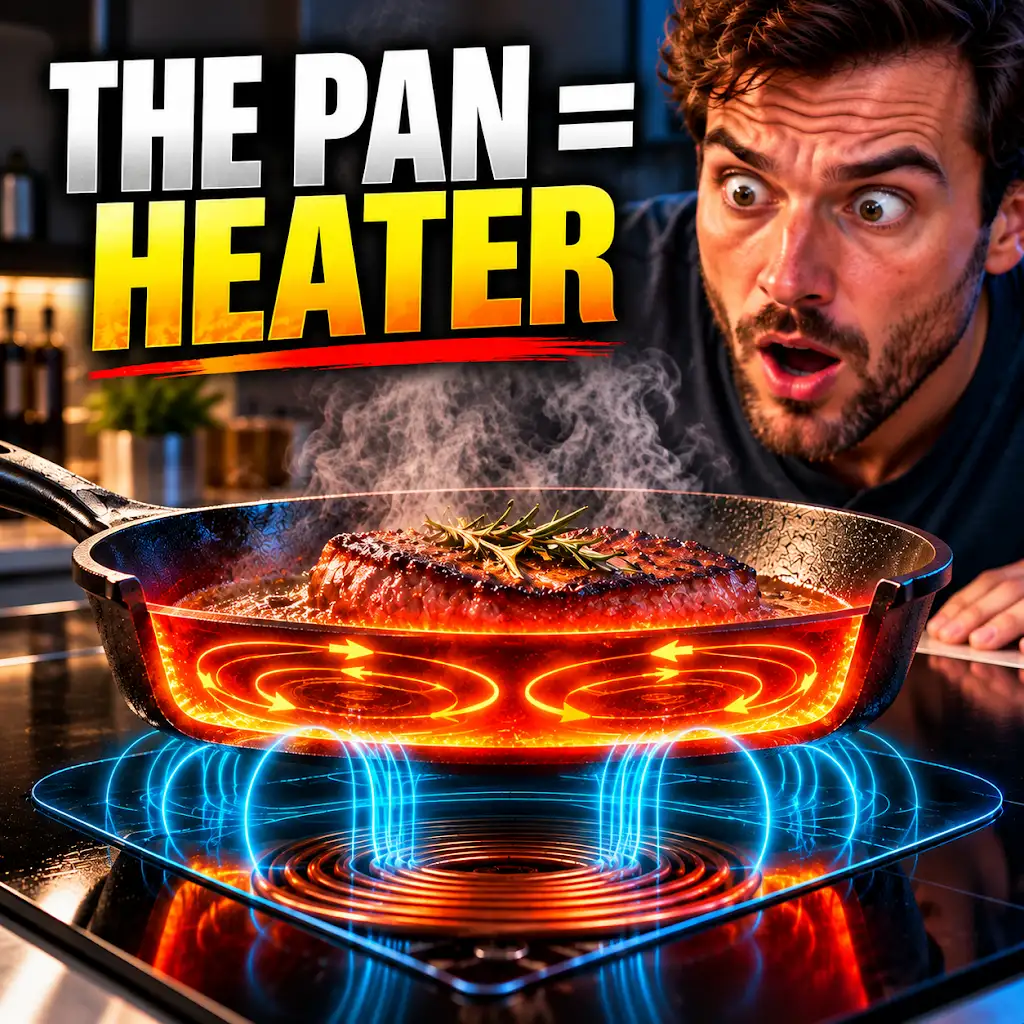
The Pan Is the Heater: How Induction Cooking Really Works
FAQs
What are eddy currents in the context of induction cooking?
Eddy currents are swirling electrical currents induced in a conductive material, such as a pot or pan, by a changing magnetic field. In induction cooking, these currents generate heat in the cookware, which then cooks the food.
How do eddy currents work in an induction cooktop?
In an induction cooktop, alternating current passes through a coil beneath the ceramic surface. This current creates a fluctuating magnetic field, which induces eddy currents in the metal cookware placed on top of the cooktop. The resistance of the metal to these currents generates heat, which cooks the food.
What are the advantages of using eddy currents for cooking?
Eddy currents in induction cooking offer several advantages, including faster heating times, precise temperature control, energy efficiency, and safety. Since the heat is generated directly in the cookware, the cooktop surface remains relatively cool to the touch.
Can any type of cookware be used with induction cooking?
Not all cookware is compatible with induction cooking. To work effectively, the cookware must be made of a magnetic material, such as cast iron or magnetic stainless steel. Non-magnetic materials like aluminum or copper will not generate eddy currents and therefore will not heat up on an induction cooktop.
Are there any safety concerns associated with eddy currents in induction cooking?
Eddy currents in induction cooking are generally considered safe, as the heat is generated directly in the cookware and not on the cooktop surface. However, it is important to be cautious when using induction cooktops, as the cookware can become very hot during cooking. Additionally, individuals with pacemakers or other electronic medical devices should consult with their healthcare provider before using induction cooktops, as they may generate electromagnetic fields that could interfere with these devices.